Richibi’s Weblog

Just another WordPress.com weblog

Tag: “Symphony No. 5 in D minor” opus 47 – Shostakovich

Symphony no 7 in C major, opus 60, the “Leningrad”- Dmitri Shostakovich
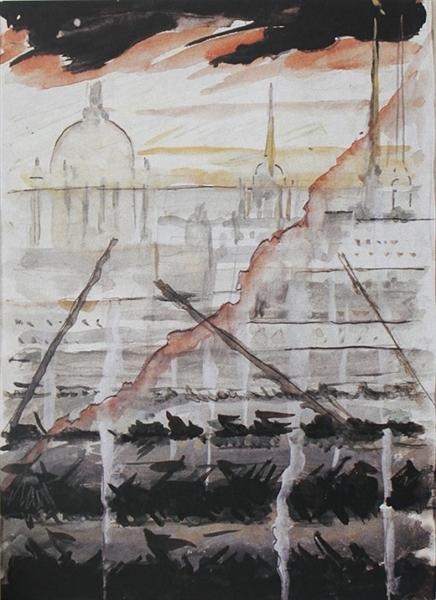
leningrad-in-blockade-sketch-on-the-theme-of-leningrad-symphony-of-d-d-shostakovich-1943.jpg!Large.jpg

Leningrad in blockade. Sketch on the theme of 
         “Leningrad Symphony” of D. D. Shostakovich. 
                                                                (c.1943) 

     Mstislav Dobuzhinsky

             __________

though I’ve been through the Seventh 
three times already, consecutively, it
doesn’t reach, for me, the heights the 
Fifth did, its first movement is
manifestly imperious, nearly even 
overwhelming, certainly unforgettable, 
I’ve been humming the ostinato in my 
sleep

but the following movements seem to 
me – not being Russian, nor having as
intimately incorporated their culture, 
where rhythms and history are 
inextricably intertwined – muddled 
about the reconstruction of its 
shattered world, melodies might be
lovely but are lost in a blur of musical
directions, there isn’t enough repetition 
of musical motifs to find solid ground, 
angry statements follow lyrical adagios
too often to get our bearings on what 
might be going on 

the first movement, however, remains a 
triumph, note the debt owed to Ravel’s 
Bolero in the rousing ostinato, the 
part where the same musical phrase 
obstinately repeats its peremptory and 
ever more vociferous mantra, its 
headlong incantation, an interesting 
blend in either symphonic work of the 
sinuous, the seductive, the beguiling,
turning into the overtly martial, all to 
do with pulse 

the Symphony no 7, the “Leningrad”,
was first presented in that very city 
during its siege by the Germans
which lasted from 1941 to 1944, 
however unbelievably, Shostakovich, 
already giant, was expected to deliver 
masterpiece by both the people and 
by the regime, imagine Bono doing a
concert for Syria 

Shostakovich doesn’t disappoint

players were culled from what remained 
of instrumentalists among the survivors
of both Stalin’s criminal purges and of 
the German siege itself left in the city, 
those who hadn’t survived the famine
there, Valery Gergiev, an exalted 
Russian conductor, describes them as
walking skeletonsmeagre from 
starvation, we’ve seen these before at 
Auschwitz

the world heard, and was moved, 
imperialism in any form was being 
vociferously condemned, going back 
to Napoleon even and his own failed 
invasion, if not also to Hannibal 
crossing the Alps, Caesar, his 
Rubicon

much of this symphony is about cultural 
resistance, the survival of a proud and 
resilient seed, any proud and resilient 
seed, hence its international standing

see Beethoven’s 9th Symphony for 
comparable fanfare, flourish, and 
circumstance, the only other work of
any such historical political importance
and, appreciably, still unsurpassed,

except for, maybe, Roger Waters
channeling Pink Floyd at the Berlin 
Wall, along with, not incidentally
thereagain Beethoven 


R ! chard

psst: the other great composer of the 
          20th Century, Messiaen, also 
          composed a commemoration of
          an awful moment in our history,
          the Holocaust, his Quartet for 
          the End of Time“, played originally
          in his very concentration camp by 
          similarly “walking skeletons”, does   
          for me everything Shostakovich’s 
          Seventh didn’t 
         

“Symphony no 6 in B minor, opus 54” – Dmitri Shostakovich

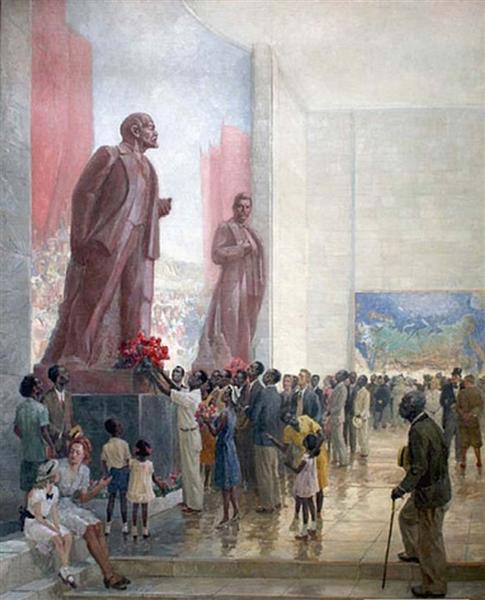
great-expectations-ussr-pavilion-on-1939-new-york-world-s-fair-1947.jpg!Large

Great Expectations. USSR pavilion on 1939 New York World’s Fair (1939) 

    Veniamin Kremer

       ____________

 “I hope that these few preparatory words 
can give you an insight that may permit 
you to experience this strangely 
heterogeneous work as a single entity, 
flashpoint in musical history”, says
Leonard Bernstein, somewhat, 
admittedly, grandiloquently, in an indeed
thrilling introduction to Shostakovich’s
Sixth Symphony in B minor, opus 54

that he reiterates several of the points 
that I earlier brought up does me no
disservice, coming especially from a
person of such high quality, pedigree, 
in the musical world, I’m abashed, 
bashful, indeed blushing, that my 
humble insights have been so 
eminently corroborated

but I cannot second his enthusiasm
for Shostakovich’s Sixth Symphony
a failed, to my mind, entity, a long 
introductory lament that lingered 
long after its “best before” date, 
followed by indifferent, though 
perhaps energetic, yet unrelated,
final movements, the instrumentation 
might be, admittedly, brilliant, the 
Shostakovichian precise array of 
sounds, but the sum is less than the 
parts, I think, I took home only 
confusion, as did the crowd, 
apparently, at its first presentation, 
Leningrad, November 21, 1939,
Mravinsky conducting, wow, an
even more convincing argument,
maybe, than Bernstein’s, however 
rousing, interpretation

for your information, I’ve included
Tchaikovsky’s Sixthaccording to
Bernstein intimately related, he 
explains, to Shostakovich’s Sixth

you’ll note how different, however, 
these two symphonies are compared 
to how similar in so many respects 
Beethoven’s and Shostakovich’s 
Fifths are, Tchaikovsky’s Sixth is
manifestly more Romantic than
Revolutionary 

but imagine Tchaikovsky starting and 
ending with an adagio, how audacious, 
daring, though not particularly efficient, 
I think, not especially successful, the 
adagio lamentoso seems to me 
anticlimactic after the vigorous allegro 
molto vivacewhich receives a 
thunderous applause, the last 
movement, the lamentoso, however 
lovely, doesn’t rise to the heights of a 
proper finale for this forerunner’s
contagious ebullience, sounds rather 
like an encore, melodramatic and a bit 
pretentious

or maybe I’m just getting cranky


sooner or later though, the conundrum 
of adagio bookends will be resolved, 
someone inevitably will do it, like
finding the square on the hypotenuse, 
unearthing warped space, discovering 
a way to recapture carbon dioxide and 
make it work for us, as trees would do 
if we let them, someone always exceeds, 
miraculously, our expectations, watch 
for it, dare I say, here

R ! chard