Richibi’s Weblog

Just another WordPress.com weblog

Tag: “Symphony No 5 in C minor” opus 67 – Beethoven

“Symphony no 6 in B minor, opus 54” – Dmitri Shostakovich
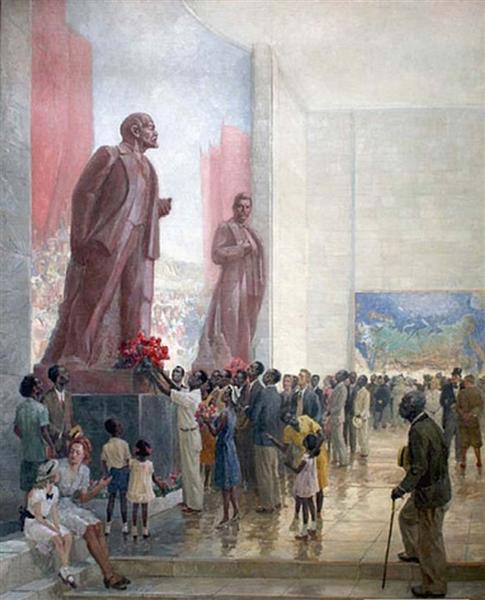
great-expectations-ussr-pavilion-on-1939-new-york-world-s-fair-1947.jpg!Large

Great Expectations. USSR pavilion on 1939 New York World’s Fair (1939) 

    Veniamin Kremer

       ____________

 “I hope that these few preparatory words 
can give you an insight that may permit 
you to experience this strangely 
heterogeneous work as a single entity, 
flashpoint in musical history”, says
Leonard Bernstein, somewhat, 
admittedly, grandiloquently, in an indeed
thrilling introduction to Shostakovich’s
Sixth Symphony in B minor, opus 54

that he reiterates several of the points 
that I earlier brought up does me no
disservice, coming especially from a
person of such high quality, pedigree, 
in the musical world, I’m abashed, 
bashful, indeed blushing, that my 
humble insights have been so 
eminently corroborated

but I cannot second his enthusiasm
for Shostakovich’s Sixth Symphony
a failed, to my mind, entity, a long 
introductory lament that lingered 
long after its “best before” date, 
followed by indifferent, though 
perhaps energetic, yet unrelated,
final movements, the instrumentation 
might be, admittedly, brilliant, the 
Shostakovichian precise array of 
sounds, but the sum is less than the 
parts, I think, I took home only 
confusion, as did the crowd, 
apparently, at its first presentation, 
Leningrad, November 21, 1939,
Mravinsky conducting, wow, an
even more convincing argument,
maybe, than Bernstein’s, however 
rousing, interpretation

for your information, I’ve included
Tchaikovsky’s Sixthaccording to
Bernstein intimately related, he 
explains, to Shostakovich’s Sixth

you’ll note how different, however, 
these two symphonies are compared 
to how similar in so many respects 
Beethoven’s and Shostakovich’s 
Fifths are, Tchaikovsky’s Sixth is
manifestly more Romantic than
Revolutionary 

but imagine Tchaikovsky starting and 
ending with an adagio, how audacious, 
daring, though not particularly efficient, 
I think, not especially successful, the 
adagio lamentoso seems to me 
anticlimactic after the vigorous allegro 
molto vivacewhich receives a 
thunderous applause, the last 
movement, the lamentoso, however 
lovely, doesn’t rise to the heights of a 
proper finale for this forerunner’s
contagious ebullience, sounds rather 
like an encore, melodramatic and a bit 
pretentious

or maybe I’m just getting cranky


sooner or later though, the conundrum 
of adagio bookends will be resolved, 
someone inevitably will do it, like
finding the square on the hypotenuse, 
unearthing warped space, discovering 
a way to recapture carbon dioxide and 
make it work for us, as trees would do 
if we let them, someone always exceeds, 
miraculously, our expectations, watch 
for it, dare I say, here

R ! chard
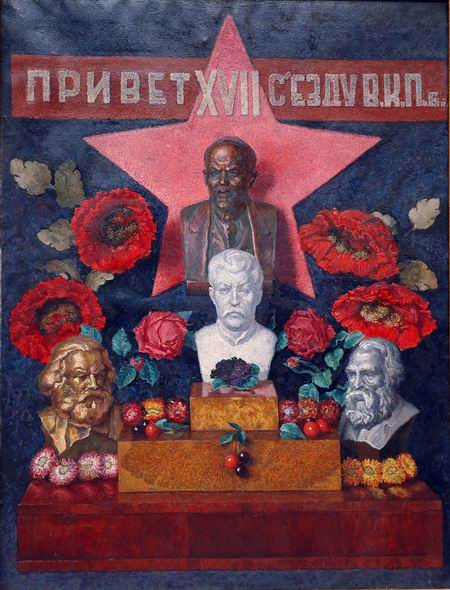
Dmitri Shostakovich – “Symphony No 5” in D minor, opus 47

hi-xvii-congress-of-the-cpsu-b-1934

     “Hi, XVII Congress of the CPSU (B) (1934) 

              Ilya Mashkov

__________

if I thought the Fourth would knock 
your socks of, stockings, the Fifth 
ought to leave you with, dare I say, 
nothing on but your awe, it is 
extraordinary, so settle in, pour 
yourself a glass of wine, or vodka 
if you want to bethnic, for a 
mesmerizing three-quarter hour

days only before the first performance
of Shostakovich’s new symphony, an 
article showed up in a leading Moscow
paper suggesting that it would be
Soviet artist’s creative response to 
justified criticism” in reference, of 
course, to Stalin’s displeasure with 
Shostakovich’s Lady Macbeth of 
Mtsensk, which had led to the 
cancellation of his Fourth Symphony,
read all about it here

disregard for Stalin’s opinion would
have meant certain execution in an
environment where the leader could
not be contradicted, the ruler wanted
uplifting tunes, the rule was Socialist
Realism, art to celebrate the Party

a similar thing was happening at the
same time in Germany, incidentally, 
with Hitler objecting to entartete 
Kunst“, the degenerate art that 
moderns were producing, Kirchner
KleeDix, for example, who were 
only painting, as Shostakovich was 
only composing, what they heard, 
saw, for which they were all 
persecuted


a few necessary words about the 
Fifth Symphony itself, if 
Shostakovich had been moving

toward dissonance, you’ll find the
Fifth particularly notable for its 
tonal melodies, however sometimes
astringent, more larger intervals, 
sevenths, octaves, than strident 
atonal conjunctions

and since Shostakovich had been 
strictly adhering to the two other
Classical conditions, of tempo and
repetition, this symphony might as
well be a Romantic composition

listen to Beethoven’s Fifth and 
compare, they sound nearly 
identical but for a 130 years
distance, the peremptory opening, 
loud, brash, bracing, followed 
quickly by a lull in intensity, four 
movements eachhorns blare in 
either military salvos, propensity 
toward dance rhythms, short, sweet 
solo moments for several assorted 
instruments, usually contemplative, 
piercingly personal – after a 
comparison, you’ll never see 
Beethoven’s Fifth in the same light 
again

Beethoven, however, though 
forceful, indeed thunderous, is 
more centred on the actual music, 
which is jubilant, celebratory, an
exultation, while Shostakovich by 
contrast, however equally martial, 
sounds the implacability, the 
ruthlessness of the fanfare, the 
parade, you can feel the iron step 
of the guard, their advance 
inexorable, this is unquestionably 
political statement, then again 
Beethoven didn’t live in France


it’s to be noted that both works
are products of a recent revolution,
the French, the Russian, and the 
imminence of a Terror, as well of
the return of an autocratic leader,
the Emperor Napoleon in the first 
instance, in the second, of course 
Stalin

it’s helpful to view the bombastic 
portions in Shostakovich, as the 
unassailable positions of the Party, 
the more melting moments and 
single voices as those of the 
oppressed proletariat, people up 
against the stringent requirements 
of an unforgiving state growing up 
all around them 

a return to strict Classical 
conditions, by the way, which is 
to say tunes”, might’ve been 
Shostakovich’s way of placating, 
however risky still, a dictator’s 
fearful edicts regarding 
permissible taste, that’s what 
you can do when you can speak  
the language


incidentally, the symphonies are  
either composer’s Fifth, perhaps 
not incidentally


R ! chard

psst: the applause at the first 
          performance, November 21, 
          1937, lasted over half an hour,
          people were crying, they’d 
          found a prophet