the conditional
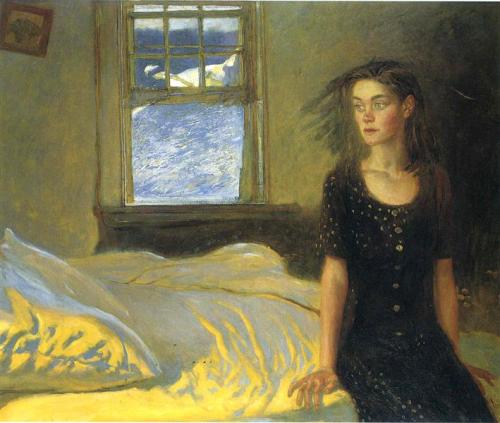
“If Once You Have Slept on an Island“ (1996)
Jamie Wyeth
________
the conditional mood is easy, it always
follows if
if I had a hammer, for instance
or
if I were a rich man
it is not a real event, as Classical
representation would be in art, were I
to make that synesthetic juxtaposition,
which is to say, were I to replace the
visual sense with that of letters, but
rather like Surrealism, for instance,
in that other context, a superimposed
idealization
here’s a poem you’ve probably
already heard, or heard of, through
its final, and epochal, verse, Kipling’s
“If“, a towering instance of moral
suasion on our culture
If you can keep your head when all about you
Are losing theirs and blaming it on you,
If you can trust yourself when all men doubt you,
But make allowance for their doubting too;
If you can wait and not be tired by waiting,
Or being lied about, don’t deal in lies,
Or being hated, don’t give way to hating,
And yet don’t look too good, nor talk too wise:
If you can dream—and not make dreams your master;
If you can think—and not make thoughts your aim;
If you can meet with Triumph and Disaster
And treat those two impostors just the same;
If you can bear to hear the truth you’ve spoken
Twisted by knaves to make a trap for fools,
Or watch the things you gave your life to, broken,
And stoop and build ’em up with worn-out tools:
If you can make one heap of all your winnings
And risk it on one turn of pitch-and-toss,
And lose, and start again at your beginnings
And never breathe a word about your loss;
If you can force your heart and nerve and sinew
To serve your turn long after they are gone,
And so hold on when there is nothing in you
Except the Will which says to them: ‘Hold on!’
If you can talk with crowds and keep your virtue,
Or walk with Kings—nor lose the common touch,
If neither foes nor loving friends can hurt you,
If all men count with you, but none too much;
If you can fill the unforgiving minute
With sixty seconds’ worth of distance run,
Yours is the Earth and everything that’s in it,
And—which is more—you’ll be a Man, my son!
in the spirit of juxtaposition, compare
that to Polonius’ admonition to his son,
Laertes, upon that young colt’s imminent
return to France, where he had earlier
been, reputedly, carousing
Yet here, Laertes! aboard, aboard, for shame!
The wind sits in the shoulder of your sail,
And you are stay’d for. There; my blessing with thee!
And these few precepts in thy memory
See thou character. Give thy thoughts no tongue,
Nor any unproportioned thought his act.
Be thou familiar, but by no means vulgar.
Those friends thou hast, and their adoption tried,
Grapple them to thy soul with hoops of steel;
But do not dull thy palm with entertainment
Of each new-hatch’d, unfledged comrade. Beware
Of entrance to a quarrel, but being in,
Bear’t that the opposed may beware of thee.
Give every man thy ear, but few thy voice;
Take each man’s censure, but reserve thy judgment.
Costly thy habit as thy purse can buy,
But not express’d in fancy; rich, not gaudy;
For the apparel oft proclaims the man,
And they in France of the best rank and station
Are of a most select and generous chief in that.
Neither a borrower nor a lender be;
For loan oft loses both itself and friend,
And borrowing dulls the edge of husbandry.
This above all: to thine ownself be true,
And it must follow, as the night the day,
Thou canst not then be false to any man.
from Shakespeare’s “Hamlet”, act 1, scene 3,
all, incidentally, in the imperative, the mood
of command, authority, however consequential
there, or not
a film called “If…” is also worth visiting
in this context, from the 1970s, with an
iconic soundtrack that gripped the
generation then that heard it, listen,
watch, the Missa Luba, be gripped

 Richibi's Weblog