Richibi’s Weblog

Just another WordPress.com weblog

Tag: String Quartet Opus 54 no 2 – Haydn

String Quartet in F major, opus 77, no 2 – Joseph Haydn
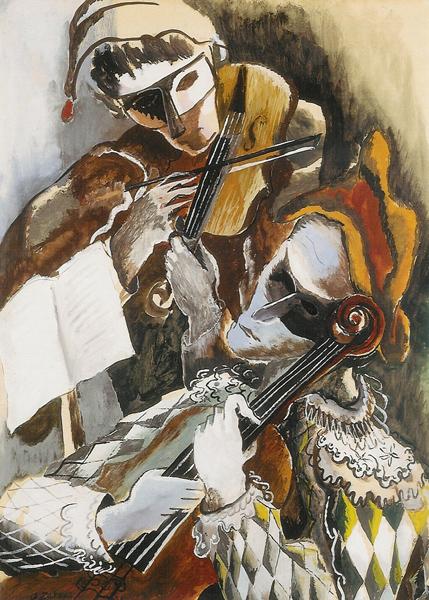
 

harlequins-violinists-hidden.jpg!Large.jpg

   Masked Harlequin Violinists (1944) 

              Ossip Zadkine

                  ________

the Opus 77, no 2, of Haydn is the last
full string quartet of his, his very last  
remaining unfinished, the Opus 103,
written in 1803

Haydn died in 1809, the Opus 77, no 2
was composed in 1799, he would’ve 
been 67

but by then, he had established the 
form that music would take for the 
next over two hundred years

call, response, and recapitulation is 
the house that Haydn built, and verily 
cemented, you can hear it in our own 
period’s Love Me Tender“, for 
instance, if you’ll also permit me here
its irresistible elaborationto today’s 
top hits, like my own most recent 
favourite such contemporary iteration,
released in 2014, Photograph

we could be listening otherwise to 
Bach right now, counterpoint, 
fugues, intricate, linear music, 
however powerfully transcendental, 
instead of recurring music, call,  
response, as I said, and 
recapitulation, something like how 
a clock works

but already Haydn is testing the 
waters, in the Opus 77, no 2, the
andante, a step up from an adagio, 
is in third place, something we 
haven’t heard before, and not, to 
my mind, especially effective, like 
his mixture of tempos in the Opus 
54, no 2, which was disconcerting, 
however masterfully resolved we 
find those to be in this very Opus
77, no 2notably in the second 
movement’s “Minuet, Presto – Trio”, 
where the tempo change is nearly 
imperceptible  

art works on contravention, but 
the affronts are to established 
conventions, which are very 
hard to overturn 

watch Haydn here continue to 
do just that, for better or for 
worse


R ! chard

psst: listen to Bach hereincidentally,  
          put his largo, or slow movement, 
          right where he wants to, at the 
          very top of the bill, does it work,    
          you tell me, a trivial pursuit,  
          you’ll ask, I say not, you are    
          defining your own aesthetic  
          sensibility, something 
          profoundly, think, important, 
          who it is, with perspective, you 
          want to be   
       

String Quartet in B flat, Opus 55, no 3 – Haydn

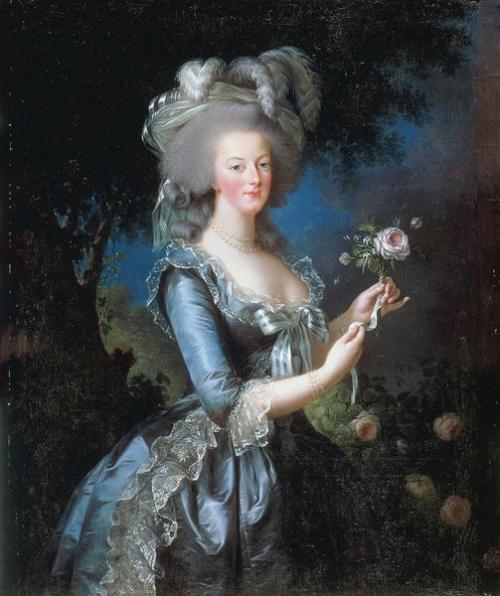
queen-marie-antoinette-of-france-1783.jpg!Large

                      “Queen Marie Antoinette of France (1783) 

                                Louise Élisabeth Vigée Le Brun

                                              ___________________

first of all, let me grievously repent an
egregious confusion I probably left
in my last diatribe, I said that the second
movement of the Opus 54, no 2 sounded 
to me like a minuet, I had, through 
embarrassing inattention, confused its,
however unmemorable, adagio with that
of this Opus 55, no 3, which I’d listened 
to in too quick succession, driven as I 
am by my thirst for epiphanies

the Opus 54, no 2 will do, but I’m not 
going back for seconds, nor to the 
Opus 55, no 3, though here’s where  
I flaunt nevertheless Haydn, not to 
mention Bach, Mozart, Beethoven, 
all the way to eventually Bruckner, 
Brahms, the extraordinary Richard
Wagner, passing through Schubert,
Mendelssohn, the Strausses, father
and son, and the unrelated Strauss,
Richard, another incontrovertible 
giant, and I nearly left out the 
unforgettable Liszt, all of them 
forefathers of our present music

you might have noticed that these 
are all Germanic names, obedient 
to the Hapsburg empire, with 
Vienna as its supreme cultural 
capital, and it was that 
Austro-Hungarian dynasty that
indeed nearly single-handedly 
secured our Western musical 
traditions

a few Italians are remembered,
from the 18th Century, Scarlatti 
maybe, Boccherini, Albinoni
but not many more 

no one from France, but they were 
about to have a revolution, not a 
good time for creative types,
though, incidentally, Haydn was 
getting Tost, to whom he was 
dedicating his string quartets for 
services rendered, to sell his stuff 
in very Paris 

then again, Marie Antoinette, I thought, 
was Austrian, an even archduchess, 
and would’ve loved some down-home 
music at nearby Versailles

so there you are, there would’ve been 
market

the English had Handel, of course,
who was, albeit, German, getting 
work where he could when you 
consider his competition, he was 
too solemn and plodding by half,
to my mind, for the more 
effervescent, admittedly Italianate, 
continentals, Italy having led the 
way earlier with especially its 
filigreed and unfettered operas

but here’s Haydn’s Opus 55, no 3
nevertheless, the best Europe had
to offer, socking it to them

Haydn’s having a hard time, I think, 
moving from music for at court to
recital hall music, music for a much
less genteel clientele, however 
socially aspiring, we still hear 
minuets, and obeisances all over 
the place, despite a desire to 
nevertheless dazzle, impress

then again, I’m not the final word, as
my mea culpa above might express, 
you’ll find what eventually turns 
your own crank, floats your own 
boat, as you listen

which, finally, is my greatest wish


R ! chard