Just another WordPress.com weblog
Tag: sonatas
_____
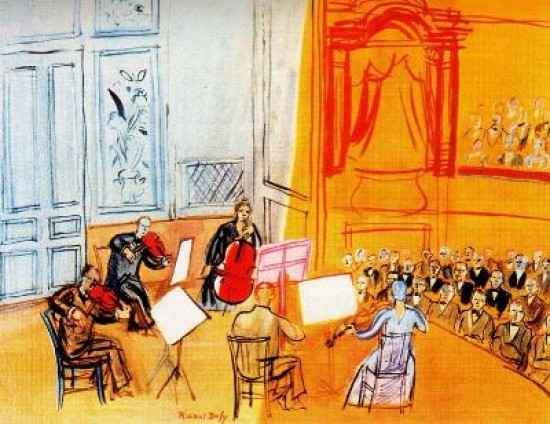
if a trio is a sonata written for three instruments,
a sonata, a piece of music consisting of more
than one segment, or movement, written for
four instruments, is called a quartet
a quartet is also what we call the group itself
of four players
quartets can play more than just quartets, they
can also play waltzes, nocturnes, rhapsodies,
for instance, just as trios, groups of three, can
play more than just trios
but quartets, the form, have had a long and
glorious history, from Mozart and Haydn,
the Classicists, through Beethoven, an
ardent Romantic, to the more political
Shostakovich, enemy, for a time, of his
repressive Soviet state, and on to
Messiaen, who composed his own
concentration camp
let me start with the Messiaen, now that I’ve
whetted your appetite, and work our way back
to Mozart to see where we came from, and
how
there are seven movements in Quartet for
four, atonality abounds, discordant, not
unexpectedly, progressions, repetition also
takes its punches, not easily identifiable
throughout, but tempo, the third pillar of
Western music, more or less holds its
own, keeping the tradition, however
precariously, together, listen
it’s 1941, we’re in a concentration camp,
Messiaen is caught between hope and
despair, give the guy a break, he hasn’t
many absolutes to hold onto, tempo
might be one of them, the heartbeat,
pulse, perseverance, an actual human
pace, a rhythmic instinct, by which
eventually, hopefully, meaning
transpires
hope is in one’s creativity, he says, each
individual answer can be a tribute to
one’s own tribulations, our responses
can be poetry, lessons rather than
invectives, epiphanies rather than
agonies, may the Force, in other words,
be with you, in the face of even the most
trying difficulties, honour can supplant
trials, he concludes, given grace and
integrity
Beethoven says pretty much the same
corroboration
R ! chard
_____________
a trio is a group of three instrumentalists,
most often a piano, a violin, and a cello,
in our Western musical tradition
but it is also a musical form, like a waltz
is, or a prelude, or a nocturne, a trio is
a sonata, essentially, but written for
three instruments, not one, nor two,
consisting of more than one segment,
or movement
though I’ve presented trios as trios to date,
sonatas for three instruments, here’s a piece
for three instruments but in one movement,
though segmented, admittedly, as variations,
see above, a similar collection of rhythms
and styles, brought together by a common
essential element, a game audiences played
back then, and still do even now, trying to
distinguish the individual variations, before
falling prey to their enchantment
R ! chard
_____
if I object to sonatas consisting of only
one movement, I can also object to
sonatas consisting of more than two
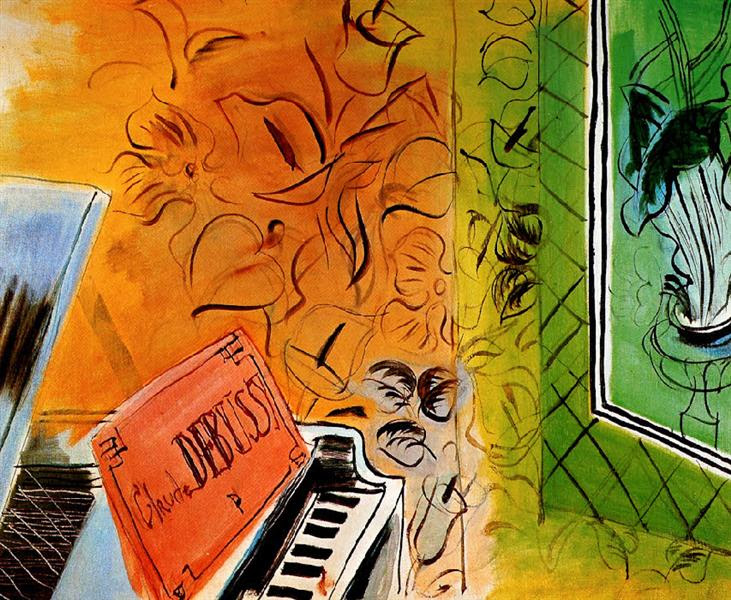
instruments, but here’s Debussy’s
which should more accurately have
been called a trio, a trio is a sonata
with three instruments
note also in the Debussy the breakdown
of all the Classical imperatives, tempo,
tonality, and repetition, another blow to
established authority
but the test is, does it work, at which
point, if it does, terminology becomes
moot, and meaning changes
today, I pondered the word love, its
myriad meanings, and how we still
call that infinite variety of emotions
the same thing, the word sonata
doesn’t hold a candle to the word
love for disinformation
I thought, okay, just make it work,
I’ll define it for myself later, each
one of us being the final arbiter
of our own aesthetic sensibility
the question
R ! chard
______
Alban Berg isn’t the only composer to
write a sonata with only one movement,
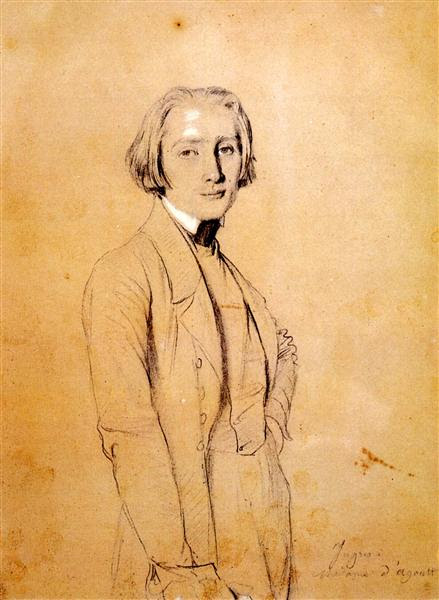
nor even the first, Franz Liszt, some
sixty years earlier, 1853, wrote this one,
Franz Liszt was an entertainer, more
performer than poet, you’ll hear more
bravado in this piece, to my mind,
than substance
but then again, sometimes, that is
the substance
though the finger work here is magical,
entirely worth the price of admission
earlier still, during the Baroque era,
sonatas had consisted of only one
movement, but the term had referred
to, then, the structure of the piece, its
inner workings, not so much the form,
the intention, the change happened
during the Classical Era, starting
around the middle of the Eighteenth
Century, the mid-1700s, which has
been the focus of this month’s
investigation, therefore excluded
from my survey, not being of the
modern era
1685 to 1757, an exact contemporary,
incidentally, of Bach, 1685 to 1750,
except for the extra seven years,
who wrote over five hundred of
them, all available on the Internet
contextually peripherally, you’ll
be utterly enchanted, the Baroque
is not an era to be easily overlooked
R ! chard

________
Johannes Brahms is pretty well the last of
the great Romantics, 1833 – 1897, he wrote
when he was not quite twenty, with the
same bravura as Beethoven, let me point
out, his sonata has five movements, a sign,
as I’ve said before, of bristling confidence
as a form grows from its original, pristine,
shape, it can only grow by evolving,
becoming something, eventually, that it
wasn’t, by dint of breaking all the rules,
transgressing
style becomes the manner in which a
work is transformed from its integral
state into something more decorated,
more intricately designed, like adding
lace to a perfectly adequate collar, or
making a soufflé out of an egg
but who wouldn’t, won’t
a point is reached where style overcomes
substance then, and becomes the focus
of the entertainment, one watches the
bravura
sonata, hasn’t the emotional appeal
that I’d heard in the earlier Romantics,
that would keep me rapt to the end,
the draw for me is the prestidigitation,
the manual dexterity, which is like
watching someone fly through the
air with the greatest of ease, but be
not otherwise moved, see above
but that’s me, and that’s to my mind
incidentally, since this is Brahms’
this is probably the last of the
great Romantic sonatas, after
which Impressionism
R ! chard

______
Beethoven’s piano sonatas are divided in
three sections, Early, Middle and Late,
indeed, the last of his Early sonatas is
the early ones are all still highly influenced
by his illustrious predecessors, Mozart and
and Haydn, and derive, however
idiosyncratically, from the Classical Era,
though there are notable differences, his
addition of a fourth movement, for instance,
instead of the standard three, an upstart
strutting his stuff, asserting his potent
individuality
with the Middle sonatas, Beethoven is well
on his way to defining the Romantic Period,
nearly single-handedly, the works are bold,
expansive, lush, powerful, a story is told,
movements are chapters in a book, a book
of metaphysical dimensions
with the Late sonatas, Beethoven will leave
the planet, deliver musical revelations
compositional issues apply, which I won’t
get into, for being abstruse, but you can
already hear in his Middle sonatas the
powerful voice of a musical prophet
the name, it straddles the Classical and
Romantic Periods, at home in the salons
of the nobles, but dazzling as well for the
new audiences that are flocking to the
flourishing concert halls
and we’re only at the start of his Middle
Period
stay tuned
R ! chard
_____________
meanwhile, back at sonatas for one
instrument, it’s about time I brought
up Chopin, the one composer that
everyone associates before anyone
else with Romanticism, 1800, say,
till about 1880, he incorporates it,
not without reason, Chopin
personifies the Romantic Era, like
Mozart represents the Classical
others who count would be Elizabeth
Barrett Browning, her “Sonnets from
“Les Misérables”, and Charles Dickens
preaching, in all his works, humanity
Chopin sounds a lot like Beethoven,
indeed, the first notes of his Second
are a reference to Beethoven’s
you’ll hear the same peremptory,
commanding, chord, demanding
attention, the rest is consummate,
however, Chopin
in the last movement, you’ll specifically
hear what Chopin brought to the table,
texture, soundscape, rather than a
narrative line, music as background,
atmosphere, context
enjoy
R ! chard
_________
if there could be violin sonatas, there
could be sonatas for, also, other
instruments
here’s one for cello, Beethoven’s utterly
note that the structure of the sonata is
being challenged, two movements only,
though the first has two sections that
are linked without pause, the aim is to
connect the musical information, the
work becomes a narrative, not a
collection of disparate pieces
Beethoven is telling a story, speaking
in notes, listen, it’s revelatory
I wish you ears
R ! chard
_____
is to an apple pie, its essential component,
after which the rest is decoration, however
inspired
sonatas existed before Mozart, but he’s
the one, along with Haydn, as well as
early Beethoven, who put them on the
musical map, 1750 to 1800, more or
less
it seems to me appropriate, therefore,
to start my Sonata Month then
here’s something by Mozart, 1789, his
three movements, fast, slow, fast – allegro,
adagio, allegretto – a perfect example of
the sonata as it was establishing itself
then, a piece of music consisting of
several distinct sections, movements,
meant to highlight contrasts, musical
agility in the artist, compositional
imagination
R ! chard
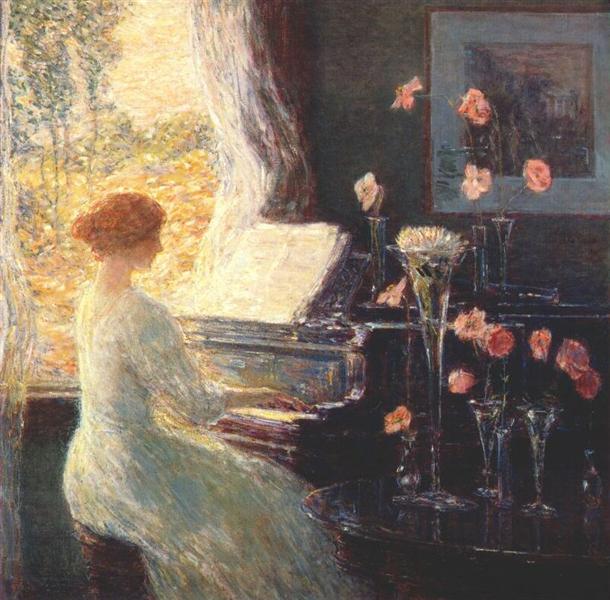
“The Sonata“
____
having recently determined that a sonata
a day keeps the doctor away, and inspired
to work upon that cure, I thought I’d initiate
a Sonata Month starting in November
there are thirty days in November, so no
more than thirty sonatas, each of which
will, I promise, be a revelation
a sonata is a piece of music consisting
of more than just one part, traditionally
three or four, called movements
within those parameters, anything was,
is, possible, any kind of music, times
three or four, traditionally, Classically
but traditions indeed applied, the tried
and true, fast, slow, fast, became the
standard, a cheery introduction,
followed by a contrasting, which is to
say slower, middle section, then a
restorative, final, energetic, act, meant
to send you, reinvigorated, on your way,
maybe even an equally vivacious fourth
there’ll be sonatas with one movement,
some seven, some with even maybe
more
and stay tuned
and thanks for joining in
R ! chard

 Richibi's Weblog