Richibi’s Weblog

Just another WordPress.com weblog

Tag: sonata

sonatas, continued (César Franck – Opus 1, No. 1)

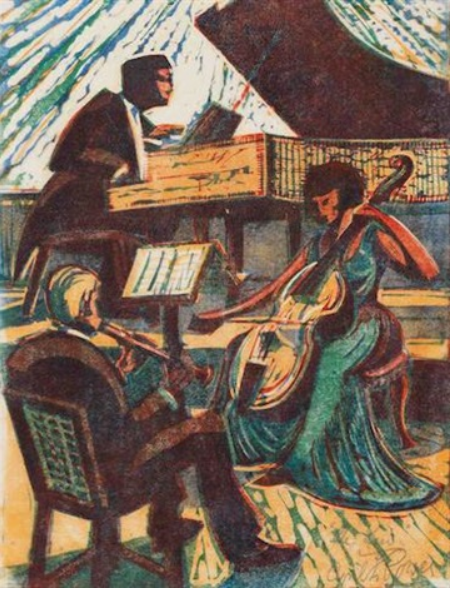
Trio, c.1936 - Cyril Power

     Trio (c.1936) 


          Cyril Power


                ______


my Month of the Sonata might be over,

November, 2023, but I still abide by the 

belief that a sonata a day keeps the 

doctor away, so I’ve continued, more 

or less, my medicine


but a sonata exceeds its definition, a 

piece of music, consisting of more 

than one segment, called movement,

for one or two instruments, the second,

should it be included, being harmony 

for an instrument that can play only 

one note at a time, which is to say, 

everything except the piano


but a piece of music written for three,

instead of just one or two, instruments 

is also called a trio


a work consisting of more than one

movement, but performed by three, 

instead of just one or two, usually 

different, instruments, is as well 

called a trio, just to confuse you


here’s one, for violin, cello, and piano,

by César Franck, a Romantic composer, 

his Opus 1, No. 1


I didn’t expect much, it being, manifestly, 

his first composition, Opus 1, No. 1, but it 

was part of the program I got tickets for

coming up at our recital society here in

February, I had to investigate


to my surprise, it was, is, magical


enjoy


R ! chard

How to Listen to Classical Music: Beginner’s Manual

 
How to Listen to Classical Music: Beginner’s Manual    
 
                                     (after Pamela Spiro Wagner
 
            First, forget everything you have learned,
            that Classical Music is difficult,
            that it cannot be appreciated by the likes of you,
            with your high school equivalency diploma,
            your steel-tipped boots,
            or your white-collar misunderstandings.    
 
            Do not assume meanings hidden from you:
            the best Classical Music means what it says and says it.
 
            To listen to Classical Music requires only courage
            enough to leap from the edge
            and trust.
 
            Treat Classical Music like dirt,
            humus rich and heavy from the garden.
            Later it will become the fat tomatoes
            and golden squash piled high upon your kitchen table.
 
            Classical Music demands surrender,
            language saying what is true,
            doing holy things to the ordinary.

            Listen to just one Classical work a day.

            Someday an irresistible composition may open in your heart
            like a daffodil offering its cup
            to the sun.
 
            When you can identify the Mozart fantasia 
            among the four of his sonatas I’ve included here in this gentle message,
            close this manual.
 
            Congratulations.
            You are now hearing 
            as opposed to listening to Classical Music 
 
 
Richard 


a couple of Mozart sonatas

if a symphony is a concerto without a soloist, a sonata
is a concerto without an orchestra, the soloist plays
alone, must deliver the same enchantment 
 
there are nevertheless always therefore the prerequisite
several movements, otherwise no sonata
 
 
the sonata, as we know it, originated in the mid-18th
century with more or less Mozart, earlier the term
applied to other structural notions in music
 
to still my consternation they were often not continuous,
movements were performed indiscriminately among other
eclectic acts in an evening of diverse entertainments, it
was Beethoven who put a decisive stop to that, though
the fame and popularity of Haydn and a few other
contemporaries, Clementi, Salieri, as well of course as
himself Mozart, had probably settled the matter for all
practical purposes somewhat earlier
 
Beethoven among his other theoretical principles codified
that, indeed wrote the book on it, like Moses delivering
the commandments, except that Beethoven presented
horizons in his mythology, miraculous and infinite,
instead of castigation and luxurious sin
 
his understanding of music, still now unsurpassed, is
demonstrable in his works through all the musical
innovations that have since, through all the very ages,
transpired, down to even his bagatelles, musical trifles,
which I’ll approach later, if you’ll stick around
    
 
but it starts essentially with Mozart 
 
Mitsuko Uchida, who is unsurpassed in Mozart, plays
Ludwig von Köchel, who catalogued finally, in 1862,
nearly a hundred years after Mozart’s death, in 1791,
the complete works of the master, other works have
been intermittently added since so that several
revised editions have dutifully followed, lettered a, b,
c according to the revision, the last Köchel number is 
626 
 
 
Mozart’s music is sprightly, effervescent, magical, but
not especially intellectually challenging, I think of toy
soldiers and candy cane, innocence and a child’s delight
in the infinite possibilities of creation, Creation  
 
 
Alfred Brendel  who stands shoulder to shoulder with
the iconic Glenn Gould when it comes to Beethoven,
 
of 18 piano sonatas, the D major K.576 above, was
his last 
 
 
Brendel is too commanding to play authentic Mozart,
though his technique is irreproachable, admirable,
spotless, wonderful 
 
he is Beethoven playing Mozart however, an uneven
fit 
 
comparing the two interpretations is instructive, Brendel
will dazzle, inevitably, but Uchida will make you fly
 
don’t believe me, count on it 
 
 
Richard