Serenade after Plato’s “Symposium” – Leonard Bernstein


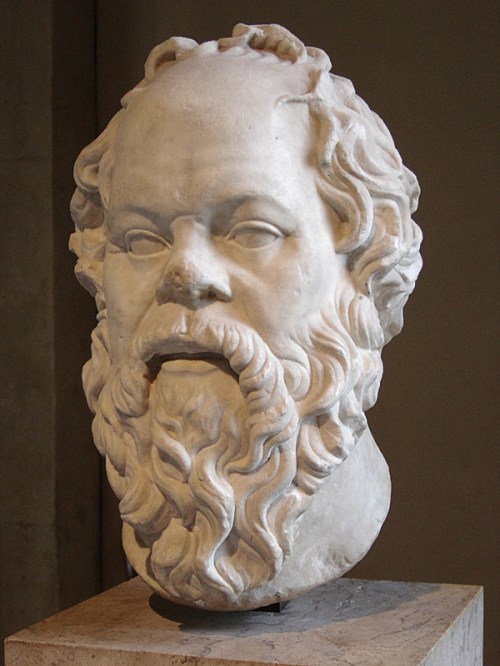
“Socrates”
__________
following in the footsteps of Socrates,
who, I agree with the Oracle, has been
ever the wisest man, one whose example
I’ve followed since first hearing of him, let
me query, what is courage
a tentative definition would have one
stating that courage is a determination
to overcome danger
but to use my own example, being called
courageous for surviving an aneurysm,
would this instance have qualified
where was my determination, apart from
waiting, submissively, for the axe to fall,
or to not fall, I felt no fear, merely time
passing, not an ounce of determination
but what of those others who endure
the pain often associated with dying,
agony, is that not a kind of enforced
courage
so did I qualify
an aneurysm swells the blood vessels
to the brain as the brain heals, but
meanwhile the heart pumps a rhythmic
tattoo on those passages rendered
more tender, so that a throbbing
anguish is ever drumming its drill
upon the cerebrum of the sufferer
perhaps I did qualify
but Socrates brings up an interesting
objection, can animals be brave, it
would seem not, therefore courage
requires self-consciousness, whether
or not it is defiant or compliant
and what about defiance before a lost
cause, is that courage or doomed
bombast
Aristotle adds to the mix the notion
of a noble cause, not merely an
instinctive, however, in the event,
morally prompted, position
so what is courage, you tell me
I say that you know it when you see
it, the courageous act defines the
word, not the other way around,
much like flowers are the result of
their own efflorescence, not the
manifestation of a preset Ideal
you are the measure of your own
words
for better or for worse
Richard
psst: it is interesting to note that
according to the Bible, in the
beginning was the Word,
John 1:1, a convenient tool
to impose order
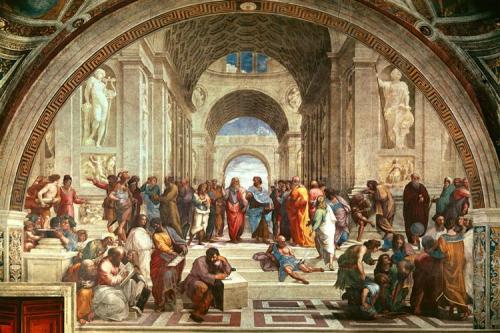
“The School Of Athens“ (1510 – 1511)
_______
upon reviewing my Socrates, Plato, and
Aristotle from a series of university
lectures I’ve been following, I came upon
a discovery so egregious, I couldn’t
believe I hadn’t seen it before, the old
story of the forest and the trees, I guess
upon hearing that the Oracle at Delphi
had replied that it was Socrates to those
who’d wondered who the wisest man
was, Socrates, abashed, began to seek
out wise men to disprove the Oracle,
but whenever Socrates asked of them
what is virtue, what is justice, what is
knowledge, for instance, the answers
were always inconclusive, they always
seemed to depend on perspective –
virtue, justice, knowledge were in the
eye of the beholder – though Plato
later putting in his own definitions
called them Ideals, a chair partook,
for instance, of an overarching
chairness somewhere, as did indeed
virtue, knowledge and justice, which
inferred another ideal universe
contiguously, of which our own
universe supplied only imperfect
renditions
you can hear the seeds of Heaven and
God already in all of that, way before
Christianity, not to mention Original
Sin
it also suggests an implacable order
Socrates wouldn’t’ve liked that
but Aristotle, with a much more critical
mind than Plato’s, less speculative, more
akin to Socrates’, less autocratic, more
inquisitive, begins to try to define,
nevertheless, abstractions, virtue,
knowledge, justice, as though they
indeed existed as ideals
this is putting the cart before the horse,
I thought, in the form of a revelation
an instance exists in the act of creation,
a physical transformation produces a
flower, the flower doesn’t happen
because of the word
a human example
for surviving an aneurysm once, someone,
to my astonishment, had called me
courageous, I’d been, I thought, only
surviving, not an inch of courage, not
even a millimetre
courage, I surmised, is in the eye of the
beholder, it is not at all a template, an
absolute, in my experience
Aristotle goes on to define a host of
Virtues, indeed 11, which come out as
essentially his Eleven Commandments,
on, in fact, courage, among others, all
essentially, and appropriately, moral,
thereby creating the moral realm of
our Western world
Jesus followed
and of course God and Heaven
which, of course, still prevail despite
sound, sober objections
as though we could know
why is this important
because, I think, we must remember
that our assumptions are only that,
and often they’re based on only what
we’ve been told, which is already a
step away from incorrect
interpretation
in the world of false news, check
your references, check your very
words, our lives, it isn’t too much
to say, I believe, depend on it
not to mention our own personal
moral code, our soul, our purpose
for being, which every wo/man
must oversee for hirself
if one has the courage
Richard
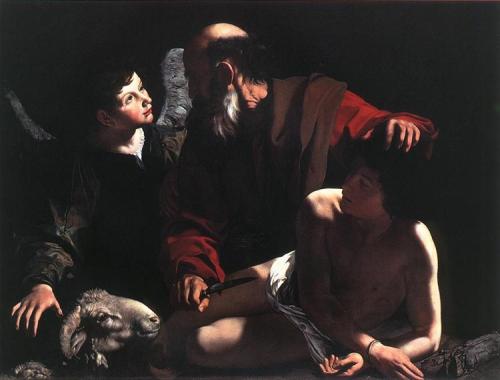
“The Sacrifice of Isaac“ (1598)
________
“If thou workest at that which is before thee, following right reason seriously, vigorously, calmly, without allowing anything else to distract thee, but keeping thy divine part pure, as if thou shouldst be bound to give it back immediately; if thou holdest to this, expecting nothing, fearing nothing, but satisfied with thy present activity according to nature, and with heroic truth in every word and sound which thou utterest, thou wilt live happy. And there is no man who is able to prevent this.”
“Meditations“, Book 3, 12
_________
the idea of the virtuous man, or the
interpretation of Marcus Aurelius of
such a person, goes back of course to
Socrates by way of Plato, 427 – 347
B.C., who’s ideal was primarily
political, what to achieve within a
political order, rather than a private
meditation, an advice rather than
a contemplation as in Marcus
Aurelius, 121 – 180 A.D., 550,
not inconsequential, years later
other moral perspectives meanwhile
applied, Epicureanism, for instance,
notably, after which the stranglehold
of Christianity produced not philosophy
but dogma, for a subservient and,
biblically labeled, fallen people,
nearly fifteen hundred years spent
trying to figure out how many angels
fit through the eye of a needle,
essentially, how many irrationalities
could prove the existence, and
authority, of a mandated God
René Descartes inadvertently in this
very quest, but not before 1637, put
an end to that, introduced a new, and
revolutionary, perspective, “I think,
therefore I am“, which put the individual
instead of the Church in the driver’s seat,
this, if it didn’t bring on the Renaissance,
at least gave it a significant push
but because of his famous scientific
method, studies afterwards in what
we now know as the humanities
became more empirical than
specifically moral, how do we
perceive rather than how do we live
according to what is right or wrong,
Nietzsche‘s “Beyond Good and Evil“,
1886, reoriented that investigation,
as it happened, ominously, in an age
where any kind of god had become
irrelevant, Beethoven would be
transformed into a Hitler, an
uncomfortably fateful Übermensch,
Superman
now philosophy is concerned with
language, what do we mean when
we say what do we mean, and can
anybody understand that
our closest moralist, our modern day
Marcus Aurelius, is at present Miss
Manners, whom I wholeheartedly
recommend
as well as, of course, Marcus Aurelius
Richard
psst: Miss Manners‘ question and answer
format, incidentally, is not at all unlike
what Plato does in his Socratic dialogues,
she just has a larger, more flip audience
____________
As I said at the very beginning, you are “sensitive”, and I was right, because you rightly perceived that I was becoming impatient. My apologies. Patience is not my forte. 🙂 However, you have not “touched a nerve”, as this is by no means an emotional discussion from my pov. I have no intention to “vehemently reject” your position (after all it is yours not mine), but only to share my perspective, including what I perceive to be irrational arguments.
Here are the two statements you made;
” I, and the “demented” Nietzsche, incidentally, equally fervently mistrust, even deem fundamentally impossible”,
“I do not profess to “know what Nietzsche believes or “fervently mistrust[s]‘”.
Is that not a self-contradiction?
You say that you’re making an interpretation. But, what is knowledge but an interpretation? A translation from the concrete and the objective to the abstract and subjective, just as we translate a work of literature from one language to another? By interpreting Nietzsche to yourself, you gain a rational understanding of him, and by interpreting him to others, you share that understanding.
I think an important distinction should be made between a) the belief in the existence of Absolute Truth” and b) the belief of one’s monopoly of the Absolute Truth. You seem to be passionately rejecting b), which is quite understandable. But Platonism is not b) but a). It does not claim monopoly of the Absolute Truth, but instead, Plato and Socrates both exhort their listeners to pursue Beauty, Goodness and Truth, to pursue virtue, to be the lover of wisdom, which is the literal meaning of “philosophy”,
According to Einstein, this pursuit of the Absolute Truth is also the guiding principle of the scientists. Without this passionate pursuit of the truth, we would never discover that the earth is not flat. Now think about this: Can you still insist that it is uncertain whether or not the earth is flat, that it is impossible to have a rational understanding of the shape of the earth?
You argue that uncertainty makes people less likely to kill. But most people who kill are not driven by belief in the Absolute, but by their lust for pleasure, wealth and power. Some may kill in the name of Truth as a disguise for their ulterior motives, but it would be unfair and irrational to blame the Truth for their acts.
I’ll refrain from discussing the Catholic Church, partly because to me this discussion is about Platonism, and Christianity is not Platonism (though they share many similar aspects), and partly because I’m not associated with the Catholic Church and frankly don’t know enough about it to say anything useful
Hi Richard,
Actually Plotinus posited a memory model that might be quite similar to yours if I understand you correctly. There are three components in this model, the object stored in our memory, our act of remembering as if retrieving an object from storage, and the activated/retrieved image of the object in our mind. To answer your friend’s retort, we are all three components combined, though most prominent in the second component.
You object to the idea of thoughts having their object existence outside our consciousness, but you agree that we’re aware of our thoughts at the same time as we’re aware of our own existence. Is that a fair representation of your position?
If so, thoughts have just as valid an existence in our consciousness as ourselves. Ergo, there are thoughts. 🙂
P.S. People who speculate on this stuff have way too much time on their hands
Plato’s theory encompasses both change and immutability. They are incomplete without the other, nay, they cannot exist without the other. This is proven by our own experience. We can observe changes only because we’re using something static as a reference

 Richibi's Weblog