Richibi’s Weblog

Just another WordPress.com weblog

Tag: Shostakovich

sonatas, continued (“String Quartet, Op. 76 no. 1” – Haydn)
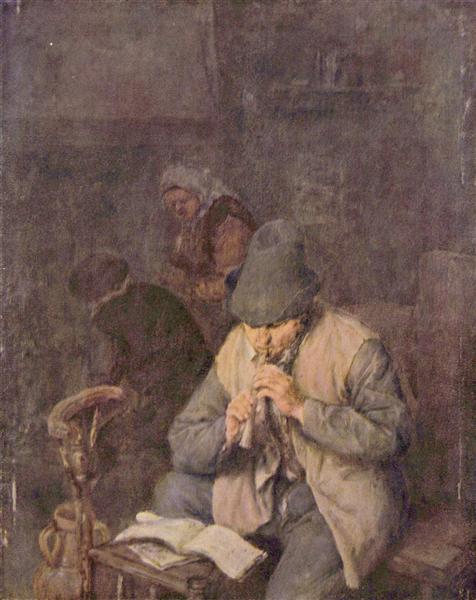
The Flute Player, c.1660 - Adriaen van Ostade


          Adriaen van Ostade


               ___________


o, I said, when my flute teacher, an art I’d taken up

too late in life, presented me with a piece I should 

learn to play, the second movement of Haydn’s 

Opus 76, no. 1, an adagio sostenuto


adagios always remind me of John, I’d read, at

a modest ceremony of remembrance for him, 

from a text I’d prepared, which prophetically, 

transcendentally, connected me with a

cornucopia of adagios, I’d sought them out,

been consoled, repaired, eventually inspired, 

by them, Haydn’s Opus 76, no.1, movement 

two, had been a total shoe-in


Haydn is where the history of string quartets 

starts in the West, they existed before, but 

not formally as a musical format, became 

thereafter, however, an identifiable category, 

and consequently, imitated


the string quartet, a piece of music written

for four instruments, all string traditionally,

two violins, a viola, and a cello, playing 

more than one segment of music, 

Classically three, then becoming four,

became a structure that has not even

nowadays lost its appeal, though the 

individual combinations might’ve 

significantly, since, been altered 


Haydn wrote 68 string quartets, which  

established him as their spiritual father, 

all string quartets devolve from him,

including Beethoven‘s, those of 

Shostakovich, and Messiaen


marvel


R ! chard

sonatas, continued (Messiaen – “Quartet for the End of Time”)

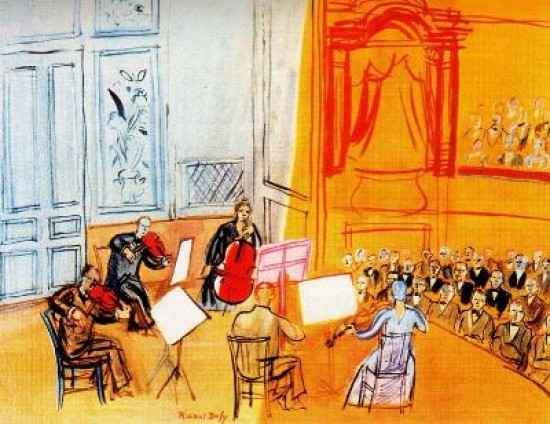
Red quartet - Raoul Dufy

    Red Quartet 


       Raoul Dufy


           _____


if a trio is a sonata written for three instruments,

a sonata, a piece of music consisting of more 

than one segment, or movement, written for 

four instruments, is called a quartet


a quartet is also what we call the group itself

of four players


quartets can play more than just quartets, they 

can also play waltzes, nocturnes, rhapsodies, 

for instance, just as trios, groups of three, can

play more than just trios 


but quartets, the form, have had a long and 

glorious history, from Mozart and Haydn, 

the Classicists, through Beethoven, an 

ardent Romantic, to the more political 

Shostakovich, enemy, for a time, of his 

repressive Soviet state, and on to 

Messiaen, who composed his own 

Quartet for the End of Time, in a Nazi 

concentration camp


let me start with the Messiaen, now that I’ve

whetted your appetite, and work our way back 

to Mozart to see where we came from, and 

how


there are seven movements in Quartet for

the End of Time, not the Classical three or

four, atonality abounds, discordant, not 

unexpectedly, progressions, repetition also 

takes its punches, not easily identifiable 

throughout, but tempo, the third pillar of 

Western music, more or less holds its 

own, keeping the tradition, however 

precariously, together, listen


it’s 1941, we’re in a concentration camp,  

Messiaen is caught between hope and 

despair, give the guy a break, he hasn’t 

many absolutes to hold onto, tempo 

might be one of them, the heartbeat,

pulse, perseverance, an actual human 

pace, a rhythmic instinct, by which 

eventually, hopefully, meaning 

transpires


hope is in one’s creativity, he says, each 

individual answer can be a tribute to

one’s own tribulations, our responses 

can be poetry, lessons rather than

invectives, epiphanies rather than

agonies, may the Force, in other words, 

be with you, in the face of even the most

trying difficulties, honour can supplant 

trials, he concludes, given grace and 

integrity


Beethoven says pretty much the same 

thing in his last piano sonata, remember,

his Opus 111listen, a not not impressive

corroboration


R ! chard

“The Seven Last Words of Our Saviour on the Cross”, opus 51 – Joseph Haydn

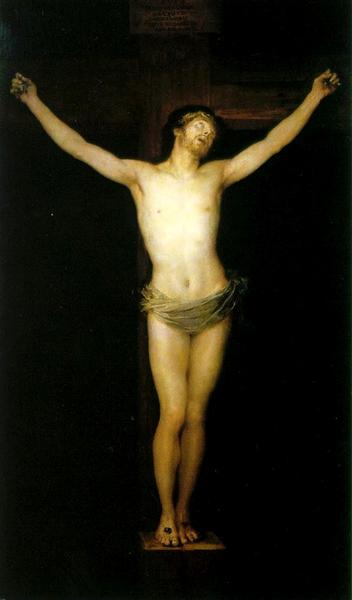
crucified-christ-1780.jpg!Large.jpg

                  “Crucified Christ (1780) 

                          Francisco Goya

                                 _______

Haydn’s Opus 51 was commissioned 
for the Oratorio de la Santa Cueva, the 
Holy Cave Oratoryin Cádiz, Spain,
church, as the name suggests, built 
partially underground, it would be
performed, the Opus 51, for the Good 
Friday service of 1787, Haydn therefore 
put his Opus 50 on hold, six string 
quartets, to finish this ecclesiastical 
work on time

what had been required was a work for 
small orchestra to inform the Seven 
Last Words of our Saviour on the 
Cross, it would therefore have at least
segments, movements, and would be 
divided by the elaboration of the 
bishop upon the significance of these 
individual “Words”, or, in fact,
statements, see this example 

Haydn added an introduction, and a 
finale in the form of an earthquake,
quite, I think, wittily and ever so 
appropriately

nearly simultaneously, Haydn 
composed the orchestral 
arrangement for string quartet, and 
later for orchestra and voice, for, in
other words, an oratorio

to my mind “The Seven Last Words 
of Our Saviour on the Cross” is 
Haydn’s crowning achievement, in 
all of its iterations

you’ll note that there is even first of 
all a title, and the title asks for 
something quite specific, indeed 
words, which the composer would
have to render musically, somehow, 
he’d need drama, something of a 
musical narrative, no minuets

all of the movements, apart from 
the end ones, are variations on 
slow – adagio, lento, largo, even 
grave – and how do you keep an 
audience, or in this case a 
congregation, happy, or even 
interested, with seven potentially 
lugubrious adagios in a row, all 
profoundly melancholy

only Shostakovich has managed 
to do that since, which I’ll talk 
about at some point later

Haydn also undoubtedly inspired 
Beethoven here with the 
consequences of so many 
movements, the possibility of 
extending a musical intention
into something resembling,
indeed, a book, a story, the 
introduction of narrative, 
essentially, into our musical 
history, which is to say, music
as literature 

the orchestral version of “The 
Seven Last Words” is performed 
here at the very Oratorio de la
Santa Cueva, the string quartet
version, played not only better 
than I’ve ever heard it played
before, but better even than any 
other quartet I’ve ever heard, 
period, includes the commentaries 
in German by an attendant prelate,
as intended in the original 
composition 

the movements’ “Seven Words” are 
indicated in Latin, not, incidentally, 
the  language of “Our Saviour”, and 
move from “Lord, why have you 
forsaken me” to “If it is Your will, 
then let it be done”

the last version presented here is 
the oratorio, for orchestra and
voice  

all of them, utterly inspiring

listen


R ! chard 

        (to be, incontrovertibly, continued,
         this piece is too loaded with 
         substance, it is transformational)
on string quartets – Opus 76, no 1 – Joseph Haydn

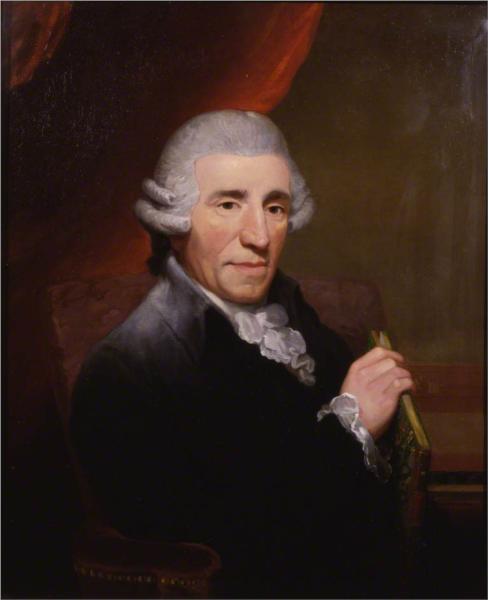
joseph-haydn-1791.jpg!Large.jpg

                                   “Joseph Haydn (1791) 

                                          Thomas Hardy

                                                 ______

to not consider other musical forms of
Shostakovich would be unfair, his
symphonies are mostly propaganda,
however often, though somewhat 
culturally specific, riveting

my favourite works of his, works I 
consider iconic, are mostly chamber 
pieces, piano solos, string quartets

a string quartet, after a symphony, is
like sitting down to dinner with four,
at the very least, acquaintances, 
rather than being a guest at a party,  
the conversation is more intimate,
every person plays hir part, everyone
is heeded, if even only with courtesy,
a social, a Classical, an aristocratic,
prerequisite 

movements can be compared to 
courses, distinct and identifiable for
their particular culinary, musical, 
propriety

later variations on this reflect the 
variations in social mores, where 
restaurants, the modern way of
socializing, allow for disparate 
choices, often superimposed, 
throughout the meal for any,
every, occasion

dim sum, tapas, celebrate this, not
unhappily 


but string quartets can be tricky, I 
thought I’d start from the beginning,
with some Haydn, their recognized 
Father, you’ll understand when you
hear this, his Opus 76, no 1, an 
outstanding string quartet to live 
up to

Haydn set the standard for string 
quartets when the norms of Western 
music were being established, Bach
had given us the alphabet, the
well-tempered clavier, Mozart, the 
grammar, the structure of music,
tempo, tonality, repetition, Beethoven 
gave us the literature, the poetry, the 
philosophical, the transcendent

Haydn is somewhere between these 
last two, but decidedly, still, the king  
of the string quartet, though Beethoven  
does a good job of trying to best him,  
and so does Shostakovich, you’ll have 
to pick

but first, let’s start with Haydn, that’ll
be already, you’ll see, or hear, enough

later, I’ll get into it


R ! chard

Olivier Messiaen – “Et exspecto resurrectionem mortuorum”

just in time for Easter here is something from
Olivier Messiaen, whom I consider to be, after
Shostakovich, the most important composer of
the Twentieth Century, and may one day, with
more distance, prove to be, of the two,
preeminent 
  
Messiaen, a devout Catholic, wrote specifically
to the glory of the Catholic God, an interesting
return to the music of the Baroque period, and
earlier, when the Church sponsored essentially
all the arts  
 
perhaps Messiaen is also a precursor – the Et
exspecto resurrectionem mortuorum“, which
I’m presenting, or, in my humble Latin,”In 
is from 1964 – of the resurgent fundamentalism
we’ve been witnessing in all churches,
synagogues, mosques, in our own times
 
Et exspecto resurrectionem mortuorum“, is
not at all Romantic, not even Impressionistic,
two world wars have been fought since, man  
has stepped on the unglorious moon, God even
died in the early sixties leaving us to reinvent
our own future, a time of youth and flowers,
and great indeed expectations, as it turned out  
 
the even profound assumptions of the earlier
order however, in the language of music
represented fundamentally by beat and tonality, 
hadn’t worked, couldn’t work anymore, having
been manifestly discredited, women had received 
the vote, financial and sexual independence,
traditional authority had been categorically
overthrown, there was no going back
 
 
Richard Strauss had already suggested this new
broader horizon, in 1896, with his “Also Sprach 
Zarathustra, a mighty work, made famous, even
unforgettable, by the movie  “2001: A Space   
Odyssey“, when the very sun bursts upon the
intergalactic universe to its interstellar strains
 
but Messiaen takes you even further into the
reaches of the infinite 
 
I couldn’t help thinking of a more adult Miró –
the individualized elements – but more profoundly 
metaphysical, I have rarely seen, heard, something
so transfixing, powerful, even the silences between
movements, there are five, are riveting
 
 
happy Easter

 
Richard 


Shostakovich’s String Quartet no 15, opus 144 (revisited)

on a day of commemoration, or at a moment even of
merely contemplation, perhaps it’s not a bad idea to
revisit Shostakovich’s String Quartet no 15, in E flat
minor, opus 144
, his flurry of mournful adagios, his
string of stately dirges, his penetrating meditation
on mortality

complete this time around, on one only site, though
just a short while ago indeed I said it wasn’t to be
found, March 28, 2012, again I was wrong

today it stood, perhaps not coincidentally, directly
before me as I clicked onto my list of music,
unadulterated, intact, complete, apart from an
irrtating audience member coughing at one point,
unforgivably, for marring so sincere an expression
of fervent string sounds, though only momentarily

by the “Filarmonica” Quartet, of Novosibirsk, Russia,
a city just north of Mongolia and Kazakhstan, the
players are not at all unimpressive

accompanying images are apparently of Russian
inspirational countryside nearby, and of
neighbouring Mongolia

Richard