Richibi’s Weblog

Just another WordPress.com weblog

Tag: Shakespeare

“Bohemian Rhapsody” – Freddy Mercury‏


the poetic dramatic monologue, which finds
its popular source in Shakespeare, though
they are essentially introspective there,
philosophical rather than strictly narrative,
making them nevertheless, in a play, by
definition, dramatic, rightful claimants
still to that name, and which was
institutionalized as a poetic form by
Robert Browning later in the XlXth Century,
by upending the Shakespearean mode,
turning poems into plays instead of plays
into poems, makes its way into the XXth
Century, probably mostly unobtrusively,
no one really particularly notices, but
powerfully culturally nonetheless when
applied to, for instance, music, which is
to say poetry, of course, with notes

here’s “Bohemian Rhapsody”*, an abridged
version, as sung by Rose Osang Fostanes,
delivering a classic dramatic monologue

here’s Freddy Mercury’s complete version,
with a Greek chorus supplying oracular
even feedback

Richard

* Bohemian Rhapsody

Is this the real life?
Is this just fantasy?
Caught in a landslide,
No escape from reality.

Open your eyes,
Look up to the skies and see,
I’m just a poor boy, I need no sympathy,
Because I’m easy come, easy go,
Little high, little low,
Anyway the wind blows doesn’t really matter to me, to me.

Mama, just killed a man,
Put a gun against his head,
Pulled my trigger, now he’s dead.
Mama, life had just begun,
But now I’ve gone and thrown it all away.

Mama, ooh,
Didn’t mean to make you cry,
If I’m not back again this time tomorrow,
Carry on, carry on as if nothing really matters.

Too late, my time has come,
Sends shivers down my spine,
Body’s aching all the time.
Goodbye, everybody, I’ve got to go,
Gotta leave you all behind and face the truth.

Mama, ooh (anyway the wind blows),
I don’t wanna die,
I sometimes wish I’d never been born at all.

I see a little silhouetto of a man,
Scaramouche, Scaramouche, will you do the Fandango?
Thunderbolt and lightning,
Very, very frightening me.
(Galileo) Galileo.
(Galileo) Galileo,
Galileo Figaro
Magnifico.

I’m just a poor boy and nobody loves me.
He’s just a poor boy from a poor family,
Spare him his life from this monstrosity.

Easy come, easy go, will you let me go?
Bismillah! No, we will not let you go. (Let him go!)
Bismillah! We will not let you go. (Let him go!)
Bismillah! We will not let you go. (Let me go!)
Will not let you go. (Let me go!)
Never, never let you go
Never let me go, oh.
No, no, no, no, no, no, no.
Oh, mama mia, mama mia (Mama mia, let me go.)
Beelzebub has a devil put aside for me, for me, for me.

So you think you can stone me and spit in my eye?
So you think you can love me and leave me to die?
Oh, baby, can’t do this to me, baby,
Just gotta get out, just gotta get right outta here.

(Oh, yeah, oh yeah)

Nothing really matters,
Anyone can see,
Nothing really matters,
Nothing really matters to me.

Anyway the wind blows.

Freddy Mercury

“Ambush at Five O’clock” – Stephen Dunn‏


from the New Yorker, February 3, 2014

Ambush at Five O’clock

We were by the hedge that separates our properties
when I asked our neighbors about their souls.
I said it with a smile, the way one asks such a thing.
They were somewhat like us, I thought, more
than middle-aged, less dull than most.
Yet they seemed to have no interest
in disputation, our favorite game,
or any of the great national pastimes
like gossip and stories of misfortunes
about people they disliked.

In spite of these differences, kindred
was a word we often felt and used.
The man was shy, though came to life
when he spotted an uncommon bird,
and the woman lively, sometimes even funny
about barometer readings and sudden dips
in pressure, the general state of things.
We liked their affection for each other
and for dogs. We went to their house;
they came to ours.

After I asked about their souls
they laughed and stumbled towards an answer,
then gave up, turned the question back
to me. And because I felt mine always was
in jeopardy I said it went to the movies
and hasn’t been seen since. I said gobbledy
and I said gook. I found myself needing
to fool around, avoid, stay away from myself.

But my wife said her soul suffered from neglect,
that she herself was often neglectful
of important things, but so was I.
Then she started to cry. What’s the matter? I asked.
What brought this on? She didn’t answer.
I felt ambushed, publicly insensitive
about something, whatever it was.

It was a dusky five o’clock, that time
in between one thing and another.
Our neighbors retreated to their home,
but the women returned
and without a word put her arms
around my wife as if a woman weeping
indicated something already understood
among women, that needn’t be voiced.
They held each other, rocked back and forth,

and I thought Jesus Christ, am I guilty again
of one of those small errors
I’ve repeated until it became large?
what about me? I thought. What about
the sadness of being stupid?
Why doesn’t her husband return
with maybe a beer and a knowing nod?

Stephen Dunn

____________

poetry is a conversation, of course, a poet
has with all the other poets who’ve come
before him, her, here Dunn is evidently
channelling Robert Browning, “This is
my last Duchess”,
Browning writes,
“painted on the wall / Looking as though
she were alive.”,
from his My Last
Duchess
“,
a poem I’ve never forgotten,
wherein the speaker discusses the
portrait of his earlier wife, one he’d
summarily purportedly got rid of

Robert Browning had learned his craft,
the dramatic monologue, from, of course,
Shakespeare, down to even its dramatic
content

Elizabeth meanwhile had been inspired
rather by Shakespeare’s sonnets, by his
thee, thy, thine, and thou’s

in Dunn the Browningian drama is
significantly less dour, nobody out and
out dies, though the dilemma is never
not existential, however less morally
compromised, less psychologically
and tragically fraught

neither does Dunn rhyme

but that just sends us back to Homer
of course, less epic, more, maybe,
middle class, very, and distinctively,
XXlst Century

but that’s how you read between the
lines, the verses, in this case, and
thus across the centuries

poetry is a conversation

Richard

“Gate C22” – Ellen Bass‏

Gate C22

At Gate C22 in the Portland airport
a man in a broad-band leather hat kissed
a woman arriving from Orange County.
They kissed and kissed and kissed. Long after
the other passengers clicked the handles of their carry-ons
and wheeled briskly toward short-term parking,
the couple stood there, arms wrapped around each other
like he’d just staggered off the boat at Ellis Island,
like she’d been released at last from ICU, snapped
out of a coma, survived bone cancer, made it down
from Annapurna in only the clothes she was wearing.

Neither of them was young. His beard was gray.
She carried a few extra pounds you could imagine
her saying she had to lose. But they kissed lavish
kisses like the ocean in the early morning,
the way it gathers and swells, sucking
each rock under, swallowing it
again and again. We were all watching —
passengers waiting for the delayed flight
to san jose, the stewardesses, the pilots,
the aproned woman icing cinnabons, the man selling
sunglasses. We couldn’t look away. We could
taste the kisses crushed in our mouths.

But the best part was his face. When he drew back
and looked at her, his smile soft with wonder, almost
as though he were a mother still open from giving birth,
as your mother must have looked at you, no matter
what happened after — if she beat you or left you or
you’re lonely now — you once lay there, the vernix
not yet wiped off, and someone gazed at you
as if you were the first sunrise seen from the earth.
The whole wing of the airport hushed,
all of us trying to slip into that woman’s middle-aged body,
her plaid bermuda shorts, sleeveless blouse, glasses,
little gold hoop earrings, tilting our heads up.

Ellen Bass – from “The Human Line” (2007)

_____________________

the line, as it were, is blurred here between
prose and poetry, what is the one and what
is the other, the answer, of course, is in the
eye of the beholder, what do you think

I cannot profess to be able to give you an
answer, to be able to tell you your difference,
I can only know what I know, and how that
accords with what I think poetry is, or
prose, for that matter, what for me are
their definitions

these have been tested, much as my
definitions of love, for instance, or
friendship as well, throughout my ages,
and for the very same reasons, to get to
know myself, to somehow learn there life’s
lessons, for art and affections have been
the most profitable sources of my
metaphysical scrutiny, who am I, where
am I, and why, these and ill health, and
the looming inexorability of its
consequence, of course, death

a simple answer to the question, is
Gate C22 a poem, would be that it is
written in iambic pentameter, like
Shakespeare, like Elizabeth Barrett
Browning
, and a host, of course, of
others, if that is for you sufficient
grounds to validate, not to mention
its metaphors, even allegories,
alliterations, onomatopeiae

the more difficult answer is in its
articulation, its condensation and
distillation, of a very magical and
immutable, perhaps even oracular,
moment

which, for me, already, is, in and of
itself, very poetry

but I’m a poet, I look for stuff like
that, you’ll have to forgive me
that idiosyncrasy, it has provided
me ever, however, with wonders

Richard

psst: loved “vernix“, who knew

“Aubade” – Philip Larkin‏

if I said about To be, or not to be that it
had never been equalled with respect to its
broodingly existential substance, this next
poem comes pretty close to doing that

note the link to Hamlet in the word
“indecision”, a consequence of the
“standing chill / That slows each
impulse down”

note also, incidentally, that the metre is
entirely Shakespearean, read “Aubade“
out loud

any further comment I’ll cede with
gratitude and delight to moonbeamtickseed,
a promise of shrewd insight I recently
discovered on the Internet, reciprocally,
as it happened, after moonbeamtickseed,
serendipitously supposedly, had discovered,
having happened on some of my Elizabeth
Barrett Browning
and alerted me to it, me,
not at all adverse, of course, to being
discovered

___________

Aubade

I work all day, and get half-drunk at night.
Waking at four to soundless dark, I stare.
In time the curtain-edges will grow light.
Till then I see what’s really always there:
Unresting death, a whole day nearer now,
Making all thought impossible but how
And where and when I shall myself die.
Arid interrogation: yet the dread
Of dying, and being dead,
Flashes afresh to hold and horrify.
The mind blanks at the glare. Not in remorse
– The good not done, the love not given, time
Torn off unused – nor wretchedly because
An only life can take so long to climb
Clear of its wrong beginnings, and may never;
But at the total emptiness for ever,
The sure extinction that we travel to
And shall be lost in always. Not to be here,
Not to be anywhere,
And soon; nothing more terrible, nothing more true.

This is a special way of being afraid
No trick dispels. Religion used to try,
That vast, moth-eaten musical brocade
Created to pretend we never die,
And specious stuff that says No rational being
Can fear a thing it will not feel, not seeing
That this is what we fear – no sight, no sound,
No touch or taste or smell, nothing to think with,
Nothing to love or link with,
The anasthetic from which none come round.

And so it stays just on the edge of vision,
A small, unfocused blur, a standing chill
That slows each impulse down to indecision.
Most things may never happen: this one will,
And realisation of it rages out
In furnace-fear when we are caught without
People or drink. Courage is no good:
It means not scaring others. Being brave
Lets no one off the grave.
Death is no different whined at than withstood.

Slowly light strengthens, and the room takes shape.
It stands plain as a wardrobe, what we know,
Have always known, know that we can’t escape,
Yet can’t accept. One side will have to go.
Meanwhile telephones crouch, getting ready to ring
In locked-up offices, and all the uncaring
Intricate rented world begins to rouse.
The sky is white as clay, with no sun.
Work has to be done.
Postmen like doctors go from house to house.

Philip Larkin

“COMMENTARY: Martin Heidegger says somewhere–I can’t seem to find the
quote online–that’s it only in solitude that people face the angst of
death and fully understand what it means to be temporary. When we have
company the logical awareness of death doesn’t produce an emotional
response because, in those self-forgetful moments, the “I” that dies
is taken over by the “we” that doesn’t. Something like that. Notice,
as the poem progresses, how Larkin switches from ‘I’ to ‘we’–as a
means of comfort? as a way of letting philosophical rhetoric displace
fear? And also notice how he ends the poem with a bitter but also
freeing description of the outside world–the world of offices and
phone-calls and correspondences–banal, clay-white, and sunless as it
may be–is also mankind’s medicine, the means of deflecting these
critical fears. Postmen are doctors in that they bring contact and
correspondence (a suggestion here of language and poetry) into the
solitude of the house.

The language in “[Aubade]” is a little uneven, but there are some
moments of dead-on description. “Arid interrogation,” “furnace fear,”
“uncaring, intricate rented world” and several dark maxims:
“religion….that vast moth-eaten musical brocade/ invented to pretend
we never die” and “being brave/ let’s no one off the grave/ death is
no different whined at than withstood.” The rhymes (set in a 10 line
pattern that has a name I can’t think of) are natural and unforced and
add to the solitary desire to “link” as he says in the second stanza.

I should say, as a sort of afterthought that it’s interesting to
compare this poem with Donne’s aubade “[The Sun Rising]“.
I think they may have more in common that the genre,
though I’m hard pressed at the moment to say what it is.
I should say, as a second afterthought,that, aptly
but unfortunately, this was the last great poem Larkin
wrote. After its publication in 1977, he had 7 years ahead
of him in which he wrote little.”

moonbeamtickseed

go, moonbeamtickseed

Richard

XLlll. How do I love thee? Let me count the ways – Elizabeth Barrett Browning‏

from Sonnets from the Portuguese

XLlll. How do I love thee? Let me count the ways

How do I love thee? Let me count the ways.
I love thee to the depth and breadth and height
My soul can reach, when feeling out of sight
For the ends of Being and ideal Grace.
I love thee to the level of everyday’s
Most quiet need, by sun and candle-light.
I love thee freely, as men strive for Right;
I love thee purely, as they turn from Praise.
I love thee with the passion put to use
In my old griefs, and with my childhood’s faith.
I love thee with a love I seemed to lose
With my lost saints, – I love thee with the breath,
Smiles, tears, of all my life! – and, if God choose,
I shall but love thee better after death.

Elizabeth Barrett Browning

__________________________

there are two lines of verse in English
poetry which are early trumpeted by even
those who would have no truck in general
with poems, one about life, one about love,
paraded by already youths with all the
passion of their unbridled years, if not
oratorically advocating, at least sardonically
making fun of perhaps too mannered, even
irrelevant, in their opinion, I would think,
matter, namely Shakespeare‘s To be, or
not to be
and Elizabeth Barrett Browning‘s
How do I love thee? Let me count the ways

nothing much of the rest of these two
poems generally is known, though their
introductions be, even at the level of the
succeeeding ages, panoramic, neither,
either, incidentally, has ever, in its
substance, been equalled

To be, or not to be upon first exploring
it surprises for being, not, as supposed,
a paean to glory, for its declamatory, I
suspect, and engaging, cadences, but a
treatise on the very value of life, Hamlet,
despairing of the state of Denmark, where,
“something”, if you’ll remember, “is rotten”,
where his mother and murderous stepfather
have evilly, he imagines, conspired to steal
his real father’s throne, who hovers now
as a disturbing, and exhortative, presence,
keeping the action, or inaction in this case,
going, can never reach an answer, come to
a decision, To be, or not to be“, “that is the
[inexorable] question”

more specifically, “Whether ’tis nobler
in the mind to suffer”,
he asks, “The slings
and arrows of outrageous fortune, / Or to
take arms against a sea of troubles, /
And by opposing end them:”,
is life
worth living if the cost is so dire

Hamlet will not do the deed himself,
ultimately, of securing his own demise,
but will actively eventually allow it

one will wonder then, is life worthwhile,
Shakespeare never gives us a direct
answer

Elizabeth, however, talks about love, its,
essentially, apotheosis, an expression,
yet unrivalled of how we would like to
love, be loved

her declamation becomes somewhat
elaborate, even morbid, at the end,
macabre, but the force of the initial
statement has weathered already
several unforgiving ages, fresh and
true and captivating, fundamentally,
as ever

Richard

XXXVll. Pardon, oh, pardon, that my soul should make – Elizabeth Barrett Browning‏

from Sonnets from the Portuguese

XXXVll. Pardon, oh, pardon, that my soul should make

Pardon, oh, pardon, that my soul should make,
Of all that strong divineness which I know
For thine and thee, an image only so
Formed of the sand, and fit to shift and break.
It is that distant years which did not take
Thy sovranty, recoiling with a blow,
Have forced my swimming brain to undergo
Their doubt and dread, and blindly to forsake
The purity of likeness and distort
Thy worthiest love to a worthless counterfeit:
As if a shipwrecked Pagan, safe in port,
His guardian sea-god to commemorate,
Should set a sculptured porpoise, gills a-snort
And vibrant tail, within the temple-gate

Elizabeth Barrett Browning

_________________________

though Elizabeth Barrett Browning is ever
abstruse, dare I say, even Baroque – the
epoch of distorted perspectives and
dimensions which preceded the Classical
Era – in her not only grammatical but also
metaphorical constructions, to the point of,
as in the last, her XXXVlth sonnet, being
incomprehensible, too athwart for my taste,
or even my tolerance, here she returns to
form to shine again in her own Romantic
Age, a more literate time, as opposed to
our more visual one, where straight talk
would not ‘ve passed muster as worthy
of any art, that would happen only later
as a reaction to too elaborate artifice,
which you might already even decry,
for instance, in these sonnets

but to make distinctive the form – the sonnet
goes back to at least Shakespeare, who is
even an obvious inspiration for Elizabeth
she would’ve had to embroider her own
version of it, which she could only have
done with fresh artifice upon the ancient
structure, like decorative elaborations on
the traditional tablecloth

if they work it’s because the artifice meets
the substance equally, enough to give
meaning to the poem, verve to the
reinvigorated tabletop

but often, dear Elizabeth, for me, and I would
think for many others in our Twitter age, for
the most part your poems do only just, albeit
enough to make you nevertheless iconic

for Elizabeth Barrett Browning and Chopin
represent for us now more than any of the
other Romantics their distinctive Age, and
with great, let there be no doubt, and easily
demonstrated, authority

Pardon, oh, pardon is not a breeze but it
expands admirably, and distinctively, on her
other masterpieces, or should I say here,
mistresspieces

forgive my soul, she asks, for mistaking your
“strong divineness” for something as fleeting
as “sand”, something “fit to shift and break”

his “sovranty” – sovereignty, which finds its
etymological roots in the French word
“souveraineté”, should you be wondering –
had not been a part of her past, her “distant
years”
and therefore led to her confusion,
her “swimming brain”, imagining he might
be “a worthless counterfeit” – haven’t we all
been there – instead of the “worthiest love”

she compares herself to a “shipwrecked
Pagan”,
who, saved, “safe in port”, gives
thanks, pays homage, to “a sea-god”, “a
sculptured porpoise, gills a-snort”,
rather
than, of course, her One and True
Christian God, an interesting instance
of religious iconographical inflexibility,
as though her Christian God had more
authenticity than the sea deity

Elizabeth Barrett Browning, it should be
noted, remained ever to her Divinity devout
despite the intermittent fluctuations of her
less religiously committed husband

who nevertheless remained ever to her
true, and ever, both romantically and
Romantically, by her, stalwart

Richard

Beethoven piano sonata no 28 in A major, opus 101

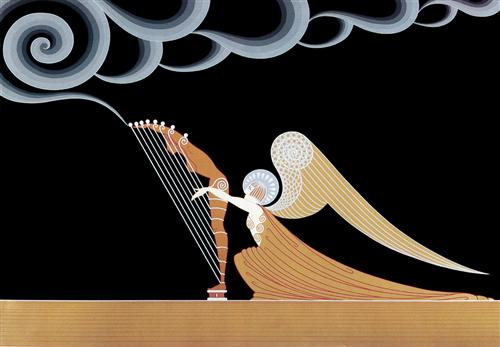
Erte - "The Angel"

The Angel

Erte

___

Beethoven’s piano sonata no 28, opus 101,
in A major
, is the first of what is considered
to be his late piano sonatas, as opposed to
early and middle, three entirely distinct
periods that are easily recognizable upon
closer listening, the early ones are bold,
even headstrong, with Beethoven’s ever
characteristic vigor and Promethean authority,
the length themselves of his early works are
a testament to his sense of his own great
personal validity, the first four, to my mind,
go on much longer than often enough they
should, a typically youthful presumption on
his part, and are musically at best trite, I find,
after their first expositions, the repeats come
as redundant, and tolerable merely, surprises,
even the famous 8th, the Pathétique“, opus 13,
is, I think, too brash and impudent, however in
this manner, nevertheless admittedly, entirely
effective, listen

the Pastorale“, of the middle period, opus 28,
no 15
, is where I deem the music to become
henceforward sublime, it has a settled
confidence that brims with not only technical
wizardry but with also positively enchanting
and entrancing musical ideas, bursting like
very flowers in springtime, with colour and
inspired, effervescent, imagination

the late period is where Beethoven becomes,
however, a sage, a prophet, and indeed a
hierarch in the new secular order of a
reconstituted Heaven, after all, someone
had to take the place of the now discredited
angels, Nietzsche called them Übermenschen,
Supermen

the 28th sonata starts out slowly, or rather,
more slowly than the earlier forthright ones,
already a sign of less physical, more
measured and considered reponses, my
impression here is of a grandfather visiting
his granchildren, jovial but not too disportive,
merely jaunty, always cheery but for a moment
of haunting melancholy, at the adagio, before
becoming congenial and avuncular again,
with then a big, boastful ending, snapping
staunchly his patriarchal suspenders,
getting the last, and traditional, word, with
a firm, which is to say, a foursquare-major-
chord, finish, the aural equivalent of turning
out the lights

musically, however, the progressions are
exploratory, incremental, more and more
layered with possible, and often apparently
rejected outcomes, in order to try out
something more fitting, maybe, more
accurate, a deconstruction, in other words,
of musical ideas, an investigation, in search
of a viable musically cohesive path

in the 28th sonata Beethoven, I think, is
doodling, however, coming up with the
methods of his great addresses, the
language here is not yet philosophically
precise, a smattering merely of pianistically
plausible ideas, musical sketches, the first
stirrings here, you’ll gather, of formal jazz

in the next sonata, the 29th, the still
unsurpassed “Hammerklavier”, he writes
the definitive book, speaking for music in
the forthcoming history of the world, and
determining its future path, we are still
moving along on his transcendent carpet,
no one ‘s come along still to give us a
more assured ride, kind of like Homer,
some would say Shakespeare, others
Albert Einstein, other, incidentally,
post-Christian, post Revolutionary
Supermen

who do you presently pray to, who are
your angels, who your Superwomen,
-men,
towards what do you aspire,
towards whom

Superwomen, -men, incidentally,
cultivate their own efflorescence,
manifest their own, I think, destinies,
or, if you like, their own Heaven

much as I believe angels also do

Mozart’s Fantasy in C minor on the
same program
shows him in a nearly
Beethovenian mode atavistically, much
more somber than he usually is, but he’s
nevertheless easily distinguished by
his much less intricate musical
accompaniment and his much more
rigorous melodic line, you’re more
likely to hum it

Mozart also composes from the nursery,
I find, the exhilaration of playful discovery,
you can see the toy soldiers, the golden
tresses on little milkmaids in dirndls with
red circles for cheeks

Mozart’s pieces are like nursery rhymes

Beethoven progresses to literature

before you judge me too harsh on Mozart,
by the way, consider that my favourite
piece of the two in this program is the
Mozart, it’s like comparing apples and
oranges, though, it depends on your
mood that day which you’ll favour

cheers

Richard

psst: just in case you missed it, this version
of the Pathétique is the best I’ve ever
heard, indeed, of all the pieces here
the most extraordinary, don’t miss it

Nemo – “Ennead I” by Plotinus (17 )‏


Date: Thu, 28 Mar 2013 00:08:23 +0000
To: richibi@hotmail.com
From: comment-reply@wordpress.com
Subject: [New comment] “Ennead I” by Plotinus
 

Richard,

You wrote, ” should there, in the instance, however, be a One, an Absolute, we would not, nor can anyway ever, from our intrinsically divergent perspectives, be able to, in any meaningful way, know It”

Our opinions are not “intrinsically”, but “accidentally” divergent. If they are intrinsic, they would not be affected by changes in our circumstances. But often times our opinions are affected by external circumstances. Therefore, they are not “intrinsic”. For instance, your story about the color of the wall reminds me of a similar story of how the English chemist John Dalton discovered color blindness. He himself was color blind but never realized it until his mother (or aunt) disagreed with him on the color. Without such a defect, there would be no disagreement.

Truth cannot be a sum of opinions or even an unanimous decision of all people. Why? Because the sum of contrary opinions amount to nothing, and the sum of contradictory opinions only lead to confusion, since people are never unanimous about anything.

To use a classic Platonic analogy: If you have a serious disease and want to be healed. Will you call everyone in from the street, hold a public assembly and have them vote for a treatment of your disease? Of course not. You’ll seek out the specialist in the field and have him examine you and give you the proper diagnosis and treatment. Because he possesses the knowledge, whereas the others don’t. Even a grain of truth is worth more than a boatload of false opinions.

Having said the above, however, I agree that the truth may be multifaceted, like the color of light shining through a prism. Because our senses have their limitations, we can only see part of the spectrum, similarly, our rational faculty may also be limited, and we only see the Truth in part. This is why dialogues such as we’re having are meaningful. That we may see the rainbow, while not losing sight of our own color.

“So please your majesty
That we may wake the king: he hath slept long.”
King Lear Act IV Scene VII


oof, Nemo, again where do I start, I’ll try to
tackle merely Truth here, deconstruct It, so
that we can know what we’re even talking
about
 
what do you mean by Truth
 
 
something corresponds to what it is that
we see, hear, feel, I would think, to be
locked in my head, my spirit, a fundamental
unity, without the support of an underlying
Reality, would be horrible, a profound, and
unbearable, solitude, I don’t want any more
to even try to imagine it, though, in my
youthful invincibilty, I once did, it would
nearly drive me, sometimes, I remember, 
crazy 
 
I would try to guess what people would
say in their next breath and found that
mostly I could do it, that mostly I could
get it right, which didn’t do much for an
outside Reality
 
but, again, babies must learn to separate,
not easily, their suddenly unfamiliar world
from their initially undifferentiated senses,
their identity from what we understand to
be Reality, I’d been merely atavistically
revisiting that fundamental experience 
 
I first fell in love, incidentally, when I met
someone I wasn’t able to preempt, to my
utter fascination, at which point I was
forced to acknowledge not only Reality
but also probably a Heaven, it has
become a condition, I fall in love with
only people from other planets, or, if
you like, dimensions
  
 
so, Nemo, I am also subservient to an
ideal, or even an Ideal
 
but it, or It, is my utter fabrication, though,
manifestly, not an uninformed one
 
my Truth is that ethereal, a bedrock, 
however, of my nevertheless basically 
nebulous view of life, made out of,
indeed, thin air
 
my opinions are therefore entirely
speculative, except for my
understanding of myself
 
I think, according to Descartes, therefore
I am, and of that, of myself, I am not at
all speculative, for I think, listen   
 
 
Truth, incidentally, is a function of our
species, assuming that it is a formal
Reality is akin to placing ourselves,
as we once did, at the centre of the
Universe, we were apparently
egregiously wrong about that, it
seems to be generally now agreed,
I suspect an Absolute, or Idealized,
potential Reality, is asking for hubris,
and too often, incidentally, we get it,
see wars, torture, man’s inhumanity
to not only man
   
 
about the world which has mathematical
dimensions we are mostly in agreement,
two plus two will always equal four in our
rational construct, and Science seems to
flow pretty smoothly from that
 
therefore Truth with respect to matter I
will not question, it is the grid we are all
at least comfortable with, like speaking
the same language, despite its even
basic insufficiencies, these fairly easy
mostly to patch up with persistence
and ingenuity   
 
but Plato’s Truth, Ideal, or Absolute, is
of a more noumenal, spiritual, which is
to say, abstract, order, and as such, like
Beauty, is in the eye of the beholder,
Truth is what we think it is
 
is John Dalton wrong to have seen a
divergent colour, and who could tell
him that his blue was green, his red,
orange, when these were categorically
his impressions, dissent is a matter
merely of concensus  
 
Truth, I believe, is our accommodation,
and is no more than the sum of its
collective parts, the truths that
scientists unearth are Science, not
Truth, Reality, not Wisdom     
 
other worlds would have entirely
different conceptions of the Universe
for being other than we, us
 
we are assuming we have the answer,
Nemo, to imponderables 
 
therefore, not Philosophy, I insist,
but Art, and metaphorical rather
than categorical imperatives
 
see Beethoven for that, and / or Proust   
 
 
Richard
 
psst: according to these two excellent
          programs,
 
                  Bernard Williams on Descartes      
 
                  Bernard Williams on Descartes (cont.)
 
           two parts of an interview with an
           authority on Descartes, I could’ve
           easily been a figment of his
           imagination for sounding nearly 
           word for word, to my surprise
           and delight, very much like him
 
           though he probably wouldn’t,    
           by my calculations, therefore,
           have loved me      


Nemo – “Ennead I” by Plotinus (16)‏

 The School of Athens - Raphael

                                             The School of Athens

                                                         Raphael   

                                                     ____________


Date: Sat, 23 Mar 2013 22:47:05 +0000
To: Richibi’s Weblog
From: comment-reply@wordpress.com
Subject: [New comment] “Ennead I” by Plotinus
 
Richard,
 

As I said at the very beginning, you are “sensitive”, and I was right, because you rightly perceived that I was becoming impatient. My apologies. Patience is not my forte. 🙂 However, you have not “touched a nerve”, as this is by no means an emotional discussion from my pov. I have no intention to “vehemently reject” your position (after all it is yours not mine), but only to share my perspective, including what I perceive to be irrational arguments.

Here are the two statements you made;
” I, and the “demented” Nietzsche, incidentally, equally fervently mistrust, even deem fundamentally impossible”,
“I do not profess to “know what Nietzsche believes or “fervently mistrust[s]‘”.

Is that not a self-contradiction?

You say that you’re making an interpretation. But, what is knowledge but an interpretation? A translation from the concrete and the objective to the abstract and subjective, just as we translate a work of literature from one language to another? By interpreting Nietzsche to yourself, you gain a rational understanding of him, and by interpreting him to others, you share that understanding.

I think an important distinction should be made between a) the belief in the existence of Absolute Truth” and b) the belief of one’s monopoly of the Absolute Truth. You seem to be passionately rejecting b), which is quite understandable. But Platonism is not b) but a). It does not claim monopoly of the Absolute Truth, but instead, Plato and Socrates both exhort their listeners to pursue Beauty, Goodness and Truth, to pursue virtue, to be the lover of wisdom, which is the literal meaning of “philosophy”,

According to Einstein, this pursuit of the Absolute Truth is also the guiding principle of the scientists. Without this passionate pursuit of the truth, we would never discover that the earth is not flat. Now think about this: Can you still insist that it is uncertain whether or not the earth is flat, that it is impossible to have a rational understanding of the shape of the earth?

You argue that uncertainty makes people less likely to kill. But most people who kill are not driven by belief in the Absolute, but by their lust for pleasure, wealth and power. Some may kill in the name of Truth as a disguise for their ulterior motives, but it would be unfair and irrational to blame the Truth for their acts.

I’ll refrain from discussing the Catholic Church, partly because to me this discussion is about Platonism, and Christianity is not Platonism (though they share many similar aspects), and partly because I’m not associated with the Catholic Church and frankly don’t know enough about it to say anything useful


first of all let me raise a glass to our conversation,
a toast that it might live long
 
and thank you for your continued respectful and
penetrating participation, I will endeavour to as
assiduously hold up
  
 
that said, we get into, as I see it, the question
posed by Wittgenstein, an obstacle of the
most impenetrable sort, the egregious
unreliability of language, what do you mean
when you say something, and how does that
synch with the other guy’s interpretation of it,
or, indeed, girl’s 
 
your meat could be my poison, my Plato,
your Proust   
 
indeed which one of us is right about this,
is Plato a saint or a sinner, a boon or a
blight
 
though Proust, of course, would remain 
unquestionably and irreversibly here,
ever, surely, for both of us, benefactor
of positively Promethean, natch, 
proportions   
 
what has become here then of the
Absolute, gone up in a whiff of, just
as insubstantial, smoke, the exhalations,
note, of a fully material mens sana,
sound mind, which can be nothing
without the enveloping corpore sano,
sound body   
 
should there, in the instance, however, 
be a One, an Absolute, we would not, nor
can anyway ever, from our intrinsically
divergent perspectives, be able to, in
any meaningful way, know It
 
 
more practically and topically, when
my mother had her living room walls 
painted, my blue was her green, or vice
versa, in either case adamantly, trying
both of us to eke out from each other
concessions to a position, undyingly,
each, though ever politely, both, held, 
a model accommodation, which is to say,
without the often attendant bombs 
 
we remained puzzled, however, each,
ever, by insidious, and inescapable,
doubt, who saw the right colour 
  
 
there is a technical solution to my mother’s
wall, I know, but only after great psychological
adjustment, even torment, will the blue think
his or her visual impression another colour  
 
and who is mistaken 
 
or can some people be ever right, 
and ever wrong
 
this, incidentally, is the central problem
of philosophy, not just our own central
topic
 
and its resolution the central problem
of politics
 
 
in this instance when her cataracts were
removed, her blue became green, or vice
versa, I’d have to be in her apartment, I
can’t remember which colour, right now,
it was I saw, another philosophical
conundrum, but surely, you get the
picture, interpretation is highly
subjective, and porous 
 
which is why Science requires absolutely
unanimous approval, if you’ll forgive this
metaphorical only use of that prickly
adverb here, to determine Its still 
fundamentally ever tenuous theories
 
we’ve even only recently deconstructed
even time,
 
or Time
 
now there’s a God for you, Giver of context
 
however, even there, It would appear arbitrary,
there may be another Reality beyond our
particular three-dimensional Plato’s cave
 
but I digress
 
 
my misuse of the word “know” in citing
my apparently contradictory statements,
is at fault, I can never know, I can only
interpret, with custom we have come to
accept our suppositions as fact, and hope
that everyone else will do the same, which
we mostly do, except when we have wars
because of some intractable position,
where someone has set a price on his, her 
incontrovertible, but still fundamentally
arbitrary, opinion, even of ownership,
family structure, interpersonal affairs,
like this one 
 
but we are talking with only air, no
concrete certainty    
 
I believe Nietzsche, in other words, to
have thought my thoughts, or I, rather,  
to have incorporated his, but that is only
my understanding of it, which surely I
propound, though I might quite possibly
be wrong, but, Nemo, I can’t remember
the last time I was, I could check, I keep
a tally
 
 
scientists, I believe, are indeed seeking
always to know, perfecting their idea of
Reality, but Truth can only be the sum
of all things we think It is, nothing else,
nothing more, after all what other entity
that we know knows anything at all
about It, about Truth
 
we can only think there is a Real out
there, and make the best of It, the rest
is, Shakespeare again,  
 
           “…………………………………. such stuff
           As dreams are made on; and our little life
            Is rounded with a sleep.”
 
                                             The Tempest – act 4, scene 1
                                                                            lines 156 -158
 
 
cheers ever
 
Richard 


Nemo – “Ennead I” by Plotinus (11)‏


Date: Tue, 12 Mar 2013 15:56:00 +0000
To: Richibi’s Weblog
From: comment-reply@wordpress.com
Subject: [New comment] “Ennead I” by Plotinus
 

Richard,

Forgive me for saying so, but it seems to me that your philosophy is quite incongruent with your personality, which is passionate, sensitive and kind. As far as I can tell, you’re much more gregarious than the demented Nietzsche.

If, as you wrote at the beginning, you can’t even be sure that I exist, why are you taking the trouble to have this conversation? If everything is in a flux, what is there to “grasp” and “tackle”? If all is a figment of the imaginations of beings in their separate cages, what’s the point of conversation? You’re still trapped in your own cage anyway.

Kant may be wrong about some things, but I do agree with him about the difference between noumenon and phenomenon. Our thoughts revolve around the phenomenal, and consequently, they are in flux, “peripheral” as you put it, or evolving, as some believe. But, this doesn’t negate the noumenon, the eternal and unchanging. To use an analogy in biology, when you observe the growth of a seed or an embryo, it seems to be changing constantly, and if you didn’t know what it was, you would think that everything was in flux, but all the while it remains the same substance: a human being


what’s to forgive, Nemo, I don’t mind at all being
called “passionate, sensitive and kind
 
thank you
 
 
and you are right, after a study of philosophy I
went my own way, which was what philosophy
had taught me to do, it is a conversation, I
learned, rather than an ideology, that secular
cousin of theology, either system oftentimes
flagrantly autocratic, for instance Plato, or
take your pick of religions 
 
along the way I discovered miracles, I wanted to
talk to my beloved, but somehow I’d only asked
my dad, who’d died earlier the same year, to
speak to me from beyond the grave, I’m your
son, I said, I’ll hear you, and, Nemo, I did, and
all, eventually, the others, I’ve been talking to
all of them ever since  
 
this might seem very strange, of course, but
you can tell from what I’ve written to date,
surely, that I’m not entirely demented,
conversely, maybe I’m inspired, maybe just
eccentric, who knows, take your pick, so
long as I’m not, I think, hurting anybody    
 
 
Kant, incidentally, didn’t affirm the noumenon,
he merely did not deny it, so he’s made room
for my unorthodox constructions, and miracles,
as a corollary, in general
 
this was also Descartes’ dilemma essentially,
or Shakespeare’s, There are more things in
 
also my own 
 
we cannot beyond our consciousness affirm,
we can only interpret, I am the only thing I can
affirm, the rest is what you make it, for better
or for worse, this from “the demented“, Nemo, 
Nietzsche
 
therefore Beethoven or Proust, or maybe
even me    
 
 
I believe in miracles, and so I experience them
 
I’d asked a friend on a cold winter day with
only icicles everywhere in the city, what
should we do, let’s go out and look for
beautiful things, he replied, we did, and all
the icicles consequently shimmered and
glistened, I’d found a key to finding beauty,
another valuable parable 
 
later, needing more than just beautiful things
to cheer me I asked for miracles, which, Nemo,
like the earlier beautiful things, profusely in
their turn abounded, you just have to be
ready to receive them
 
 
I believe there is a noumenon, but I’ll never
be able to prove it, though I feel it profoundly,
and judiciously sort out with the help of
wisdom and poetry, truth and beauty, all
I can muster, the information I receive 
 
I hope it might be of some service
 
 
to me there is poetry behind everything,
shimmering, glistening magic, but I’m not
sure that’s what everyone sees, nor wants
to see, I won’t try to impose my perspective,
I can only tell what I see
 
and I’ve long seen more than mere facts,
what I see, have long seen, is an inherently 
transcendental reality 
 
which suggests the probability of other
noumenal worlds
 
so, to answer your question, I do think
you indeed exist, though I can’t be
absolutely sure of it, though you might
not be a figment of my imagination you
are nevertheless to me merely my
impression of you, but who really are
you, that’s a tricky question, cause you
don’t even know
 
meanwhile there’s no harm in sharing
even a virtual, irony of ironies, 
conversation
 
   
cheers
 
Richard