how to listen to music if you don’t know your Beethoven from your Bach, Vl
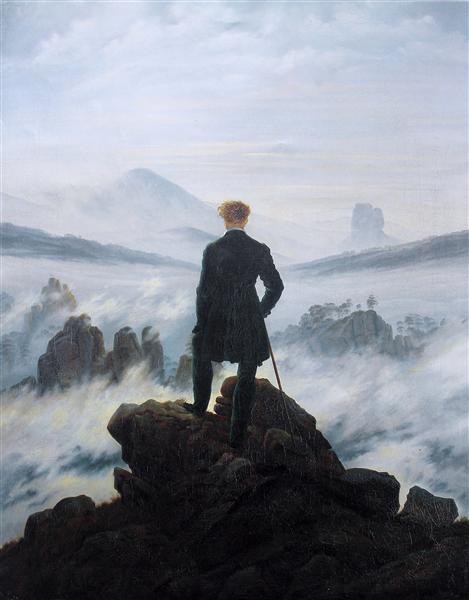
“The Wanderer above the Sea of Fog“ (1818)
_____________
if Beethoven built the Church, along
with Goethe maybe, of Romanticism,
and be assured Romanticism is an
ideology, a moral outlook, a
motivational perspective, much like
the economy is nowadays,
supplanting any more humanistic
imperatives, Brahms put up one of its
Cathedrals, just listen, the First Piano
Concerto is a monument, as mighty
as the Cologne Cathedral musically,
right next to Bonn, incidentally,
Brahms‘ birthplace
with the disintegration of the
supremacy of the Catholic deity
at the onset of the Protestant
Reformation, Luther, Calvin,
Henry Vlll and all that, bolstered
by new discoveries in scientific
speculation, that the earth wasn’t
flat, for instance, that it revolved
around the sun rather than the
other way around, contradictory,
though convincing, voices began
to abound, excite question
in the 18th Century, the Age of
Reason, the Christian Deity fell,
never effectively to be put back
together again, see for Its final
sundering, Nietzsche
in France, after the Revolution,
the Church was officially removed
from political consideration,
countermanding its centuries of
morally heinous depredations,
the United States had already at
its own Revolution separated it
from State
Romanticism was an answer to
a world wherein there might not
be a God, a world with, however,
a spiritual dimension, to respond
to the clockwork universe
envisioned by the earlier epoch,
the Enlightenment, a world where
everything could be categorized,
analyzed, predicted
Romanticism called for the
inclusion of inspiration in the mix,
there are more things in heaven
and earth, Horatio, than are
dreamt of in your philosophy,
as Shakespeare would, for
instance, have it – “Hamlet”,
1.5.167-8
poets became prophets thereby,
if they could manage it, very
oracles, the world was blessed
with, at that very moment,
Beethoven, far outstripping the
likes of, later, for example, Billy
Graham, or other such, however
galvanizing, proselytizers,
whose messages would’ve been
too, to my mind, literal
for music cannot lie, obfuscate,
prevaricate, music cannot be
fake
and then there was Schubert,
and Chopin, Tolstoy, Dickens,
Elizabeth Barrett Browning,
Robert, her husband,
Tchaikovsky, Caspar David
Friedrich, the Johann Strausses,
Byron, Shelley, Keats, whose
artworks, all, are as profoundly
in our blood, our cultural system,
as, if not more so than, our
present information about the
details of our Christian myths,
despite a superfluity of them
even, throughout the long
indeed Middle Ages, and right
up to, and including, the still
fervent then Renaissance, for
better or for worse still, for us
what Romanticism did, and
specifically through the work
of these seminal artists, was
give each of us a chance,
show us how to come
through trial and tribulation,
what a faith does, any faith
it said, here, this is my dilemma,
and this is how I deal with it
for me, Beethoven’s 32nd
Piano Sonata is, soundly, the
epitome of that, but listen to
Brahms put a stamp on it
with undaunted authority
we might be ultimately of no
consequence in an indifferent
universe, they say, but, hey,
this is what we can do, and
do gloriously, while we are
at it
Woody Allen picks up the
purpose in our own recent
20th Century, following in
the earnest footsteps of his
Existential mentor, the much
too dour, I think, Ingmar
Bergman
but that’s another story
entirely
meanwhile, listen
also watch, the conductor here,
a complete delight, is right out
of “Alice in Wonderland“, I
promise you’ll love it
R ! chard
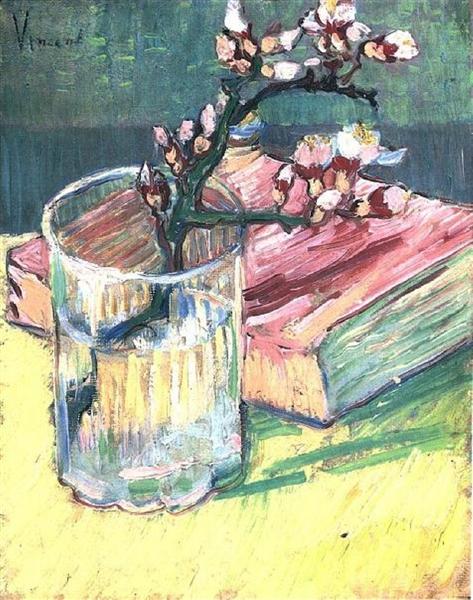
“Blossoming Almond Branch in a Glass with a Book“ (1888)
__________
if Tchaikovsky’s 2nd Piano Sonata hasn’t
remained in the canon, if it isn’t one of
the pieces you’ve heard if only through
the grapevine, it’s, I suspect, cause it’s
essentially not an advance on other more
prescient works in the form, other more
oracular compositions
Beethoven had paved the way for the
Romantic Period, nearly invented it,
established incontrovertibly the
dimensions of the sonata, notably its
purpose, its structure, Schubert had,
however belatedly, confirmed it, with
works equal to his, and even, here
and there, superior, listen
but having reached the summit of
what a sonata could say, the form
little by little withered in its several
Romantic permutations, Tchaikovsky
here, for example, and became mere
elaborations upon a waning theme
rather than exciting, and revelatory,
productions
the sonata would survive, but
transformed by another era,
Impressionism, Tchaikovsky would
as well, of course, but not through
his sonatas
his Second, however, is not not
worth a listen, would you pass,
for instance, on a less celebrated,
perhaps, van Gogh, see above
Tchaikovsky’s, therefore, Second
R ! chard
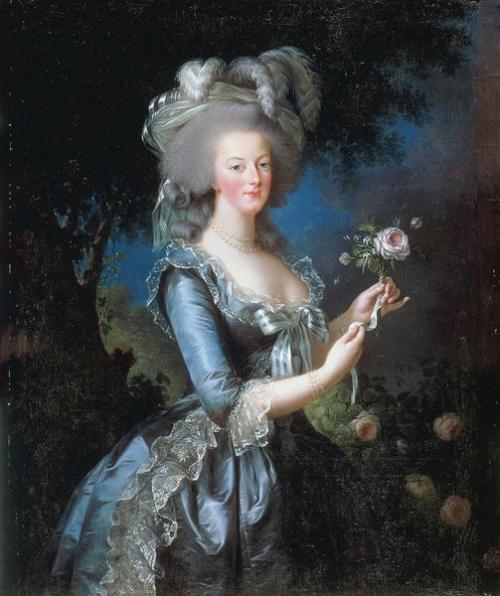
“Queen Marie Antoinette of France“ (1783)
Louise Élisabeth Vigée Le Brun
___________________
first of all, let me grievously repent an
egregious confusion I probably left
in my last diatribe, I said that the second
movement of the Opus 54, no 2 sounded
to me like a minuet, I had, through
embarrassing inattention, confused its,
however unmemorable, adagio with that
of this Opus 55, no 3, which I’d listened
to in too quick succession, driven as I
am by my thirst for epiphanies
the Opus 54, no 2 will do, but I’m not
going back for seconds, nor to the
Opus 55, no 3, though here’s where
I flaunt nevertheless Haydn, not to
mention Bach, Mozart, Beethoven,
all the way to eventually Bruckner,
Brahms, the extraordinary Richard
Wagner, passing through Schubert,
Mendelssohn, the Strausses, father
and son, and the unrelated Strauss,
Richard, another incontrovertible
giant, and I nearly left out the
unforgettable Liszt, all of them
forefathers of our present music
you might have noticed that these
are all Germanic names, obedient
to the Hapsburg empire, with
Vienna as its supreme cultural
capital, and it was that
Austro-Hungarian dynasty that
indeed nearly single-handedly
secured our Western musical
traditions
a few Italians are remembered,
from the 18th Century, Scarlatti
maybe, Boccherini, Albinoni,
but not many more
no one from France, but they were
about to have a revolution, not a
good time for creative types,
though, incidentally, Haydn was
getting Tost, to whom he was
dedicating his string quartets for
services rendered, to sell his stuff
in very Paris
then again, Marie Antoinette, I thought,
was Austrian, an even archduchess,
and would’ve loved some down-home
music at nearby Versailles
so there you are, there would’ve been
a market
the English had Handel, of course,
who was, albeit, German, getting
work where he could when you
consider his competition, he was
too solemn and plodding by half,
to my mind, for the more
effervescent, admittedly Italianate,
continentals, Italy having led the
way earlier with especially its
filigreed and unfettered operas
but here’s Haydn’s Opus 55, no 3
nevertheless, the best Europe had
to offer, socking it to them
Haydn’s having a hard time, I think,
moving from music for at court to
recital hall music, music for a much
less genteel clientele, however
socially aspiring, we still hear
minuets, and obeisances all over
the place, despite a desire to
nevertheless dazzle, impress
then again, I’m not the final word, as
my mea culpa above might express,
you’ll find what eventually turns
your own crank, floats your own
boat, as you listen
which, finally, is my greatest wish
R ! chard
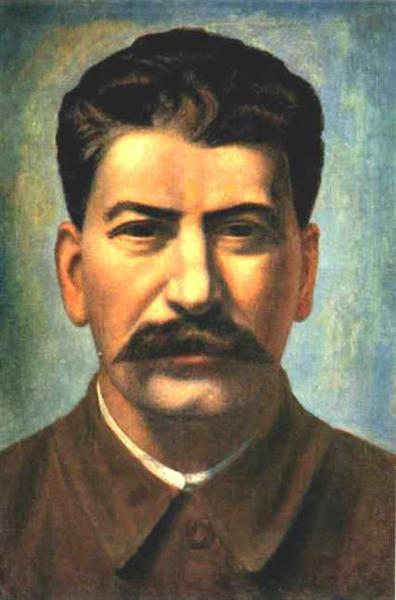
“Portrait of Joseph Stalin (Iosif Vissarionovich Dzhugashvili)“ (1936)
_________
if you’ve been waiting for a Shostakovich
to write home about among his early
symphonies, here’s the one, his
Symphony no 4 in C minor, opus 43 will
knock your socks off from its very
opening gambit, have a seat, settle in,
and get ready for an explosive hour
the Fourth was written in 1936, some
years after the death of Lenin, and the
instalment of Stalin as the supreme,
and ruthless, authority, after several
years throughout the Twenties of
maneuvering himself, cold-bloodedly,
into that position
from Stalin, “Death is the solution to
all problems. No man – no problem.“
fearing retribution after Stalin had
criticized his recent opera, “Lady
Macbeth of Mtsensk“, Shostakovich
cancelled the first performance of
this new work, due to take place in
December, ’36, others had already
suffered internal exile or execution
who had displeased the tyrant, a
prelude to the infamous Great Terror
the Symphony was eventually played
in 1961, 25 years later, conducted by
no less than Kirill Kondrashin, who’d
partnered Van Cliburn a few years
earlier in Cliburn’s conquest of Russia,
but along with this time however the
long-lived Leningrad Philharmonic
Orchestra
to a friend, I said, this is the biggest
thing since verily Beethoven, no one
has so blown me away symphonically
since then
he looked forward, he replied, to
hearing it
the Fourth Symphony has three distinct
movements, to fit thus appropriately the
definition of symphony, though the first
and third have more than one section,
something Shostakovich would have
learned from already Beethoven, it gives
the opportunity of experiencing a variety
of emotions within one uninterrupted
context, add several movements and
you have a poignant, peripatetic musical
journey, more intricate, psychologically
complex, than many other even eminent
composers, Schubert, Chopin,
Mendelssohn, even Brahms, for instance
it’s helpful to think of film scores, and
their multiple narrative incidents,
brimming with impassioned moments,
however disparate, Shostakovich had
already written several of them
let me point out that Shostakovich’s
rhythms are entirely Classical, even
folkloric in their essential aspects,
everywhere sounds like a march,
proud and bombastic, if not a
veritable dance, peasants carousing,
courtiers waltzing, and repetition is
sufficiently present to not not
recognize the essential music
according to our most elementary
preconceptions
but the dissonances clash, as though
somewhere the tune, despite its rigid
rhythms, falls apart in execution, as
though the participants had, I think,
broken limbs, despite the indomitable
Russian spirit
this is what Shostakovich is all about,
you’ll hear him as we move along
objecting, however surreptitiously,
cautiously, to the Soviet system, like
Pasternak, like Solzhenitsyn, without
ever, like them, leaving his country
despite its manifest oppression, and
despite the lure of Western accolades,
Nobel prizes, for instance, it was their
home
and there is so much more to tell, but
first of all, listen
R ! chard
the “Waldstein” Sonata, no. 21 in C major, opus 53, is
one of the few compositions that Beethoven named
himself, which is to say that he dedicated it to a
friend and patron, Count Ferdinand Ernst Gabriel
von Waldstein, if you can call that naming it
the ones with descriptive titles, the “Moonlight”, the
“Pastorale“, “The Hunt“, for instance, were mostly so
labeled by his publisher for ease of identification in
the growing market place, a more affluent merchant
class eager to take on the refinements of the nobles,
see such an instance of social mobility, however
lampooned, updated and upended, in again the
engaging and not at all unperceptive “The Beverly
Hillbillies“
this means that the suggestive names we’ve come
to associate with his sonatas, “Moonlight”, “Pastorale“,
“The Hunt“, were never conceived as such by
Beethoven, his compositions were ever purely musical
inventions, or more accurately inspirations, prophetic
pronouncements of a much more oracular order,
like Prometheus Beethoven was delivering nothing
short of fire
to match music to specific visual, or even emotive,
cues, incidentally, “Pictures at an Exhibition“,
“The Carnival of the Animals“, for example, came
later, already a nod to Beethoven’s even indirect
propositions
that titles were given to music, rather than the more
clinical and mnemonically difficult numbers, which
is to say, not easy to remember, isn’t very different
from the evolution of popular music in the early
1960′s
the Beatles, you’ll remember, had cuts on albums
that had nothing more than their group name in
the titles, or the title of one of the album’s cuts,
“Sgt Pepper’s Lonely Hearts Club Band” came
along to change all that, we saw the birth of the
concept album, where the whole extended affair
becomes a musical metaphysics, this is no
different from the move from the music of Mozart
to that of the more expansive Beethoven, music
is no longer a ditty but an extended technical
and philosophical text, listen to Pink Floyd take
on this mantle superbly in the Seventies, the only
other body since ever to effectively challenge
Beethoven in that especially rarefied field, with
the probable exception of the sublimely expressive
Schubert perhaps, who died much too young for us
to tell, for him to have decisively dialectically proven
himself beside these erudite peers, all having,
however, found ways to have us touch beyond the
sky, the very infinite, and into the no less infinite
confines of our more private and secret selves
what they state is that creation itself, absent any
other meaning, remains potent, perhaps even
ultimately redemptive
creation as a bold and noble response to eternity,
art as affirmation
you’ll note here that the structure of this sonata
is entirely Classical, unity of tone, unity of pace,
and the eventual return of the initial melody,
essential Classical components, what has
changed is the personal bravura of the composer,
Beethoven is not playing for the aristocratic court,
but for a wider, an infinite, audience, he is
pronouncing his and, by extension, our own place
and validity in the universe, by our ability as humans
to create, to respond creatively, and even sublimely,
out of only our otherwise flailing and indeterminate
existence
it is the Romantic response to the waning belief
in God, and incidentally a profound spur to,
argument for, our present notion of inalienable
individual rights
the personal soul has taken over from the earlier
unchallenged deity, the wavering concept of God
has had a seismic fall, and all the king’s horses
and all the king’s men will never be able to put it
together undiminished again
Beethoven is showing us that future
Richard
psst: Helena Bonham Carter plays excerpts from the
“Waldstein“, incidentally, in “A Room with A View“,
a movie entirely worth a revisit
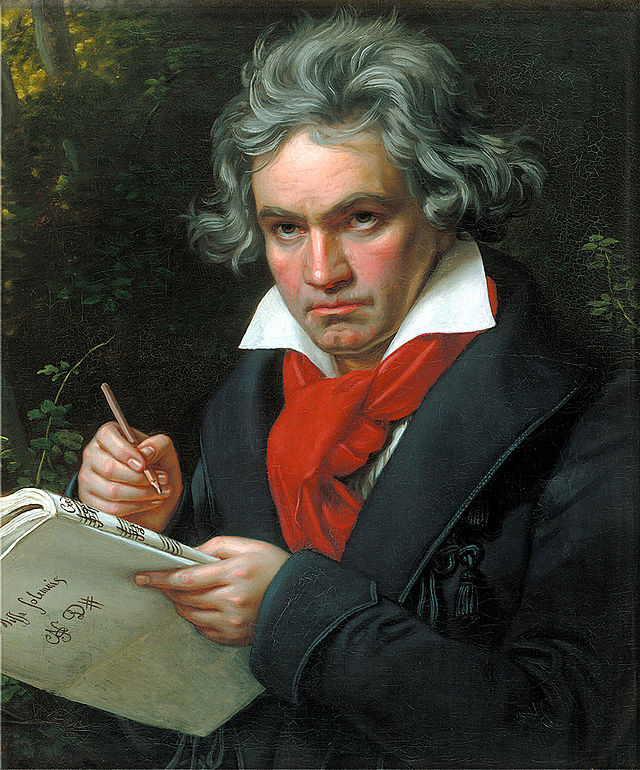
“A portrait of Ludwig van Beethoven“ (1820)
_____________
you might say a triumvirate of piano concertos dominate
our Western musical culture, a veritable trinity of pianistic
masterworks that tower over, and have ruled, our musical
consciousness throughout the modern epoch, the
Rachmaninoff 3 has been one of them, but the 5th of
Beethoven is surely the granddaddy, the “Guppa” as a
favourite grandchild I know would say, the Olympian
Zeus, the Christian God the Father, of them all, in majesty
and authority, others quake in its overwhelming aura, it is
the sun to all the other stars
Glenn Gould is the standard still by which it should be
played, none yet, to my mind, has surpassed him
Karel Ancerl conducts the Toronto Symphony Orchestra,
a competent orchestration, overshadowed inevitably by
this prodigy, who nevertheless doesn’t ever flaunt his
finger play but remains faithful throughout to the
dictates, the tonal balances, of the music, it is 1972
I had mentioned “variations in volume, tempo, tonality,
the play of harmonization and discords” in Rachmaninoff,
note the strict adherence to tempo here, even the fastest
runs of notes are grounded in beat, more solid, less elusive
than the iridescent Rachmaninoffian allusions to Debussy,
you could set a metronome to the appropriate tempo of
each individual movement in Beethoven, it would remain
constant, apart from a few restrained ritardandos near
the end of some musical elaborations, until its very final
apotheosis, beat was ever an anchor for the fulgurating
Beethoven, an article of faith from which he strayed only
with great circumspection
note the language is not emotional, passionate and ardent,
but philosophical, metaphysical, Beethoven is confronting
cosmological considerations, existential realities, not the
more emotional concerns that confound us every day, it’s
God he’s talking to, eternity, not the incarnate tendrils
of the moment, not the poignant stuff even of soon
through Schubert a Chopin, Beethoven was at the start
of that Romantic Movement, indeed its very first
proponent, but not quite ready to wear his heart itself
on his sleeve, but a more spiritual, probing reason, whose
ardent metaphysical ratiocinations would set all the others
on fire, setting the stage for all the other stars
later, if you haven’t guessed what it’ll be already, I’ll
supply you with the third concerto, the Holy Ghost, of
the trinity, the Apollo, god of music and the sun, among
our concert greats
Richard
 Richibi's Weblog