mass appeal, or “Missa Solemnis”, opus 123 – Beethoven
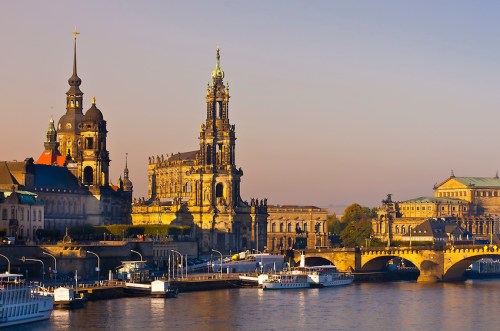
from the centre, the Hofkirche, the Dresden Cathedral, across from the
Augustusbrücke, or Augustus Bridge, extends into the Zwinger, one
of three only palaces in Europe, along with Versailles and Vienna’s
Schönbrunn, distinctly horizontally to the right, not to be confused
with a crook in the Cathedral, an intolerable, were it so, ecclesiastical
gaffe, it ‘s now become one of the most significant art galleries in
Europe, the green rooves, to the right still, are the Semperoper‘s, the
black roof, nestling before it, an unforgettable Italian
restaurant
before it all, majestically, the Elbe
_______
from the very Semperoper in Dresden,
where I’ll ever remember seeing the
worst “Barber of Seville” I’ve ever seen,
first balcony, left of centre, Figaro came
out on a motorcycle, I ask you, it was
downhill after that, my mom, beside
me, was falling even asleep, we left at
intermission, soldiered on to a
restaurant overlooking the Elbe, Italian,
if I remember, but utterly more enjoyable
than the disappointing operatic option,
there might even ‘ve been a moon at our
tableside window, picturesquely
shimmering on the river
but, hey, we both would‘ve stayed,
incontrovertibly, for this performance,
Beethoven’s “Missa Solemnis“, a late,
and towering, entry, 1823, in his opus
– second definition of that word, which
is to say, his entire output, all 135
opuses, first definition there, discrete
compositions – plus all his works
without opus – first definition again –
numbers, WoO
the plural of opus, incidentally, can
also be, both meanings, opera, just
to confuse things, I use either
interchangeably, according to my
narrative rhythm
missae solemnes, plural of missa
solemnis, are a particularly Catholic
form of music, going back to the
very Middle Ages, at which point
religious art was all that really
mattered, anything else was entirely
peripheral, of no consequence
but Catholicism, and its Protestant
offshoots, which is to say, their
common Christianity, remained
culturally entrenched during the
process of their slow disintegration
Nietzsche would, later, take care
of that, but that’s another story
Beethoven, Mozart, Catholics, if,
either, only by name, delivered
missae solemnes, while Bach,
Handel, both Protestant,
delivered oratorios, with some
intermingling
about which, later
Catholic, Protestant expression still
find, even strong, exponents at
present, though the form is,
essentially, outdated, our anthems
are national, now, mostly, if even
somewhat, that, halfheartedly, when
not, paradoxically, searchingly,
hopefully, and maybe even
revolutionarily, again, ideological
imagine “Imagine“ for instance, as
such, just click
R ! chard
 Richibi's Weblog