Richibi’s Weblog

Just another WordPress.com weblog

Tag: Schoenberg

Piano Concerto no 2 in G major, opus 44 -Tchaikovsky

beech-grove-i.jpg!Large

    Beech Grove I (1902) 

           Gustav Klimt

                 ________

if a sonata, or any composition for one 
instrument, is a meditation, a rumination,
an introspection, a concerto is its entire
opposite, it’s a declamation, a very 
harangue, the performer is not only 
before an audience, but before an
orchestra, before the conductor of that 
orchestra, that soloist had better be, 
therefore, something

Tchaikovsky’s 2nd Piano Concerto 
hasn’t cut the cultural mustard, you’ve
probably never heard of it, never mind 
heard it, not even in the miasma of our 
collective unconscious 

why

who knows, it’s magnificent

I suspect that Moscow’s distance, 
St Petersburg’s, might’ve had something 
to do with it, Russia would still have been 
a backwater to Europe, regardless of what
Catherine the Great might’ve done for its
intellectual edification, indeed a veritable 
Elizabeth the First, Queen of England
she, in her sponsorship of the arts

something like that happened, but in 
reverse, to Gustav Klimt, Egon Schiele 
in art, SchoenbergBerg, Webern, the 
Second Viennese School in music, in 
literature, Robert Musil, his The Man
Without Qualities very rival to 
Proust‘s epic trip down memory lane, 
Remembrance …“, when the centre 
of gravity for the arts moved from 
Vienna to Paris in the late 19th 
Century with the advent of 
Impressionism

France had entered its Fourth
Republic by then, was to finally 
entrench its democracy, and we got 
MonetDebussy, and indeed Proust 
instead, not to mention all of that 
city’s celebrated others

leaving creative Vienna, meanwhile,
the undisputed engine of the Zeitgeist
the spirit of the times, for over three 
quarters of an earlier century, thereby,  
in the dust

New York would take over in the 
1950s, similarly, for a time, Andy
Warhol and The Factory, eclipsing 
any other town

in other words, location, location, 
location, in tandem with historical 
events


R ! chard
Bill and Flossie Williams

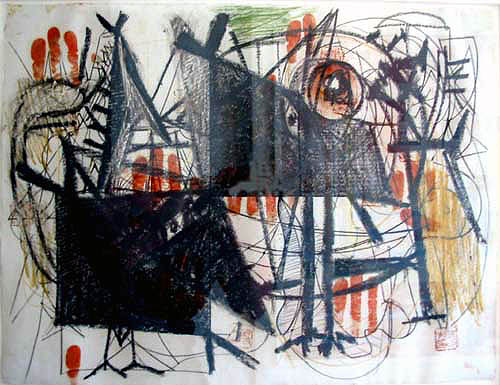
Arshile Gorky - "Hitler invades Poland" (1939)

Hitler Invades Poland (1939)

Arshile Gorky

________

it must be understood that World War l
changed everything, the old order,
orders, had been discredited, new
states were formed, territories allotted,
-isms proliferated, the arts had to, of
course, reflect that, and did, as many
-isms were hatched in the art world
as in the political world, indeed,
many more

which is why much of it at first
seems questionable, practitioners
were learning anew how to talk, paint,
make music, they were creating a new
conceptual universe to replace the one
that had been roundly discredited, the
one that had been around in the West
for the last two thousand years

therefore Schoenberg, therefore
Picasso, and therefore Finnegan’s
Wake
“,
for instance

we’ve been studying American
Modernists in the classes on the
Internet I’m taking
, none of whom
I find interesting, and I’m, contrary
to all expectations, losing even my
early enthusiasm for the much too
thorny, I think, Emily Dickinson

but here’s another abstruse poet
that I like in this poem

though I much prefer his wife
Flossie’s sardonic reply
, which
follows

________________

This Is Just To Say (1934)

I have eaten
the plums
that were in
the icebox

and which
you were probably
saving
for breakfast

Forgive me
they were delicious
so sweet
and so cold

William Carlos Williams

________________

Flossie’s Reply (1934)

Dear Bill: I’ve made a
couple of sandwiches for you.
In the ice-box you’ll find
blue-berries–a cup of grapefruit
a glass of cold coffee.

On the stove is the tea-pot
with enough tea leaves
for you to make tea if you
prefer–Just light the gas–
boil the water and put it in the tea

Plenty of bread in the bread-box
and butter and eggs–
I didn’t know just what to
make for you. Several people
called up about office hours–

See you later. Love. Floss.

Please switch off the telephone.

Florence Williams

____________

go Florence, I say, but you can
see, of course, why I’d say that

Richard

XXX. I see thine image through my tears to-night – Elizabeth Barrett Browning‏

from Sonnets from the Portuguese

XXX. I see thine image through my tears to-night

I see thine image through my tears to-night,
And yet to-day I saw thee smiling. How
Refer the cause? – Belovèd, is it thou
Or I, who makes me sad? The acolyte
Amid the chanted joy and thankful rite
May so fall flat, with pale insensate brow
On the altar-stair. I hear thy voice and vow,
Perplexed, uncertain, since thou art out of sight,
As he, in his swooning ears, the choir’s amen.
Belovèd, dost thou love? or did I see all
The glory as I dreamed, and fainted when
Too vehement light dilated my ideal,
For my soul’s eyes? Will that light come again,
As now these tears come – falling hot and real?

Elizabeth Barrett Browning

______________________

it’s been a season since we left Elizabeth
Barrett Browning
, flushed by her ardent
metaphorical, surely, exertions, in the
throes of breath[ing] within thy shadow
a new air
“, but now it seems she has
returned to her crushing insecurity, her
winter must’ve been especially barren

you’ll note the distortions in the metre,
akin to musical atonalities

as a poet, Elizabeth, who was evidently
well versed, as it were, in the Classics,
would’ve tinkered away at the form much
the same way a composer would’ve
at the conventions of music, radically
but convincingly if they were good, the
trick was in the balance achieved between
eccentricity and entertainment, artistic
wizardry and Truth, would it work, jarring
incongruities had to rouse if not delight,
as often incongruities can, do, and
should

Elizabeth is talking like Schoenberg
here, a couple of generations at least
later, notorious for dismantling harmony
in music with his rejection of the tonic
scale, allowing the neighbours to say
about his atonal music, my children
could do it, with patience and time of
course, for his works could often be
epic

her distorted cadences mirror also here,
however, her harried state, and are
mimetically instructive, in other words,
you can feel her distress in the erratic
pulse, or beat

she compares herself to an acolyte, an
attendant at mass, made often to look
like an angel – a boy, incidentally, always,
though that, by now, might’ve changed, I
haven’t kept up with ecclesiastical politics
– who has fainted, “fall[en] flat”, the musical
allusion, you’ll note here, unmistakable

in her consequent netherworld she
wonders if the love you take is equal to
the love you make
“,
is her golden ideal
merely all in her head, or, in himself,
alive before her and apparent, its
actual incarnation

haven’t we all been there

and we’ve all, o, Elizabeth, moved on

though, I’ll grant, nobody has still said
what she had to say better

Richard

Dmitri Shostakovich – String Quartet no 15, opus 144

several years ago when an angel I knew passed away
I read at his commemoration something I had written
for him, adagios, I said, always remind me of John

only a few days later, after I’d spoken, an adagio in
the distance was weaving its magic spell as I
abstractedly washed perennial dishes, a pivotal
spot, it would appear, for me, in my mystic
wanderings, my spiritual peregrinations

gradually I recognized the presence I’d apparently
inadvertently evoked with my unsuspecting but
thoughtful and caring script, opening a key, like
Ali Baba, it would transpire, to the very undiluted
infinite, something I’d wished for from my dad,
who’d died just a few months earlier, promising
me he’d speak to me if he could, though by then
I hadn’t yet heard from him

later when I was browsing for music to get into
to while away my pensive hours I happened upon
some Shostakovich in a nearby record store, I’d
recently been exploring his stuff, having reached
forward from the Romantics and even the
Impressionists, and looked to a relatively more
recent touch, the early Twentieth Century

which is to say the atonalists, Schoenberg, Berg,
Stravinsky and so forth, of which Shostakovich,
I would argue, has proven to be the most
significant voice, his music being that of a
desperate, nearly broken people enduring
the atrocities under Stalin

he is the most important composer of the
Twentieth Century, I think, along with Olivier
Messiaen, who survived a German prisoner of
war camp, two tough, even heroic, spirits

and here were not one, not two, not even three,
but six adagios in his 15th String Quartet, when
anything faster was too much for me to bear,
otherwise it would have to have been silence,
I was elated

I was not let down, Shostakovich’s 15th String
Quartet, opus 144, is a masterpiece, and helped
me through my rigorous Calvary with compassion,
grace, and ultimately golden hope, to health and
resignation

it is not an easy piece, you might find it
overwhelming, but it is the last word in adagios,
and for me it means the world, I couldn’t leave
it out

I found the distribution awkward however, I
haven’t found the quartet complete anywhere
on the Internet, you’ll have to access the movements
separately, pee breaks are therefore allowed, there
are six movements, not usual but we’ve seen
Beethoven do five already for his Sixth Symphony,
so not entirely unexpected

the first movement, Elegy (Adagio), is played by the
Rubio Quartet, but with only an image of war torn
Leningrad to inspire visually

the second, Serenade (Adagio), by the Borodin String
Quartet, perhaps Shostakovich’s best interpreters, are
also presented visuals inert

the third, fourth, and fifth – Intermezzo (Adagio),
Nocturne (Adagio), and Funeral March (Adagio molto)

in that order, are played live by the Shostakovich
Quartet, named of course in the composer’s honour

and the sixth, Epilogue (Adagio), again by the Borodin

may you be granted the poise and profound grace
of the adagio

Richard