Richibi’s Weblog

Just another WordPress.com weblog

Tag: Romanticism

Mozart – Clarinet Quintet in A major, K581

there are several reasons for which Classical music
is called Classical, the word itself suggests a standard – 
austere, concise, clear, rigorously authoritative – nearly
like mathematics 
 
and such is the music of Mozart, and most others, even
into Romanticism
 
despite the flurry of iridescent notes filling vaults of
effervescent atmosphere, like the apparent serendipity
of so many flights of birds that describe music for us in
our own heavens, you’ll hear a tune, then another
constrasting one, then you’ll hear both of them all over
again, not much different from a song’s refrain and verse,
except that the verse is not new but like the refrain a
repetition 
 
both repetitions usually will have some embellishments,
and sometimes the repetitions are in a divergent order,
but the idea remains the same, you’ll always hear again
what you heard at the beginning no matter how far away
you’ve strayed
 
this foursquare structure is at the basis of music
 
nearly like mathematics
 
 
beat remains also essential, a peremptory component of
what it means to be music in the Classical Age, despite
the leeway now given by a revolutionary it would turn
out fortepiano  
 
Mozart doesn’t sway from the tempo he imposes on a
movement, does so even categorically, otherwise would
be louche, disruptive, in an age of order 
 
 
in the last movement of his Clarinet Quintet in A major,
however, K581, he has his way with that proscription by
making the movement a set of variations, which allow
him, of course, to on a theme display an array of melodic
options, irrelevant of coherence of pace, to test the
boundaries of what it means to be within the larger
musical structure one of its movements 
 
a path is thereby forged to a new understanding
 
 
he gives us also here another new invention, the
addition of a clarinet to the usually set quartet – two
violins, a viola and a cello – that was then the staple
of chamber music essentially 
 
nor can I think of an earlier Clarinet Quintet 
 
you’ll find this unassuming, usually more reclusive, 
wind instrument to be an utterly inspired addition
to even the most vaunted sounds of even this most
silken string quartet
 
 
Richard     


Xll. Indeed this very love which is my boast – Elizabeth Barrett Browning

from Sonnets from the Portuguese

Xll. Indeed this very love which is my boast

Indeed this very love which is my boast,
And which, when rising up from breast to brow,
Doth crown me with a ruby large enow
To draw men’s eyes and prove the inner cost, –
This love even, all my worth, to the uttermost,
I should not love withal, unless that thou
Hadst set me an example, shown me how,
When first thine earnest eyes with mine were crossed,
And love called love. And thus, I cannot speak
Of love even, as a good thing of my own:
Thy soul hath snatched up mine all faint and weak,
And placed it by thee on a golden throne, –
And that I love (O soul, we must be meek!)
Is by thee only, whom I love alone.

Elizabeth Barrett Browning

_______________________

though the sonnet has a history going back to the
13th Century, English poets probably found their
soul spring in Shakespeare, all CLlV of his seminal
blueprints

you’ll notice the order of rhymes, the set number of
lines of verse, 14, are the same, Barrett Browning
hides however her consonant sounds by blurring
the meter as she forces it into the following line by
the dictates of correct grammar and meaning

the result is Romantic urgency, instead of the more
controlled poetry of a ceremonious, therefore less
indulgent, more rigidly formal, monarchic court, and
age

majesty has ceded here to democracy, for better
or for worse

Richard

lll. Unlike are we, O princely Heart! – Elizabeth Barrett Browning

from Sonnets from the Portuguese

lll. Unlike are we, unlike, O princely Heart!

Unlike are we, unlike, O princely Heart!
Unlike our uses and our destinies.
Our ministering two angels look surprise
On one another, as they strike athwart
Their wings in passing. Thou, bethink thee, art
A guest for queens to social pageantries,
With gages from a hundred brighter eyes
Than tears even can make mine, to play thy part
Of chief musician. What hast thou to do
With looking from the lattice-lights at me,
A poor, tired, wandering singer, singing through
The dark, and leaning up a cypress tree?
The chrism is on thine head,—on mine, the dew,—
And Death must dig the level where these agree.

Elizabeth Barrett Browning

___________________

this was the Nineteenth Century of course with high drama
and overt sentimentality running amok, look at any of Dickens’
heartwrenching urchins and orphans, for instance, that’s
Romanticism

the Twentieth Century determinedly picked it up, especially
after the First World War, opera became Broadway, get over it
the clarion call, life’s short, enjoy it

here’s George and Ira Gershwin’s Let’s Call the Whole Thing
Off
a much more Twentieth Century resolution

granted Elizabeth is not on the verge of leaving her husband,
who will remain, despite her protestations, ever true and devoted,
and she knows it, but albeit both their “ministering two angels
look surprise / On one another, as they strike athwart / Their
wings in passing”,
both couples seem ready enough to
move on

and only Death will dissolve their differences, “dig the level
where these agree”,
East is East and West is West, she says,
and Yin will never be Yang, Death alone will level the playing
field of our terminally divergent destinies

thanks for that, Elizabeth

Richard

psst:”Let’s Call the Whole Thing Off

Things have come to a pretty pass,
Our romance is growing flat,
For you like this and the other
While I go for this and that.
Goodness knows what the end will be,
Oh, I don’t know where I’m at…
It looks as if we two will never be one,
Something must be done.

You say eether and I say eyether,
You say neether and I say nyther,
Eether, eyether, neether, nyther,
Let’s call the whole thing off!
You like potato and I like potahto,
You like tomato and I like tomahto,
Potato, potahto, tomato, tomahto!
Let’s call the whole thing off!
But oh! If we call the whole thing off,
Then we must part.
And oh! If we ever part,
Then that might break my heart!
So, if you like pajamas and I like pajahmas,
I’ll wear pajamas and give up pajahmas.
For we know we need each other,
So we better call the calling off off.
Let’s call the whole thing off!

You say laughter and I say lawfter,
You say after and I say awfter,
Laughter, lawfter, after, awfter,
Let’s call the whole thing off!
You like vanilla and I like vanella,
You, sa’s’parilla and I sa’s’parella,
Vanilla, vanella, Choc’late, strawb’ry!
Let’s call the whole thing off!
But oh! If we call the whole thing off,
Then we must part.
And oh! If we ever part,
Then that might break my heart!
So, if you go for oysters and I go for ersters
I’ll order oysters and cancel the ersters.
For we know we need each other,
So we better call the calling off off!
Let’s call the whole thing off!

George and Ira Gershwin

l. I thought once how Theocritus had sung – Elizabeth Barrett Browning

from “Sonnets from the Portuguese

1. I thought once how Theocritus had sung

I thought once how Theocritus had sung
Of the sweet years, the dear and wished-for years,
Who each one in a gracious hand appears
To bear a gift for mortals, old or young:
And, as I mused it in his antique tongue,
I saw, in gradual vision through my tears,
The sweet, sad years, the melancholy years,
Those of my own life, who by turns had flung
A shadow across me. Straightway I was ‘ware,
So weeping, how a mystic Shape did move
Behind me, and drew me backward by the hair;
And a voice said in mastery, while I strove, —
‘Guess now who holds thee?’ — ‘Death,’ I said. But, there,
The silver answer rang, — ‘Not Death, but Love.’

Elizabeth Barrett Browning

____________________

despite trying to deflect attention from her own love
and muse, her husband, by calling her collection of
poems Sonnets from the Portuguese“, as though these
were translations from existing texts, no such template
exists, so that the truth, the now legendary truth, has
always been known

there is no higher Romanticism than these poems

Richard

psst: Elizabeth was six years older than her husband,
she was already 39, when they met, this adds
context to the poem, she had also been always
very sickly, deathly frail

a cello concerto‏

Portrait of Marquise de Pompadour, 1759 by Fran?ois Boucher

               “Portrait of Marquise de Pompadour

                                 François Boucher  
 
                                     __________
 
 
Joseph Haydn, 1732 to 1809, who preceded and outlived
Mozart, 1756 to 1791, was also an older contemporary of
the more imperious Beethoven, 1770 to 1827 
 
of the three Haydn is the most pleasant, polite, courtly,
witty, elegant, congenial, the musical equivalent of, say, 
the painters Boucher or Fragonard, though with a perhaps
more restrained sensuality 
 
his audience, and indeed his sponsors, were aristocrats,
his music makes no political, emotional, ideological
demands, it is meant merely to delight, which it does
in spades 
 
one of his symphonies, the number 45, for instance, loses
instrumentalists one at a time in its final movement until
two only remain, Haydn himself and the concertmaster,
the orchestra had been wanting to go home but had been
retained by the count at his summer palace, Esterhazy,
longer than anyone expected, each one, according to
instructions in the score, was to put out the candle on
his music stand, in Vienna, incidentally, not one of
them of course was a woman, then was to leave the
shrinking stage, the not inconsiderate count let them
scurry the very next day
 
 
Mozart is more spontaneous, less academic than Haydn,
playful, unaffected, less inhibited, younger, by very
definition therefore less refined, more maybe, as a
consequence, unintentionally magical
 
Beethoven meanwhile is a quantum leap from their
Classicism, which is to say the musical groundwork
for our epoch set down by both those other
foundational pillars, into Romanticism, unleashing
upon his forebears’ firm structural, Classical, base 
his more humanist, less formalized, view of the
emotions, paving the way, for instance, blazing a
very trail for, among others, its later towering
figure, Chopin 
 
 
in 1761, Eve-Marie Caravassilis plays the cello, Patrick
Botti conducts the Concilium Musicum de Paris in the
Church of St-Catherine of Hungary in Paris, all of these
to me unknown, August 10, 2011, just last year  
 
I was not unimpressed
 
 
note the consistency throughout of the pace, and the
courtly discretion ever, in even the nimble, never 
boisterous or brash, concluding, for instance, presto
pithy, pert, but always peremptorily polite, it would
never come crashing down 
 
what Revolution, it assumes, what 1789, let’s party


Beethoven: piano concerto no 5, in E flat major, opus 73‏

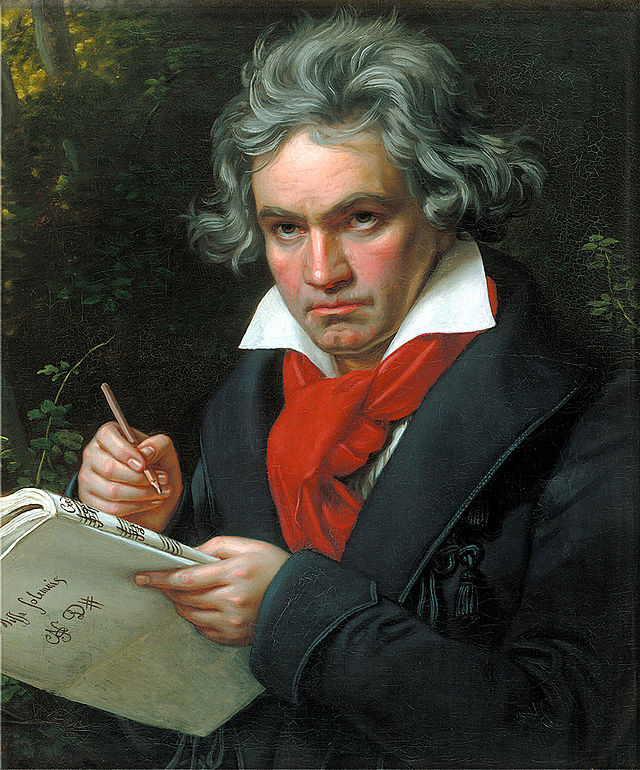
"Beethoven" - Joseph Karl Stieler

A portrait of Ludwig van Beethoven (1820)

Joseph Karl Stieler

_____________

you might say a triumvirate of piano concertos dominate
our Western musical culture, a veritable trinity of pianistic
masterworks that tower over, and have ruled, our musical
consciousness throughout the modern epoch, the
Rachmaninoff 3 has been one of them, but the 5th of
Beethove
n is surely the granddaddy, the “Guppa” as a
favourite grandchild I know would say, the Olympian
Zeus, the Christian God the Father, of them all, in majesty
and authority, others quake in its overwhelming aura, it is
the sun to all the other stars

Glenn Gould is the standard still by which it should be
played, none yet, to my mind, has surpassed him

Karel Ancerl conducts the Toronto Symphony Orchestra,
a competent orchestration, overshadowed inevitably by
this prodigy, who nevertheless doesn’t ever flaunt his
finger play but remains faithful throughout to the
dictates, the tonal balances, of the music, it is 1972

I had mentioned “variations in volume, tempo, tonality,
the play of harmonization and discords” in Rachmaninoff
,
note the strict adherence to tempo here, even the fastest
runs of notes are grounded in beat, more solid, less elusive
than the iridescent Rachmaninoffian allusions to Debussy,
you could set a metronome to the appropriate tempo of
each individual movement in Beethoven, it would remain
constant, apart from a few restrained ritardandos near
the end of some musical elaborations, until its very final
apotheosis, beat was ever an anchor for the fulgurating
Beethoven, an article of faith from which he strayed only
with great circumspection

note the language is not emotional, passionate and ardent,
but philosophical, metaphysical, Beethoven is confronting
cosmological considerations, existential realities, not the
more emotional concerns that confound us every day, it’s
God he’s talking to, eternity, not the incarnate tendrils
of the moment, not the poignant stuff even of soon
through Schubert a Chopin, Beethoven was at the start
of that Romantic Movement, indeed its very first
proponent, but not quite ready to wear his heart itself
on his sleeve, but a more spiritual, probing reason, whose
ardent metaphysical ratiocinations would set all the others
on fire, setting the stage for all the other stars

later, if you haven’t guessed what it’ll be already, I’ll
supply you with the third concerto, the Holy Ghost, of
the trinity, the Apollo, god of music and the sun, among
our concert greats

Richard

Rachmaninoff: Piano Concerto no 3, in D minor, opus 30

fully 150 years after Mozart the concerto was still a thriving
musical form though it had undergone some modifications,
you’ll hear a more passionate account in Rachmaninoff than
the more lyrical, less emotionally overt compositions of
Mozart, the variations in volume, tempo, tonality, the play
of harmonization and discords, all incidentally within a single
movement, show the passage of time, of Beethoven, of Chopin,
of Debussy between Mozart and the more Romantic, Impressionistic
Rachmaninoff, note the sweeping ritardandos, where the beat is
drawn out, stretched for pathos, a Chopinesque insinuation into
music not found in earlier stuff, one imagines torrid expressions
of fervent sentiment, note the evanescent flurry of notes passing
by like the fleeting glitter of stars, the ephemerality of an
incorporeal idea that Debussy originated and brought to music,
and of course note the irrepressibility, the authority, the masculinity
of a volcanic Beethoven underpinning the lot, you can hear them all

the Vladimir Horowitz Piano Concerto no 3 of Rachmaninoff at
Carnegie Hall, January 8, 1978, with Eugene Ormandy leading the
New York Philharmonic Orchestra is, after Van Cliburn’s historic
1950s account, May 19, 1958, again at Carnegie Hall but under Kiril
Kondrashin this time, and the now defunct Symphony of the Air,
don’t ask, the one I then grew up with, it was riveting even without
the pictures

with pictures here he is again a few months later at Avery Fisher
Hall in New York, September 24, 1978, under Zubin Mehta with
again the New York Philharmonic, so good you’ll even forgive
Mehta his usual sentimental excesses

incidentally Horowitz was 74 at this concert, he is astounding

Vladimir Horowitz, colossus and legend, 1903 -1989

enjoy, be transported, be transfixed, you have been warned

Richard