Richibi’s Weblog

Just another WordPress.com weblog

Tag: Romanticism

“Death and the Maiden” – Franz Schubert‏

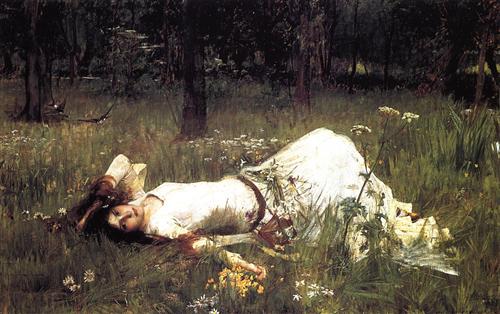
 "Ophelia" -  John William Waterhouse

Ophelia (1889)

John William Waterhouse

___________

though death is not an especially
appealing topic for many, it was
nevertheless of fundamental
consideration during the
Romantic Period

Goethe, the German poet, had
already created a sensation
with his The Sorrows of Young
Werther
, a young man,
disappointed in love, takes his
own life, a potent seed for the
new era, secularism was
overtaking theocracy, the
autocracy of the Christian
Church was giving way to the
prevalence of human rights,
a private opinion, well disputed,
was holding sway against the
rigidities of religious orthodoxies,
science and reason had been
chipping away at the very idea
of God

but with human rights there was
the question of personal
responsibility, if not an imposed
authority, then each man, woman
was in charge of his, her own

the fundamental question,
therefore, was Shakespeare’s
To be or not to be, or, for that
matter, Burt Bacharach’s and
Hal David’s What’s it all about

this is not me, this is Albert Camus
talking, who formalized the situation
in the 1940s

“There is but one truly serious
philosophical problem, and that
is suicide. Judging whether life
is or is not worth living amounts
to answering the fundamental
question of philosophy. All the
rest — whether or not the world
has three dimensions, whether
the mind has nine or twelve
categories — comes afterwards.”

after Werther, Madame Bovary followed,
Anna Karenina, suicide had become an
option, the penalty was no longer
opprobrium, castigation, as it had been
under unforgiving religious constraints

death itself, fatefully rather than
personally determined, was, of course,
no less considered when the era of
heartfelt declarations dominated,
Mendelssohn had written his
Quartet no 6 in F minor, opus 80
for his deceased sister, Beethoven
and Chopin, each his Funeral March,
either, incidentally, still iconic, and
perhaps the most poignant work
of all in this manner, Schubert’s
Death and the Maiden, a precursor
of his own much too premature
demise

this is music as if your life depended
on it

watch, listen

Richard

psst:

the Alban Berg Quartet, a group who
set the standard for several significant
string quartets in the ’80s, do no less
with this one

you’re not likely to see a better
performance of it ever, nor, for that
matter, of anything, pace even Glenn
Gould, a statement I think nearly
against my religion

you be the judge
septet / schleptet – Beethoven / Schikele‏

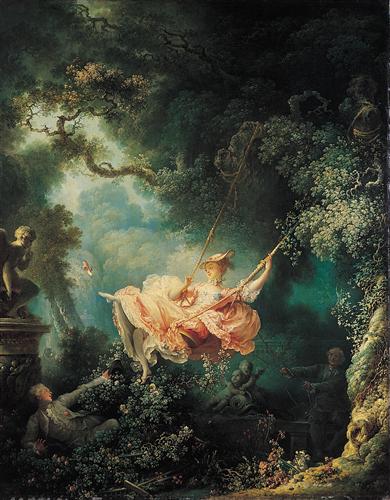
"The Swing" ("Les hasards heureux de l'escarpolette") -  Jean Honoré Fragonard

The Swing (“Les hasards heureux de l’escarpolette“) 1767

Jean Honoré Fragonard

_____

though I’ve spent the last forty years
exploring Beethoven, I still haven’t
heard, much less seen performed
all of his music, unexpected gems
pop up still to prick up even my
weathered ears

but a septet this time, who’d ‘a’
thunk it

the opus 20, not unexpectedly, sounds
like Mozart, formal, musically inventive,
but not prompted by Beethoven’s later
transcendental passions, it was 1800,
he was still showing off his Classical
shoes, spinning andante cantabiles
out of minuets, for no less than Maria
Theresa in this instance, the Empress,
its august dedicatee, not yet having
profoundly outgrown them, the tiara,
the shoes, though you’ll find
expressions of his surpassing majesty
already throughout this masterpiece

six movements, for instance, uppity,
impudent, bold, an impertinence
towards imperial time and its
exigencies, unless it’s worth it, of
course, even in the case of my own
more relaxed schedule

but a precursor to his seven-part
C# minor String Quartet, opus 131,
for its breadth, for its ambition, for
the prefiguring of a monument, a
cultural institution, for its
proclamation of the advent of a
veritable sonic Parthenon

you’ll note a peculiarity, he uses
in the Septet‘s third movement
the same air that served him well
in his 20th piano sonata, opus 49,
no 2
, second movement – why not,
it’s his – an earlier composition
despite the later opus number

don’t ask

opus 49, no 2 has only two
movements, incidentally, like his
earlier opus 5, no 1, or his later
incandescent no 111, to shed light
on the chronology of his musical
evolution, his eventual historical
apotheosis

find the movement with variations
in the Septet, your body will tell
you, much like it does slow tempi
from fast ones, you merely listen
with your senses, not just your
ears, your unconsciousness, while,
distractedly, you’re, say, washing
dishes, you’ll say, hey, I’ve just
heard this before, but different,
only this minute

hence the term variation

compare this Schleptet in Eb major,
from Peter Schikele for fun, from
the year 2000, a spoof on Beethoven’s
Septet
in the identical key the
better to roast him, but in five
movements this one, in the Classical
style, but where the mood is neither
Classical, nor even Romantic, it’s
ironic, satirical, wry, even cynical,
note the slapstick tempo markings

I. Molto Larghissimo – Allegro Boffo
II. Menuetto con brio ma senza Trio
III. Adagio Saccharino
IV. Yehudi Menuetto
V. Presto Hey Nonny Nonnio

the voice, for better or worse, of our
time

Richard

Chopin piano concerto no 1, opus 11‏


this is for Brain, who, according
to its response to my last blog,
is about to explore Chopin, a
transformational experience,
which I’d like to encourage
and heartily abet

____________

watch, be transported

Evgeny Kissin at the piano, Zubin
Mehta conducts, Chopin’s First
Piano Concerto
, an indisputable
masterpiece, just click

before this performance I will remain,
uncharacteristically, mum, let Chopin
speak for himself, from the early
Nineteenth Century, letting us know
what they were up to then

it appears to have been utterly
astonishing

Richard

psst: thanks Brain

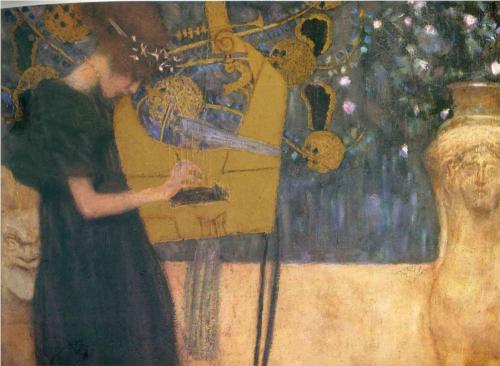
“Music”

Gustav Klimt's "Music"

Music (1895)

Gustav Klimt

______

not for lack of imagination, lately, but for,
rather, lack of confidence, the complaint
of any would-be poet, the complaint of
any proponent of oneself, one’s persona,
one’s own, however benign, however even
benevolent, ideas, I retreated into myself,
surrendering to forthright inspiration for
any, elusive enough, courage

inspiration, through its usual unsuspected
channels, and as ever categorically, gave
me, reliably, Music“, Klimt‘s ineluctable
masterpiece, not even for its iconic image,
but for its transcendental comment on
art’s interpretive counterpart, music

world’s meld

a “magical mystical miracle” happens, as
Katharine Hepburn, in her utterly
enchanting movie, Summertime“,
would have it, irrepressible as ever

I had to share

Richard

psst: note the juxtaposition of contrasting
colours, patterns, impressions, note
the Baroque presentation of Classical
imperatives, touched with Romantic
sensibilities, kicking off, not
incidentally, Modernism

Beethoven – piano sonata no 7, in D major, opus 10, no 3‏

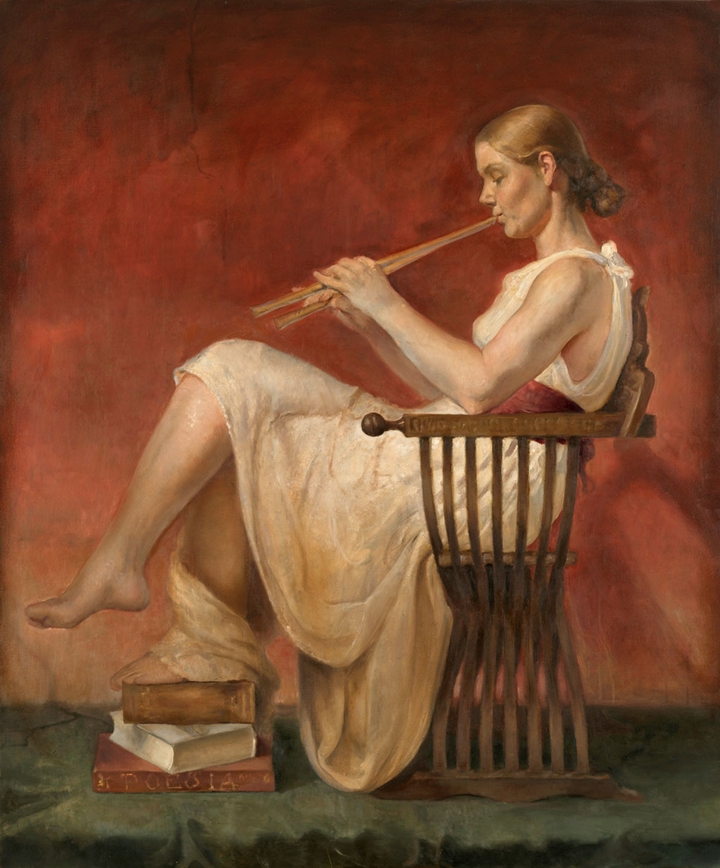
Euterpe - Apollo and the Muses - Helene Knoop 1979 - Norwegian Figurative painter - Tutt'Art@

EuterpeApollo and the Muses (2008 – 9)

Helene Knoop

________

if the piano sonata no 4 of Beethoven,
in E flat, opus 7, was academic, an
exercise, a display of technical
dexterity and some, admittedly,
even mighty, compositional verve,
it lacked, in my estimation, a centre,
a convincing motivating factor, a muse,
though ever ardent, ever entertaining,
it is ultimately arid, I think, trite, I’m
not, one is not, keen on returning to it

but in the piano sonata no 7, in D major,
opus 10, no 3
, Beethoven hits, I submit,
his stride, this sonata is enchanting

note the similarities of structure
between the two, the order of the
movements with identical, essentially,
tempo patterns, notably the middle
slow movement, in the first a largo,
con gran expressione,
slow with
great expression, in the latter, a
largo e mesta, slow with sadness,
where Beethoven plumbs, evidently,
the limits of pacing, the time lapse
between two notes, the capacity for
silence of this new instrument, the
pianoforte, of which he’ll look into
also, and even vigorously, its
capacity for volume, the crashing
introduction to his celebrated 8th,
for instance, to establish the
instrument’s new perimeters

you’ll note you can listen to the later
largo, the opus 10, no 3, forever, you
can get lost in its aural world, I can’t
think of anywhere else right now a
more profound largo

the other movements are dazzling
in their thrilling prestidigitation, all
organically sound, and, crucially,
motivationally centred, I think, this
is indeed music, magisterial music,
Beethoven’s not just kidding
anymore, he’s hitched onto his
proper inspirational deity, his own
private Euterpe, music’s muse, and
we’re in for something, from here
on, of a ride

note the cool riff closing off the last
movement, Beethoven in the guise
of Gene Kelly stepping in for a
breezy good-bye, prefiguring, of
course, XXth-Century music, and
the serendipitous extrapolations
of jazz

Richard

psst: incidentally, the headings, largo,
con gran expressione, largo e
mesta,
are entirely Romantic
musical notions, notations,
Classical composers would’ve
been too sedate, formal, courtly,
for such flagrant sentiment

XLl. I thank all who have loved me in their hearts – Elizabeth Barrett Browning‏

from Sonnets from the Portuguese

XLl. I thank all who have loved me in their hearts

I thank all who have loved me in their hearts,
With thanks and love from mine. Deep thanks to all
Who paused a little near the prison-wall
To hear my music in its louder parts
Ere they went onward, each one to the mart’s
Or temple’s occupation, beyond call.
But thou, who, in my voice’s sink and fall,
When the sob took it, thy divinest Art’s
Own instrument didst drop down at thy foot
To hearken what I said between my tears, –
Instruct me how to thank thee! Oh, to shoot
My soul’s full meaning into future years,
That they should lend it utterance, and salute
Love that endures, from Life that disappears!

Elizabeth Barrett Browning

______________________

addressing everything that came before
Elizabeth seems to be addressing also
everything that comes after, which is to
say eternity, infinity, her legacy

her hope is that she will be able to express
the thanks she owes to someone, among all
others who loved her indeed but could only
move on after listening to her, who didn’t

inadvertently she therein defines true love,
he, or indeed she, who would “thy divinest
Art’s / Own instrument”
– in this instance
Robert‘s poetry – “didst drop down at thy
foot / To hearken what I said between my
tears”
– who would suspend his work, and
pay attention to her sorrow, to even her
inanities, I here interpolate advisedly, her
achievements, her very joys

for fleeting love loves mostly itself in passing,
a love which easily overlooks, and dissipates

I believe Elizabeth in this poem has thrust
herself into significant poetic history, finally,
combining her account of her personal love
with a voice which for the first time in the
sonnets
addresses itself to, however
circuitously, some would say surreptitiously,
even circumspectly – for she’s speaking still
to him – to history, to “future years, / That they
should lend it utterance“,
a literary marriage,
she’s effected by this extrapolation, this
synecdoche – supplanting the part for the
whole – of the personal and the, at the very
least anthropologically, profound

topped off with a toast, “salute”, even to a
coveted, though perhaps only apocryphal,
I interject, ideal, “Love that endures, from
Life that disappears”

how, and by very definition, Romantic, is
that

Richard

Liszt – piano concerto no 2 in A major‏

since discovering Tamás Érdi, feral hands,
uncommonly hirsute, but uncovering the
soul of a poet, an angel in wolf’s clothing,
a satyr, without a flute but, at the piano,
I’ve been hooked, combined with Liszt he
is again irresistible, not to mention totally
transcendental

you’ll find Liszt quite a bit like Beethoven,
but more bombastic than philosophical,
style trumps substance, Liszt was a
show-off, a pianistic Paganini

stylistic flourishes abound in the hands
of a deft, however uninformed might he
or she be, technical wizard, it doesn’t
take an Einstein, in other words, to be
a Puccini

and Liszt is a Puccini, who delivers
likewise, and for the very ages

note the same intensity as Beethoven
in Liszt, much of the same musical
idiosyncrasies, but with more dramatic,
late Romantic, alterations of tempo, he’ll
milk a phrase before returning to a more
Classical, which is to say, less elastic
beat

his extemporisations are also less
ruminative, more serendipitously
motivated, like jazz, Liszt wants
primarily to dazzle, kick around,
not instruct

and he does, masterfully, just that

here’s Alfred Brendel doing an alternate,
wholly incandescent version
I couldn’t
at all leave out

here’s Julie Andrews giving her take on
the history of jazz

Richard

XXXlX. Because thou hast the power and own’st the grace – Elizabeth Barrett Browning‏

from Sonnets from the Portuguese

XXXlX. Because thou hast the power and own’st the grace

Because thou hast the power and own’st the grace
To look through and behind this mask of me
(Against which years have beat thus blanchingly
With their rains), and behold my soul’s true face,
The dim and weary witness of life’s race, –
Because thou hast the faith and love to see,
Through that same soul’s distracting lethargy,
The patient angel waiting for a place
In the new Heavens, – because nor sin nor woe,
Nor God’s infliction, nor death’s neighbourhood,
Nor all which others viewing, turn to go,
Nor all which makes me tired of all, self-viewed, –
Nothing repels thee, . . . dearest, teach me so
To pour out gratitude, as thou dost good!

Elizabeth Barrett Browning

_____________________________

after XXXVlll indeed iconic poems, wherein
Elizabeth speaks nearly exclusively about
herself, intimately and, as history would
show, epochally, breaking new, fertile,
Romantic in this instance, ground, she
turns her attention here to someone else,
to Robert, her paragon

Bette Midler would later say, now that’s
enough about me, let’s talk about you,
what do you think about me

having shed some of her insecurity,
Elizabeth seems equally more solid, less
fragmented, in her inordinate, indeed
disarming, ardour

you’ll note a return to rhyme, metre, cadence,
commas are in the right place, the reiteration
of certain words, like markers, beat rhythm
as well as emphasis, the ground of the
verses seems sounder, sound, all elements
which earlier would have determined the
very parameters of poetry, as though she
could now return to balance, order, lyricism,
even convention, when turned away from
strictly herself, a lesson I’m sure we could
all learn

Schubert, incidentally, could ‘ve easily set
this to music, as indeed someone else did
here only over a year ago, David MacIntyre,
and called it Love in Public“, an inspiration
which set me off on this very journey

to date this is my very favourite of Elizabeth‘s
poems

Richard

Schubert – Piano Sonata D959‏

to my utter surprise when I checked I’d never
but only once in the many months I haven’t
been able to shut up since I started spouting
my bristling endorsements, like a very rushing
river gushing with the overflowing bounty of
an inveterate spring, mentioned Schubert, an
incandescent voice from surely heaven

it was about his String Quartet in C major, the
D956, not surprisingly, it is utterly enchanting,
D for Otto Erich Deutsch still, incidentally

here’s an alternate version of it, an utterly
inspired one

but if I’ve reintroduced Schubert it’s specifically
this time to compare him with Beethoven, they’re
easily confounded, I even did it once myself, to
my crushing embarrassment, in erudite and
unflinching company, oof, I cringe to even
remember it

the D959, moments only after the 956 of course,
has all the idioms of a Beethoven, and exercises
them as expertly, the beat, however, is always
on, unlike Beethoven, whose beat is always off,
contrary, rebellious, against the prevailing
order

though this variance might seem slight, one
senses already in the younger and later
Schubert a return to form, elegance, and civility,
the First Empire had indeed taken hold during
the transformation of Napoleon from hero of
the Revolution to a different incarnation of
Emperor, Chopin as well would be beholden
to later similarly reinstated French courts

so seemingly trivial an alteration speaks
volumes when one attentively listens, one
must do this with one’s heart

such a return to aristocratic principles is not
uncommon, incidentally, we seem, indeed, to
thirst for dynasties, if you’ll note the return of
late, of the Bushes, the Clintons, and most
recently the Canadian Trudeaux

Putin is another, though arguably somewhat
less democratic, version of that principle

Beethoven is off the beat then, Schubert on, you
won’t find much else that’s different upon first
listening, you’ll note only that their music is very
much the same, rigorous beat, tonal, essentially,
harmonics, and the return eventually of the
melodies, Classical imperatives, but with the
distinction of the new Romantic,
transformational however, sensibilities

Schubert might’ve even outpaced Beethoven
had he survived, I think, but he didn’t, he died
much too young, at the most tender age of
only 31, younger even than the more
celebrated Mozart, famous for succumbing
prematurely at the still early age of 36

may they rest, may they all rest, Schubert,
Mozart, and the somewhat longer-lived
Beethoven, still early deceased at 56, in
eternal peace, for they have brought us
but wonders

Richard

psst: here’s a movie to go with the earlier
Schubert
, The Company of Strangers“,
the very best film Canada has ever had
to offer, bar none, a gaggle of old women
are stranded in the Laurentians after their
tour bus breaks down, Schubert would’ve
loved it

and been honoured

XXXl. Thou comest! all is said without a word – Elizabeth Barrett Browning‏

from Sonnets from the Portuguese

XXXl. Thou comest! all is said without a word

Thou comest! all is said without a word.
I sit beneath thy looks, as children do
In the noon-sun, with souls that tremble through
Their happy eyelids from an unaverred
Yet prodigal inward joy. Behold, I erred
In that last doubt! and yet I cannot rue
The sin most, but the occasion – that we two
Should for a moment stand unministered
By a mutual presence. Ah, keep near and close,
Thou dovelike help! and, when my fears would rise,
With thy broad heart serenely interpose:
Brood down with thy divine sufficiencies
These thoughts which tremble when bereft of those,
Like callow birds left desert to the skies.

Elizabeth Barrett Browning

______________________

it is a natural instinct nearly to read such
a poem in iambic pentameter, until you get
to the end of the verse, pause, and then do
the same thing with the next line, applying
a rhythm to each phrase, much like toneless
singing, after all, one surmises, it’s a poem,
words without the tune, it has a beat

but the beat in Elizabeth Barrett Browning‘s
poems, though staunch, is steeped in the
less evidently accented constructions of
prose, looser and less regimented, for
realism

like Beethoven, Elizabeth Barrett Browning
is breaking out of the Classical mode and
introducing the overflowing elements of
the Romantic personality, personal
expression dominating form the better
to reflect a new cultural reality

it’s interesting to note that Beethoven as
well found the key to representing that
new revolutionary spirit through the
manipulation of beat, both achieving
thereby the very pinnacle of consummate
artistry, icons of their, however great their
own personally chronologically distant,
age

but read the poem as though it were an
everyday sentence, the poetry will be clear,
beautiful, even wondrous, the rhythms not
immediately apparent though always
present and profoundly sure

both music and poetry would attempt
to sound like real life, to speak more
intimately and therefore truthfully,
while others will attempt to make
poetry out of mere prose, watch me,
we live in different times

about the poem, compare you are
the wind beneath my wings
“,
for a
not dissimilar sentiment, watch
Patti Labelle make powerhouse
poetry out of mere prose

Richard

psst: more about wings