Richibi’s Weblog
Just another WordPress.com weblog
Tag: Romanticism
April 23, 2024
a veritable Schubertiade, VI
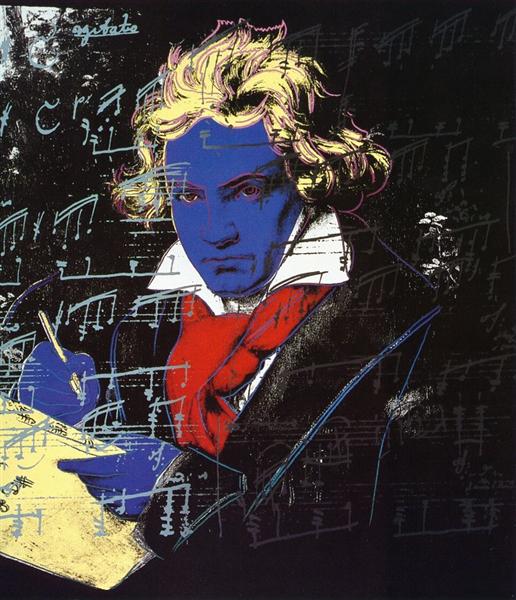
by this time, in his Piano Sonata in A minor,
D 845, Schubert has accumulated so much
Beethoven that his Beethoven is beginning
to shine through in his own compositions,
Beethoven was a forefather, still present,
it’s often difficult to tell one, indeed, from
the other, even here
Beethoven, see above, punched through
Classicism – Mozart, Haydn – its artificiality,
delivering emotion, instinctively, from the
very start, from which he nearly
single-handedly delivered to the world no
less than Romanticism, like delivering the
recalibration of time and space after
Einstein essentially, so profound a
cultural metaphysical reorganization
Schubert remains ever more courteous,
more beholden to the upper crust that
supports him, and that he ever wants to
court, you can hear it, listen, there is no
confrontation here, just, dare I say,
entertainment
Schubert was not a revolutionary
R ! chard
April 18, 2024
a veritable Schubertiade, V
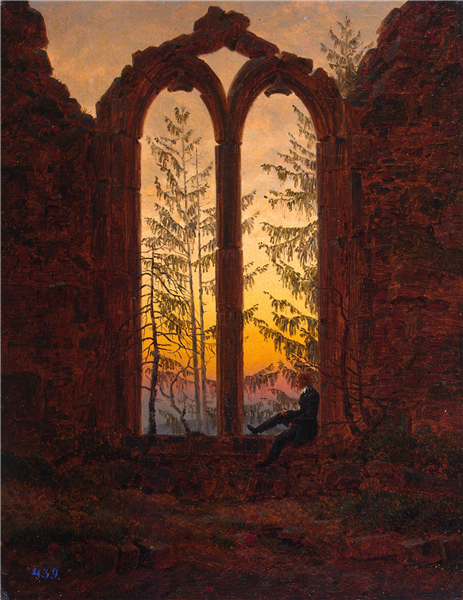
“The Dreamer“ (1820 – 1840)
Caspar David Friedrich
______________
from the start, in his Piano Sonata in C major, D 840,
Schubert is steeped in Mozart, the exhilaration, the
fantasy, not surprisingly, Mozart is Schubert’s
motherland, the courts, the salons, the chamber
music, in Schubert’s day, aristocrats still sponsored,
to a great degree, the arts
but soon the Romantic impulse takes hold, the
introduction of melancholy into the mix, rather
than sang froid, artifice, merely, Schubert has
imbibed, to supplement his manifest technical
agilities, the temper of the times, Schubert is
moving his cultural world forward, into
Romanticism, see above
there are only two movements in his D 840,
there are sketches of its third and fourth
movements, but Schubert had abandoned
them, the sonata, unfinished, was only
published after he died, profoundly worthy
still, if truncated
what do you think
April 16, 2024
a veritable Schubertiade, IV
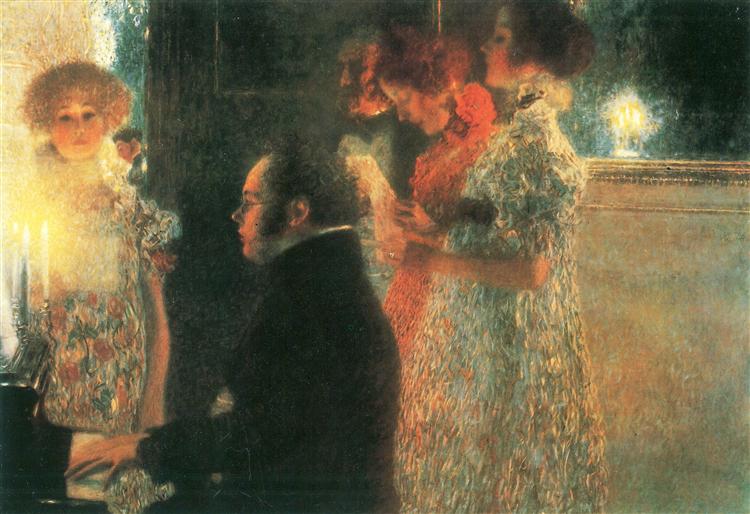
“Schubert at the Piano II“ (1899)
Gustav Klimt
______
for the second evening of Schubert sonatas
during my May Schubertiade, it wouldn’t be
surprising to hear again an early work, 1819,
Schubert would’ve been 22, the series is
undoubtedly and necessarily somewhat
chronological
his Piano Sonata in A major, D 664, is
blatantly anchored in the Classical idiom,
you can hear Mozart all over the place, not
all pejoratively, Mozart is effervescent, full
of exuberance and creativity, Schubert
diligently follows
but Romanticism equals intimacy, poignancy,
which Schubert touches upon in his andante,
the second movement, to a degree not yet
as markedly as, for instance, Chopin yet,
famous for his sweeping Romanticism, but
still convincing and promising
the third movement, the allegro, is right back
at Mozart, to delight the aristocracy, his
essential audience, see above
listen
R ! chard
November 20, 2023
November / Month of the Sonata – 20
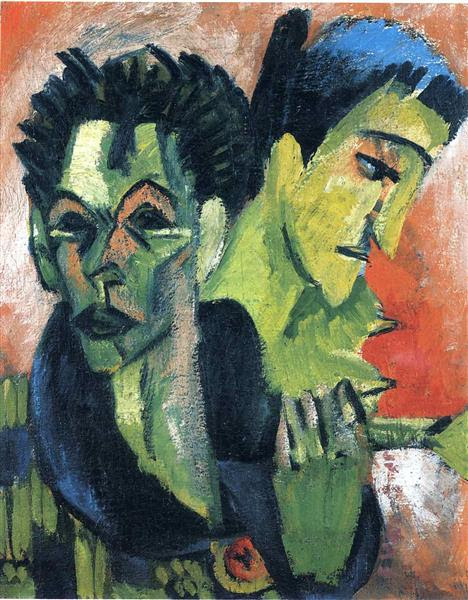
“Double Self-Portrait“
Ernst Ludwig Kirchner
________
Ravel’s Violin Sonata no 2, of 1927, is a
long way from the Romantics, though I
usually settle Ravel among the
Impressionists, this piece seems rather
to reflect the later Expressionists in art,
see above, for its virulence and eccentric
tonalities and performance techniques
in both the violin and the piano, the age
had given us the First World War, and
would soon lead to the Second
the three Classical imperatives of tonality,
tempo, and repetition are maintained still,
but their descendants are unruly, willful,
bold and impervious, there are no holds
barred here, they take no prisoners
listen
R ! chard
November 19, 2023
November / Month of the Sonata – 19

“Over the Town“ (1918)
Marc Chagall
________
Johannes Brahms is pretty well the last of
the great Romantics, 1833 – 1897, he wrote
his Piano Sonata no 3, in F minor, Opus 5,
when he was not quite twenty, with the
same bravura as Beethoven, let me point
out, his sonata has five movements, a sign,
as I’ve said before, of bristling confidence
as a form grows from its original, pristine,
shape, it can only grow by evolving,
becoming something, eventually, that it
wasn’t, by dint of breaking all the rules,
transgressing
style becomes the manner in which a
work is transformed from its integral
state into something more decorated,
more intricately designed, like adding
lace to a perfectly adequate collar, or
making a soufflé out of an egg
but who wouldn’t, won’t
a point is reached where style overcomes
substance then, and becomes the focus
of the entertainment, one watches the
bravura
to my mind, this, however wondrous,
sonata, hasn’t the emotional appeal
that I’d heard in the earlier Romantics,
that would keep me rapt to the end,
the draw for me is the prestidigitation,
the manual dexterity, which is like
watching someone fly through the
air with the greatest of ease, but be
not otherwise moved, see above
but that’s me, and that’s to my mind
incidentally, since this is Brahms’
last sonata, he only wrote three,
this is probably the last of the
great Romantic sonatas, after
which Impressionism
R ! chard
November 12, 2023
November / Month of the Sonata – 12
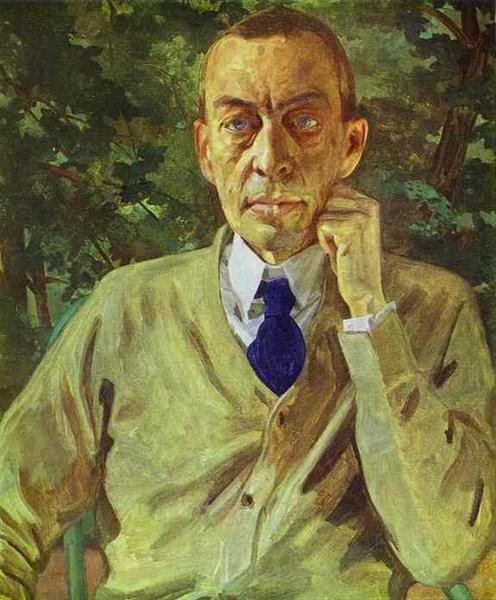
“Portrait of the Composer Sergei Rachmaninov“ (1925)
Konstantin Somov
__________
Rachmaninov, late Romantic, early
Impressionist, yanked, despite his
modern bent, Romanticism, solidly,
into the Twentieth Century, we
heard him in movies, and
consequently on TV, back then, on
long-play albums, 78s at the time,
that were flooding the market, first
movement on the one side, the next
two on the other, that’s how we used
to listen
later, we’d hear Sergeant Pepper’s
Lonely Heart’s Club Band doing the
same, in the late ’60s, before discs
Rachmaninov doesn’t sound like
Chopin, Beethoven, Schubert, but
you can hear their roots, their blood
running through his compositions
but here, in his Piano Sonata no. 2,
Opus 36, he elaborates, a sure sign
of Impressionism, intellectual rather
than emotional appeal, something
had become tiresome after half a
century of Romantic dramatization,
how many Anna Karenina‘s can you
take
the culture was returning to objective,
rather than emotional, Charles Dickens,
Victor Hugo, and the like, bleeding-heart,
considerations, and seeking out more
rational answers to our psychological
stresses, consequently Freud, music
had to keep up
later, I’ll tell you a story about how
music changes the world
meanwhile, here’s Rachmaninov’s
Piano Sonata no 2
enjoy
R ! chard
November 10, 2023
November / Month of the Sonata – 10
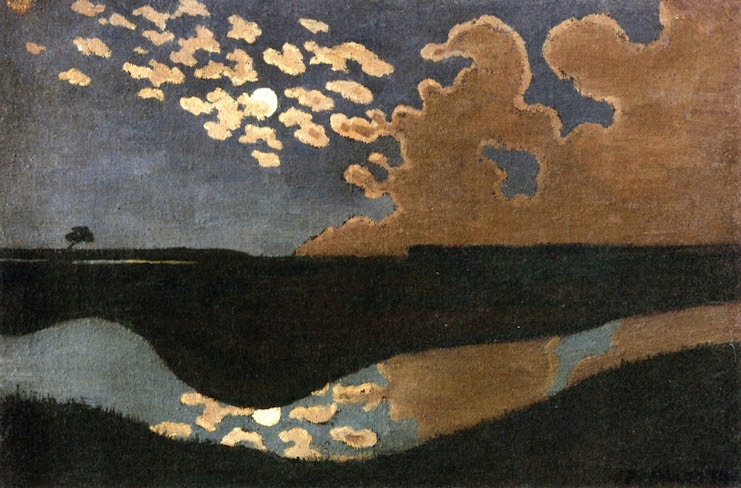
“Moonlight” or “Clair de lune” (c.1895)
Félix Vallotton
_______
at the end of the Nineteenth Century, a
a seismic shift occurred in our Western
culture’s sensitivity to art
much as visual representation during
the Renaissance and up until the late
Baroque Period had dominated, to
be replaced by music during the
Classical Age as the sensory
temperature of the times, visual
representation once again took over
as arbiter of Western sensibility
during Impressionism
you’ll remember the artists of the
Renaissance, but not many of the
composers, you’ll be able to name
the composers of the Classical Age
and the Romantic, but not many, if
any, of the painters, you’ll then
immediately toss off a list of artists
of the Impressionist Era, but not
many of its composers
this lasts till, I’d say, Andy Warhol,
when the visual arts still held sway,
but the present is, it seems, up for
grabs
here’s meanwhile, an Impressionist,
Claude Debussy – his Clair de lune,
an obvious Impressionist statement,
to be compared, incidentally, with
its Romantic counterpart, Beethoven’s
Moonlight Sonata – delivering his
Sonata for Violin of 1917
enjoy
R ! chard
November 7, 2023
November / Month of the Sonata – 7
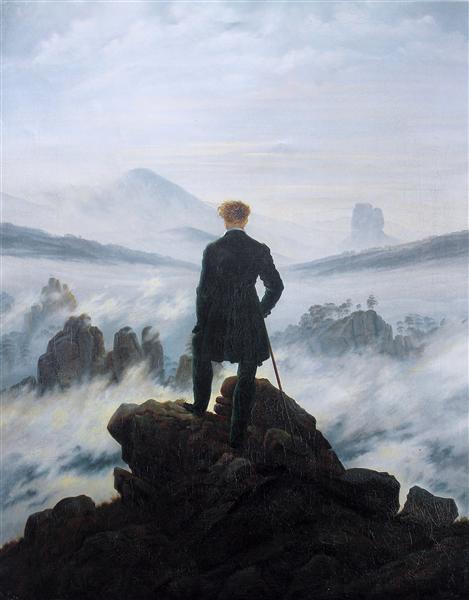
“The Wanderer Above the Sea of Fog” (1818)
Caspar David Friedrich
_____________
meanwhile, back at sonatas for one
instrument, it’s about time I brought
up Chopin, the one composer that
everyone associates before anyone
else with Romanticism, 1800, say,
till about 1880, he incorporates it,
not without reason, Chopin
personifies the Romantic Era, like
Mozart represents the Classical
others who count would be Elizabeth
Barrett Browning, her “Sonnets from
the Portuguese” – How do I love thee?
Let me count the ways – Victor Hugo’s
“Les Misérables”, and Charles Dickens
preaching, in all his works, humanity
Caspar David Friedrich‘s, also, iconic
Wanderer Above the Sea of Fog“,
see above
Chopin sounds a lot like Beethoven,
indeed, the first notes of his Second
Piano Sonata, in B-flat minor, Op. 35
are a reference to Beethoven’s
Sonata no 8, his “Pathétique“, listen,
you’ll hear the same peremptory,
commanding, chord, demanding
attention, the rest is consummate,
however, Chopin
in the last movement, you’ll specifically
hear what Chopin brought to the table,
texture, soundscape, rather than a
narrative line, music as background,
atmosphere, context
enjoy
R ! chard
June 1, 2023
how to listen to music if you don’t know your Beethoven from your Bach, XV – what’s a rhapsody
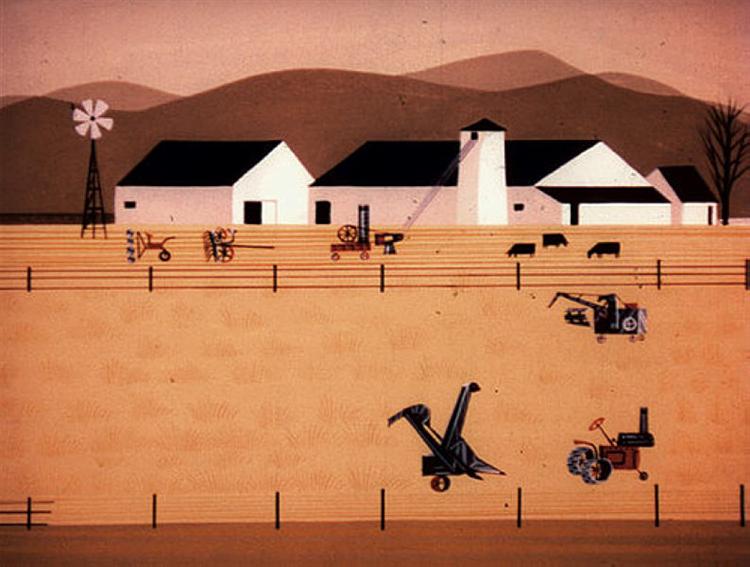
“Rhapsody of Steel“ (1959)
________
so what’s a rhapsody
 Richibi's Weblog