Richibi’s Weblog

Just another WordPress.com weblog

Tag: Romantic music

Polonaise in F# minor, opus 44 – Frédéric Chopin
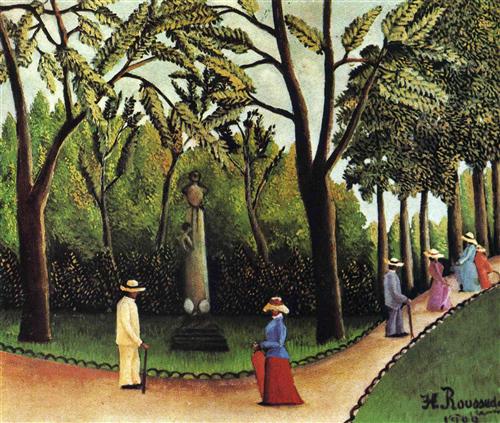
"The Monument to Chopin in the Luxembourg Gardens" - Henri Rousseau

The Monument to Chopin in the Luxembourg Gardens (1909)

Henri Rousseau

__________

a short while ago, my sister touted,
virtually of course, an up-and-coming
pianist, from around the corner,
relatively, from where she lives

Charles Richard-Hamelin was born in
Lanaudière, Quebec, whereas she’s
been living in Montreal forever, apart
from a stint in Timmins, Ontario, where
we were both born, at least a generation
before Shania Twain put it on the map

I left in a hurry, she followed
somewhat less urgently, a condition
of an intermediary marriage, which
engendered a miracle, my single,
but extraordinary, nephew, though
not much else

at his website, Charles Richard-Hamelin
delivers a few examples of his talent, I
listened to a couple of his Chopins, was
especially impressed by their structure,
the way Chopin imbues strict Classical
conditions with melting, Romantic,
sentiment, the very ideal, in my
estimation, of poetry

you’ll note in the Polonaise he plays
the adherence to tonality, never a
melodic line out of place, a strict
tempo, not ever indulgent, or maudlin,
despite evident emotional appeals,
and the recurrence of the original
theme after an however intoxicating
digression, giving subsistence to an
otherwise flight of aimless airs, out
of any context

music gives coherence, order, to an
otherwise inchoate, inscrutable world,
Classical music represents the original
rhythm of the heartbeat – time, regularity,
logic, the possibility of understanding,
the foundation of our present Western
culture, for better, of course, or for
worse, if not, indeed, of our very
species – defrayed of language’s inherent
ambiguities, its malleability, elasticity,
the indeed outright potential for
duplicity it accords the spoken, or
written, word

music is not just entertainment, it is
a philosophy, Apollo’s most transparent
muse

listen

Richard

Beethoven – piano sonata no 7 in D major, opus 10, no 3‏

when I first decided to explore Classical music
the field of course being so large it seemed
advisable to narrow my search, approach it 
methodically, I hadn’t had, nor since have had,
formal training, neither in the history nor in the
evaluation of music, apart from lessons in
flute and piano however extensive and
undistinguished those might’ve been it’s
been just me and my headphones ever and
my Walkman®, remember Walkman®s
 
but a world nevertheless opened up, and
bountifully, not this one, but the one I was
exploring
 
putting two things together and comparing
is at the root of any kind of knowledge, your
plant will grow profusely if you choose well
your soil, your soil is your avidity
 
I stirred in some Beethoven, already for me
question for being so highly revered by
succeeding generations, Nietzsche had
even made him out to be the template for
his superman, and I hadn’t got it yet
 
it seemed to me that a chronological
investigation, opus 1, then 2, then 3, would
be the manner in which to proceed for being
able to watch a genius grow, I couldn’t’ve 
chosen better  
 
the movement from Classical music to
Romantic rests on essentially his shoulders,
something I’d determined even then, and one
can watch, hear, its advance as Beethoven
moves from his early to middle to late periods,
it is like being there 
 
the early sonatas are trite to my mind, though
other informed people have disagreed, and
I am merely responding to my own aesthetic
impulses, but there you have it
 
they are academic, didactic, musically constricted,
to my mind, though they are full of evident personal
power, Beethoven bristles and burns through the
Classical chains that constrain him, through also
his own inexperience and emotional immaturity      
 
he kicks in splendidly however early enough with
a beautiful cello sonata, for cello and assumed
piano, his opus 5, no 1, in an apparently amateur
production here nevertheless utterly commendable,
but reaches total emancipation already by his
opus 10, after which he doesn’t  put a foot wrong,
but rather consistently inspirationally 
 
with the okay pieces you follow dutifully their
music, perhaps with even an encouraging smile,
with the great ones you’re simply irresistibly
carried away, drawn in, you alone can tell the
difference
 
as with art
 
as with poetry 
 
in the first case you wonder when it’ll finish,
in the second you don’t want it ever to end,
that’s your unmistakable cue, given that you’re
at least paying some attention
 
 
his opus 10, no 3 is irresistible at the hands
of Eric Zuber, precise and meticulous in his
rendering, but mostly electric, effervescent  
and exhilarating
 
and evidently also timeless
 
enjoy
 
 
Richard 
 
 
         cello sonata no 1, opus 5, no 1      
 
         sonata no 4, opus 7 
 
         sonata no 7, opus 10, no 3 
 
         for your ease of chronological comparison,
         if you follow the list and the opus numbers