Richibi’s Weblog

Just another WordPress.com weblog

Tag: Richard Wagner

“Metamorphoses” (The Giants’ War, VI) – Ovid

rainstorm-over-the-sea-1828.jpg!Large

     Rainstorm over the Sea (1824 – 1828) 


            John Constable


                  _______


              Already had he toss’d the flaming brand;
              And roll’d the thunder in his spacious hand;
              Preparing to discharge on seas and land: 


in order to begin to fulfil his decree

of ridding the world of humans, Jove

had toss’d [a] flaming brand, a piece

of wood that’s been set on fire, and

roll’d [ ] thunder, set it to rumble, in 

his spacious, or large, hand, ready 

to cast it upon the seas and land


              But stopt, for fear, thus violently driv’n,
              The sparks should catch his axle-tree of Heav’n. 


an axletree is a beam that connects 

two wheels of a carriage in order to 

make them turn simultaneously 


the suggestion here is that Heaven

is intimately connected to the earth,

both interwoven parts of a functioning, 

and interdependent, mechanism


              Remembring in the fates, a time when fire
              Shou’d to the battlements of Heaven aspire,
              And all his blazing worlds above shou’d burn;
              And all th’ inferior globe to cinders turn. 


Jove remembers that the fates had 

decreed a time when fire would reach 

the very battlements of Heaven, and 

shou’d burn it, as well as the earth 

below, turning everything there to 

cinders, ashes


a counterpart to this event exists in 

Norse mythology, incidentally, which 

Richard Wagner sets to extraordinary 

music, in the last segment, 

Götterdämmerung, or The Twilight

of the Gods, of his four-part opera, 

The Ring of the Nibelungwherein 

Valhalla, the great hall of the Gods, 

goes up in flames, bringing an end 

to the dominion of that hallowed, 

not to mention earlier incontestable, 

pantheon


do not, despite its lack of subtitles, 

not watch this Götterdämmerung, 

do not not be astonished, Richard 

Wagner is the Pink Floyd of the 

19th Century, let him take you to

the conflagration


I cried


              His dire artill’ry thus dismist, he bent
              His thoughts to some securer punishment:
              Concludes to pour a watry deluge down;
              And what he durst not burn, resolves to drown. 


having decided against fire, his dire

artill’ry, as an effective way of carrying

out his destructive mission, Jove opts 

for water instead, a wat’ry deluge 


need I even bring up here, Valhalla,

an obvious mythological equivalent,

but which of the two was the chicken,

one wonders, which was the egg, both 

trails leading deep into inscrutable,

and indecipherable, antiquity


              The northern breath, that freezes floods, he binds;
              With all the race of cloud-dispelling winds:
              The south he loos’d, who night and horror brings; 


to set in motion his scheme, Jove 

enlists, or binds, the winds, [t]he 

northern breath, and [t]he south 

wind, both of which apply their 

own destructive methods


              And foggs are shaken from his flaggy wings. 


flaggy, in layers, feathers upon 

feathers, Jove is represented

here, however unusually, with 

wings


              From his divided beard two streams he pours,
              His head, and rheumy eyes distill in show’rs,
              With rain his robe, and heavy mantle flow:
              And lazy mists are lowring on his brow; 


the water that will lay waste the 

earth flows from Jove’s very

physical attributes, his divided

beard, his rheumy eyes, his 

brow, et cetera


              Still as he swept along, with his clench’d fist
              He squeez’d the clouds, 


not only does Jove exude a flow 

of water through divine, though 

intrinsically viable coroporeal 

avenues, but he also actively 

promotes it, squeez[ing] the 

very clouds  


but


                                               th’ imprison’d clouds resist: 


however


              The skies, from pole to pole, with peals resound;
              And show’rs inlarg’d, come pouring on the ground. 


February, for instance, in Vancouver


              Then, clad in colours of a various dye,
              Junonian Iris breeds a new supply
              To feed the clouds: 


Iris was a messenger of the gods, 

though of Juno, Jove’s wife, in 

particular 


Iris, herself a goddess, of the 

rainbow, was usually depicted 

arrayed, appropriately, in vibrant 

colours


                                             impetuous rain descends;
              The bearded corn beneath the burden bends:
              Defrauded clowns deplore their perish’d grain;
              And the long labours of the year are vain.


clowns, people who’ve been made 

to look foolish, having been deprived,

[d]efrauded, of the fruit of their labour


R ! chard


Symphony no. 15 in a major, opus 141 – Dmitri Shostakovich

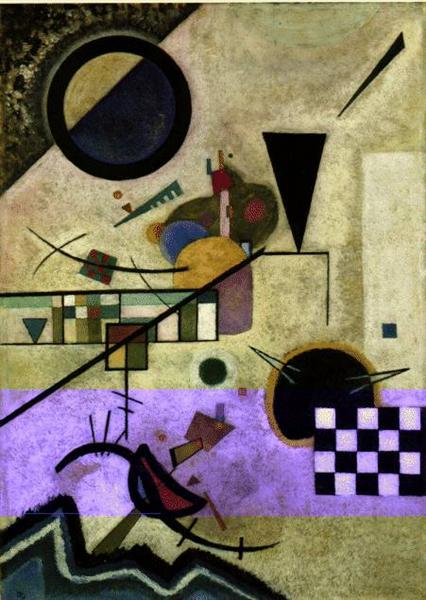
contrasting-sounds-1924.jpg!Large.jpg

        “Contrasting Sounds (1924) 

                Wassily Kandinsky

                       __________

Shostakovich can be difficult, he speaks a
foreign language, discordant notes leave 
you wondering where you’re going

the disruption of the three conditions of
Classical music, tonality, tempo and 
repetition, has given us here, the 
equivalent of derivatives of Latin, you 
don’t understand Italian if you speak 
only French, despite the profound
interconnections, roots

or think of trying even to read 
Shakespeare

also Shostakovich is more literal than 
other composers, his works are intimately
connected with the history and trials 
of his homeland, wrapped in folkloric 
references later cultures and generations 
would not be aware of

one can detect a composer of great 
consequence, like reading Homer in
translation, but never be able to feel 
their local, tribal, force

only a French Canadian could truly 
understand French Canadian, say,  
in hir very atoms, and that, everywhere


there are many references to personal
influences in Shostakovich’s 15th
Symphony, which he viewed, apparently,
as a kind of autobiography – the initial
revolutionary ardour, his profound 
disillusion, the day to day struggles to 
endure the murderous tribulations of his 
political masters, the moral ambiguities  
that would have gone with them, the  
existential crosses to bear – with   
appropriately pertinent quotations from   
other foundational composers

you’ll surely not miss Rossini’s Overture” 
to his opera, William Tell“, which Russians 
would’ve been entirely familiar with, though 
we’re more likely to have known it in North 
America as the theme from the TV show, 
The Lone Ranger

much as we got our Shostakovich, however 
circuitously, from Walt DisneyHanna-Barbera,
if you’ll remember them

and if you think you’ve heard in this symphony 
something you might’ve heard already
Shostakovich quotes himself from his earlier 
symphonies 

and if you’re good, you might even catch 
some WagnerMahler, some, however 
esoteric, Glinka, even

much of it, I’m afraid, now lost to us, in 
this new century, unless we’re total 
nerds

which is where, of course, I take a bow


the first movement was conceived as a 
toy box, it’s disorganized in the manner
of a child discovering

I heard, as well, a drunken degenerate
dancing, or trying to, a bull in a china 
shop 

but in the next movement, a dirge, an
“adagio – largo – adagio – largo”, if 
you’ve ever heard one, the drunken 
lout, in my mind, the next morning 
wakes up, broken but nevertheless
patient, and resilient

with one shoulder to the pillow, he 
props himself up, having understood 
that he must face the day, if only to do
his morning business, with a hand on 
the night table, he braces himself for 
the effort of heaving himself up from
the side of the bed, hears every bone
crack, every muscle stir as he lifts
himself up to a stable posture, tests 
his balance, then turns to move 
forward, crouched under the weight 
of all of his days, towards the basin 
and the mirror, where the picture 
could be better, but could also be 
worse

a blemish there takes up less than
a minute, a residual sense of duty, 
much more than of pride

his business done, the coffee, the 
grinder, the beans, the warmed cup
and then the hour or two to read 
poetry and find the inspiration, to 
undertake the day that’s been 
thrust upon him

he writes his Symphony no 15


the following movements are 
excessive to me, we drown in a sea 
of adagios and allegrettos, a not
unpleasant fate, but more confusing
than entertaining

though I’ll return

I think I might even get to really like
this symphonyit took me years to 
adjust to Kandinsky’s paintings


R ! chard

psst: thanks for listening

Dmitri Shostakovich – Symphony no. 2 in B major, opus 14 – “to October”

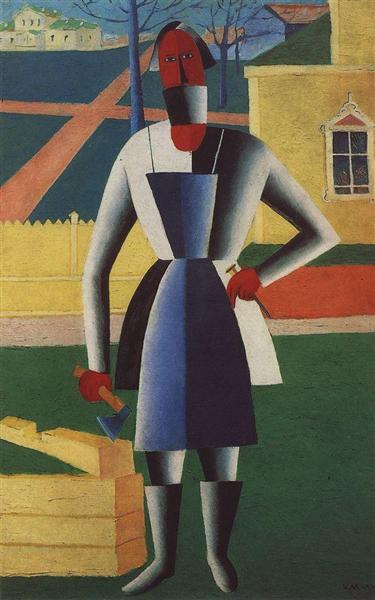
carpenter-1929.jpg!Large

    “Carpenter (1929) – note the industrialization 
                                       of the subject, however 
                                       Cubist, for better or for 
                                       worse

      Kazimir Malevich

             _________

Shostakovich’s Symphony no. 2 doesn’t 
sound like a symphony – one movement
only, a chorus – but was never meant to, 
it had been conceived as a piece in 
commemoration of the October 
Revolution, a significant event in the 
Communist cosmology, and
commissioned by that very polity, 
hence the name, to October

but later, the symphonic poem was 
included chronologically, thus no 2,  
in the Shostakovichian oeuvre – if 
you’ll excuse that pedantry, “oeuvre” 
being too sweet a word for me not to 
resist its austere territoriality – the 
Symphony no 2 in B major being 
first performed in 1927 

it starts a shade above inaudibly, which 
I often find irritating – unless, of course, 
it’s Wagner, or Richard Strauss, who 
knew what they were doing – suggesting 
something significant is rumbling, 
brewing on the musical horizon, after 
which we enter in a lively fashion upon 
a dance, full of folkloric flavour

but the harmonies are atonal, discordant, 
a society, however traditional, is in disorder, 
tonality, one of the stalwarts of Classicism, 
along with tempo and repetition, has been 
upended, distorted, the commune, the 
community, can, no longer unburdened, 
with only discordant harmonies, dance, 
though you can feel them trying

Ravel does something similar in his 
La valse“, where, with a distortion  
of tempo, the world is spinning  

with only a change in volume, intensity,
in Shostakovichthe music becomes 
martial, autocratic, peremptory, nearly 
even frightening

I found at this point that the subtlety of 
the move from the conviviality of dance  
to the aggression delivered by a more 
forceful music, marches and so forth,
lay in a mere alteration of the musical 
pulse, from seduction to, indeed, rape, 
in a simple change of rhythm – thus is it 
written in our very sensibilities 

a violin obbligato then intervenes, 
strangely, but welcome, in a piece of
brash, by this point, agitprop, but 
soon becomes as vociferous as 
earlier the crowd who wanted to, 
however awkwardly, dance

the obbligato, incidentally, instead of
an out and out solo part, as also with 
the piano in Shostakovich’s First 
Symphony, suggests the work of a
a community, a Soviet ideal, rather 
than that of an individual asserting 
hir particular predominance, if you  
listen between the lines

a particularly impressive chorus 
eventually delivers a tribute, a  
hagiographic poem, to Lenin, which 
Shostakovich abjured, but delivered 
nevertheless for the money, and for 
the influence, reportedly, however 
ignominiously, for he was young, 
not fully formed, innocent yet  

it resembles, of course, a cantata, a
religious chant – see Bach, one of the 
evident muses of Shostakovich – but 
which addresses here a political 
system, a cute trick of contemporary 
secular regimes, the several –isms 
within our post-religious ideological
societies 

watch for it

note the spoken, or rather, prosaically 
proclaimed last verses of the oration,
hortatory, don’t you think, or what

R ! chard

psst: incidentally, few composers are as 
          political, though few have been 
          under such ideological pressure,
          as Shostakovich

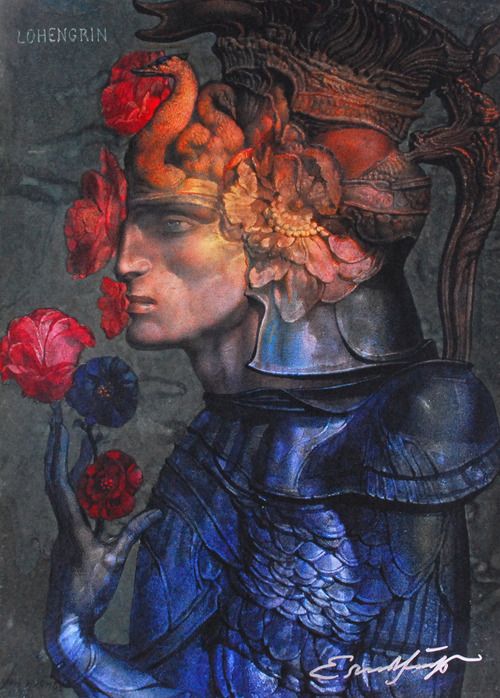
“Lohengrin”, Act 1‏

"Lohengrin" - Ernst Fuchs

Lohengrin (1977)

Ernst Fuchs

_______

this morning, requiring especially strong
medicine to get me through my day, I put
on Lohengrin, Wagner’s masterpiece,
directed by the thorny and unpredictable
Werner Herzog, from Bayreuth, the high
temple of that music, its very Acropolis,
1990, to lighten my load, to give me
mythic, maybe even Sisyphean,
perseverance, it didn’t disappoint

Elsa of Brabant is accused by Friedrich
of Telramund of having killed her brother,
who stood before both of them in line to
the throne, Ortrud, Friedrich’s wife, stands
silent throughout the first act looking
positively Machiavellian, Lady,
incontrovertibly, Macbeth

Elsa, summoned to plead her corner, tells
of a shining knight who appears to her in
her dreams, calls upon him to defend her
honour, he shows up at the very last
moment, on no less than a swan

he’ll only fight for her, he says, after she’s
offered him her anticipated kingdom, her
throne, her very honour and chastity, to
do with what he will, should he win for
her her cause, if she’ll pledge to never
ever ask about his origins, despite his
extraordinary entrance

she accedes, of course, though no other
knight, critically, has shown up to redeem
her

the shining knight conquers, of course,
but Ortrud, during the celebrations,
lurking ominously nearby, doesn’t give
the impression that anyone’s going to
live happily ever after, so long as
she can help it

it was the end of Act 1, I got up, made
a sandwich, I’d watch the following act
tomorrow, and so on, until the distant
end of that four-hour saga, to which
the epithet “Wagnerian”, for “epic”,
also, manifestly, belongs

wistfully I wondered about my own
knights in shining armour, who might
be my own guardian angels, entering
on fabled, maybe, even, swans,
concluded one of them had just been
Wagner, who’d turned, from heavy to
at the very least wistful, my day
around

wishing you Wagners

Richard