Just another WordPress.com weblog
Tag: “Rhapsody on a Theme of Paganini” – Rachmaninov’
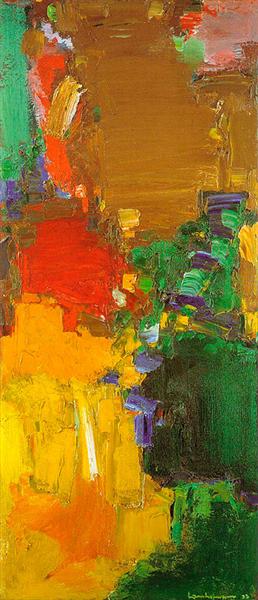
“Rhapsody“ (1958)
________
before putting variations aside, if only
for the moment, let me explain why
this piece, an essential component
in the history of the form in our
Western Classical musical culture,
is not called variations
let me get into it
a set of variations, but even more
so, it’s a concerto, for piano and
orchestra
what’s a concerto, a concerto is a
sonata, a piece of music consisting
of more than one segment, movement,
but written for a full orchestra, and one
central soloist
Rachmaninov has therefore combined
two musical forms, variations and the
concerto, but eliminated the pauses
between the movements, thereby
blocking his path to calling his work
a concerto, which requires identifiable
separate movements
with variations, Rachmaninov asserts
the significance of repetition in our
Western Classical musical structure,
each variation returns us to its source,
making manifest repetition, tradition,
ritual, as primary, as essential to
community, to one-on-one trust
but each variation allows also for a
difference in tempo, another essential
element of the Classical architecture,
these two aspects are therefore in
something of a conflict
tonality, the third essential component
of Classical music, remains essentially
untouched, there are no discordant
episodes
this will happen, but only later
R ! chard
_________
if a sonata is a piece of music with more
than one section, by definition a rhapsody
is not a sonata, a rhapsody has only one
section, only one movement, all that is
required, therefore, essentially, of a
rhapsody, is that it be – a subjunctive
here, incidentally, the mood of aspiration,
high hopes, ideals – that it be, I reiterate,
rhapsodic
in the spirit of juxtaposition, here are two
rhapsodies, the first, George Gershwin’s
how are they different, you tell me
I’ll just point out that the one seems, to
my ears, steeped still in the Romantic
Period, the early 19th Century, despite
its publishing date, 1934, the other,
earlier, composition, 1924, sounds like
full blown, in comparison, 20th Century
America, the future
Old Europe, in other words, meets the
New World, however chronologically
counterintuitively
listen, you can hear all of it, both are,
either era, extraordinary, time is what
eventually tells
R ! chard

 Richibi's Weblog