Richibi’s Weblog

Just another WordPress.com weblog

Tag: rhapsody

how to listen to music if you don’t know your Beethoven from your Bach, XV – what’s a rhapsody

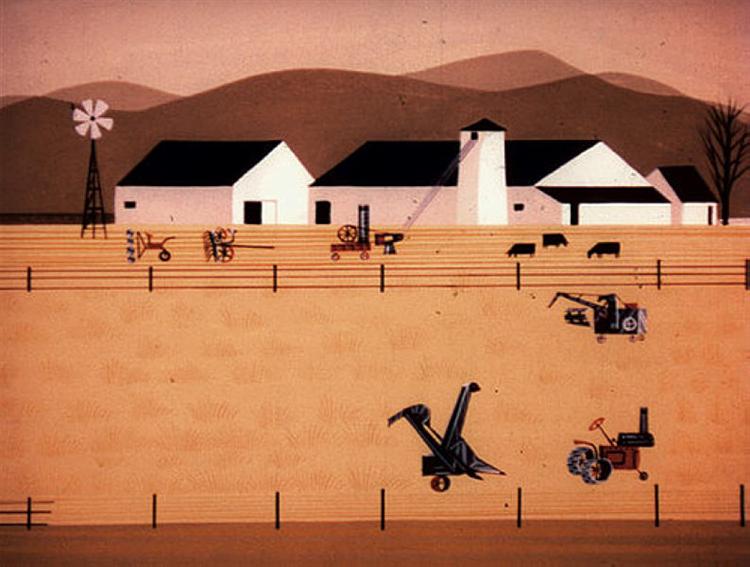
Rhapsody of Steel, 1959 - Eyvind Earle

        Rhapsody of Steel (1959)

                   Eyvind Earle

                       ________

so what’s a rhapsody

if you’ve been following at all my 

musical adventure, you’ll have 

heard by now several rhapsodies 


at first, I suggested that the rhapsody

was an evolution from the fantasia,

a piece of music in one movement

that allowed for any internal 

construction, but that, after the

Classical Period, became imbued  

with Romanticism, passion became 

a condition of music, mere technical

ability was no longer enough  


note that the audience was different,

rather than nobles who commissioned

artists to decorate their salons, the

burgeoning Middle Class was hungry 

for them to entertain, performers were

becoming the main attraction, not just

the background, see, for instance, 

Beethoven


but not only did rhapsodies spread 

from just one player to an entire

orchestra – see Brahms, then 

see Gershwin – but its essential 

structure, one movement, was 

challenged, see Ravel here, or 

Rachmaninov, whose rhapsodies 

are both composed of distinct 

movements, Rachmaninov even 

further refining his movements 

into variations, for years, I 

referred to his Rhapsody on a 

Theme of Paganini as his 

Variations


all this to say that a rhapsody is 

turning out to be not identified 

by its structure, its technical

parts, but rather by its intention,

a rhapsody is in the eye of its 

composer, like a nocturne, or 

a ballade


I’d thought that rhapsodies had 

been relegated to the Romantic 

Era, with the occasional later 

tribute


who, I wondered, could be

writing rhapsodies anymore


but here’s something, however

unexpectedly, you’ll be familiar

with, from 1975, Queen’s Bohemian

Rhapsodyin several movements 

– intro, ballad, opera, hard rock, 

outro – and including in all of them,

note, voice


all of which speaks of tradition

being a lot closer than one would 

think, ancestral, residual, but

defining, traces, like genes, 

however updated, however

posthumously interpreted,

pervade, infiltrate, pursue,

inexorably


rhapsodies are in our DNA, it

would appear, for better or for 

worse, ever


here’s to them


R ! chard


how to listen to music if you don’t know your Beethoven from your Bach, XII – on rhapsodies 

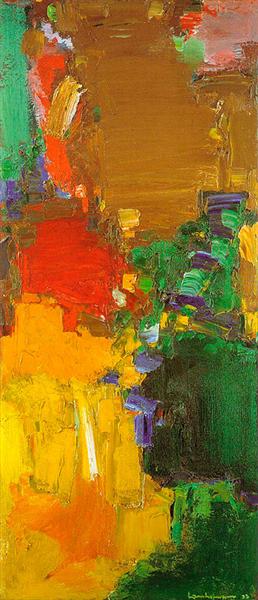
Rhapsody, 1958 - Hans Hofmann

   Rhapsody (1958) 

           Hans Hofman 

                       _____


if, in my last instalment, I compared iconic

funeral marches, let me do the same for

a couple of iconic rhapsodies, another 

musical form that came and went, that’s

come and gone, but not forgotten

what’s a rhapsody

as far as I can make out, it’s much the 

same as a fantasia, if you can remember 

what a fantasia is, a free form composition, 

but with a Romantic, which is to say a 

heartfelt, twist, more pathos, less 

technical wizardry


Gershwin wrote his Rhapsody in Blue 

in 1924, you can hear New York, Times 

Square, Broadway, from the first wail 

of the languid horn


Rachmaninov’s Rhapsody on a Theme

of Paganini, written in 1934, ten years 

later, gives you, however, Vienna, its 

Romantic Period, the traditions of, 

a century earlier, Beethoven, Schubert 


Rachmaninov is personal, introspective,

tragic, Gershwin is extroverted, social, 

fun


Rachmaninov looked back to his 

European, Old World, traditions, 

Gershwin augurs an entirely new 

voice 


listen, you can hear it 

enjoy


R ! chard   

Beethoven – 32 Variations In C Minor On An Original Theme, WoO 80‏

of all musical forms variations lend themselves 
best to intellectual speculation, which is to say, 
by way of concepts, words, objects of rational, 
cohesive, not nebulous, thought
it is immediately evident that a set of variations 
considers the many facets of a given subject, in 
music represented by a theme to be analyzed, 
dissected, explored and, in the best of cases, 
rendered transcendental   
this is of course also the case in any science  
it is more difficult to so investigate a waltz, a 
sarabande, a rhapsody, which speak a much 
less literal language usually, unless of course 
the verbal construct itself has been applied to 
the composition, The Carnival of the Animals“ 
or Pictures at an Exhibition“, for instance, but 
that’s putting the cart before the theoretical 
horse, unfair and unethical 
variations demand inherently cerebral 
participation, a considered evaluation, a 
nearly literal result, music finds its one-way 
ticket thereby to veritable language 
around the same time as he wrote the 
“Waldstein” Sonata, 1806, Beethoven wrote 
Theme, WoO 80, my very favourite of his 
sets of variations, courtesy here of the 
inimitable Glenn Gould 
note, in passing, the similarities between 
the two contemporary works
of the C minor Variations, however utterly
improbably, played by one Ivan Moravec
an earlier great, accompanied by immensely 
helpful annotated commentary the sum of 
which is hugely more telling than its mere 
point form parts, sharpening in the process, 
inconspicuously but highly effectively, one’s 
aesthetic pencil, pulse 
what could be more fun than that 
variations, incidentally, are a most democratic 
form, where every iteration is the equal of the 
other, given always, however, that fixed and 
intractable initial model 
an interesting interpolation, incidentally, that, 
philosophically, of course, speaking, asking,
as it does, does democracy require, rest on, 
a founding contextual blueprint, in light 
especially of the infinite number of those 
blueprints possible
is our democracy merely an arbitrary, and 
only contingent, shade, therefore, of that 
ideational abstract
you decide
psst: WoO is an acronym for Werke ohne 
          Opuszahl, or, in English, works
          without opus number, Beethoven 
          seems to have been completely 
          unconcerned with naming his 
          compositions, that he’d written the 
          music had been apparently already 
          quite enough