how to listen to music if you don’t know your Beethoven from your Bach, XV – what’s a rhapsody
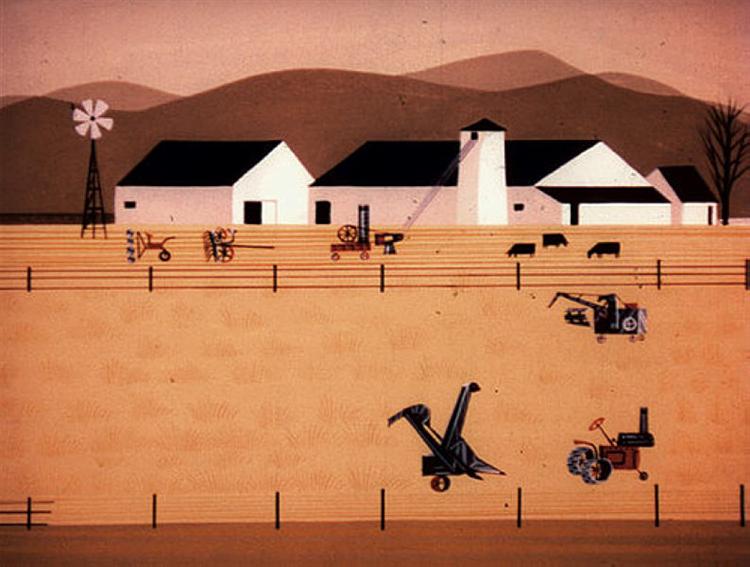
“Rhapsody of Steel“ (1959)
________
so what’s a rhapsody
“Rhapsody of Steel“ (1959)
________
so what’s a rhapsody
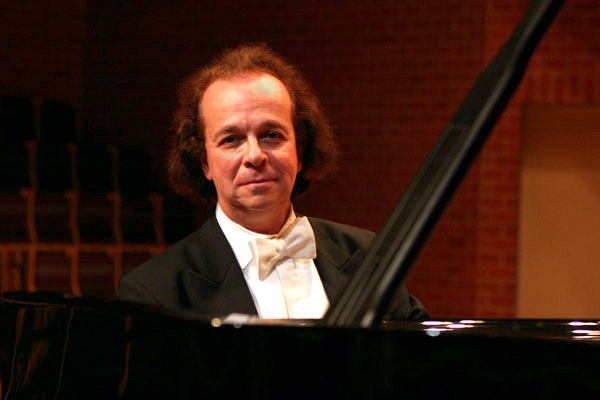
Cyprien Katsaris
________
if there’s only one concert you see
this week – I would’ve said this year
but I have way too many irresistible
concerts to promote – make it this
one, like none I’ve ever seen before,
Cyprien Katsaris, who wowed us in
my last encomium, delivers, not one,
but two concertos, when emotionally
I can usually deal with only one
but you can pause between the pieces,
like I did, to wipe a tear or two away
after the adagios, which remind me,
always, of my beloved, John
but that’s another story
Katsaris starts with an improvisation,
which he elucidates as an art form
much more expertly than I would,
then delivers a stunning rendition of
his mastery of that gift
though I couldn’t identify the first part
of it, the melting melody in the last
section of his homage to, essentially,
the Romantic Period, rushed back
memories for me of a piece I could
never forget, the music from Fellini’s
heartbreaking masterpiece “La Strada“
– listen, listen – right out of Romantic
Period idioms, its very story even, like
Dickens’ “Oliver Twist“, his Little Nell
from the “The Old Curiosity Shop“,
staples of my adolescence, married
to a nearly mythic lyrical invention
let me add that improvisations have
been an integral part of concertos for
a very long time, the cadenzas, an
interpolation by the performing artist,
hir riff, a strutting of hir stuff, late
in the, usually final, movement, a
consequence, incidentally, of the
more forward, individualistic,
18th-Century progression towards
individual rights, some left to the
performing artist, but many
prescribed by the composer himself,
where, here, I must, gender sensitive
myself, unceremoniously interject to
explain my deference to the
designation above, “himself“, to male
merely composers, who were then the
only ones, however culturally ignobly,
to nevertheless shape our quite, I
think, extraordinary musical trajectory,
for better, of course, or for worse
in this instance, I suspect Katsaris
wrote his own cadenzas for the
Mozart, notice his arm at the end of
the first movement fly up in an
especial transport, and in the last
movement, watch his very
exuberance mark the spot, but I
couldn’t put it past Mozart to have
written something so historically
visionary
Bach, incidentally, wasn’t doing
cadenzas, so don’t look for them
the two concertos that follow the
improvisation, Bach’s, my favourite
of his – you’ll understand why when
you hear it – then Mozart’s 21st –
everyone’s favourite – are both
played transcendentally
consider the difference in period,
the earlier Baroque, with Bach’s
notes skipping along inexorably,
the pace required by the
harpsichord, which didn’t have
hold pedals to allow notes to
resonate, the music moves along
therefore nearly minimalistic tracks,
a pace, and musical motif, that don’t
stop, they keep on chugging, until
they reach their destination, their,
as it were, station, or even their
stasis
Mozart’s music is as effervescent,
but conforms to a different cadence,
where a theme is presented, then a
musical, and contrasting, second,
with recapitulation, sometimes
merely partial, which is to say that
the call and response dynamic of
the dance, or for that matter, by
extension, modern ballads, is
being established, codified, and
elucidated
an era has intervened
then as an encore, Katsaris delivers,
not a cream puff, but Liszt, of all
people, we’re used to performers
giving us trifles at this point, but not
Katsaris
then to top it all off, he plays the Chopin
you thought you’d never ever hear again,
but here immaculate and utterly
inspirational
the orchestra alone performs after the
intermission, works by Ravel and Bizet,
surprisingly similar, I thought, the two
composers, in their musical idiom, the
use of the winds as metaphors, for
instance, for originality, eccentricity,
unmitigated poetry within the context
of what is not unnatural
neither is either composer adverse to
atonality, they work in textures, instead
of melodies, all of which is very
Impressionistic, see of course Monet
and others for historical reference
did I say I want to be Cyprien Katsaris
when I grow up, well there, it’s said,
he’s lovely
R ! chard
for my sister
a competition program that pits
youngsters against each other,
but on a variety of instruments,
with some operatic voice, has
riveted us to our sets on Friday
evenings, seven o’clock local
time throughout Canada
out of the province of Quebec,
however, and therefore in
French
“Virtuose“ lives up to its name
with extraordinary performances
from mere children, and some
adolescents, you can catch all of
the past episodes, and performers,
on their website
last week a young man delighted
us with a movement from a bassoon
sonata, an unlikely instrument, of
Saint-Saëns, his opus 168
my sister expressed surprise,
un basson, she marvelled
quickly I sought out, of course, the
full composition, it’s otherwise for
me like reading one chapter only
out of a book
it’s a short piece, no longer the
grand statements of the earlier
Romantic Period, but a series of
pastiches, fleeting impressions,
impromptu ruminations rather
than extended dissertations,
something like what I’m doing
here with these texts
you’ll recognize also a similar
approach in other composers of
the period, Debussy especially,
but too Satie, Ravel, Poulenc to
name only a few, the speed of
the new century precluded
extended musical peregrinations,
you’ll remark on the dearth of
symphonies, concertos,
composed during this epoch
the composition is in G major, my
cleaning lady had come over, was
already busy in an adjoining room
at the time, I was nearing the
end of the first movement, the
allegro moderato, a wistful
evocation of spring, I thought,
an innocent, fragile blossom
unfurling its delicate petals
with unaffected grace and
unconscious poetry
the final note sounded, the
bassoonist removed his lips from
the tube, but the note kept on
playing, coming, as I soon
understood, not from the video I
was watching, but from the other
room, Jo had turned on the
vacuum cleaner
o my god/dess, I uttered, hurried
over to where she was, subdued
my enthusiasm in order not to
unduly rattle her, as I brimmed
with my scintillating insight
your vacuum cleaner vacuums in
G, I gushed when she turned to
acknowledge me, it continued the
last note, I explained, of the first
movement of my sonata, Saint-
Saëns’ – say that three times with
a lisp, I interjected – until you
turned your vacuum cleaner off,
which is also, I pointed out, a
wind instrument
her delight was modest compared
to mine, however ever nevertheless
congenial, and quickly she returned
to her duties
I went back tickled pink to my
monitor and the following
movement, the sprightly and equally
enchanting allegro scherzando
Richard

“The Blue Boy (Portrait of Jonathan Buttall)“ (1770)
____________
if you’ve missed me lately, it’s because I’ve been
in Tel Aviv for the past week, virtually of course,
taking in the 14th Arthur Rubinstein International
Piano Master Competition, and they’re not kidding,
every challenger to date has been at the very least
astonishingly dextrous, sparkling even, though
some have been hampered by their own dire
program, with the unfortunate added condition
that, for all, they must integrate one of two
commissioned works that, to my mind, are
completely uninspired
other performers have been astounding, lots
of Beethoven of course, Chopin, Liszt, the
technically utterly daunting
among the moderns Ravel takes centre stage
as an option, with too many, to my mind, of his
tedious pieces,“Gaspard de la nuit”, yawn,
“La [, yawn again] valse”
but Bartok pops up, and Prokofiev, a great set
of variations by Szymanowski, unexpectedly,
and, at one point, a completely irresistible
Ligeti, more of which later
Nikolay Khozyainov starts with the only Ravel
I’ve been able to sit through without getting
impatient, “Gaspard de la nuit” to my mind
should stay there, “La valse” should
immediately stop, but Khozyainov‘s “Pavane
pour une infante défunte”, or “Procession for
a Deceased Princess” was everything you
would want in a dirge, solemn, transcendental,
transfixing
he follows up with a Liszt to knock your socks
off, “Feux follets”, “Fireflies”, fleet as the night
air, as mesmerizing
the final Rachmaninov sonata reminds us of
how wonderful Rachmaninov really was
Richard
 Richibi's Weblog