philosophers at play
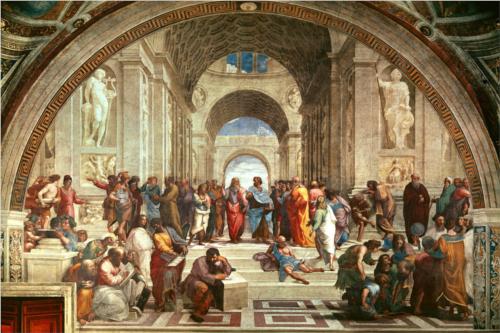
“The School of Athens“ (1510-11)
_________
the Philosophers’ World Cup – Germany vs. Greece,
enjoy the live action
the Philosophers’ World Cup – Germany vs. France,
read the debate
existentially yours
Richard
“The School of Athens“ (1510-11)
_________
the Philosophers’ World Cup – Germany vs. Greece,
enjoy the live action
the Philosophers’ World Cup – Germany vs. France,
read the debate
existentially yours
Richard
the only thing that rang in my ears ever
about Ghent until contemplating the van
Eyck Altarpiece was Robert Browning‘s
poem about it, “How They Brought the
Good News from Ghent to Aix“, the
idea, like in his “Pheidippides“, of
dying valiantly for a cause had mightily
impressed me
that cause is incidental, of course,
dependent on the beliefs and situation
of that particular stalwart person
it might make you unforgettable, that
unfettered and irevocable devotion, as
it did for me, for instance, the heroes
of these two poems, such an exalted
mission is an ambition for lots of folks,
very much for a young boy, especially,
such as I was when I read these
Rose Valland rose indeed to the occasion
when it came to saving priceless art before
the onslaught of ruthless Naziism, wherein
the very van Eyck Altarpiece, and also even
Raphael‘s incandescent “Sistine Madonna“,
to my utter horror, from another, and opposite,
corner of Europe, Dresden, could’ve been
forever lost
but the “good news” was in kind returned
to Ghent, eventually, in this fascinating
documentary, “Hitler’s Museum: The Secret
History of Art Theft During World War II”,
part 1, part 2, just click, from its hiding place
in Altaussee, a mountain fortress in Austria
“The Adoration of the Lamb” now resides in
its rightful Ghent, even more, after so fraught
a trek, a wonder
also returned to Dresden, incidentally, the
“Sistine Madonna“, that city’s own defining
artwork
it is to be noted that a task force had been
set up by no less than the Americans to
save the purloined art of Europe in that
however fraught time
this hasn’t been at all the case in their
recent military forays, what do you gain,
I ask, if you lose your ideals, what exactly
do you conquer
Richard
psst: Browning‘s “news”, if you’re wondering,
was of the “Pacification of Ghent“, 1576
____________
As I said at the very beginning, you are “sensitive”, and I was right, because you rightly perceived that I was becoming impatient. My apologies. Patience is not my forte. 🙂 However, you have not “touched a nerve”, as this is by no means an emotional discussion from my pov. I have no intention to “vehemently reject” your position (after all it is yours not mine), but only to share my perspective, including what I perceive to be irrational arguments.
Here are the two statements you made;
” I, and the “demented” Nietzsche, incidentally, equally fervently mistrust, even deem fundamentally impossible”,
“I do not profess to “know what Nietzsche believes or “fervently mistrust[s]‘”.
Is that not a self-contradiction?
You say that you’re making an interpretation. But, what is knowledge but an interpretation? A translation from the concrete and the objective to the abstract and subjective, just as we translate a work of literature from one language to another? By interpreting Nietzsche to yourself, you gain a rational understanding of him, and by interpreting him to others, you share that understanding.
I think an important distinction should be made between a) the belief in the existence of Absolute Truth” and b) the belief of one’s monopoly of the Absolute Truth. You seem to be passionately rejecting b), which is quite understandable. But Platonism is not b) but a). It does not claim monopoly of the Absolute Truth, but instead, Plato and Socrates both exhort their listeners to pursue Beauty, Goodness and Truth, to pursue virtue, to be the lover of wisdom, which is the literal meaning of “philosophy”,
According to Einstein, this pursuit of the Absolute Truth is also the guiding principle of the scientists. Without this passionate pursuit of the truth, we would never discover that the earth is not flat. Now think about this: Can you still insist that it is uncertain whether or not the earth is flat, that it is impossible to have a rational understanding of the shape of the earth?
You argue that uncertainty makes people less likely to kill. But most people who kill are not driven by belief in the Absolute, but by their lust for pleasure, wealth and power. Some may kill in the name of Truth as a disguise for their ulterior motives, but it would be unfair and irrational to blame the Truth for their acts.
I’ll refrain from discussing the Catholic Church, partly because to me this discussion is about Platonism, and Christianity is not Platonism (though they share many similar aspects), and partly because I’m not associated with the Catholic Church and frankly don’t know enough about it to say anything useful

“View of Dresden from the Right Bank of the Elbe with Augustus Bridge”
(1748)
_________________________________
these earlier “back tracks“, of which the following is one example, are pieces I consider still to be worth your while
_______________________

Sistine Madonna, c.1512-1514
Raphael
(1483-1520)
_______________________
in my search for what is beautiful, in my unending, my unyielding quest for the sublime, I’ve come upon many things that ‘ve been awesome, before the Venus de Milo I trembled, stood silent, reverent before her incandescent aura, in consternation before her shimmering grace, marvelled that time alone, I supposed, and magnificence could so irradiate, create actual energy
in Dresden the Sistine Madonna did the same, the only other work ever to so palpably illuminate
during the late Beethoven string quartets I cried, especially the fourteenth, but who wouldn’t, they are masterpieces
on first looking into Homer I confirmed indeed the promise of Keats, nearly subscribed to the gods of Olympus, would’ve converted to their convincing myths, but Proust finally remains my true religion, the reflection of all I believe, the poet aspiring to be a philosopher, the philosopher aspiring to be a poet, where Truth and Beauty inextricably intermix, interweave and inspire
for a while I had my doubts, art, music, literature seemed seductive enough, even important, but not urgent, not necessary, there would be life without art, I rued, but hadn’t been able to pursue it further
then in a revelation someone somewhere said, without art there would be no civilization, and I regained forthwith my faith
earnestly I’ve returned to its service
yours in art richibi
_______________________________

 Richibi's Weblog