Richibi’s Weblog

Just another WordPress.com weblog

Tag: Rachmaninoff

the essential Romantic violin concertos
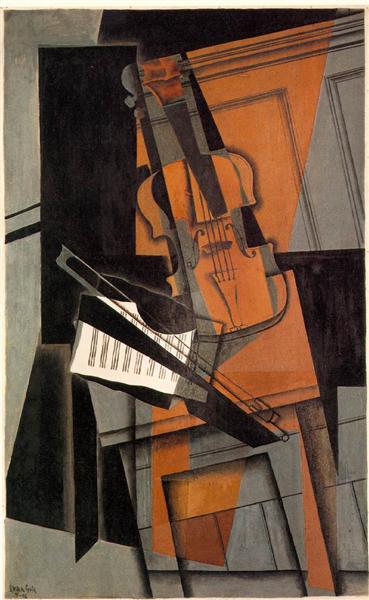
the-violin-1916.jpg!Large

   “The Violin (1916) 

        Juan Gris

            _____

if I was able to bring up a list of 
ten top Romantic piano concertos  
throughout the 19th Century earlier
can number of violin concertos 
only three essential ones, with,
however, two other significant 
such compositions, which remain, 
for one reason or another, 
peripheral, secondary  

more about which later

but the exalted three are situated
conveniently, the first, at the very 
beginning of the Romantic Era, 
Beethoven’s magisterial, even 
extraordinary, Opus 61 in D major
1806, and close doubly with the
two others, Tchaikovsky’s
resplendent workwords cannot 
do it justice, and Brahms’ no less
transcendental one, at its very end, 
1878, none are negligible, it’d be 
like missing the Eiffel Tower while 
in Paris, skipping the pyramids 
along the Nilethey are part of our 
cultural consciousness, it would 
be an utter shame to pass them 
by, they are our glory, our 
magnificent heritage

it should be noted that the 
concerto, be it for violin, piano, 
cello, what have you, a soloist 
in concert with an array of 
instruments, is the perfect allegory 
for the Romantic Era, an individual 
in contention with a community, 
under the influence of a conductor, 
a mayor, a mentor, a polity, the
individuality afforded by the 
proclamation of human rights in 
the aftermath of the French 
Revolution, and its social 
consequences, musically 
manifested

the match might be fraught, 
should be, though with 
compromise, considerate 
accommodation, fruitful, 
hopefully even transcendental, 
if not at least entertaining, 
cooperation, music seems to 
infer eventual concord, 
congress, harmony, a way out 
of, even dire, distress, or at 
least point the way toward it

concertos die out, incidentally, in 
the 20th Century, you don’t hear 
of very many, if any at all, after 
Rachmaninoff, they are gone,
much like later, in the 1950s, the 
waltz, forever, with the wind

may they rest in peace


R ! chard

Gounod’s “Ave Maria”, etc.


Gounod’s Ave Maria sung by John Paul ll, 

for pedigree you can’t get much better than

that, nearly as impressive as Rachmaninoff

playing his own Rachmaninoff, listen


Richard


“Rhapsody on a Theme of Paganini”/”Variations on a theme of Paganini”‏

a friend wrote me, after my most recent instalment
about musical variations
, a few very probing
comments

I delight in sharing them

__________________

Richard,

An interesting counterpoint to your comment about variations being an “intellectual” form of composition. This is
only in the best of cases — the cases that have survived to this day.

In the period in which I centred my dissertation studies — the 1820s and 1830s in Paris — the bane of reviewers’
existence was the steady stream of variations for flute, for piano, for oboe, for every conceivable instrument from
every possible performer who wanted to make his mark as a “composer” as well as an instrumentalist. It was,
shall we say, a form of composition “light,” something that minor talents could write if they weren’t capable of
writing a longer form, such as a sonata.

And yet we have impressive sets of variations in the canon today, from composers such as Bach (the Goldbergs),
Haydn (his delicious piano set in F minor), Mozart (Ah vous dirai-je, maman), Beethoven (the epic C minor
variations that you rightly point to), Schumann (Symphonic Etudes), Schubert (last movement of the Trout Quintet),
Brahms (the Haydn & Paganini sets), Liszt (his Totentanz for piano & orchestra), Tschikovsky (Variations on a
Rococco Theme for cello & orchestra), Rachmaninoff (Rhapsody on a Theme of Paganini), Dohnanyi (Variations
on a Nursery Rhyme), and Lutoslawski (Paganini Variations for 2 Pianos).

As you can see, the most fertile source of variations has been Paganini’s 24 Caprices, to which Marc Hamelin has
added his own contirbution:

The form has come a long way …

DONALD

___________________

I will gratefully accept implicit acknowledgment,
in his having confirmed me in my assertion, that
variations “in the best of cases” burn bright, are
“rendered transcendental”, timeless, much as my
friend states, “This is only in the best of cases”, he
says, dotting his contention with a peremptory
“only”, and I’m just fine with that, especially in
the light of so many, as he lists, “only{s}”

thanks, Donald

meanwhile the addition of a most recent set
of variations, this one on a theme of Paganini
.
played right here at the Chan Centre in
Vancouver by the pianist who composed it,
Marc-André Hamelin, delights and astounds

it is the same theme, incidentally, as in
the wondrous Rachmaninoff composition
for piano and orchestra, essentially a
piano concerto but without the pauses
that would indicate alternate movements,
a unified musical concept therefore is in
order for its name, Rachmaninoff called it
his Rhapsody on a Theme of Paganini“,
though he could’ve easily called it his
Variations on a Theme of Paganini“,
for being just that, a set of variations

I even called them his Variations for
years before smartening up, though I
don’t remember the exact date

rhapsody is a much more Romantic term,
you’ll consider, and if Rachmaninoff was
anything at all it was ever Romantic, despite
being nearly a century late, the Rhapsody
was written in 1934, one of many similar
musical atavisms

his Variations follow the Classical fast,
slow, fast template, in passing, variations 1
to 10 are fast, 11 to 18 slow, positively
melting, in fact, unforgettable, the rest, 19
to 24, again fast, in the very manner of the
concerto, just to confuse you, to push
the limits musically of evidently ultimately
arbitrary notions of form, another
particularly philosophical investigation

Richard

psst: here’s the original theme of Paganini,
his 24th, and last, Caprice

a couple of violin concertos‏

a violin concerto is of course the same thing as a piano
concerto with a violin however where the piano would
be, performing histrionics before an orchestra for the
length of several movements, traditionally three, usually
fast, slow, fast, for reasons of presentation psychology,
a fast, arresting introduction, then a slow, languorous
beat to forcefully display an alternative musical sensibility,
then fast again for a big, splashy, electrifying finish, leaving
no question about outsized either compositional or
interpretive capabilities, or rather, about outright,
manifest, wizardries 
 
Beethoven and Tchaikowsky give us again the big ones,
Rachmaninoff, essentially a pianist, didn’t write for the
violin, composing to be able to play himself his own works, 
superbly in fact, even definitively, his performances of his
piano concertos are matchless 
 
Anne-Sophie Mutter, one of the brightest stars in
Herbert von Karajan‘s Deutsche Grammophon galaxy,
the company that he put on the international map in
the sixties to cast, magisterially, the richness of our
musical heritage upon that unsuspecting decade, and  
beyond, still commands rapt attention internationally 
though her mentor died in 1989, leaving the world
with less charisma, I might add, less glamour and
authority, less power and panache, in his musical
wake, though other concert luminaries shine
illustriously still, only without now the power of his
charged magnetism, his inspired musical sensibility
and the consummate ability to market his own and
his artistic community’s wares to an often otherwise
distracted audience
 
here he is a divinity overseeing the motion of the sun,
the moon, the stars in a universe of his own creation,
he is extraordinary, he is composed, supremely
confident, while his eyelids reveal the reaches of his
ecstasy 
 
Anne-Sophie Mutter is impeccable, evidently a star
pupil in her master’s stable 
 
 
Sarah Chang, a mere child, is no less dazzling in her
piece, an old spirit in the guise of a sprite, she polishes
off a fiendish Tchaikowsky, an electrifying work, with
the invaluable help of her own conductor, the eminent,
Charles Dutoit, you can see it in her trusting, ever
soulful intermittent gaze 
 
be assured you will be dazzled 
 
 
the Royal Concertgebouw Orchestra, which accompanies
her, is a symphony orchestra of the Netherlands, considered
one of the very best in the world  
 
 
Richard


Tchaikowsky piano concerto no 1 in B flat minor, opus 23‏

the piano concerto no 3 of Rachmaninoff was written in 1909,
a hundred years after Beethoven’s piano concerto no 5, the
“Emperor”
, 1811, to the attentive ear the intervening years
are present in the evolution of the music

the most evident structural alteration, sensed now rather
than consciously heard, though this change would’ve been
glaring during that period, is the often elastic rhythm, the
hesitation, the reserve, the recapitulation of forces before
a surging onslaught, before a turbulent apotheosis, as a
movement returns to its fundamental tempo

the beat ever essentially reigns

this will change

let me point out here that this rallentando wouldn’t’ve been
even conceivable before the invention of the piano, which
happened around the time of Mozart, the harpsichord before
that couldn’t do that, it was confined, you might say, to
only rallentandon’ts, the harpsichord didn’t provide the
possibility of resounding a note, neither of moderating of
course its volume, which the piano, by very definition, did,
“piano” means “soft”, “pianoforte” “soft loud”, the very
foundational elements of the instrument, the elaboration
of beat would thus perforce henceforward play a major role

between Rachmaninoff and Beethoven, these two pillars of
our musical Trinity, there is the mighty, the third supreme
immortal, Tchaikowsky, a Late Romantic, of all composers
perhaps to us the most familiar, his piano concerto no 1 in
B flat minor, opus 23, written in 1875, is the concerto most
associated with my generation, Van Cliburn was a rock star
then, after winning the Tchaikowsky Piano Competition in
Moscow, 1958, an achievement of the very highest order
for an American in that historical context

and his performance of it was spectacular

the most salient aspect of Tchaikowsky‘s music to my mind
is the charged dramatics, which is not surprising when you
consider that he wrote the music for “The Nutcracker”,
“Swan Lake”, musical story-telling, you’ll note he evokes
this dramatic tension by sustaining, withholding, then
unleashing the beat before a storm of prestidigitatori

Tchaikowsky tells grandiose stories, Rachmaninoff opens
an anguished heart, Beethoven speaks with God, they are
our foundational musical poets, our sonic oracles

the formidable Emil Gilels, 1916 – 1985, plays Tchaikowsky,
he is electric, he is epic, he is extraordinary

Alfred Wallenstein conducts

Richard

Rachmaninoff: Piano Concerto no 3, in D minor, opus 30

fully 150 years after Mozart the concerto was still a thriving
musical form though it had undergone some modifications,
you’ll hear a more passionate account in Rachmaninoff than
the more lyrical, less emotionally overt compositions of
Mozart, the variations in volume, tempo, tonality, the play
of harmonization and discords, all incidentally within a single
movement, show the passage of time, of Beethoven, of Chopin,
of Debussy between Mozart and the more Romantic, Impressionistic
Rachmaninoff, note the sweeping ritardandos, where the beat is
drawn out, stretched for pathos, a Chopinesque insinuation into
music not found in earlier stuff, one imagines torrid expressions
of fervent sentiment, note the evanescent flurry of notes passing
by like the fleeting glitter of stars, the ephemerality of an
incorporeal idea that Debussy originated and brought to music,
and of course note the irrepressibility, the authority, the masculinity
of a volcanic Beethoven underpinning the lot, you can hear them all

the Vladimir Horowitz Piano Concerto no 3 of Rachmaninoff at
Carnegie Hall, January 8, 1978, with Eugene Ormandy leading the
New York Philharmonic Orchestra is, after Van Cliburn’s historic
1950s account, May 19, 1958, again at Carnegie Hall but under Kiril
Kondrashin this time, and the now defunct Symphony of the Air,
don’t ask, the one I then grew up with, it was riveting even without
the pictures

with pictures here he is again a few months later at Avery Fisher
Hall in New York, September 24, 1978, under Zubin Mehta with
again the New York Philharmonic, so good you’ll even forgive
Mehta his usual sentimental excesses

incidentally Horowitz was 74 at this concert, he is astounding

Vladimir Horowitz, colossus and legend, 1903 -1989

enjoy, be transported, be transfixed, you have been warned

Richard