Richibi’s Weblog

Just another WordPress.com weblog

Tag: prose

songs of some birds‏


untitled-1939-1.jpg!BlogPablo Picasso - "Untitled" (1939)

Untitled (1939)

Pablo Picasso

_________

having wondered only recently about
bird song, whale song
, can these be
considered singing when they are
essentially language, we think, and
not codified, technically constricted,
I see pertinently appear a study
suggesting birds follow a pentatonic
scale, our own musical basis,
harmonics between birds and
humans are apparently identical

this suggests that harmonics in
nature are as fundamental as
mathematics, we have somehow,
humans, diverged from what we
think of as singing, left rhythm
and tonality from our conversation
to produce uninflected prose and
monotony, language at the level
of atonal, arhythmic expression,
for better or for worse, corruption,
or refinement, evolution

I wonder, again, if prose is not
bad poetry, or has poetry evolved
into prose

should we feel shame or ingenuity,
do birds have their own divergent
degrees of poetry, do some, most
maybe, veer also towards the less
exacting prose

do some birds not sing, in other
words, or only sometimes maybe,
when mating, for instance,
something like how we croon
when we’re dating, put on our
very best airs

Richard
XXXl. Thou comest! all is said without a word – Elizabeth Barrett Browning‏

from Sonnets from the Portuguese

XXXl. Thou comest! all is said without a word

Thou comest! all is said without a word.
I sit beneath thy looks, as children do
In the noon-sun, with souls that tremble through
Their happy eyelids from an unaverred
Yet prodigal inward joy. Behold, I erred
In that last doubt! and yet I cannot rue
The sin most, but the occasion – that we two
Should for a moment stand unministered
By a mutual presence. Ah, keep near and close,
Thou dovelike help! and, when my fears would rise,
With thy broad heart serenely interpose:
Brood down with thy divine sufficiencies
These thoughts which tremble when bereft of those,
Like callow birds left desert to the skies.

Elizabeth Barrett Browning

______________________

it is a natural instinct nearly to read such
a poem in iambic pentameter, until you get
to the end of the verse, pause, and then do
the same thing with the next line, applying
a rhythm to each phrase, much like toneless
singing, after all, one surmises, it’s a poem,
words without the tune, it has a beat

but the beat in Elizabeth Barrett Browning‘s
poems, though staunch, is steeped in the
less evidently accented constructions of
prose, looser and less regimented, for
realism

like Beethoven, Elizabeth Barrett Browning
is breaking out of the Classical mode and
introducing the overflowing elements of
the Romantic personality, personal
expression dominating form the better
to reflect a new cultural reality

it’s interesting to note that Beethoven as
well found the key to representing that
new revolutionary spirit through the
manipulation of beat, both achieving
thereby the very pinnacle of consummate
artistry, icons of their, however great their
own personally chronologically distant,
age

but read the poem as though it were an
everyday sentence, the poetry will be clear,
beautiful, even wondrous, the rhythms not
immediately apparent though always
present and profoundly sure

both music and poetry would attempt
to sound like real life, to speak more
intimately and therefore truthfully,
while others will attempt to make
poetry out of mere prose, watch me,
we live in different times

about the poem, compare you are
the wind beneath my wings
“,
for a
not dissimilar sentiment, watch
Patti Labelle make powerhouse
poetry out of mere prose

Richard

psst: more about wings

XXV. A heavy heart, Belovèd, have I borne – Elizabeth Barrett Browning‏

from Sonnets from the Portuguese

XXV. A heavy heart, Belovèd, have I borne

A heavy heart, Belovèd, have I borne
From year to year until I saw thy face,
And sorrow after sorrow took the place
Of all those natural joys as lightly worn
As the stringed pearls, each lifted in its turn
By a beating heart at dance-time. Hopes apace
Were changed to long despairs, till God’s own grace
Could scarcely lift above the world forlorn
My heavy heart. Then thou didst bid me bring
And let it drop adown thy calmly great
Deep being! Fast it sinketh, as a thing
Which its own nature doth precipitate,
While thine doth close above it, mediating
Betwixt the stars and the unaccomplished fate.

Elizabeth Barrett Browning

__________________

despite a rigorous rhyme scheme and a mostly
strict iambic pentameter here, which is to say
each verse is given five, or penta, metres, or
beats, where iambic means that the accent is
on the second syllable of each of those five
individual metres, ta-da, ta-da, ta-da times
five, should your Greek be understandably
amiss, Elizabeth still manages to skew the
pace of the piece again in this instance,
turning her poetry, as always, into a more
direct and purposeful prose

just try to follow the sentence metrically as
in a more traditional poem, or song, you’ll
block her headlong and unfettered propulsion

alteration of the beat is not much different
from what composers were doing then with
music, the early eighteen-hundreds, not much
different indeed at all, and which they did for
the very same particular reason, greater
authenticity, the truth part of the iconic
imperatives of beauty and truth

incidentally, where Elizabeth was trying to
invigorate poetry by giving it the apparent
immediacy of prose you might’ve noted
that in my own flurry of literary tidbits,
however ever so humble, I’ve been quite
consciously peppering prose rather with
the elements of poetry, for better or for
worse, but in my mind to reflect a less,
dare I say, prosaic, more inherently
enchanting, vision of the world

Richard

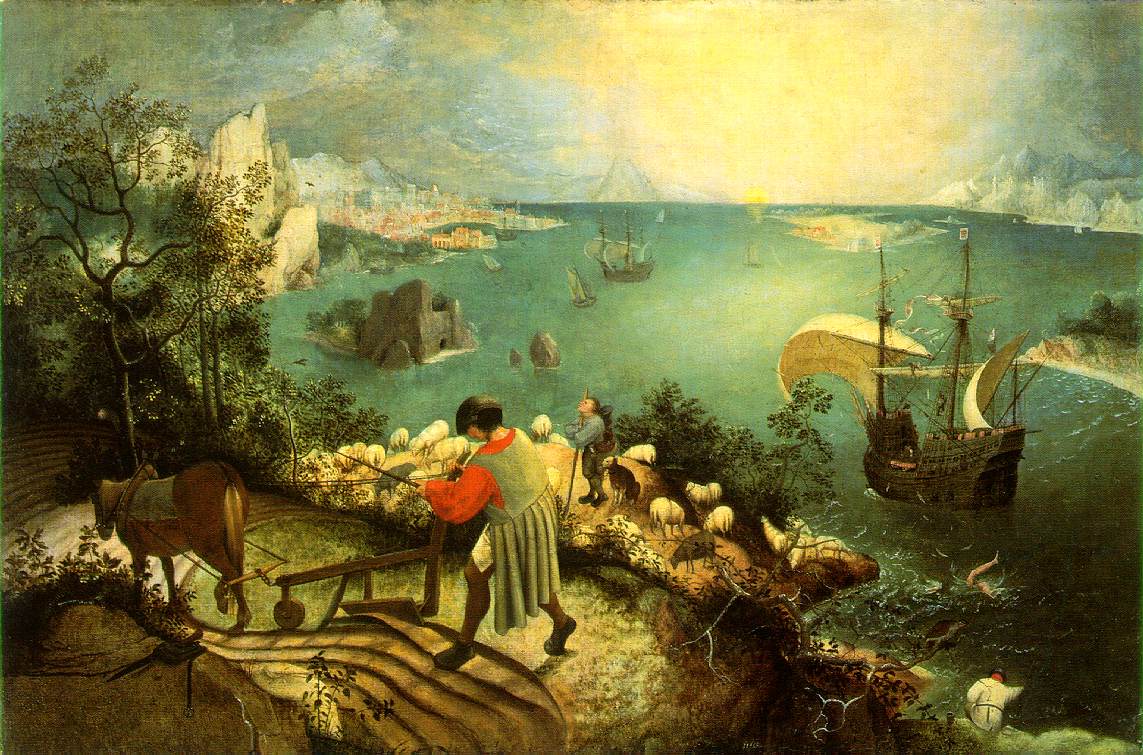
upon being asked to make a poem out of Pieter Bruegel the Elder’s “Landscape with the Fall of Icarus”

                  “Landscape with the Fall of Icarus”, c.1558

                            Pieter Bruegel, the Elder

                                    (1525-1569)

                                     __________

                                                                                                                                                                      upon being asked to make a poem out of Pieter Bruegel the Elder’s “Landscape with the Fall of Icarus”                                             

                                                                                                                                      what is a poem, the question came up around my earlier errant composition, was what I’d written a poem, though one could be made out between the, dare I say, ivied even cracks
 
something that rhymes, my mom answered when I asked, which mine of course didn’t
 
though mellifluous and rhythmic maybe, and peppered here and there with inventive and artful devices – metaphors, alliteration, onomatopeia, the like, the meat and potatoes, the very stuff, I think, of poems – I still didn’t rhyme, don’t rhyme, and run a sentence on mostly much too long for a proper pentameter
 
like, I guess, a prose poem 
 
or maybe even just prose
 

but about the Bruegel


at the back a radiant sun dominates the picture, sheds not only light but life on everything, the sky is thick with grays and blue and takes on actual dimension, whereas a more silken application of paint to the sun makes that orb evanescent, a portal into heaven, a source instead of a force, an opening instead of an engine
 
in the foreground a farmer ploughs his field, another tends his sheep, life is going on despite the splendour 
 
no one notices Icarus either, the flailing figure in the waves, bottom right, drowning, despite the might of the myth, the potency, the poignancy, of the poetry
 
but who notices even poetry 
 
 
across a stretch of water to the horizon and to at its edge the resplendent sun, ships with sails, indeed medieval galleons, sit in the placid harbour of a city in the blue crook of, upper left, a range of mountains, the City of God of Augustine maybe for its iridescent pastels, for its sunlit gold maybe the gilded Greek Atlantis  
                                                                                                                                                                       above the flailing Icarus a ship is setting joyful sail out towards the promise of the blazing sun, the way seems clear

there will be other, it appears, Icaruses

                                                                                                                                                               medieval caricaturization and perspective inextricably of course obtain throughout


    __________________________________________