Richibi’s Weblog
Just another WordPress.com weblog
Tag: preludes
August 15, 2023
if you’ve listened to the pieces I’ve
January 4, 2019
Chopin / Debussy – Preludes
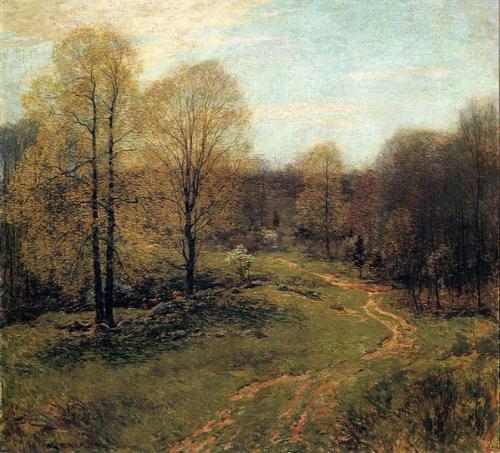
“Prelude“ (1909)
Willard Metcalf
_________
what’s a prelude
something that, by definition,
precedes something else
which it had been, formally,
before Chopin made it stand
alone as a musical form,
much, incidentally, as he
later did the scherzo
a prelude, earlier, had preceded
several other dance pieces in
suites, Bach’s Cello Suites, for
example, all start with a
prelude
or fronted fugues, in, again,
notably, Bach’s celebrated
Preludes and Fugues sets,
more of which, for their
complexity, later
here’s Chopin, however, with
his array of 24, his Opus 28,
one for each key, incidentally,
much in the manner of Bach’s
template pieces, the Preludes
and Fugues
here’s Debussy’s Book 1,
picking it up for the 20th
Century, with his tonally
indiscriminate 12
what’s the difference
you tell me
R ! chard
psst: apples and oranges, I think,
depends on my mood that
particular night, whether
meditative or melancholy
August 22, 2012
Chopin Preludes, opus 28
you will remember surely preludes from Bach’s
Well-Tempered Clavier, but as indeed an
introduction to, there, fugues
it might be interesting to note that preludes
were originally ditties instrumentalists cooked up,
spontaneously and improvisationally, to warm up
and tune their muse, one would expect the form
then to be short, sweet and pithy
and, by definition, unfinished, which is why Bach
added the fugue
have become by then of course entirely stylized,
less improvisational than formal
Chopin gives them their rightful eminence by simply
validating their claim to the role, they have no trouble
at all standing forthrightly in the footlights, and are
even still individually commanding, unblemished yet
by the infelicities of most lacerating time
like Bach they are still an intellectual exercise, there’s
a prelude for every key, all 24 of them, major and minor,
pianist, an Everest to climb, the work of an eminently
able nevertheless practitioner who didn’t shirk at
challenging himself heroically, though surely goaded
by the most magnanimous, if unrelenting, of gods
others of course took up the contest for the sake of
both the prestidigitational Olympics his compositions
represented as well as for itself the rapturous music,
works for the deftest of fingers as well as for the
newly stranded, existentially unfettered and
hungering, 19th-Century soul
you’ll note the humanity that didn’t appear in Mozart,
the intensely emotional appeal of both a more ardent
fury, a tip of the hat here to Beethoven, and a more
melting, sentimental tone
incidentally I find Chopin infinitely more aristocratic
than Mozart ever, despite being the epitome of the
more democratic Romanticism, whereas it had been
the more unruly Mozart who’d written for the
“Classical” courts
Haydn is temperamentally the only other so courtly
composer, appropriately and most efficiently fitting
in his case his own Classical mold, even up until now,
no others have had that distinct personal pedigree
allow me to submit my prose therefore to your most
good and gentle graces, as well as the illustrious
music contained therein
yours
Richard
psst: here‘s a version played in a castle, noteworthy
for its aristocratic allusions not to mention its
accomplished artistry
 Richibi's Weblog