Richibi’s Weblog

Just another WordPress.com weblog

Tag: “Poetics” – Aristotle

on “Aristotle” – Billy Collins

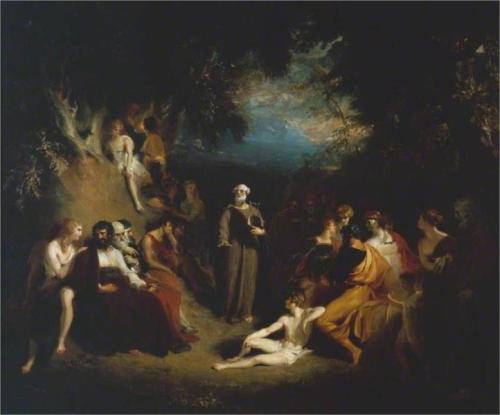
homer-reciting-his-poems-1790.jpg!Large.jpg

      Homer Reciting his Poems (1790) 

             Thomas Lawrence

                    _________

thanks Collin

hot on the heels of my paean to
Billy Collins, his my favourite 
poem of the year, a friend sent 
me Aristotle“, saying, hey, you 
might like this, like this, Aristotle 
has been my rebuke to Plato for 
a while now, latent even in my 
least metaphysical speculations

in his poem, Collins goes back 
to the earliest definitions of the
structure of literary works as 
anticipated, or defined even, by
arbiters who were trying to 
understand their place and 
function, the poems’, in the 
culture, Aristotle’s Poetics is 
the very source, 350 BCE, the 
diagram, for our understanding, 
even in the present age, of what 
we mean, in the West, by art, 
we’ve been answering him ever 
since, it’s genetic  

Billy Collins‘ description is not 
chronological, it’s poetic, 
appropriate to its topic

its structure nevertheless 
follows specifically Aristotelian 
logic, shedding glory, 
coincidentally, on both prophets

for a special treat, listen to the 
poet’s audio recording at the
poem’s site – which delivers 
even more compelling 
information – by clicking the 
red arrow pointing right 
beside Aristotle“, the title

R ! chard

           ___________ 

Aristotle

This is the beginning.
Almost anything can happen.
This is where you find
the creation of light, a fish wriggling onto land,
the first word of Paradise Lost on an empty page.
Think of an egg, the letter A,
a woman ironing on a bare stage
as the heavy curtain rises.
This is the very beginning.
The first-person narrator introduces himself,
tells us about his lineage.
The mezzo-soprano stands in the wings.
Here the climbers are studying a map
or pulling on their long woolen socks.
This is early on, years before the Ark, dawn.
The profile of an animal is being smeared
on the wall of a cave,
and you have not yet learned to crawl.
This is the opening, the gambit,
a pawn moving forward an inch.
This is your first night with her,
your first night without her.
This is the first part
where the wheels begin to turn,
where the elevator begins its ascent,
before the doors lurch apart. 

This is the middle.
Things have had time to get complicated,
messy, really. Nothing is simple anymore.
Cities have sprouted up along the rivers
teeming with people at cross-purposes—
a million schemes, a million wild looks.
Disappointment unshoulders his knapsack
here and pitches his ragged tent.
This is the sticky part where the plot congeals,
where the action suddenly reverses
or swerves off in an outrageous direction.
Here the narrator devotes a long paragraph
to why Miriam does not want Edward’s child.
Someone hides a letter under a pillow.
Here the aria rises to a pitch,
a song of betrayal, salted with revenge.
And the climbing party is stuck on a ledge
halfway up the mountain.
This is the bridge, the painful modulation.
This is the thick of things.
So much is crowded into the middle—
the guitars of Spain, piles of ripe avocados,
Russian uniforms, noisy parties,
lakeside kisses, arguments heard through a wall—
too much to name, too much to think about.

And this is the end,
the car running out of road,
the river losing its name in an ocean,
the long nose of the photographed horse
touching the white electronic line.
This is the colophon, the last elephant in the parade,
the empty wheelchair,
and pigeons floating down in the evening.
Here the stage is littered with bodies,
the narrator leads the characters to their cells,
and the climbers are in their graves.
It is me hitting the period
and you closing the book.
It is Sylvia Plath in the kitchen
and St. Clement with an anchor around his neck.
This is the final bit
thinning away to nothing.
This is the end, according to Aristotle,
what we have all been waiting for,
what everything comes down to,
the destination we cannot help imagining,
a streak of light in the sky,
a hat on a peg, and outside the cabin, falling leaves.


                                         Billy Collins

an homage to the victims of the Titanic

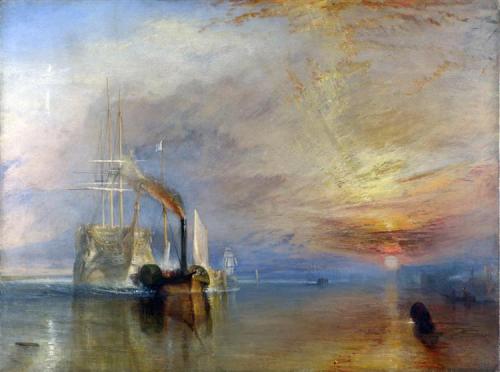
the-fighting-temeraire-tugged-to-her-last-berth-to-be-broken-up-1839.jpg!Large

  The Fighting Temeraire tugged to her last berth to be broken up (1839) 

          William Turner

                _______

while I’m on the subject of threnodies
which is to say “song[s] of lamentation
for the dead”, as I earlier statedlet me 
bring your attention to this extraordinary 
piece, an homage to the victims of the
Titanic
 
it doesn’t even have a title, much as 
Mozart and Haydn didn’t before music 
went mainstream, into public forums 
rather than merely aristocratic salons, 
and when an identifying moniker 
instead of a number became manifestly 
more practical, especially when the 
emerging Middle Classes were 
becoming the ones who were paying 
the composer’s bills, at the opera 
houses and the other sprouting 
concert venues, when some composers 
had even up to 32 sets of piano sonatas 
to remember, three and four often to 
a single set, opus number, as many as 
there are movements in a very sonata

and that’s not counting the numbered 

symphonies and string quartets of 
theirs, left to similarly calculate, 
decipher, extricate

it doesn’t have a title, I think, because
to my knowledge, it is the first of its
kind, a composition created by 
computer, for computer, an entirely 
self-contained digital work of, 
manifestly, art – I’d been waiting, 
diligently, for one – and like Beethoven, 
after the work was done, the artist(s)
just felt the title best left to the 
wordsmiths, thus – you’re welcome –  
Threnody for the Victims of the 
Titanic

sure, computers have done practical
things before, admirably, but never 
told a story, and certainly never one 
as profound as this one

these are the last moments of the 
Titanic, digitally reproduced, in real 
time, 2 hours and 40 minutes, they
are mesmerizing, you don’t want 
to miss a thing

there are no voices, apart from a 
few radio transmissions at the 
start, spotting the iceberg, calling 
out commands to beware, stop 
the engines

afterwards only silence, and the 
sound of the waves, the churning
of the engines, which have been 
restarted, sounding as rhythmic, 
incidentally, and numbing, as the 
wheels on the railroad tracks of
Steve Reich‘s Different Trains“,
another powerful threnody 

later the flash and crack of flares,
the crunch of the ship sinking  

the pervasive, however disrupted, 
silence and the inexorable passage 
of ever ticking time combine to be, 
thereafter, transfixing, meditative, 
ultimately transcendent, a fitting 
setting for a threnody 

I know of only another work to take
you to that venerable place,
Beethoven’s opus 111

and often enough Pink Floyd, for 
that matter, and the visionary 
Alan Parsons Project, of course, 
discoursing on inexorable Time 

and, now that I think of it, Elgar‘s
The Dream of Gerontius, whose 
character goes from his deathbed 
in the first act, to his afterlife in 
the second, effecting transcendence
for us by, yes, ingenious 
metaphorical proxy

but I digress

what I call Threnody for the Victims 
of the Titanic is a narrative with 
sound, not a movie, not a television
program, it has more commonality 
with a musical production than 
anything else but painting in art 
history, though its means are 
intuitively literary, ship stories go
back to The Odyssey through
Gulliver’s TravelsTreasure 
Island and to one of my very 
favourites, Ship of Fools“,
relatively recently

I could add Mutiny on the Bounty“,
Moby Dick“, “The Caine Mutiny 

in art, a precedent would’ve been set
in our collective consciousness by 
William Turner‘s celebratedThe 
Fighting Temeraire …, but I would 
mention as well Caspar David 
Friedrich‘s The Wanderer above 
the Sea of Fog for its existential
pertinence

a few literary points I’d like to stress
to back up my overt adulation, I find  
it impressive that the Classical rules
of tragedy have been maintained, 
unity of action, time, and place, 
prescriptions going back to 
Aristotle‘s Poetics in our cultural 
history, to profoundly express 
tragedy, iconic, epic, misfortune

not to mention the Classical musical
imperatives of tempo, tonality and 
repetition, none of which can be 
faulted here in this consummate 
composition

there is a no greater leveller of tempo 
than time, larghissimo here*, in the 
largest sense of that word, the 
cosmic, the inexorable pace of 
temporality in our brief heavens

a greater leveller of tonality neither  
is there than the rigorously impartial 
hum of the imperturbable Cosmos 

nor is there greater repetition than 
uniformity, however disrupted by  
however fervent ever human 
intervention, see Sisyphus, or 
Martha in “Who’s Afraid of Virginia
Woolf for iconic disrupters

R ! chard

*   Shostakovich had asked the 
     Beethoven Quartet to play the first 
     movement of his 15th String Quartet,
     “Elegy: Adagio“, so that flies 
     drop dead in mid-air, and the 
     audience start leaving the hall from 
     sheer boredom  

     well this inspired elucidation is even  
     slower than that
“Medea” – Euripides

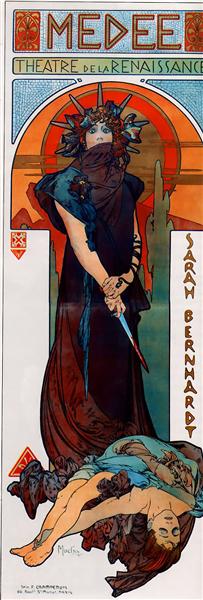
medea-1898-jpglarge

       Medea (1898) 

       Alphonse Mucha

          ____________

catching up on my Greek tragedies 
for a course I’m following online, I
happened upon this marvel

Medea, by Euripides, was written 
in 431 BCE, the next significant 
playwright in world history was
Shakespeare, the Dark Ages had
been “Dark” indeed, it took a 
Renaissance, in fact a new 
flowering of Greek and Roman
arts and institutions to get us 
moving forward again, you’ll 
notice how much of Euripides 
there is in Shakespearenot to 
mention in the French Classicists, 
Racine and Corneille

none of these, incidentally, have 
yet been equalled, never mind 
surpassed, except by maybe 
Anton Checkov, the superb 
Russian playwright

Zoe Caldwell won the 1982 Tony 
Award for best actress for her
incarnation of Medea, she was 
up against Katharine Hepburn 
and Geraldine Pageno less, 
among other distinguished 
luminaries, this is, in other 
words, no ordinary performance, 
watch her turn a mere script, 
however incandescent, into 
set of spoken arias worthy of 
the most celebrated divas

everyone else in the play is also
strong, excellent, impeccable

note the application of the three 
unities, of time, place, and action,
there is no set change, everything 
takes place within 24 hours,
according to the dictates of the 
very plot, the action surrounds 
the expulsion from Corinth of 
Medea and her two, and Jason’s, 
sons, the restrictions of the form 
put the tension, the drama, utterly 
in the hands of the poet, the 
success of the work depends not
on stunts, special effects, but on
words, poetry

Aristotle says in his Poetics“, 
section I, part VI, “The Spectacle has, indeed, an
emotional attraction of its own, but, of all the parts,
it is the least artistic, and connected least with the
art of poetry. … Besides, the production of
spectacular effects depends more on the art
of the stage machinist than on that of the poet.”  

the three unities have no room,
therefore, for Spectacle“, their 
product must be reflections of 
the poet’s humanity, heart, 
straight through, if s/he can, 
to ours

Richard

Aristotle on poetry

aristotle-jpglarge

      Aristotle” (1653)

        Luca Giordano

          ___________

so what’s a poem

in an attempt to get a clearer picture 
of what a poem should be, rather 
than trust only my own, however 
informed perhaps, opinion – though 
it must be added that we all bring 
something to that word’s definition, 
mine no less worthy than yours, 
yours no less worthy than mine – 
thought I’d go back to authoritative 
sources to see what they might 
have said

and it doesn’t get any earlier and 
authoritative than Aristotlewriting 
in 350 B.C.E., at the height of 
Ancient Greek preeminence, 
dissecting the term in his 
penetrating and perspicacious, 
ahem, Poetics” 

I propose to treat of Poetry in itself and of its various kinds,
noting the essential quality of each, to inquire into the
structure of the plot as requisite to a good poem; into the
number and nature of the parts of which a poem is
composed; and similarly into whatever else falls within
the same inquiry.“, he says in Part 1 of his 
magisterial treatise

and proceeds to declare the parameters 
of “Poetry” for the ages  

Poetry in general seems to have sprung from two causes“, 
he proceeds, imitation and rhythm 

by imitation I think it best to think of 
representation, which is another way, 
anyway, of saying imitation, but 
much more evocative in this instance,
more attuned to our sense of his word 

a poem is a representation then, a 
reproduction of something other than 
itself 

while its rhythm is what George
Gershwin‘s got, and by extension, as  
you can see from this videoGene Kelly

and yes, that means that “Epic poetry and Tragedy, Comedy also
and Dithyrambic poetry, and the music of the flute and of the lyre in
most of their forms, are all in their general conception modes of
imitation.” 

so, according to Aristotle, is dance 

all, therefore, poems

an interesting elaboration about “Tragedy” 
states that it should have the three unities 
that I grew up with during my French 
Canadian upbringing, the unity of time, of
space, and of action the famous French 
Classical dramatists, Racine and Corneille,
applied under the aegis of Louis XlV

not to mention Tragedy’s use of iambic 
pentameter, Shakespeare’s ubiquitous 
beat, a beat that persevered into the very 
Nineteenth Century, in France with 
Rostand‘s Cyrano de Bergerac“, for 
instance, and into the Twentieth Century 
with Eliot‘s Murder in the Cathedral“, 
about the assassination of Archbishop
Thomas Becket at Canterbury in 1170 
under Henry the Second‘s own aegis,
all written as poetry 

the most famous play to follow the 
three unities in the modern era is 
Who’s Afraid of Virginia Woolf?“,
the play which I think defines the 
Twentieth Century, which takes 
place overnight somewhere in 
New England college town, mid-
century, at George and Martha’s 

though followed closely by O’Neill‘s 
Long Day’s Journey int Night“, 
which transpires from morning, one 
day in August, 1912, till midnight, at 
the home ofunity of space, note, 
the dysfunctional Tyrones

so it appears not much has changed
about poetry, Aristotle got a lot of 
mileage out of his early definition, 
nearly 2500 years 

makes you wonder  why so much 
attention was paid instead to 
Platohis contemporary, the 
mystic, who would’ve banned
poetry, he thought it was 
subversive
 
Richard

psst: for a modern day application
          of the three unities, watch 
          In Treatment“, a television
          series, which takes place 
          in a psychotherapist’s office,
          each episode a session,