Richibi’s Weblog

Just another WordPress.com weblog

Tag: Pluto / god of the Underworld

The Story of Phaeton (VII) – Ovid
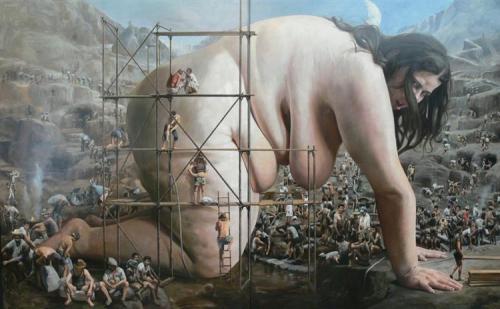
earth.jpg!Large

   Earth (2010) 


            Rolf Ohst


                     ______


mythologies are stories a people will 

tell itself to explain phenomena that 

remain mysterious, by transforming 

conundrums into people, 

anthropomorphizing them, a tale is

told that not only entertains, but 

informs, gives context in order to

shape moral character


most mythologies, if not all, it’s a 

question of definition, which I’ll 

get into later, past and present, 

are pantheistic, which is to say 

they refer to many goddesses 

and gods, rather than to one 

almighty one, therefore they see 

deities in rivers, trees, oceans, 

mountains, the sun, the moon, 

constellations, as well as in the 

more metaphysical entities, 

poetry, beauty, love  


there is therefore a more respectful,

even reverent, attitude to all of these

otherwise neglected realities, for 

being, often, peripheral to more 

immediate, daily, domestic, 

concerns


our prevalent monotheistic 

mythologies, by contrast, purport 

to be historical, however specious, 

which is why the word mythology 

here might not be appropriate, but 

regardless, they all posit one 

omnipotent God, notably 

imponderable, esoteric, and there 

are, correspondingly, only a few 

mentions in their foundational  

texts, the Bible, the Koran, the 

Torah, of nature playing any  

significant part, it is secondary to

to their overriding message


we therefore have allowed ourselves 

to watch the world burning without

having even noticed it come about, 

a function exacerbated, incidentally,

by our living mostly, now, in cities


Phaeton has let his horses stray from 

the cosmically ordained path of the 

Sun, the constellations have already

complained, Earth will follow


we, for our part, have despoiled our 

mother, we are presently watching 

her being ignominiously desecrated


see above


                   The Earth at length, on ev’ry side embrac’d
                   With scalding seas that floated round her waste, 


waste, waist, though waste itself throws 

its own homonymic reverberations of 

disorganized detritus, float[ing] round, 

into the mix, something Shakespeare,

incidentally, was especially good at


                   When now she felt the springs and rivers come,
                   And crowd within the hollow of her womb, 


the waters are receding, evaporating


                   Up-lifted to the Heav’ns her blasted head, 


blasted, overwhelmed


                   And clapt her hand upon her brows, and said
                   (But first, impatient of the sultry heat,
                   Sunk deeper down, and sought a cooler seat): 


a strange, and not especially effective

interjection between the parentheses

here, I think


                   “If you, great king of Gods, my death approve,
                   And I deserve it, let me die by Jove; 


Earth asks of Jove, king of Gods, 

that she might die at his own hands,

if her time has come


                   If I must perish by the force of fire,
                   Let me transfix’d with thunder-bolts expire.
                   See, whilst I speak, my breath the vapours choak
                   (For now her face lay wrapt in clouds of smoak),
                   See my singe’d hair, behold my faded eye,
                   And wither’d face, where heaps of cinders lye! 


we are familiar with forest fires,

hurricanes, droughts in our own day


                   And does the plow for this my body tear? 


after all I have given through 

agriculture, the plow, of nourishment, 

Earth asks, is this how I am to be 

repaid 


                   This the reward for all the fruits I bear,
                   Tortur’d with rakes, and harrass’d all the year?
                   That herbs for cattle daily I renew,
                   And food for Man, and frankincense for you? 


not only does Earth benefit living

creatures, but also the goddesses

and gods, she exclaims


                   But grant me guilty; what has Neptune done? 


Neptune, god of Water, the Sea,

is also Jove‘s brother


                   Why are his waters boiling in the sun?
                   The wavy empire, which by lot was giv’n,
                   Why does it waste, and further shrink from Heav’n? 


wavy empire, made of waves


Jove, Neptune, and Pluto were all

sons of Saturn, Titan, god of Time, 

after the sons overthrew their father 

during the Giants’ War, they divided 

the world by lot, which is to say, who

had the longest straw, Jove got the 

Heavens, Neptune, the Seas, Pluto

the Underworld


waste, resounding from above 


                   If I nor he your pity can provoke,
                   See your own Heav’ns, the Heav’ns begin to smoke!
                   Shou’d once the sparkles catch those bright abodes,
                   Destruction seizes on the Heav’ns and Gods;
                   Atlas becomes unequal to his freight,
                   And almost faints beneath the glowing weight. 


Atlas, a Titan, condemned to hold 

the heavens up for eternity


                   If Heav’n, and Earth, and sea, together burn,
                   All must again into their chaos turn. 


into their chaos turn, see the Creation

of the World


                   Apply some speedy cure, prevent our fate,
                   And succour Nature, ere it be too late.” 


sounds disquietingly familiar


                   She cea’sd, for choak’d with vapours round her spread,
                   Down to the deepest shades she sunk her head. 


surrounded by vapours, round her 

spread, Earth inexorably succumbs
 

gasp


R ! chard


The Story of Phaeton (VII) – Ovid

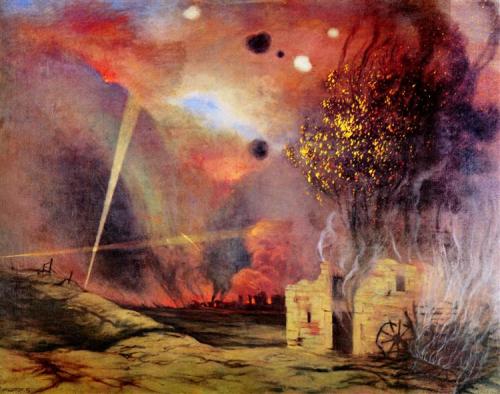
landscape-off-ruins-and-fires-1914.jpg!Large

   Landscape of Ruins and Fires (1914)


               Félix Vallotton


                   _______


                ‘Twas then, they say, the swarthy Moor begun
                To change his hue, and blacken in the sun. 


Moor, a flagrant anachronism here, 

as Moors, Muslim inhabitants of

North Africa, didn’t exist before the 

advent of Islam, which began in the 

Seventh Century CE, Ovid, in Latin,

uses Ethiopian, which would entirely 

throw off, note, Dryden‘s poetic 

metre, thus Moor


                Then Libya first, of all her moisture drain’d,
                Became a barren waste, a wild of sand. 


Libya, Ancient Libya, a much larger 

country of North Africa than the 

Libya we know of today


                The water-nymphs lament their empty urns,
                Boeotia, robb’s of silve Dirce, mourns, 


empty urns, the water has evaporated


Boeotia, a region still of Greece


Dirce, upon her gruesome death, which 

I won’t get into here, was transformed 

by Dionysus, god of revelry and fertility,  

into a fountain, which became revered


silve, sylvan, of the forest, the 

countryside


robb’s, I’ll guess robbers, because 

Boeotia is where Dirce, abducted,

became a fountain 


                Corinth Pyrene’s wasted spring bewails,
                And Argos grieves whilst Amymone fails. 


Corinth, a city still in Greece


Pyrene, a princess, who was, another 

distressing story, transformed into the 

Pyreneesby Heracles, her seducer,

as well as being a god renowned for 

his extraordinary exploits


Argos, a city still in Greece


Amymone, another unfortunate maiden,

who was granted by Poseidon, god of 

Water, for, throughout her tribulations, 

her probity, springs, sources of water, 

for her community, which, in the 

instance, all fail[ ] 


                The floods are drain’d from ev’ry distant coast,
                Ev’n Tanais, tho’ fix’d in ice, was lost. 


Tanais, the river today known as the 

Don in Russia, thus fix’d in ice


                Enrag’d Caicus and Lycormas roar, 


Caicus, a river in Asia Minor, now

given a different name in a different

script, Bakırçay, which I’ll let you 

try to pronounce 


Lycormas, a river in Ancient Greece, 

now called Evinos


                And Xanthus, fated to be burnt once more. 


Xanthus, or Xanthos, a river in Ancient

Asia Minor, which was yellowish already

due to its surrounding tainted soil, thus 

burnt once more    


                The fam’d Maeander, that unweary’d strays 


Maeander, a river in Ancient Asia

Minor


                Through mazy windings, smoaks in ev’ry maze. 


smoaks, smokes


mazy, maze, cute


                From his lov’d Babylon Euphrates flies;
                The big-swoln Ganges and the Danube rise
                In thick’ning fumes, and darken half the skies. 


the Euphrates, the Ganges, and the

Danube, rivers which still go by their

ancient names


                In flames Ismenos and the Phasis roul’d, 


Ismenos, or Ismenus, a river in 

Boeotia, Greece


Phasis, ancient name for the 

Rioni River in Georgia, Eurasia


roul’d, rolled


                And Tagus floating in his melted gold. 


Tagus, a river in the Iberian 

Peninsula


                The swans, that on Cayster often try’d
                Their tuneful songs, now sung their last and dy’d. 


Cayster, a river in Turkey


                The frighted Nile ran off, and under ground
                Conceal’d his head, nor can it yet be found:
                His sev’n divided currents all are dry,
                And where they row’ld, sev’n gaping trenches lye: 


it is being suggested that the Nile

had at one point seven tributaries,

some of which dried up, never

recovered


rowl’d, rolled


                No more the Rhine or Rhone their course maintain,
                Nor Tiber, of his promis’d empire vain. 


the Rhine, the Rhone, and the Tiber

are all European rivers


vain, deprived


                The ground, deep-cleft, admits the dazling ray,
                And startles Pluto with the flash of day. 


dazling, dazzling


Pluto, god of the Underworld, who 

would be understandably startle[d] 

by a flash of day


                The seas shrink in, and to the sight disclose
                Wide naked plains, where once their billows rose; 


billows, of [t]he seas


                Their rocks are all discover’d, and increase
                The number of the scatter’d Cyclades.

 discover’d, uncovered


Cyclades, a group of islands in the 

Aegean Sea, between present-day

Greece and Turkey


                The fish in sholes about the bottom creep, 


sholes, shoals


                Nor longer dares the crooked dolphin leap
                Gasping for breath, th’ unshapen Phocae die, 


Phocae, plural of Phoca, is the 

generic name, and therefore, 

interestingly, capitalized, for 

seals, walruses, sea lions


                And on the boiling wave extended lye. 


lye, lie


                Nereus, and Doris with her virgin train,
                Seek out the last recesses of the main; 


Nereus, and Doris, Sea god and 

goddess, parents, notably, of the 

Nereids, sea nymphs, the virgin 

train


the main, the ocean


                Beneath unfathomable depths they faint,
                And secret in their gloomy caverns pant. 


secret, unseen, alone, untended


                Stern Neptune thrice above the waves upheld
                His face, and thrice was by the flames repell’d. 


Neptune, principal god of the Sea


it is interesting to note that where 

earlier the earth had been 

submerged in water, during the 

Giants’ War, now the earth is

engulfed in flames, a primordial

global warming, as it were, the 

result, consider, of a human, 

Phaeton, trying to take on the 

duties of a god, a warning the 

Ancients were already delivering,

so many years, so many centuries, 

so many millennia, ago


I suspect, worldwide, indigenous 

people would be telling a similar 

tale were we able to access their 

own, unfortunately unwritten, 

though undoubtedly comparable, 

ancestral wisdom, going back,

perhaps, even as far 


R ! chard