on odes
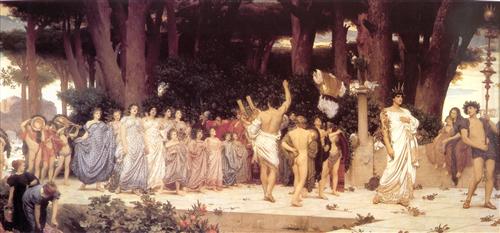
“The Daphnephoria“ (c. 1875)
________________
odes, with their suggestion of music
– despite a history of merely words
spoken in the intervening interim,
counting on meaning and rhythm
without music’s attendant tonality –
go back to the Greeks, the Seventh
Century, BCE, Sappho, for instance,
one of history’s most honoured
women poets, surely quite an
achievement for her in an age of
predominant, indeed
disenfranchising, masculinity
the ode was meant to accompany
tributes to people, events, things,
thereby acquiring an element of
acclamation and praise within its
dimensions, Pindar, ca 552 – 442
BCE, wrote odes for heroes of the
original Greek Olympics, for
instance
by the time of Horace, 65 – 8 BCE,
odes had become stylized,
independent of music, here’s one,
not inappropriately in this season’s
vernal context, to spring
odes remained spoken throughout
their resurrection in the wake of the
rediscovery of the Ancient World
during the Renaissance, onwards
through some famous Romantic
ones, Shelley, for instance, Keats,
up to even this one, by Stanislaw
Barańczak, which I found in the
New Yorker, April 20th, a gem, I
think, and in the very spirit of our
Age of Irony
O plywood, second best to the real stuff,
believe me, one day I will say “Enough”
to my stooping shoulders, my slouched spine;
my sloped shape and your stiff boards will align,
and you’ll see how my backbone will unbend
and I’ll be standing straight until the end
of my makeshift but rectilinear
prayer, one stiff-backed as a chest of drawers
when we shove heavy furniture around;
I will rise from the dead, though on what ground
and which I, I don’t know; I’ll stand erect,
though my vertebrae’s hierarchic sect
won’t outlive plywood, no, it just can’t win
against that vertical eternity, so thin
and yet so sturdy in its ersatz pride;
as if the moon had shown me its dark side,
I lean, my ear glued to a cupboard’s back,
and I can hear its hollow and exact
hymn to its own cheap immortality;
no, wait, I still can straighten, still can be
square with this upright world (you knew I could),
just as plumb as four planks of real wood.
(Translated, from the Polish,
by Clare Cavanagh and the author.)
__________
though you mightn’t’ve caught an “Ode”
in the title, the clue to its essence is in
the initial “O”, an acclamation
and yes, “O, Canada” is therefore also
an ode, as would be most anthems
incidentally Beethoven put the music
back into the form with his incendiary
use of Schiller’s poem for his vocal
triumph in his ninth Symphony, “An
die Freude“, the “Ode to Joy“,
incomparable in this rendering for
an improbable 10,000, yes 10,000, just
click
Richard
 Richibi's Weblog