Richibi’s Weblog

Just another WordPress.com weblog

Tag: Piano concerto no 3 / Opus 37 – Beethoven :

Piano Concerto no 4, Opus 58 – Beethoven
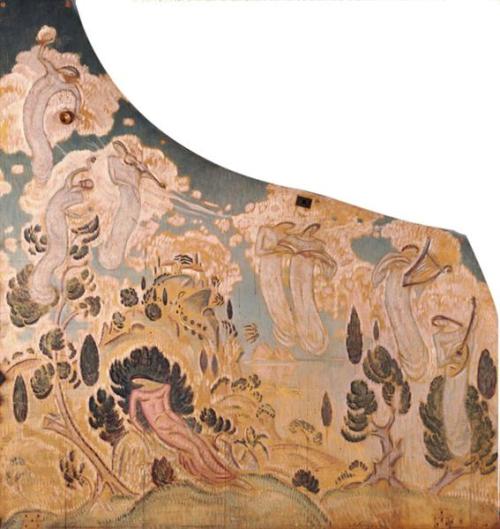
music-painting-and-decoration-of-a-piano-1920.jpg!Large.jpg

     Music (Painting and Decoration of a Piano) (1915-1920) 


          Konstantinos Parthenis


                    __________


like with Shakespeare, some of Beethoven’s

work doesn’t reach the heights I find in their 

utter masterpieces, his Fourth Piano Concerto

is, to my mind, such a piece, though it’s not at

all not impressive


my complaint is that the musical motive, the

original theme, the cluster, merely, of notes

that make up the matter of the ensuing 

harmonic explorations, in all of the three 

movements of the Fourth, is lost in his 

excessive elaborationsone is distracted by 

the soloist’s dazzling showmanship rather 

than by the work’s metaphysical magic, as 

is conversely the case rather in Beethoven’s 

sister concertos, his OneTwo, Three, and 

Five 


most notably, the Fourth‘s slow movement,

the andante con moto, slow, but not unduly,

passes by in an instant, nearly imperceptibly,

but for the conspicuousness of its plodding 

rhythm, you wonder what just happened,

what did I miss


the first movement, the allegro moderato, 

or slightly slower than allegro, begins highly

unconventionally with the soloist at the helm, 

setting up the conversation, as it were, the

subject of the matter


that an individual, a commoner, would’ve  

dared to initiate a dialogue of purported 

significance in a culture where subjects

would have known their place, like later,

for instance, a woman asserting her 

position in a patriarchal society, would’ve 

been shocking, and highly controversial


but Beethoven raps out a rhythm, four

quick notes followed by four quick notes

followed by the same four notes again,

ra ta ta tat, ra ta ta tat, ra ta ta tat, like

someone knocking at a door, however

plaintively, requiring attention, before the

orchestra responds, determinedly and

categorically, though the soloist will ever 

remain the prime, and manifest, mover


this is not a tune, this is a statement


this is also the 18th Century’s introduction 

to the Romantic Period, where individual 

voices were stating their answer to the 

question of the disintegration of the

aristocratic as well as the religious 

ideals which had prevailed throughout 

the earlier Christian centuries, when 

their controlling dogmas, however still 

entrenched, were being questioned, 

and rejected, as evidenced by both the 

constitutional dictates of the American ,

and the French Revolutions, which 

were installing, codifying for their 

progeny, their individual continents,

and for very history, the idea of Human,

as opposed to the traditionally assumed

Divine, Rights


secular voices would consequently

sprout in myriad profusion 

throughout the ensuing 19th Century 

in order to people with personalities, 

as distinct from omnipotent, whether 

secular or ecclesiastical, established 

figures, to shape the ideologies of the 

impending future, for better or for 

worse


but I digress, exponentially


the third movement of the Fourth Piano

Concerto reminds me, in all its urgency,

of the finale of Rossini’s William Tell

Overture, of which I suspect it might  

have been an inspiration, the work

better known to many of my generation

as the theme to The Lone Ranger


Lone Ranger indeed, Beethoven was

already leaving his indelible, not to

mention generative, mark on our

present, 21st Century, culture


enjoy


R ! chard


Piano Concertos 2, 3, 4 – Beethoven

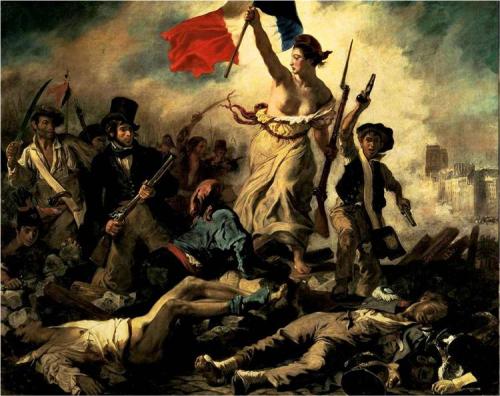
the-liberty-leading-the-people-1830.jpg!Large

     “Liberty Leading the People (1830) 

             Eugène Delacroix

                    _________

                               for everyone, with great gratitude, 
                                  who reads me, I mean only to 
                                     bring poetry, which is to say,
                                        light

though I’d considered leaving the 
Romantic Piano Concertos behind
to explore other areas of the period
in this survey, it seemed unfair,  
indeed remiss of me, not to include 
the three among my top ten that I 
haven’t yet highlighted, Beethoven’s 
2nd, 3rdand 4th Piano Concertos
Opuses 1937and 58 respectively,
after all, these are where the spirit 
of the age, the Zeitgeist, was 
constructed, like a building, with 
walls, windows, a hearth, all of 
which would become church, 
then a Church, and by the time of 
Brahms, a very Romantic Cathedral 

the foundation had already been laid 
by Mozart with his 27, but music had 
not yet become anything other than 
an entertainment by then, or 
alternatively, an accessory to 
ceremonial pomp and circumstance, 
see Handel and England for this, or 
liturgical stuffsee, among many 
others here, Bach

but with the turn towards 
independence of thought as the 
Enlightenment progressed, cultural 
power devolved from the prelates, 
and their reverent representations, 
to the nobles, who wanted their own 
art, music, which is to say, something 
secular, therefore the Classical 
Period, 1750 – 1800, in round figures

then in the middle of all that, 1789, 
the French Revolution happened, 
and the field was ripe for prophets, 
anyone with a message of hope, 
and a metaphysical direction, midst 
all the existential disarray – the Age
of Reason had set the way, 
theoretically, for the possibility of a 
world without God, something, or 
Something, was needed to replace 
the The Trinity, the Father, the Son, 
and the Holy Ghost, Who had been 
seeing Their supremacy contested 
since already the Reformation 

Beethoven turned out to be just
our man, don’t take my, but history‘s 
authentification of it, see the very
Romantic Period for corroboration

in a word, Beethoven established 
Faith, a Vision, not to mention the 
appropriate tools to instal this new 
perspective, a sound, however
inherited, musical structure – his 
Piano Concertos TwoThreeand 
Four, for instance, are paramount 
amongst a host of others of his  
transcendental revelations

briefly, the initial voice, I am here, in 
the first movement, is declamatory, 
even imperious, but ever 
compositionally solid, and proven, 
tempo, tonality, recapitulation, the 
materials haven’t changed from the 
earlier Classical epoch, just the 
design, the interior, the 
metaphysical conception

his construction is masterfully
direct, the line of music is 
throughout ever clear and concise, 
despite flights ofoften, ethereal, 
even magical, speculation, you 
don’t feel the music in your body 
as you would in a dance, as in the 
earlier eraof minuets, but follow 
it, rather, with your intellect, you,
nearly irresistibly, read it

but the adagio, the slow movement, 
the middle one Classically, is always, 
for me, the clincher, the movement 
that delivers the incontrovertible 
humanity that gave power to the 
Romantic poet, who touched you 
where you live 

Beethoven says life is difficult, and
eventually, at the end of his Early, 
Middle and Late Periods, life may 
even have no meaning
 
but should there be someone, he 
says, who is listening, Someone – 
though implicit is that one may be 
speaking to merely the wind – this 
is what I can do, this is who I am
 
and while I am here, however 
briefly, am not insignificant, I 
can be worthy, even glorious, 
even beautiful, I am no less 
consequential, thus, nor  
precious, than a flower

for better, of course, or for worse


R ! chard