philosophers at play
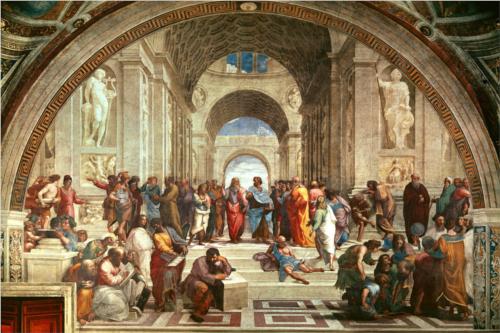
“The School of Athens“ (1510-11)
_________
the Philosophers’ World Cup – Germany vs. Greece,
enjoy the live action
the Philosophers’ World Cup – Germany vs. France,
read the debate
existentially yours
Richard
“The School of Athens“ (1510-11)
_________
the Philosophers’ World Cup – Germany vs. Greece,
enjoy the live action
the Philosophers’ World Cup – Germany vs. France,
read the debate
existentially yours
Richard
“How much trouble he avoids who does not look to see what his
neighbour says or does or thinks, but only to what he does himself,
that it may be just and pure; or as Agathon says, look not round at
the depraved morals of others, but run straight along the line
without deviating from it.”
“Meditations“, Book 4, 18
___________
having given the sciences their theoretical
foundations, philosophy, overtaken by facts,
theorems and numbers, impermeable verities
based on rigorous calculations and verifiable
experimentations, feared ceding its austere
position at the head of progressive thought
and ground its studies in more rationally
impregnable pursuits, empiricism overtook
speculation, morality became merely a
subtext instead of the existential quest
it had earlier informed
it has never recovered, though the
importance of the question of good
and evil has never subsided
towards what do we aspire, how do we
accord that with our environment, be it
social, political, natural
it is not a bad thing to consider our
priorities, otherwise we are merely
wisps, I would think, of undifferentiated
dust in the wind, dust having returned
inexorably to untransubstantiated
dust
therefore Marcus Aurelius
Richard
To apply Plotinus’ theory of memory to Alzheimer, and answer your earlier question. The disease damaged the first component of memory, i.e., our memory storage facility, but it leaves the second and third components intact, where “we” are most active. People afflicted with Alzheimer are no less human than the rest, because they still have their thoughts, emotions, desires, judgment and will.
To use analogy, I’d liken living with Alzheimer to walking on the beach. Our memory is like the footprints we leave in the sand, which are constantly washed away by the waves, but the lack of footprints doesn’t prevent us from continue walking/living
 Richibi's Weblog