Richibi’s Weblog

Just another WordPress.com weblog

Tag: Pandrosos / daughter of Cecrops
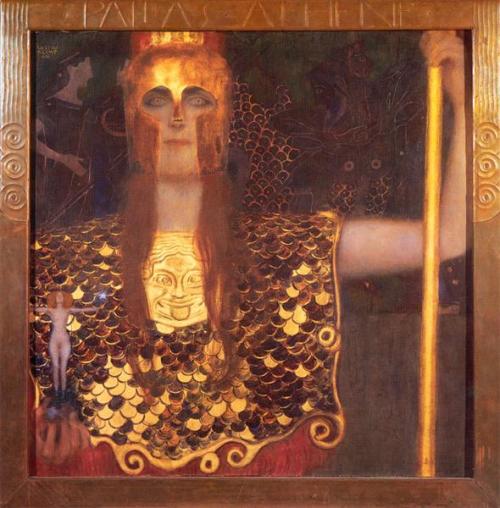
“The Story of Aglauros, transform’d into a Statue” (ll) – Ovid

minerva-or-pallas-athena.jpg!Large


        Minerva or Pallas Athena” (1898)


               Gustav Klimt


                      _______


Hermes / Mercury, messenger god,

has spotted Herse, Greek princess,

from on high, the most beautiful

among a procession of shining

virgins and, fir’d, swoops down to

earth, to th’ apartment of the royal

maid, in order to seduce her


             The roof was all with polish’d iv’ry lin’d,

             That richly mix’d, in clouds of tortoise shin’d.


tortoise, tortoiseshell, either the

colour, or the substance itself,

are referenced here, or maybe

even both


             Three rooms, contiguous, in a range were plac’d,


contiguous, one beside the other


             The midmost by the beauteous Herse grac’d;

             Her virgin sisters lodg’d on either side.


Herse, you might remember, had

two sisters, Pandrosos and

Aglauros, daughters of King

Cecrops, they’d seen the child

Ericthonius, half man, half snake,

son of Minerva, who had been

given to them, into their care, 

cradled in a basket, a chest, of

twining osierswhich they were

categorically not to open, but did,

to their great, to their utter, indeed

mythic, chagrin


             Aglauros first th’ approaching God descry’d,


descry’d, witnessed, beheld


             And, as he cross’d her chamber, ask’d his name,

             And what his business was, and whence he came.

             “I come,” reply’d the God, “from Heav’n, to woo

             Your sister, and to make an aunt of you;


however unabashedly be he

forthright


             I am the son and messenger of Jove;

             My name is Mercury, my bus’ness love;

             Do you, kind damsel, take a lover’s part,

             And gain admittance to your sister’s heart.”


take a lover’s part, Mercury entreats,

be of help, he asks Aglauros, in this

amorous adventure, strategize a path,

gain admittance for me, to your sister’s

heart, to her serene acquiescence


             She star’d him in the face with looks amaz’d,
             As when she on Minerva’s secret gaz’d,


Minerva’s secret, her babe,

Ericthonius, half man, half snake,

whom Aglauros had earlier,

however treacherously, beheld


             And asks a mighty treasure for her hire;


sure, says Aglauros, I’ll help, but

what will you give me in return

for my service, my hire


             And, ’till he brings it, makes the God retire.


Aglauros will not assist till she

receives the mighty treasure she

requests for her hire


             Minerva griev’d to see the nymph succeed;


Minerva, is not happy to see Aglauros

get anything at all because of her

earlier indiscretion, disobediently

uncovering Ericthonius, the

goddess’ son


             And now remembring the late impious deed,

             When, disobedient to her strict command,

             She touch’d the chest with an unhallow’d hand;

             In big-swoln sighs her inward rage express’d,

             That heav’d the rising Aegis on her breast;


Aegis, the shield that Minerva wore,

fashioned by the Cyclopes, brothers,

one-eyed giants, in the workplace of

Hephaestus, god of Craftsmen, Fire,

Metallurgy, it bore the Gorgoneion,

the head of Medusa, which would

turn one to stone when looked upon


see above


             Then sought out Envy in her dark abode,

             Defil’d with ropy gore and clots of blood:

             Shut from the winds, and from the wholesome skies,

             In a deep vale the gloomy dungeon lies,

             Dismal and cold, where not a beam of light

             Invades the winter, or disturbs the night.


Envy, its personification, is a goddess

here, though the representative of

Envy is usually considered to be

Phthonus, a male deity


next stop, Envy’s dark abode


stay tuned


R ! chard


“The Story of Coronis, and Birth of Aesculapius” (II) – Ovid
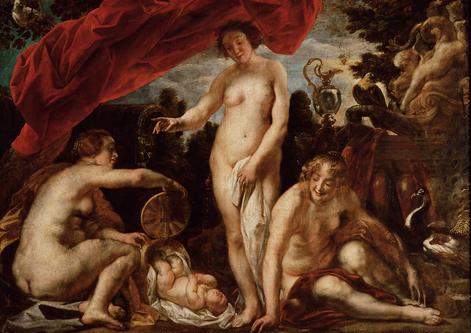
the-daughters-of-cecrops-finding-the-child-erichthonius

     “The Daughters of Cecrops Finding the Child Erichthonius (1640) 


               Jacob Jordaens


                   _________


                                 Once upon a time, 


something interesting happens here,

where earlier in this particular myth

we had a fable, a story in which 

animals play major roles, Aesop is 

famous for his, for instance, as is

Jean de la Fontainewith the

opening catchphrase above, a line

as old at least as Dryden, we’re

suddenly in the land of fairy tales,

structurally, technically


              The two-shap’d Ericthonius had his birth 
              (Without a mother) from the teeming Earth; 


Ericthonius, son of Minervagoddess 

of Wisdom, and of several other traits 

and abilities, and Hephaestus, god of 

Craftsmen, Metallurgy, Fire, among

other, again, areas of malleability 

and possibility


Without a mother, not in the usual,

mammalian, manner


two-shap’d, half human, half serpent,

don’t ask


              Minerva nurs’d him, and the infant laid 
              Within a chest, of twining osiers made. 


Minerva hid her fearsome child in  

a box, a chest, closed the lid, and 

entrusted the secret contents to a 

trio of sisters


              The daughters of king Cecrops undertook 
              To guard the chest, commanded not to look 
              On what was hid within.


king Cecrops, mythical founder and

first king of Athens


                                                               I stood to see 
              The charge obey’d, perch’d on a neighb’ring tree. 


I, the daw, the storyteller


              The sisters Pandrosos and Herse keep 
              The strict command; Aglauros needs would peep, 


Pandrosos, not to be cofused with 

Pandora, Herseand Aglauros, the

three daughters of Cecrops


              And saw the monstrous infant, in a fright, 
              And call’d her sisters to the hideous sight: 
              A boy’s soft shape did to the waste prevail, 
              But the boy ended in a dragon’s tail. 


there’s the ring here, nevertheless,

of Pandora’s tale, though this story

is not at all as dire for humanity as 

Pandora‘s fateful introduction of 

very evil into the world


              I told the stern Minerva all that pass’d; 
              But for my pains, discarded and disgrac’d, 
              The frowning Goddess drove me from her sight, 
              And for her fav’rite chose the bird of night. 


the bird of night, the owl, with which

Minerva is often associated, often

portrayed


              Be then no tell-tale; for I think my wrong 
              Enough to teach a bird to hold her tongue. 


and aptly, we learn the lesson a

fable is meant, by definition, to 

expose


R ! chard