Richibi’s Weblog

Just another WordPress.com weblog

Tag: Pan / god of the wilds

“The Afternoon of a Faun” – Debussy / Nijinsky / Nureyev

397px-Faun_merse

      Faun and Nymph (1867)


              Pál Szinyei Merse               


                      ________


to take a break, for a moment, from the

travails of Io, a heifer still, though her

father, Inachus, is aware of the situation,

and Hermes, messenger of the gods, is 

out, on the orders of Jove/ Jupiter / Zeus

to save her, and, at the same time, 

inspired by the music Hermes tells Argus

her many-eyed keeper, Pan, god of the

wilds, has been playing, with reeds he’s 

been left with of Syrinx, the nymph he  

would’ve loved had she not been 

transformed into rushes, as imagined by 

Debussy in his evocative Syrinx for solo 

flute, as highlighted in my last instalment

I could not not remember Debussy‘s 

other similarly mythological, and intimately

related, work, his Prelude to the Afternoon 

of a Faun, as modified itself by Vaslav

Nijinsky, legendary dancer and 

choreographer, into an event that verily 

shook the early 20th Century 


retitled, L’après-midi d’un faune, The

Afternoon of a Faun in English, the 

performance captures everything one

would gather from Ovid’s myths of its 

primitive, primal, sensibilities


the faun, needless to say, is representative 

of Pan, god of the wild, woodlands, a satyr, 

part instinct, part man, see above 


watch Rudolf Nureyev, then, his equally 

celebrated successor, take on the role

Nijinsky made famous, without any 

alterations made to the original 1912 

production, however improbably, 

though entirely successfully, we’re in 

Paris, May 29, though transposed,

faithfully and superbly, to New York,

Broadway, 1979 


proceed, however, at your own discretion, 

The Afternoon of a Faun is steaming, it’s 

about what happens when a young buck’s 

fancies, implacable and irrepressible, turn 

to love, not for the scrupulous, where does 

love begin, it asks, and lust retire, or is it 

the other way around, where does yin, in 

other words, meet, become, yang


these are questions that more and more 

begin to come up, you’ll find, in Greek 

and Roman, and most other ancient, 

for that matter, mythologies, something 

that isn’t at all touched upon in the 

Abrahamic traditions, Christanity, Islam, 

Judaism, monotheistic, though they’re 

at least as old, where nature, the place 

of animals, vegetation, land, water, our

intimate interconnection with them, 

don’t much, for better or for worse, 

come up


I miss the wonder of the more 

pantheistic, the pagan, perspective 


enjoy


R ! chard


“Syrinx” – Claude Debussy‏

big

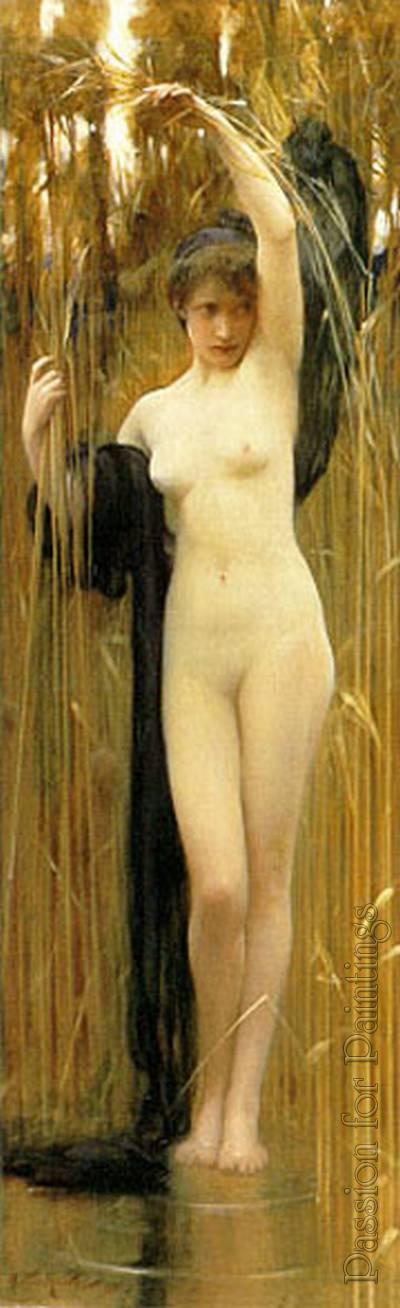
         Syrinx (1892)
 
          Arthur Hacker
 
            __________
 
 
though Debussy would’ve called his
Syrinx “Flûte de Pan”, “Pan Flute”,
alas, the name had already been 
taken, he therefore came up with the 
much more inspired Syrinx
 
Syrinx, with the help of other nymphs, 
who’d come at her cry for help as she 
fled the god Pan, a pursuer, had been 
turned into a bush of reeds, its canes 
producing a song so sweet as to 
confound and disarm him, impelling
him to create of them that sublime 
instrument  
 
Hermes had been telling Argus, Argus 
Panoptes, the giant with the hundred 
eyes, the story about the pipes he  
was playing, an implement received 
from Jove, apparently, god of all the 
gods, who wanted him to kill Argus, 
for confining Io, who’d been turned 
into a heifer by Juno, Jove’s wife, 
who’d caught him chasing her, Io’s 
plaintive lows had been getting to 
Juno as Io fretted unfettered through 
the fields too close to Olympus 
 
when Hermes’ music finally closed the
giant’s last two eyes, he beheaded him,
but Juno, in merciful recognition of his
service, however ultimately ineffectual, 
set them into the variegated tail of the 
peacock
 
are you kidding me, I always think when
I read Ovid’s “Metamorphoses”, and am
ever nevertheless entirely enchanted
 
a flute solo had not been composed in
over 150 years when Debussy composed
his Syrinx“, 1913, after C.P.E. Bach’s not  
at all unimpressive Sonata in A Minor 
of 1747, it duly set off a new life for the 
long overlooked flute, a reed which 
Mozart famously didn’t like
 
note the tonal, rhythmic, and repetition 
shifts from the rigid Classical model, 
where these are much more strict, 
Impressionism was not only breaking 
down pictures, the pictorial arts, but its
sound world as well, it was an utterly
new era, new sensibility, new zeitgeist, 
and you can feel it, though you might
not be quite able to immediately 
verbalize it, the arts were again, as
they ever ‘ve been, the canary in the 
gold mine
 
 
Richard
 
psst:
 
   The Transformation of Syrinx into Reeds 
 
Then Hermes thus: A nymph of late there was 
Whose heav’nly form her fellows did surpass. 
The pride and joy of fair Arcadia’s plains, 
Belov’d by deities, ador’d by swains: 
Syrinx her name, by Sylvans oft pursu’d, 
As oft she did the lustful Gods delude: 
The rural, and the woodland Pow’rs disdain’d; 
With Cynthia hunted, and her rites maintain’d: 
Like Phoebe clad, even Phoebe’s self she seems, 
So tall, so streight, such well-proportion’d limbs: 
The nicest eye did no distinction know, 
But that the goddess bore a golden bow: 
Distinguish’d thus, the sight she cheated too. 
Descending from Lycaeus, Pan admires 
The matchless nymph, and burns with new desires. 
A crown of pine upon his head he wore; 
And thus began her pity to implore. 
 
Now while the lustful God, with speedy pace, 
Just thought to strain her in a strict embrace, 
He fill’d his arms with reeds, new rising on the place. 
And while he sighs, his ill success to find, 
The tender canes were shaken by the wind; 
And breath’d a mournful air, unheard before; 
That much surprizing Pan, yet pleas’d him more. 
Admiring this new musick, Thou, he said, 
Who canst not be the partner of my bed, 
At least shall be the confort of my mind: 
And often, often to my lips be joyn’d. 
He form’d the reeds, proportion’d as they are, 
Unequal in their length, and wax’d with care, 
They still retain the name of his ungrateful fair.
 
                                                  Ovid