Richibi’s Weblog

Just another WordPress.com weblog

Tag: Ovid

“The Transformation of Io into a Heyfer” (IV) – Ovid

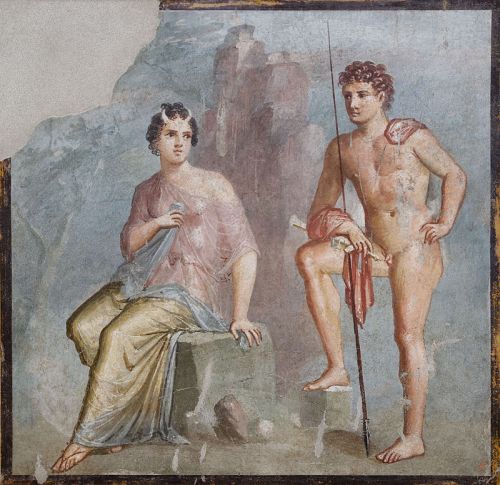
800px-Io_Argos_MAN_Napoli_Inv9556

   Io Wearing Bovine Horns Watched over by Argos on Hera’s Orders

                                                                                               (1st century AD)


           ______________


before moving forward with the trials 

of Io in Ovid’s poem, let me interject 

a few extracurricular opinions


a great work of art, be it poetry, prose,

a painting, a piece of music, is indicated 

by what you can read between the lines


this very Ovid is such an example, 

interrupted, as it is, by my

commentaries


but a better example, a more personal 

one, I would think, would be that of 

listening to music, and finding oneself 

wandering, often often, in all kinds of 

apparently unrelated areas of 

introspection, before being drawn 

back into the piece, the present, often 

unexpectedly, when it recaptures, with 

artful ingenuity, an arresting mixture of 

substance and style according to the

poet’s artistry, one’s errant attention, 

helping one find one’s way back home  


to rekindle again and again your 

attention, therein lies the art


the journey, the reverie, has been the

point of the music, where it is that the 

enchantment, and I use that word 

advisedly here, has taken you, that 

jaunt has been your part of the  

communication, which has turned it

into, indeed, a conversation


all art tries to do that


here are a few of my own reveries 

around Ovid’s poem, that it must be 

read as a cooperation in this instance  

between Ovid and John Dryden, who 

translated it, along with the help, here 

and there throughout the work, of a 

few other noteworthies, who must be 

acknowledged


it would be impossible to translate

alliteration, onomatopeia, other 

literary devices from one language 

to another, these exist only, and

specifically, in the individual 

vernacular, like fingerprints, the 

personal and particular impression 

of teeth, in people, for example 


of a more technical nature is the 

fact that though Dryden‘s verse

is in iambic pentameter

Shakespeare‘s shtick, a notably

conversational metre, Ovid‘s 

dactylic hexameter is of a heroic 

cadence, orotund and imperious,

like ceremonial music is 

unmistakably different from more 

lilting popular ditties


the point is that this translation of 

Metamorphoses must be read, in

my opinion, as a collaboration 

between Ovid for his substance, 

which is to say, the essential 

story, and John Dryden for his 

style


for better or for worse


otherwise we must learn Latin


an interesting element of the style,

meanwhile, I’ve uncovered, upon 

reading this text, is that the 

apostrophe that is often removed 

from verbs we see today with the 

e typically installed before the d, 

in the first line below, cry’d, for 

instance, reply’d in the next,

would’ve been that the poet was 

indicating, in his 1717, by the 

insistent elision, that the letter 

not be pronounced, where 

custom had earlier had it that it 

often was


for a more vivid impression, compare 

bless’d with blessed, both pronunciations 

still in use today, where the second 

spelling, the one with the e, is a 

throwback to a time when most of these 

participles would’ve been voiced in that

manner


1717, we learn, however incidentally, 

was a year when the English language 

was evolving, their is not was turning 

into their isn’t  


but back now to Ovid


                 Ah wretched me! her mournful father cry’d;
                 She, with a sigh, to wretched me reply’d:


how, between two profoundly 

different oratories, Inachus, Io‘s 

father, wonders, to translate 


see my exegesis above


                 About her milk-white neck, his arms he threw;
                 And wept, and then these tender words ensue. 


Inachus speaks


                 And art thou she, whom I have sought around
                 The world, and have at length so sadly found?
                 So found, is worse than lost: with mutual words
                 Thou answer’st not, no voice thy tongue affords: 


mutual words,a shared language


                 But sighs are deeply drawn from out thy breast;
                 And speech deny’d, by lowing is express’d. 


lowing, the sound a cow makes


                 Unknowing, I prepar’d thy bridal bed;
                 With empty hopes of happy issue fed. 


happy issue, children


                 But now the husband of a herd must be
                 Thy mate, and bell’wing sons thy progeny. 


bell’wing, bellowing 


Inachus fears Io will be mothering

calves


                 Oh, were I mortal, death might bring relief:
                 But now my God-head but extends my grief:
                 Prolongs my woes, of which no end I see,
                 And makes me curse my immortality! 


note that even the gods in this 

mythology suffer


                 More had he said, but fearful of her stay,
                 The starry guardian drove his charge away, 


The starry guardian, Argus


see above


                 To some fresh pasture; on a hilly height
                 He sate himself, and kept her still in sight. 


to sate, to refresh, satisfy


Io is still not out of the woods


R ! chard


“The Transformation of Io into a Heyfer” (III) – Ovid

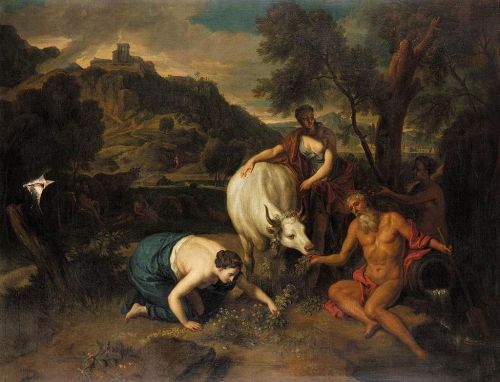
1024px-Victor-Janssens_Io-recognized-by-her-father

     Io Recognised by Her Father 


          Victor Honoré Janssens


              ______________


               The head of Argus (as with stars the skies)
               Was compass’d round, and wore an hundred eyes. 


not only did [t]he head of Argus have

an hundred eyes, but they circled,

compass’d, round his head, as with

stars the skies, as with stars the

geocentric firmament 


note the passive form of the verb to 

compass in the two lines above 

standing in for the inverted sentences

I earlier made mention of as literary 

devices Ovid, or Dryden, uses 

throughout the poem


the standard sentence, the active

sentence,  should read, an hundred

eyes compass’d [t]he head of Argus


compass’d, encircled


               But two by turns their lids in slumber steep;
               The rest on duty still their station keep;
               Nor cou’d the total constellation sleep. 


never could all the eyes, the total

constellation, sleep, or in slumber 

steep, since only two of them would 

turn[ ] their lids, close, at a time, 

while the others continued diligently

to keep watch


steep, incidentally, is a verb here, 

as in to put the kettle on, not an 

adjective, as in dauntingly

pitched, threateningly angled 


               Thus, ever present, to his eyes, and mind,
               His charge was still before him, tho’ behind. 


even when she was standing behind

him, Argus could still see Io, [h]is

charge, with the eyes he had in the

back of his head


               In fields he suffer’d her to feed by Day,
               But when the setting sun to night gave way,
               The captive cow he summon’d with a call;
               And drove her back, and ty’d her to the stall.
               On leaves of trees, and bitter herbs she fed,
               Heav’n was her canopy, bare earth her bed:
               So hardly lodg’d, and to digest her food,
               She drank from troubled streams, defil’d with mud. 


hardly lodg’d, given difficult living 

conditions


               Her woeful story fain she wou’d have told,
               With hands upheld, but had no hands to hold. 


fain, gladly


               Her head to her ungentle keeper bow’d,
               She strove to speak, she spoke not, but she low’d: 


to low is to make the sound that 

cows do, to moo


               Affrighted with the noise, she look’d around,
               And seem’d t’ inquire the author of the sound. 


the sound that she herself was making 

not only [a]ffrighted her, frightened her, 

but had her wondering where could 

it possibly be coming from 


               Once on the banks where often she had play’d
               (Her father’s banks), she came, 


Her father, Inachus, god of rivers


                                                    and there survey’d
               Her alter’d visage, and her branching head;
               And starting, from her self she wou’d have fled. 


much as the sound of her altered

voice had [a]ffrighted Io, now her 

reflection in the water chastened 

her as well, enough to make her

start, be startled, and want to run 

away from her self


               Her fellow nymphs, familiar to her eyes,
               Beheld, but knew her not in this disguise.
               Ev’n Inachus himself was ignorant;
               And in his daughter, did his daughter want. 


no one recognized Io, not even 

her father, who, in his daughter, 

the one who stood before him, 

the altered Io, could not make 

her out 


did his daughter want, as in to 

be found wanting, in the cow, 

to not even be suggested in

the, however conspicuous, 

heifer, not at all part of the 

picture 


Io is there but, simultaneously, 

disconcertingly, not there


               She follow’d where her fellows went, as she
               Were still a partner of the company: 


it should be remembered that 

Io was a beautiful heifer, even 

Juno had been impressed, so

that her fellows, her companions,

only other maidens, I’ll point out, 

fellows taking on its sexually 

indiscriminate meaning here, 

not at all restricted to males, 

would have easily let her follow


note the symmetry, incidentally, 

between follow’d and fellows, 

the nearly hidden alliteration, 

a delightful literary effect, 

though if you blinked you’d 

miss it


               They stroak her neck; the gentle heyfer stands,
               And her neck offers to their stroaking hands.
               Her father gave her grass; the grass she took;
               And lick’d his palms, and cast a piteous look;
               And in the language of her eyes, she spoke. 


her lowing would’ve had no effect,

would’ve let no one in on the fact

that beneath the animal exterior 

there might be an Io


               She wou’d have told her name, and ask’d relief,
               But wanting words, in tears she tells her grief.
               Which,


and here we get the punchline,

the plot twist, which turns this

story into, relatively speaking,

a total enchantment, as though 

Ovid were giving us, prefiguring

in fact, Walt Disney, our own 

20th Century mythologist


                            with her foot she makes him understand;
               And prints the name of Io in the sand. 


see above


R ! chard


“The Transformation of Daphne into a Lawrel” (III) – Ovid

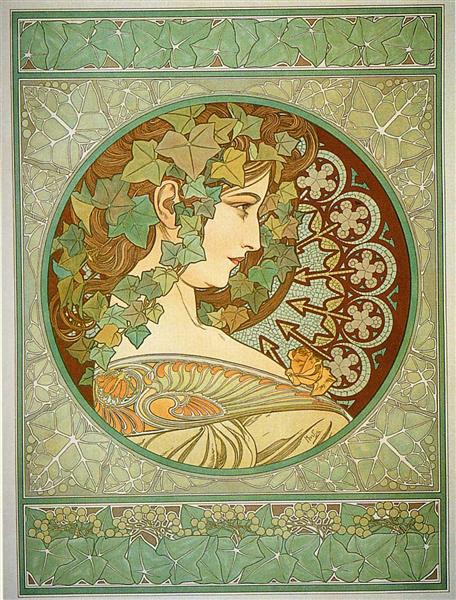
laurel-1901.jpg!Large

       Laurel”  (1901) 


             Alphonse Mucha


                         _______


however ardently might’ve Phoebus 

been pleading his case before 

Daphne, his, however recalcitrant,  

intended, flashing his divine pedigree, 

vowing to put all that aside to serve 

only her


               She heard not half; so furiously she flies;
               And on her ear th’ imperfect accent dies, 


th’ imperfect accent might be the 

unnatural tone of a divinity Daphne 

might be hearing, the unusual timbre 

of a deity’s voice, I can’t imagine Ovid 

would be suggesting that Daphne and 

Phoebus spoke different Greek dialects


perhaps th’ imperfect accent is the

unsettling manner of his entreaties,

his indecorous urgency


poets can be confounding


               Fear gave her wings; and as she fled, the wind
               Increasing, spread her flowing hair behind;
               And left her legs and thighs expos’d to view:
               Which made the God more eager to
pursue. 


the pagan gods were notoriously 

mischievous, spirited, impulsive,

quite human, never sublime and

irreproachable as is the Abrahamic 

Supreme Deity


the pagan gods lived in the fields

and streams, the hills and vales,

the seas and mountains, that 

surrounded Greek and Roman 

communities, Olympus was their 

steepest height, never the 

supernatural elevations, beyond 

even our visible heaven, that our 

present pervasive monotheism 

proclaims


               The God was young, and was too hotly bent
               To lose his time in empty compliment:
               But led by love, and fir’d with such a sight,
               Impetuously pursu’d his near delight. 


often, the gods of antiquity were

perverse, not at all blameless,

not innocent, not irreproachable, 

like the one and only god that, 

today, in its several interpretations, 

even murderously conflicting, rules,

oversees, mostly, our present, at 

least Western, faith communities


               As when th’ impatient greyhound slipt from far,

               Bounds o’er the glebe to course the fearful hare,


glebe, fields


               She in her speed does all her safety lay; 
               And he with double speed pursues the prey; 
               O’er-runs her at the sitting turn, and licks 
               His chaps in vain, and blows upon the flix: 


flix, fur, the greyhound’s pelt 


perhaps greyhounds do this, blow

upon their flix, you’ll have to ask 

Ovid, or maybe Dryden, his 

translator


               She scapes, and for the neighb’ring covert strives, 


 a covert, a bush in which to hide


               And gaining shelter, doubts if yet she lives: 


doubts if yet she lives, she can’t 

believe she made it 


               If little things with great we may compare,
               Such was the God, and such the flying fair, 


the flying fair, Daphne, the God,

Phoebus


               She urg’d by fear, her feet did swiftly move,
               But he more swiftly, who was urg’d by love. 


love, as Ovid, or is it, once again,  

Drydenwho defines it, urg’d, 

compelled by hormones, not at all 

our romantic conception of it


               He gathers ground upon her in the chace:
               Now breathes upon her hair, with nearer pace;
               And just is fast’ning on the wish’d embrace. 


Red Riding Hood and the Big

Bad Wolf


               The nymph grew pale, and in a mortal fright,
               Spent with the labour of so long a flight; 


Spent, defeated


               And now despairing, cast a mournful look
               Upon the streams of her paternal brook; 


her father, Peneus, was a river god, 

if you’ll remember, paternal brook, 

the rill, the rivulet, of her father


               Oh help, she cry’d, in this extreamest need!
               If water Gods are deities indeed: 


if there is a god, be with me, she 

cry’d, you, yourself, I’m sure, have 

been there, though Daphne‘s faith 

was grounded in help, in this case, 

from her father, god of, appropriately

in this instance, streams


               Gape Earth, and this unhappy wretch intomb; 


I’d rather die, Daphne pleads, I’d

rather the earth swallowed me up, 

I’d rather be intomb[ed]


               Or change my form, whence all my sorrows come. 


transform me, rid me of what makes 

me appealing, Daphne pleads


               Scarce had she finish’d, when her feet she found
               Benumb’d with cold, and fasten’d to the ground:
               A filmy rind about her body grows; 


a condition I’ve found not unlike the 

ravages I call, ironically, bark, crusty 

imperfections that afflict my own 

ageing body


               Her hair to leaves, her arms extend to boughs:
               The nymph is all into a lawrel gone; 


Daphne is turning into a tree,

a lawrel 


               The smoothness of her skin remains alone. 


of Daphne, only her smoothness 

remains


               Yet Phoebus loves her still, and casting round
               Her bole, his arms, some little warmth he found. 


bole, the stem of a tree


               The tree still panted in th’ unfinish’d part: 


where Daphne had not yet become

a tree, she still panted, pulsed


               Not wholly vegetive, and heav’d her heart. 


heav’d her heart, passionately

reacted


               He fixt his lips upon the trembling rind; 


rind, bark


               It swerv’d aside, and his embrace declin’d. 


kisses not at all sweeter than wine,

said the lawrel 


               To whom the God, Because thou canst not be
               My mistress, I espouse thee for my tree: 


Phoebus begins to speak directly 

here, Because thou canst not be, /

My mistress, he says, I espouse 

thee for my tree: 


espouse, marry


               Be thou the prize of honour, and renown; 


you will be, he continues, the 

prize that will represent heroes


               The deathless poet, and the poem, crown. 


honour, first of all, worthy, deathless, 

poets, Phoebus commands, let the 

laurel wreath crown deserving 

wordsmiths


Ovid had reason to champion poets,

he’d been exiled from Rome by the

Emperor, Augustus, his catering to

the Roman ruler becomes 

intermittently evident throughout 

this masterpiece


               Thou shalt the Roman festivals adorn,
               And, after poets, be by victors worn. 


victors, Olympic champions, notably


               Thou shalt returning Caesar’s triumph grace; 


Ovid curries imperial favour here with 

Augustus, by simply immortalizing in

poetry the name of Caesar, the new

Emperor’s great-uncle, and adoptive

father, making his own personal 

nemesis shine, for what it might be 

worth, by association


               When pomps shall in a long procession pass. 


the parades will be long ones


               Wreath’d on the posts before his palace wait; 


the laurel leaves will garland the 

posts, stations, before, in front of, 

the imperial palace


               And be the sacred guardian of the gate.
               Secure from thunder, and unharm’d by Jove, 


even Jove / Jupiter, god of gods,

will stand by, honour, the symbol 

of the laurel


               Unfading as th’ immortal Pow’rs above: 


Unfading, into very eternity


it’s interesting to note that the 

laurel has not lost its significance

despite the intervening centuries, 

epochs, we find reference to it even 

in the honorific title of laureate, as 

in Nobel laureate, or even in the

accolade of baccalaureate, the

bachelor’s degree, the prestigious

academic accomplishment 


Unfading indeed


               And as the locks of Phoebus are unshorn, 


Phoebus always sports perfect 

hair


               So shall perpetual green thy boughs adorn.


it would seem that, according to 

this, laurel leaves, perpetual 

green, don’t ever lose their 

colour, but I can’t attest to this,

being a poet rather than an

arborist, a gardener, though

bay leaves, laurel, even dry,

don’t turn brown, I’ve since

noticed


               The grateful tree was pleas’d with what he said;
               And shook the shady honours of her head. 


and they all lived happily ever 

after


or didn’t


myths are the enduring fairy tales 

that adults continue to believe in, 

according to their culture, about 

men and women rather than 

boys and girls, they help us, like

fairy tales, make up our moral 

order


R ! chard


“Metamorphoses” (The Giants’ War, XII) – Ovid

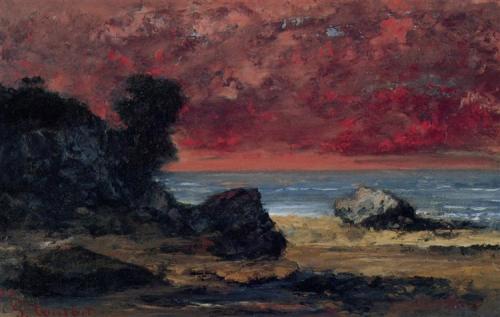
after-the-storm-1872.jpg!Large

      “After the Storm (1872)


            Gustave Courbet


                __________


                  A thin circumference of land appears;
                  And Earth, but not at once, her visage rears,
                  And peeps upon the seas from upper grounds; 


as the land begins to peep[ ] through 

the water, a circumference of land 

appears, a circle of Earth within the 

earlier universal water


to rear, to raise upright, boldly, the better,

here, for Earth‘s visage, Earth‘s face, to 

peep[ ] upon the seas from newly gained 

upper grounds


                  The streams, but just contain’d within their bounds,
                  By slow degrees into their channels crawl; 


streams, just recently redefining their  

boundaries, or bounds[b]y slow 

degrees settle, become waterways, 

channels, rivers, rivulets, rills


I love crawl here, incidentally, the slow, 

insidious, infiltration of a territory, silent 

and immutable, as [t]he streams, at the 

dispassionate pace of nature, find their 

individual course


                  And Earth increases, as the waters fall. 


the waters fall, the waters recede


                  In longer time the tops of trees appear, 


[i]n longer time, after a while


                  Which mud on their dishonour’d branches bear. 


for which the only solution here, would

be, I thought, however ironically, a

shower, rain


but I digress

                 
                  At length the world was all restor’d to view;

                  But desolate, and of a sickly hue:  

see, for instance, above


                  Nature beheld her self, and stood aghast,
                  A dismal desart, and a silent waste. 


desart, is desert, even my spellcheck 

insisted


meanwhile, back on Mount Parnassus

our two survivors, look around


                  Which when Deucalion, with a piteous look
                  Beheld, he wept, and thus to Pyrrha spoke: 


let me point out that what follows, 

which is to say when Deucalion 

… thus to Pyrrha spoke, we have 

an extended monologue, rather 

than a narration, the poet, Ovid

has given a voice to Deucalion

his character, his creation


I was reminded of Shakespeare‘s 

monologues, especially since the 

metre is iambic pentameter,

Shakespeare‘s signature poetic

rhythm 


it should be noted that this translation

of Metamorphoses is from 1717, a

century and a very year after 

Shakespeare‘s demise, in 1616, time 

for poets to have imbibed his already 

profound influence


nor could they not have been marked

by the spirit of their own time, and the 

many transformative epochs since 

Metamorphoses had been written, in 

the year 1, that would’ve affected the 

translation 


the original Latin text, for instance,

was in dactylic hexameter, not 

iambic pentameter


                  Oh wife, oh sister, oh of all thy kind
                  The best, and only creature left behind,
                  By kindred, love, and now by dangers joyn’d;
                  Of multitudes, who breath’d the common air,
                  We two remain; a species in a pair:
                  The rest the seas have swallow’d; nor have we
                  Ev’n of this wretched life a certainty.
                  The clouds are still above; and, while I speak,
                  A second deluge o’er our heads may break.
                  Shou’d I be snatcht from hence, and thou remain,
                  Without relief, or partner of thy pain,
                  How cou’dst thou such a wretched life sustain?
                  Shou’d I be left, and thou be lost, the sea
                  That bury’d her I lov’d, shou’d bury me.
                  Oh cou’d our father his old arts inspire,
                  And make me heir of his informing fire,
                  That so I might abolisht Man retrieve,
                  And perisht people in new souls might live.
                  But Heav’n is pleas’d, nor ought we to complain,
                  That we, th’ examples of mankind, remain. 


cou’d our father, JoveDeucalion asks,

breathe into me his inspiration, his old 

arts, his informing fire, so that I could 

reconstitute Man, retrieve him, and 

supply the perisht people with new, and

presumably more honourable, souls


                  He said; the careful couple joyn their tears: 


He said, or this he spoke, and the

couple joyn their tears


                  And then invoke the Gods, with pious prayers.
                  Thus, in devotion having eas’d their grief,
                  From sacred oracles they seek relief;
                  And to Cephysus’ brook their way pursue: 


Cephysus, or Cephissus, was a river god,

associated with the river Cephissus, which 

runs through Central Greece


                  The stream was troubled, but the ford they knew; 


the ford, the way across the stream


                  With living waters, in the fountain bred, 


living waters would gush from a 

spring, around which a fountain 

would’ve been built


                  They sprinkle first their garments, and their head,
                  Then took the way, which to the temple led.
                  The roofs were all defil’d with moss, and mire,
                  The desart altars void of solemn fire.
                  Before the gradual, prostrate they ador’d;
                  The pavement kiss’d; and thus the saint implor’d.


the gradual is a hymn sung within

the context of a full religious service


desart here is again desert, but in

this instance signifying deserted


the saint, an anachronism here, 

for saints were not at all even a

concept at the time of Ovid

would’ve been Themis, goddess,

at Delphi, on Mount Parnassus

of Divine Justice


R ! chard


“Metamorphoses” (The Giants’ War, VII) – Ovid

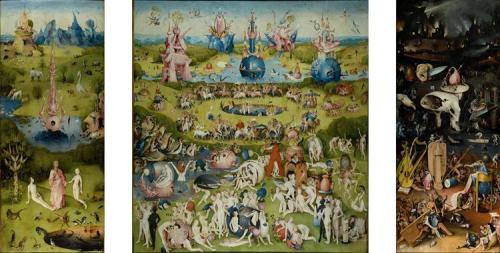
the-garden-of-earthly-delights-1515-7.jpg!Large

    The Garden of Earthly Delights (1510 – 1515) 


             Hieronymus Bosch


                  __________


              Nor from his patrimonial Heaven alone
              Is Jove content to pour his vengeance down; 


let me say something about Heaven 

here, a concept that is quite different 

from the earlier Ancient Greek and 

Roman understanding of the term, 

was it, for that matter, even a term

then, of the Ancients, that would’ve 

meant nothing other to them than 

the blue sky above, not at all an 

area reached by extraterrestrial 

transcendence


the abode of the gods and goddesses 

at the time of Ovid was Mount Olympus

and had been for centuries, much closer 

to the earth than the more ethereal home 

we imagine of the gods today, every one

of them, however professedly uniquely  

supreme, otherworldly


all gods, note, no goddesses, what’s up  

with that, I’ve long wondered


the Underworld was for the Ancients 

the dwelling place of the departed, 

somewhere deep beneath the earth, 

or at the very ends of all the seas, 

never totally beyond the very 

cosmos, as our prevailing faiths 

now uniformly preach 


the image of Heaven, Hell, and 

Purgatory for that matter, that last

a completely Catholic invention – to 

account for the salvation, however 

partial, of innocent souls deprived 

of Heaven for not having been 

christened, though not able yet, at 

so early an age, to have sinned – 

was pretty well codified by Dante

in the 14th Century in his 

masterpiece, The Divine Comedy,​ 

a daunting, but profoundly

illuminating read, which has 

shaped our impression of these 

several possible afterlives ever 

since


see above


this particular translation, however 

magisterial, but crafted after over a

thousand years of Catholic cultural 

domination, cannot avoid the impact 

of the Catholic understanding of 

Heaven


neither, now, can we, for that matter, 

intimately imbued as we are with

the binding faiths of our relatively

more recent forebears


be therefore perspicacious


              Aid from his brother of the seas he craves,
              To help him with auxiliary waves. 


later, we’ll learn that Jove’s brother 

of the seas is Neptune, god of all

aqueous things


            The watry tyrant calls his brooks and floods,
            Who rowl from mossie caves (their moist abodes); 


rowl, or roil, upset 


mossie, mossy


            And with perpetual urns his palace fill:
            To whom in brief, he thus imparts his will.


Neptune is stockpiling water, with

the help of his conforming waterways


            Small exhortation needs


no time, in other words, no need, 

to do much coaxing, much 

exhortation


                                          your pow’rs employ: 


use, put into action, or employ, 

your pow’rs


            And this bad world, so Jove requires, destroy. 


Jove, god of gods, is here commanding, 

authorizing, orchestrating    


            Let loose the reins to all your watry store:
            Bear down the damms, and open ev’ry door.


             The floods

 will inexorably follow


stay tuned


R ! chard


“Metamorphoses” – Ovid, 102

to-be-titled.jpg!Large

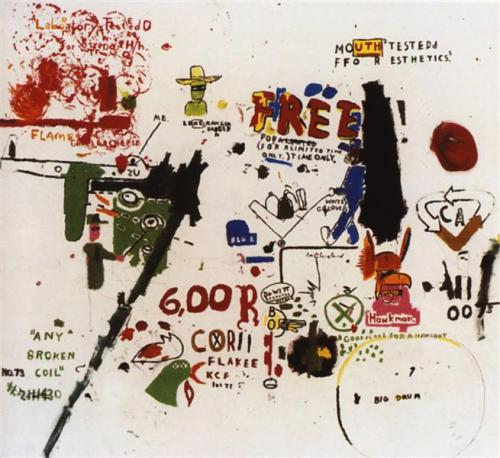
   To Be Titled (1987) –


          Jean-Michel Basquiat


                     __________


next, according to Ovid, inspired, presumably,  

by the Gods, is what happens before the world 

is created


        Before the seas, and this terrestrial ball, 


which is to say, the earth


        And Heav’n’s high canopy, that covers all,

        One was the face of Nature; if a face:


the “face of Nature” was “One”, an 

indistinguishable, perhaps not even, “face”


        Rather a rude and indigested mass:

        A lifeless lump, unfashion’d, and unfram’d,

        Of jarring seeds; and justly Chaos nam’d.


this undifferentiated agglomeration, this “lifeless 

lump” was called Chaos


note the “seeds”, however, potential, though 

“jarring”, or conflicting, the genesis for what 

is to follow   


           No sun was lighted up, the world to view;

           No moon did yet her blunted horns renew:


the horns of the moon are visible when the 

crescent moon lies flat on the horizon, in 

the shape of a smile, presenting “horns”, 

the twin elevated extensions


           Nor yet was Earth suspended in the sky,

           Nor pois’d, did on her own foundations lye:


or lie


           Nor seas about the shores their arms had thrown;

           But earth, and air, and water, were in one.


see again Chaos here


           Thus air was void of light, and earth unstable,

           And water’s dark abyss unnavigable.

           No certain form on any was imprest;

           All were confus’d, and each disturb’d the rest.

           For hot and cold were in one body fixt;

           And soft with hard, and light with heavy mixt.


next, the first metamorphosis


stay tuned


R ! chard


Beethoven – piano sonata no.31, op.110 (3rd movement)‏

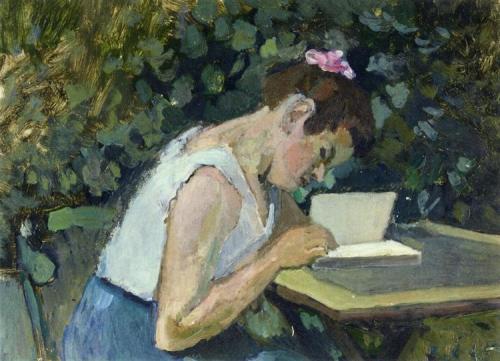
woman-reading-in-a-garden-1903.jpg!Large

Woman Reading in a Garden (1902-03)


         _______


perhaps my best teacher ever was
my father, others never questioned
the orthodoxy, spewing out the
curriculum like it was sacred, dead,
untouchable, depriving it of its very
worth

my father was a philosopher, God 
was a question, not an answer, I,
at the time, needed an answer
 
we were sent to a Catholic school,
my sister and I, where God was in 
everything, everywhere, omnipotent,
omniscient, and, like a father then, 
autocratic, industrious, demanding,
not unopposed to punishment
 
sins against the Father could be 
summarized, at that age, briefly,
do not kill, do not lie, do not 
disobey your parents, do not 
cheat on your husband, wife, 
and follow all the rituals of the 
Church, the Ten Christian 
Commandments, brought to 
you universally then by Charlton 
“Moses” Heston, under the aegis 
 
none of these graded offences  
applied to me, really, then, but 
lying, and disobeying one’s 
parents, the others were all so 
remote as to be inconsequential, 
though the Church kept up on 
our family’s abrogations of 
religious rites – non-attendance 
at Sunday mass, eating meat 
on Fridays, worse – while 
nevertheless tending dutifully
to our wayward souls, they told 
us, holding out for a final repentant 
confession
 
we never lied at home, I’d lied about 
something once, and was so daunted
when my father probed, I sweated,
must’ve turned purple, not just red,
of embarrassment, I knew I couldn’t 
use that tactic again, I’d inexorably 
blush, flush
 
who put the Brylcreem on the dog,
he’d queried
 
not me, I trembled
 
my sister stood beside me, might 
not have even known anything 
about it, I can’t remember, though 
I recall her dismay, I think, at having 
been so blithely thrown under the 
bus, or maybe that’s just me 
extrapolating 
 
my dad turned back to what he’d 
been doing, having, I’d understood, 
got his answer, proving himself to 
be to me thereby omniscient, I’d 
have no chance, I gathered, against 
something like that, this turned me 
into a good, an at least conscientious, 
person
 
my teachers, paradoxically, only 
ever took marks off for technical 
stuff, Math, History, French, they 
never taught me lessons   
 
a teacher, once, had asked me to
stand at the head of the class and 
read a passage from Shakespeare,
be Romeo, Mark Antony, Lear, I
can’t remember which
 
“O, pardon me, thou bleeding 
piece of earth, / That I am meek 
and gentle with these butchers!”,
I uttered, fraught with emotion,
“Thou art the ruins of the noblest 
man / That ever lived in the tide 
of times”
 
in my mind and in my body I was 
Mark Antony there, shot through 
with the weight of his friend’s 
brutal death, his own irretrievable 
loss 
 
my teacher laughed
 
what, I asked
 
you’re right into it, aren’t you, he 
replied, and shut me up right there 
to any public display of expression 
 
 
I didn’t stop reading Shakespeare 
though, but by myself
 
later I read Homer, Ovid, Proust,
others, did the same with music 
and art, made countless lifelong 
friends thereby, people I’ve always 
been able to turn to, even just in 
ruminative thought as their stories 
still pervaded me, diligently leading   
still the way, like guardian angels,  
maybe


Richard
Nemo – “Ennead I” by Plotinus (3)‏


having thrilled at the very first moment of an
apparent convergence on the Internet with
a kindred spirit, of the intellect, let me point
out, rather than of the more pressing, for
some, senses, I gurgled out a ready program 
of philosophical positions to him meant to
engage and perhaps more profoundly
together ponder   
 
to my delight the conversation took hold
and is ensuing, I thought I’d share 
 
here is the third instalment, the first two are
available on my counterpart’s impressive blog,
“Ennead”, of which to date he’s got three 
 
at the bottom in the comments section,
should you be interested 
 
how, of course, could you not      
 
 
Richard  
 
              _____________________ 
 
 
Date: Sat, 2 Mar 2013 19:19:11 +0000
To Richibi’s Weblog
From: comment-reply@wordpress.com
Subject: [New comment] “Ennead I” by Plotinus
 
Descartes did not prove the existence of “I”. To prove that something exists, you cannot presuppose its existence and say “something” does this or that. In other words, “I exist” is the condition that comes before “I think”, not after. If Descartes wanted to prove the existence of “I”, he made the mistake of circular logic, putting the cart before the horse.Even if we grant that the individual is conscious of the “I”. Does the “I” exist as a part, a mere concept, in his thoughts, just as other people exist as mere concepts of his thoughts, or is there an “I” beyond his consciousness? To borrow the imagery of Plotinus, does the Moon exist as part of the reflection in the water, or does it exist independently outside the water?

Plato’s theory encompasses both change and immutability. They are incomplete without the other, nay, they cannot exist without the other. This is proven by our own experience. We can observe changes only because we’re using something static as a reference

first of all, Nemo, thank you for this conversation,
I’m finding this exercise very stimulating, not many 
have called me on my philosophical positions, not
many, I suspect, having given these positions much
thought in the first place, you are perhaps a kindred
spirit, what a delight 
 
and as such I can only be, respectfully and humbly
ever, forthright 
 
in a Socratic, as it were, contract 
 
this part of Plato, incidentally, is the only part I accept,
his celebration of the Socratic Method, to put words
later into the greater philosopher’s mouth, to me, is
highly unethical, especially to spout with that authority
such drivel  
 
you can tell I don’t like Plato
 
 
the flurry of consciousness is the clue, in Descartes,
the moment of realization, the inkling of perception,
that allows us to know that something is behind that,
producing that, without which there would be no
actuality, that something is what we call “I”
 
interestingly, “Cogito, ergo sum”, the Latin, often used,
translation of the original French, “Je pense, donc je
suis”, doesn’t show an “I” in its very grammar, which
is an apt demonstration of the proposition we are
discussing
 
if there is conscioussness of something being
conscious, something must be being conscious,
that something Descartes called “moi”, we call
“me”, others call whatever they call it   
 
therefore I am
 
but I could not have done that without consciousness,
nebulous and indeterminate consciousness, but that’s
all we have, all we’ve ever had   
 
Plato tried to fashion an alternate, paternalistic, I might
add, conscience driven, later driven-by-Christian-fear,
reality, somewhere out there, that lasted for all of the 
Middle, did I say Middle or Dark, Ages, a good thousand,
count them, thousand, years, conservatively even
speaking  
 
Nietzsche got rid of that, finally, but still all of nearly
five hundred years later
 
oof   
 
 
where does Plato “encompass[–] both change and
immutability“, “The Republic” makes short shrift of
that, how is this “proven by our own experience
 
I like “We can observe changes only because we’re
using something static as a reference“, where did
you get that, I’ll have to ponder it
 
but “static” is my stumbling block, in a world
I cannot see as in any way static, autocratic,
unbending 
 
help   
 
 
read also Ovid 
 
 
cheers
 
Richard 
 
psst: I’m putting this thrilling conversation on my 
            blog, look out for it


the ensuing Ages – Ovid‏

    The Silver Age - Lucas Cranach the Elder

                            The Siver Age  (c.1516)

                              Lucas Cranach the Elder

                                                     ________


it is interesting to note how profoundly Ovid‘s mythological
setting marked Christian notions of the Creation, which at
least in the West have held sway now for some nearly two
thousand years
 
it is a tale then twice told, the last time however with not
half even the first one’s contagious exuberance, I think  
 
I believe more in Ovid then, also in Cranach and da Cortona,
worthy indeed proponents of that earlier oracular deity 
 
 
Richard
 
                       ____________________


But when good Saturn, banish’d from above,
Was driv’n to Hell, the world was under Jove.
Succeeding times a silver age behold,
Excelling brass, but more excell’d by gold.
Then summer, autumn, winter did appear:
And spring was but a season of the year.
The sun his annual course obliquely made,
Good days contracted, and enlarg’d the bad.
Then air with sultry heats began to glow;
The wings of winds were clogg’d with ice and snow;
And shivering mortals, into houses driv’n,
Sought shelter from th’ inclemency of Heav’n.
Those houses, then, were caves, or homely sheds;
With twining oziers fenc’d; and moss their beds.
Then ploughs, for seed, the fruitful furrows broke,
And oxen labour’d first beneath the yoke.
 
 
To this came next in course, the brazen age:
A warlike offspring, prompt to bloody rage,
Not impious yet…


   The Age of Iron - Pietro da Cortona
 
                             The Age of Iron”  (1637)
 
                                      Pietro da Cortona
 
                                            __________


Hard steel succeeded then:
And stubborn as the metal, were the men.
Truth, modesty, and shame, the world forsook:
Fraud, avarice, and force, their places took.
Then sails were spread, to every wind that blew.
Raw were the sailors, and the depths were new:
Trees, rudely hollow’d, did the waves sustain;
E’re ships in triumph plough’d the watry plain.

Then land-marks limited to each his right:
For all before was common as the light.
Nor was the ground alone requir’d to bear
Her annual income to the crooked share,
But greedy mortals, rummaging her store,
Digg’d from her entrails first the precious oar;
Which next to Hell, the prudent Gods had laid;
And that alluring ill, to sight display’d.
Thus cursed steel, and more accursed gold,
Gave mischief birth, and made that mischief bold:
And double death did wretched Man invade,
By steel assaulted, and by gold betray’d,
Now (brandish’d weapons glittering in their hands)
Mankind is broken loose from moral bands;
No rights of hospitality remain:
The guest, by him who harbour’d him, is slain,
The son-in-law pursues the father’s life;
The wife her husband murders, he the wife.
The step-dame poyson for the son prepares;
The son inquires into his father’s years.
Faith flies, and piety in exile mourns;
And justice, here opprest, to Heav’n returns.

 
                                               Ovid 
                                                                    
                                   (fromMetamorphoses“, Book I, in a translation by
                                   Sir Samuel Garth, John Dryden, Alexander Pope,
                                   Joseph Addison, William Congreve and other
                                   eminent hands)


“The Golden Age” – Ovid‏

      The Golden Age - Pietro da Cortona

                                  The Golden Age (1637)

 
                                                   Pietro da Cortona 
 
                                                       ____________
 
 
Eden revisited 
 
 
Richard
 
         __________________


The Golden Age

The golden age was first; when Man yet new,
No rule but uncorrupted reason knew:
And, with a native bent, did good pursue.
Unforc’d by punishment, un-aw’d by fear,
His words were simple, and his soul sincere;
Needless was written law, where none opprest:
The law of Man was written in his breast:
No suppliant crowds before the judge appear’d,
No court erected yet, nor cause was heard:
But all was safe, for conscience was their guard.
The mountain-trees in distant prospect please,
E’re yet the pine descended to the seas:
E’re sails were spread, new oceans to explore:
And happy mortals, unconcern’d for more,
Confin’d their wishes to their native shore.
No walls were yet; nor fence, nor mote, nor mound,
Nor drum was heard, nor trumpet’s angry sound:
Nor swords were forg’d; but void of care and crime,
The soft creation slept away their time.
The teeming Earth, yet guiltless of the plough,
And unprovok’d, did fruitful stores allow:
Content with food, which Nature freely bred,
On wildings and on strawberries they fed;
Cornels and bramble-berries gave the rest,
And falling acorns furnish’d out a feast.
The flow’rs unsown, in fields and meadows reign’d:
And Western winds immortal spring maintain’d.
In following years, the bearded corn ensu’d
From Earth unask’d, nor was that Earth renew’d.
From veins of vallies, milk and nectar broke;
And honey sweating through the pores of oak.

                                                 Ovid                                                                     

                                   (fromMetamorphoses“, Book I, in a translation by
                                   Sir Samuel Garth, John Dryden, Alexander Pope,
                                   Joseph Addison, William Congreve and other
                                   eminent hands)