Richibi’s Weblog

Just another WordPress.com weblog

Tag: Olympus

“Europa’s Rape” – Ovid
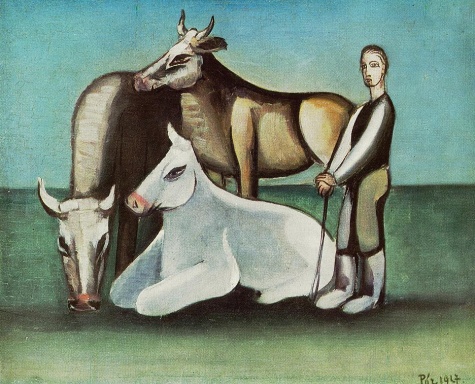
Bulls, 1948 - Bertalan Por

       Bulls” (1948)


               Bertalan Por


                           ____


though I’d heard, indeed, of the rape of

Europa, I wasn’t aware, I’d thought, of

the details, was loathe, therefore, to

read on, in the next segment of Ovid’s

Metamorphoseshaving been earlier

put off by such incidents in that text


as it turned out, Europa isn’t raped,

but, rather, abducted, more or less

willingly, however innocently, by

Jove / Jupiter / Zeus, and will even,

later, consensually, bear his children


who will then migrate, from their base

in Crete, to populate, to people, the

continent which we’ll come to know

as Europe, after their mum


but that’s a whole other story


meanwhile


           When now the God his fury had allay’d,

           And taken vengeance of the stubborn maid,

           From where the bright Athenian turrets rise

           He mounts aloft, and re-ascends the skies.


the God, Hermes / Mercury, if you’ll

remember, had just transformed

Aglauros, the stubborn maid, into a

statue for having been impudent

with him, and mounts aloft now,

re-ascends the skies over Athens,

where the damsel had lived


           Jove saw him enter the sublime abodes,


the sublime abodes, Olympus,

home of the gods


           And, as he mix’d among the crowd of Gods,

           Beckon’d him out, and drew him from the rest,

           And in soft whispers thus his will exprest.


Jove / Jupiter / Zeus wants something

from Hermes / Mercury


“My trusty Hermes, by whose ready aid

           Thy sire’s commands are through the world convey’d.


sire, Jove / Jupiter / Zeus is the father

of Hermes / Mercury, his sire


Hermes / Mercury, the messenger god,

patron of travellers, heralds, newscasters,

those who convey information

through[out] the world


           Resume thy wings, exert their utmost force,

           And to the walls of Sidon speed thy course;


Sidon, a city still in Lebanon


There find a herd of heifers wand’ring o’er

           The neighb’ring hill, and drive ’em to the shore.”

           Thus spoke the God, concealing his intent.


Jove / Jupiter / Zeus, the God, has

an ulterior motive, a conceal[ed] …

intent


           The trusty Hermes, on his message went,

           And found the herd of heifers wand’ring o’er

           A neighb’ring hill, and drove ’em to the shore;


mission accomplished


           Where the king’s daughter, with a lovely train
           Of fellow-nymphs, was sporting on the plain.


the conceal[ed] …intent is exposed,

Jove / Jupiter / Zeus, in character,

is on the prowl


           The dignity of empire laid aside,

           (For love but ill agrees with kingly pride)


power, empire, will not abide being

deprived, we’ve seen ample examples

of that in our, even most recent, past


           The ruler of the skies, the thund’ring God,

           Who shakes the world’s foundations with a nod,


Jove / Jupiter, Zeus, god, remember,

of Thunder


           Among a herd of lowing heifers ran,

           Frisk’d in a bull, and bellow’d o’er the plain.


Frisk’d, accoutered, dressed up as,

in the guise of, a bull


           Large rowles of fat about his shoulders clung,


rowles, rolls


           And from his neck the double dewlap hung.


dewlap, a looseflap of skin hanging

from the throat of some animals, or

birds, cattle, for instance, turkeys,

a wattle


           His skin was whiter than the snow


see above


                                                             that lies

           Unsully’d by the breath of southern skies;


breath of southern skies would

melt away white snow, revealing,

fatefully, ignominiously, patches

of [ ]sully’d earth


           Small shining horns on his curl’d forehead stand,

           As turn’d and polish’d by the work-man’s hand;

           His eye-balls rowl’d, not formidably bright,


rowl’d, rolled


           But gaz’d and languish’d with a gentle light.


as in doe eyes


           His ev’ry look was peaceful, and exprest

           The softness of the lover in the beast.


a wolf, if here a bull, in

sheep’s clothing


stay tuned


R ! chard

The Story of Phaeton (VI) – Ovid

mountain-fire.jpg!Large

    Mountain Fire (c.1903 – c.1908)


              John Singer Sargent


                       _________


because Phaeton was light, nor cou’d 

he fill the seat, the horses he would’ve

controlled forsake / Their stated course, 

and leave the beaten track


                What cou’d he do? his eyes, if backward cast,
                Find a long path he had already past;
                If forward, still a longer path they find:
                Both he compares, and measures in his mind;
                And sometimes casts an eye upon the east,
                And sometimes looks on the forbidden west, 


note the description of the movement 

of the eyes, backward, forward, east

and west, uncontrolled, erratic, nearing 

madness, despite attempts, however 

futile, to remain rational, steady, his 

very mind, comparing, measuring, is 

quickly losing its bearings


forbidden, once again, this should 

probably read forbidding


                The horses’ names he knew not in the fright,
                Nor wou’d he loose the reins, nor cou’d he hold ’em right. 


“Now, Dasher! Now, Dancer! Now, 

Prancer, and Vixen! / “On, Comet! 

On, Cupid! On, Donner and Blitzen!,

who drove another of the very few 

famous chariots in our Western 

cultural history


couldn’t help it


the only other one I could think of 

is that of the Four Horsemen of 

the Apocalypse, red, white, black, 

and pale horses, which I won’t get 

into, but to say that they have no 

names


the horses who drove the Chariot of

the Sun, meanwhile, were called

Phlegon, Aeos, Aethon, and Pyrios, 

though I fully admit that I had to 

look those up, then again I’ve never 

had to ride the Chariot of the Sun


it appears that Helios / Phoebus / 

Apollo had other steeds in his stable 

as well, for a rainy day, but they don’t 

feature in this particular story


                Now all the horrors of the Heav’ns he spies,
                And monstrous shadows of prodigious size,
                That, deck’d with stars, lye scatter’d o’er the skies. 


lye, lie


                There is a place above, where Scorpio bent
                In tail and arms surrounds a vast extent; 


Scorpio, the constellation Scorpius

visible only in the Southern hemisphere


Scorpio, represented by a scorpion,

thus has eight legs, or arms, and a 

highly distinctive tail


                In a wide circuit of the Heav’ns he shines,
                And fills the space of two coelestial signs. 


coelestial, celestial


                Soon as the youth beheld him vex’d with heat
                Brandish his sting, and in his poison sweat,
                Half dead with sudden fear he dropt the reins; 


vex’d with heat, from the wayward 

chariot, Scorpio [b]randish[es]

his sting


poison sweat, Scorpio, under the 

influence of the heat, sweat[s],

exudes, produces, characteristically, 

poison


                The horses felt ’em loose upon their mains, 


mains, manes, long hair


                And, flying out through all the plains above,
                Ran uncontroul’d where-e’re their fury drove;
                Rush’d on the stars, and through a pathless way
                Of unknown regions hurry’d on the day. 


hurry’d on the day, kept the day going

at its usual, however presently pathless, 

or uncharted, pace


                And now above, and now below they flew,
                And near the Earth the burning chariot drew. 


ever, and increasingly, ominously

                The clouds disperse in fumes, the wond’ring Moon
                Beholds her brother’s steeds beneath her own; 


wond’ring, confused, puzzled


Brother Sun, Sister Moon


                The highlands smoak, cleft by the piercing rays,
                Or, clad with woods, in their own fewel blaze. 


smoak, smoke


fewel, fuel


where the highlands are clad with 

woods, they blaze in the fires 

consuming their own trees


                Next o’er the plains, where ripen’d harvests grow,
                The running conflagration spreads below.
                But these are trivial ills: whole cities burn,
                And peopled kingdoms into ashes turn. 


an apocalypse

                The mountains kindle as the car draws near, 


the car, the chariot


                Athos and Tmolus red with fires appear; 


Athos, Mount Athos, Tmolus, Mount

Tmolus, both mountains in Greece,

both named after mountain gods


                Oeagrian Haemus (then a single name) 


Haemus Mons, an early name for 

the Balkan Mountains


Oeagria, Agria, a town in Greece


                And virgin Helicon increase the flame; 


Helicon, Mount Helicon, notable for

being the home of the Muses


                Taurus and Oete glare amid the sky, 


Taurus, the Taurus Mountains, a 

mountain range in southern Turkey 


Oete, Mount Oeta, a mountain in

Central Greece


                And Ida, spight of all her fountains, dry.
                Eryx and Othrys, and Cithaeron, glow,
                And Rhodope, no longer cloath’d in snow;
                High Pindus, Mimas, and Parnassus, sweat,
                And Aetna rages with redoubled heat. 


spight, in spite

Ida, Eryx, Othrys, CithaeronRhodope

Pindus, and the more familiar Parnassus

and Aetna, or Etna, are all mountains, or 

ranges, in the Mediterranean, Mimas, an 

island there, which is to say, a partially 

submerged mountain, all of them

sweltering


see above


                Ev’n Scythia, through her hoary regions warm’d, 


Scythia, a region northeast of Ancient 

Greece, barbarian to the more cultured 

people of Greek Antiquity, coarse 

forebears of the Cossacks 


hoary, sullied white, tired, withered 


                In vain with all her native frost was arm’d. 


even so frosty a region as Scythia

was not immune to, arm’d against, 

the running conflagration


                Cover’d with flames the tow’ring Appennine,
                And Caucasus, and proud Olympus, shine;
                And, where the long-extended Alpes aspire,
                Now stands a huge continu’d range of fire. 


the AppennineCaucasusOlympus

and Alpes, or Alps, are all mountain 

ranges throughout Europe, the 

representative part then of the 

known world


               Th’ astonisht youth, where-e’er his eyes cou’d turn,
                Beheld the universe around him burn:
                The world was in a blaze; nor cou’d he bear
                The sultry vapours and the scorching air,
                Which from below, as from a furnace, flow’d;
                And now the axle-tree beneath him glow’d:
                Lost in the whirling clouds that round him broke,
                And white with ashes, hov’ring in the smoke.
                He flew where-e’er the horses drove, nor knew
                Whither the horses drove, or where he flew. 


R ! chard


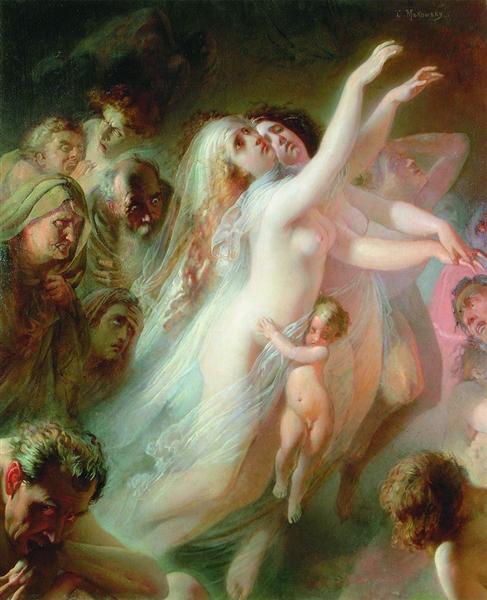
“Metamorphoses” (The Giants’ War, III) – Ovid

charon-carries-dead-souls-across-the-river-styx.jpg!Large

    “Charon Carries Dead Souls across the River Styx(1861)


           Konstantin Makovsky


                 ____________


Jove, god of Thunder, speaks


            I was not more concern’d in that debate
            Of empire, when our universal state
            Was put to hazard, and the giant race
            Our captive skies were ready to imbrace: 


I was not especially disturbed, Jove says,

when the state of our universe was 

challenged, or debate[d], when the giants 

tried to usurp our territory, were ready to 

imbrace, or embrace, take on, our  

vulnerable, [o]ur captive, skies


            For tho’ the foe was fierce, the seeds of all
            Rebellion, sprung from one original; 


because the enemy, then, the adversary, 

came from the one original source, its 

however manifold predations, its 

however myriad desecrations, would’ve

been identifiable to Jove, not foreign, not

unmanageable, he would’ve recognized

the black sheep of the Olympian family,

the giants  


            Now, wheresoever ambient waters glide,
            All are corrupt, and all must be destroy’d. 


ambient, nearby, related, infected, corrupt,

all has been corrupted


            Let me this holy protestation make,
            By Hell, and Hell’s inviolable lake, 


here’s another anachronism, for Hell wouldn’t’ve 

been even a concept in the era of Ovid, where

the Underworld, and Hades, entirely different

afterworlds, would’ve prevailed, areas of 

persistent gloom and shade, see Homer here,

for instance, or Virgil


the Underworld of the ancient world was 

surrounded by five rivers, Hell’s inviolable 

lake, the most famous of which was the 

river Styx


in the Divine Comedy, Dante updates this 

watery boundary for his own 14th Century

readers, and makes it the passageway to

the fifth circle of Hell, where Charon 

remains, after even over a thousand 

years, the very same ferryman


see above


nor was there either any of our present

conception of Heaven, Heaven would’ve 

been Olympus then, the exclusive domain 

of the Gods, either Greek or Roman 


            I try’d whatever in the godhead lay: 


Jove says, I tried everything a god 

could use


            But gangren’d members must be lopt away,
            Before the nobler parts are tainted to decay. 


you’ve got to lop[ ] away, cut off, the bad 

parts before they infect the more vital 

components of the body

 
            There dwells below, a race of demi-gods,
            Of nymphs in waters, and of fawns in woods:
            Who, tho’ not worthy yet, in Heav’n to live,
            Let ’em, at least, enjoy that Earth we give. 


not all beings are corrupt, but nymphs 

and fawns, innocents, Jove pleads, 

should be given consideration on 

Earth, if they be not yet worthy of the 

majesty of Heav’n, and granted earthly 

areas of enjoyment in the confines of 

their forsaken place 


            Can these be thought securely lodg’d below,
            When I my self, who no superior know,
            I, who have Heav’n and Earth at my command,
            Have been attempted by Lycaon’s hand? 


if Lycaon could attack me, Jove, god 

of Thunder, asks, how can these 

innocents, nymphs, fawns, ever be 

safe


             At this a murmur through the synod went,
             And with one voice they vote his punishment. 


the punishment of Lycaon, which we’ll 

soon encounter


             Thus, when conspiring traytors dar’d to doom
             The fall of Caesar, and in him of Rome,
             The nations trembled with a pious fear;
             All anxious for their earthly Thunderer: 


Thus, or in a similar manner, did the nations

of the earth tremble when Caesar, their 

earthly Thunderer, was assassinated 


nations, incidentally, is another anachronism,

nations didn’t appear on earth until the 

18th Century, with the French Revolution


             Nor was their care, o Caesar, less esteem’d
             By thee, than that of Heav’n for Jove was deem’d: 


Ovid addresses Caesar here, his contemporary,

and compares that emperor’s esteem for nations, 

his reliance on their allegiance, to the esteem 

Heav’n has for Jove


             Who with his hand, and voice, did first restrain
             Their murmurs, then resum’d his speech again. 


Jove calls for silence in the assembly

before speaking again


             The Gods to silence were compos’d, and sate
             With reverence, due to his superior state. 


The Gods … sate, or sat, then took heed,

bowing to Jove’s superior position


the tale of the punishment of Lycaon

will follow  


R ! chard


the sixth and seventh circles of Purgatory

after having managed with Dante first the seven circles of lurid Hell,
then five in the much more tolerable Purgatory, I’ve reached the sixth
and seventh circles there of Lust and Gluttony, sins I have been more
particularly prone to
  
the egregious crimes of murder, fraud, treason, blasphemy, the stuff 
of very Hell, were never a concern for me, while the venial imperfections 
of pride, envy, wrath, sloth, Purgatory’s more tempered lot, would never,
surely, transcendentally confound me, I thought, should there be indeed
a Hell, a Heaven, or a Purgatory, notions incidentally that were first made
explicit by Dante himself in his “Divine Comedy“, no earlier topographical
description of the place had ever been written, later Bosch would paint his
Garden of Earthly Delights”  
 
we owe our notions of the Christian afterlife even still to Dante 
  
  
but where of course does all this fit in a universe we know to be infinite,
an idea itself, that last, that is no less awesome
 
somewhere above Olympus, the home of the Greek Gods, is where it sits,
I think, but beneath the canopy of the stars, which enclosed the earth then, 
but which dispersed, it would seem, of its own incorporeality when we’d
reached beyond  
 
  
at the terrace of Gluttony, a level that winds around the mountain,
Dante meets among emaciated shades – “shades”, he says, “that
seemed things dead twice over”, who hunger for instead of victuals
eternal life – Forese Donati, an old flame 
  
“how did you come so far so fast?”, he asks his bosom friend who’d died
only a short four years earlier  
  
“It is my Nella”, he replies, his wife
  
        “whose flooding tears so quickly brought me 
         to drink sweet wormwood in the torments. 
  
         With her devoted prayers and with her sighs,
         she plucked me from the slope where one must wait  
         and freed me from the other circles.”
   
but I think it was Dante himself who could never have consigned such a
privy buddy to anything short of Purgatory   
 
                                                                                                                                                                                                                                                    and that was the terrace of Gluttony
 
tomorrow I do Lust   
 
 
upon moving towards that terrace, the last before reaching the
circles of Paradise, an angel blinds Dante with its radiance so that
he must turn away his eyes  
 
        “And as, announcing dawn, the breeze of May
          stirs and exudes a fragrance
          filled with the scent of grass and flowers,
 
          just such a wind I felt stroking my brow  
          and I could feel the moving of his feathers,
          my senses steeped in odor of ambrosia.” **


I wish you angels, and Heaven 
 
Richard 
 
 
*    “Purgatorio“, XXIII, 85-90 
**  “Purgatorio“, XXIV, 145-150 
 
                           translations by Robert and Jean Hollander


Raphael – The Sistine Madonna

  Raffael 051.jpg                 

                          Sistine Madonna, c.1512-1514

                                         Raphael

                                      (1483-1520)

                             _______________________

                                                                                                                                      in my search for what is beautiful, in my unending, my unyielding quest for the sublime, I’ve come upon many things that ‘ve been awesome, before the Venus de Milo I trembled, stood silent, reverent before her incandescent aura, in consternation before her shimmering grace, marvelled that time alone, I supposed, and magnificence could so irradiate, create actual energy
 
in Dresden the Sistine Madonna did the same, the only other work ever to so palpably illuminate

during the late Beethoven string quartets I cried, especially the fourteenth, but who wouldn’t, they are masterpieces
 
on first looking into Homer I confirmed indeed the promise of Keatsnearly subscribed to the gods of Olympus, would’ve converted to their convincing myths, but Proust finally remains my true religion, the reflection of all I believe, the poet aspiring to be a philosopher, the philosopher aspiring to be a poet, where Truth and Beauty inextricably intermix, interweave and inspire  

for a while I had my doubts, art, music, literature seemed seductive enough, even important, but not urgent, not necessary, there would be life without art, I rued, but hadn’t been able to pursue it further

then in a revelation someone somewhere said, without art there would be no civilization, and I regained forthwith my faith

earnestly I’ve returned to its service

                                                                                                                                     yours in art                                                                                                                                                                    richibi


      _______________________________