Richibi’s Weblog

Just another WordPress.com weblog

Tag: Neptune / god of the Sea

“The Story of Coronis, and Birth of Aesculapius” (III) – Ovid

minerva-or-pallas-athena.jpg!Large

   “Minerva, or Pallas Athena (1898) 


             Gustav Klimt


                  ______


             But you, perhaps, may think I was remov’d, 

             As never by the heav’nly maid belov’d:


says the daw to the still snowy plume[d], 

[w]hite as the whitest dove’s unsully’d 

breast raven


remov’d, rejected, discarded and

disgrac’d 


the heav’nly maid, Minerva


             But I was lov’d; ask Pallas if I lye; 


Pallas, another name for Minerva


             Tho’ Pallas hate me now, she won’t deny: 


hate, note, is in the subjunctive here, 

the mood of conjecture, where the s 

is removed from the ending of the 

third person singular, that she, he, or 

one, for instance, read, no s on read, 

Ovid, would be a part of any Latin 

curriculum


             For I, whom in a feather’d shape you view, 
             Was once a maid (by Heav’n the story’s true) 
             A blooming maid, and a king’s daughter too. 
             A crowd of lovers own’d my beauty’s charms; 


own’d, admitted to, acknowledged


             My beauty was the cause of all my harms; 


to a vain friend once who complained 

to me of the rigours of being beautiful, 

I said, your beauty, girl, to upend the, 

otherwise tiresome, conversation, is 

your curse, get over it, which he did, 

it did, in at least that instance


             Neptune, as on his shores I wont to rove, 


Neptune, god of the Sea


wont, to be used to, predisposed to


             Observ’d me in my walks, and fell in love. 
             He made his courtship, he confess’d his pain, 
             And offer’d force, when all his arts were vain; 


all of the gods, it appears, are engines, 

ever, of irrepressible lust, perhaps 

allegorically alluding to the unquenchable 

generative powers of very Nature 


             Swift he pursu’d: I ran along the strand, 
             ‘Till, spent and weary’d on the sinking sand, 
             I shriek’d aloud, with cries I fill’d the air 
             To Gods and men; nor God nor man was there: 


who hasn’t been there, forlorn, 

abandoned, desolate, forsaken


             A virgin Goddess heard a virgin’s pray’r. 


virgin Goddess, Minerva / Pallas 

Athena


note that Minerva / Pallas / Athena,

the virgin Goddess, remains, however 

unconventionally, however irregularly,

the mother of Erichthonius 


             For, as my arms I lifted to the skies, 
             I saw black feathers from my fingers rise; 
             I strove to fling my garment on the ground; 
             My garment turn’d to plumes, and girt me round: 
             My hands to beat my naked bosom try; 
             Nor naked bosom now nor hands had I: 


the king’s daughter, still unnamed, note, 

attesting to the interchangeability of 

virgin’s in Greek and Roman mythology, 

is in the process of becoming a daw, a

black bird


             Lightly I tript, nor weary as before 
             Sunk in the sand, but skim’d along the shore; 


it appears there are advantages 

to becoming a bird


             ‘Till, rising on my wings, I was preferr’d 
             To be the chaste Minerva’s virgin bird: 


go, girl


             Preferr’d in vain! I am now in disgrace: 
             Nyctimene the owl enjoys my place. 


Nyctimene, Minerva’s owl


friendship, it appears, can turn 

on a dime, or an inadvertent,

but decisive, irritation


R ! chard


The Story of Phaeton (VII) – Ovid

earth.jpg!Large

   Earth (2010) 


            Rolf Ohst


                     ______


mythologies are stories a people will 

tell itself to explain phenomena that 

remain mysterious, by transforming 

conundrums into people, 

anthropomorphizing them, a tale is

told that not only entertains, but 

informs, gives context in order to

shape moral character


most mythologies, if not all, it’s a 

question of definition, which I’ll 

get into later, past and present, 

are pantheistic, which is to say 

they refer to many goddesses 

and gods, rather than to one 

almighty one, therefore they see 

deities in rivers, trees, oceans, 

mountains, the sun, the moon, 

constellations, as well as in the 

more metaphysical entities, 

poetry, beauty, love  


there is therefore a more respectful,

even reverent, attitude to all of these

otherwise neglected realities, for 

being, often, peripheral to more 

immediate, daily, domestic, 

concerns


our prevalent monotheistic 

mythologies, by contrast, purport 

to be historical, however specious, 

which is why the word mythology 

here might not be appropriate, but 

regardless, they all posit one 

omnipotent God, notably 

imponderable, esoteric, and there 

are, correspondingly, only a few 

mentions in their foundational  

texts, the Bible, the Koran, the 

Torah, of nature playing any  

significant part, it is secondary to

to their overriding message


we therefore have allowed ourselves 

to watch the world burning without

having even noticed it come about, 

a function exacerbated, incidentally,

by our living mostly, now, in cities


Phaeton has let his horses stray from 

the cosmically ordained path of the 

Sun, the constellations have already

complained, Earth will follow


we, for our part, have despoiled our 

mother, we are presently watching 

her being ignominiously desecrated


see above


                   The Earth at length, on ev’ry side embrac’d
                   With scalding seas that floated round her waste, 


waste, waist, though waste itself throws 

its own homonymic reverberations of 

disorganized detritus, float[ing] round, 

into the mix, something Shakespeare,

incidentally, was especially good at


                   When now she felt the springs and rivers come,
                   And crowd within the hollow of her womb, 


the waters are receding, evaporating


                   Up-lifted to the Heav’ns her blasted head, 


blasted, overwhelmed


                   And clapt her hand upon her brows, and said
                   (But first, impatient of the sultry heat,
                   Sunk deeper down, and sought a cooler seat): 


a strange, and not especially effective

interjection between the parentheses

here, I think


                   “If you, great king of Gods, my death approve,
                   And I deserve it, let me die by Jove; 


Earth asks of Jove, king of Gods, 

that she might die at his own hands,

if her time has come


                   If I must perish by the force of fire,
                   Let me transfix’d with thunder-bolts expire.
                   See, whilst I speak, my breath the vapours choak
                   (For now her face lay wrapt in clouds of smoak),
                   See my singe’d hair, behold my faded eye,
                   And wither’d face, where heaps of cinders lye! 


we are familiar with forest fires,

hurricanes, droughts in our own day


                   And does the plow for this my body tear? 


after all I have given through 

agriculture, the plow, of nourishment, 

Earth asks, is this how I am to be 

repaid 


                   This the reward for all the fruits I bear,
                   Tortur’d with rakes, and harrass’d all the year?
                   That herbs for cattle daily I renew,
                   And food for Man, and frankincense for you? 


not only does Earth benefit living

creatures, but also the goddesses

and gods, she exclaims


                   But grant me guilty; what has Neptune done? 


Neptune, god of Water, the Sea,

is also Jove‘s brother


                   Why are his waters boiling in the sun?
                   The wavy empire, which by lot was giv’n,
                   Why does it waste, and further shrink from Heav’n? 


wavy empire, made of waves


Jove, Neptune, and Pluto were all

sons of Saturn, Titan, god of Time, 

after the sons overthrew their father 

during the Giants’ War, they divided 

the world by lot, which is to say, who

had the longest straw, Jove got the 

Heavens, Neptune, the Seas, Pluto

the Underworld


waste, resounding from above 


                   If I nor he your pity can provoke,
                   See your own Heav’ns, the Heav’ns begin to smoke!
                   Shou’d once the sparkles catch those bright abodes,
                   Destruction seizes on the Heav’ns and Gods;
                   Atlas becomes unequal to his freight,
                   And almost faints beneath the glowing weight. 


Atlas, a Titan, condemned to hold 

the heavens up for eternity


                   If Heav’n, and Earth, and sea, together burn,
                   All must again into their chaos turn. 


into their chaos turn, see the Creation

of the World


                   Apply some speedy cure, prevent our fate,
                   And succour Nature, ere it be too late.” 


sounds disquietingly familiar


                   She cea’sd, for choak’d with vapours round her spread,
                   Down to the deepest shades she sunk her head. 


surrounded by vapours, round her 

spread, Earth inexorably succumbs


gasp


R ! chard


The Story of Phaeton (VII) – Ovid

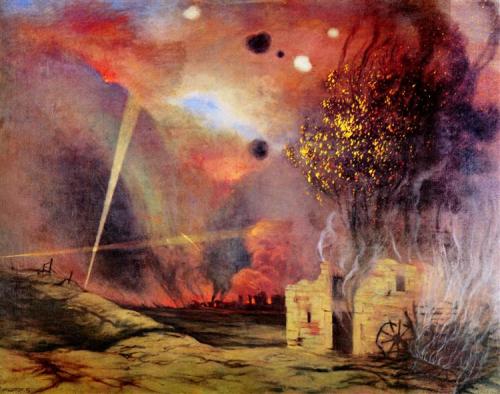
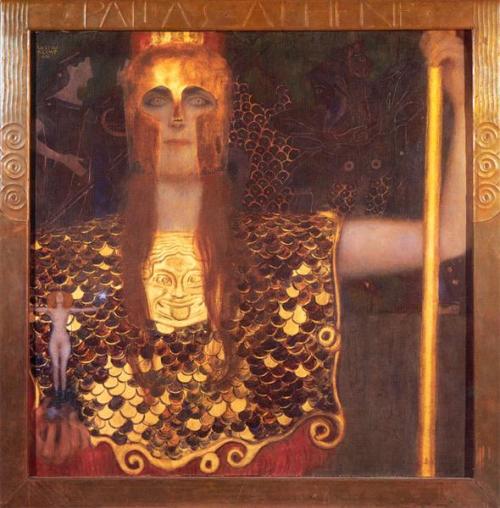
landscape-off-ruins-and-fires-1914.jpg!Large

   Landscape of Ruins and Fires (1914)


               Félix Vallotton


                   _______


                ‘Twas then, they say, the swarthy Moor begun
                To change his hue, and blacken in the sun. 


Moor, a flagrant anachronism here, 

as Moors, Muslim inhabitants of

North Africa, didn’t exist before the 

advent of Islam, which began in the 

Seventh Century CE, Ovid, in Latin,

uses Ethiopian, which would entirely 

throw off, note, Dryden‘s poetic 

metre, thus Moor


                Then Libya first, of all her moisture drain’d,
                Became a barren waste, a wild of sand. 


Libya, Ancient Libya, a much larger 

country of North Africa than the 

Libya we know of today


                The water-nymphs lament their empty urns,
                Boeotia, robb’s of silve Dirce, mourns, 


empty urns, the water has evaporated


Boeotia, a region still of Greece


Dirce, upon her gruesome death, which 

I won’t get into here, was transformed 

by Dionysus, god of revelry and fertility,  

into a fountain, which became revered


silve, sylvan, of the forest, the 

countryside


robb’s, I’ll guess robbers, because 

Boeotia is where Dirce, abducted,

became a fountain 


                Corinth Pyrene’s wasted spring bewails,
                And Argos grieves whilst Amymone fails. 


Corinth, a city still in Greece


Pyrene, a princess, who was, another 

distressing story, transformed into the 

Pyreneesby Heracles, her seducer,

as well as being a god renowned for 

his extraordinary exploits


Argos, a city still in Greece


Amymone, another unfortunate maiden,

who was granted by Poseidon, god of 

Water, for, throughout her tribulations, 

her probity, springs, sources of water, 

for her community, which, in the 

instance, all fail[ ] 


                The floods are drain’d from ev’ry distant coast,
                Ev’n Tanais, tho’ fix’d in ice, was lost. 


Tanais, the river today known as the 

Don in Russia, thus fix’d in ice


                Enrag’d Caicus and Lycormas roar, 


Caicus, a river in Asia Minor, now

given a different name in a different

script, Bakırçay, which I’ll let you 

try to pronounce 


Lycormas, a river in Ancient Greece, 

now called Evinos


                And Xanthus, fated to be burnt once more. 


Xanthus, or Xanthos, a river in Ancient

Asia Minor, which was yellowish already

due to its surrounding tainted soil, thus 

burnt once more    


                The fam’d Maeander, that unweary’d strays 


Maeander, a river in Ancient Asia

Minor


                Through mazy windings, smoaks in ev’ry maze. 


smoaks, smokes


mazy, maze, cute


                From his lov’d Babylon Euphrates flies;
                The big-swoln Ganges and the Danube rise
                In thick’ning fumes, and darken half the skies. 


the Euphrates, the Ganges, and the

Danube, rivers which still go by their

ancient names


                In flames Ismenos and the Phasis roul’d, 


Ismenos, or Ismenus, a river in 

Boeotia, Greece


Phasis, ancient name for the 

Rioni River in Georgia, Eurasia


roul’d, rolled


                And Tagus floating in his melted gold. 


Tagus, a river in the Iberian 

Peninsula


                The swans, that on Cayster often try’d
                Their tuneful songs, now sung their last and dy’d. 


Cayster, a river in Turkey


                The frighted Nile ran off, and under ground
                Conceal’d his head, nor can it yet be found:
                His sev’n divided currents all are dry,
                And where they row’ld, sev’n gaping trenches lye: 


it is being suggested that the Nile

had at one point seven tributaries,

some of which dried up, never

recovered


rowl’d, rolled


                No more the Rhine or Rhone their course maintain,
                Nor Tiber, of his promis’d empire vain. 


the Rhine, the Rhone, and the Tiber

are all European rivers


vain, deprived


                The ground, deep-cleft, admits the dazling ray,
                And startles Pluto with the flash of day. 


dazling, dazzling


Pluto, god of the Underworld, who 

would be understandably startle[d] 

by a flash of day


                The seas shrink in, and to the sight disclose
                Wide naked plains, where once their billows rose; 


billows, of [t]he seas


                Their rocks are all discover’d, and increase
                The number of the scatter’d Cyclades.

 discover’d, uncovered


Cyclades, a group of islands in the 

Aegean Sea, between present-day

Greece and Turkey


                The fish in sholes about the bottom creep, 


sholes, shoals


                Nor longer dares the crooked dolphin leap
                Gasping for breath, th’ unshapen Phocae die, 


Phocae, plural of Phoca, is the 

generic name, and therefore, 

interestingly, capitalized, for 

seals, walruses, sea lions


                And on the boiling wave extended lye. 


lye, lie


                Nereus, and Doris with her virgin train,
                Seek out the last recesses of the main; 


Nereus, and Doris, Sea god and 

goddess, parents, notably, of the 

Nereids, sea nymphs, the virgin 

train


the main, the ocean


                Beneath unfathomable depths they faint,
                And secret in their gloomy caverns pant. 


secret, unseen, alone, untended


                Stern Neptune thrice above the waves upheld
                His face, and thrice was by the flames repell’d. 


Neptune, principal god of the Sea


it is interesting to note that where 

earlier the earth had been 

submerged in water, during the 

Giants’ War, now the earth is

engulfed in flames, a primordial

global warming, as it were, the 

result, consider, of a human, 

Phaeton, trying to take on the 

duties of a god, a warning the 

Ancients were already delivering,

so many years, so many centuries, 

so many millennia, ago


I suspect, worldwide, indigenous 

people would be telling a similar 

tale were we able to access their 

own, unfortunately unwritten, 

though undoubtedly comparable, 

ancestral wisdom, going back,

perhaps, even as far 


R ! chard


“The Story of Phaeton” (II) – Ovid

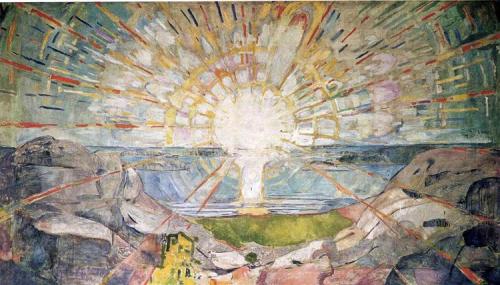
the-sun-1916.jpg!Large

   “The Sun (1911 – 1916) 


            Edvard Munch


                _______


                    The Sun’s bright palace, on high columns rais’d, 


The Sun, Helios / Phoebus / Apollo


                    With burnish’d gold and flaming jewels blaz’d;
                    The folding gates diffus’d a silver light,
                    And with a milder gleam refresh’d the sight; 


since the folding gates of the bright

palace shimmered with a silver light 

rather than with the glow of the gold 

and flaming jewels of the palace itself,

their milder gleam was easier on the 

eyes, refresh’d the sight


                    Of polish’d iv’ry was the cov’ring wrought: 


the palace was covered with polish’d

wrought ivory


                    The matter vied not with the sculptor’s thought, 


the execution of the palace was  

everything that its sculptor, its

architect, had had in mind to 

create


                    For in the portal was display’d on high
                    (The work of Vulcan) a fictitious sky


Vulcan, god of fire, metal, smiths, 

metalworkers


at the entrance to the palace, the

portal, Vulcan had painted the ceiling, 

he’d display’d on high … a fictitious 

sky, I suspect Dryden must’ve had 

Michelangelo and his ceiling of the  

Sistine Chapel in mind during his 

translation of this passage of Ovid


                    A waving sea th’ inferiour Earth embrac’d, 


inferiour, Earth, surging from under the 

greater masses of water dominating it, 

especially after the flood, is, therefore, 

beneath the waving sea, inferiour to it


                    And Gods and Goddesses the waters grac’d. 


remember that Ovid is describing a 

painting here, on the ceiling at the

entrance, the portal, to the palace 

of the god of the Sun


                    Aegeon here a mighty whale bestrode; 


Aegeon, marine god, god of storms,

note the similarity of the name with 

that of the Aegean Sea, but which 

came first, the chicken or the egg, 

the god or the expanse of water, 

remains, as far as I’ve been able 

to determine, undetermined


                    Triton, and Proteus (the deceiving God) 


Triton, another god of the Sea, you’ll 

remember him coming to the aid of 

Neptune, his father, in settling the

waters after the flood at the request 

of Jove / Jupiter / Zeus


Proteus, still another sea god, 

described as deceiving, for his 

ability to effortlessly, and 

spontaneously, change his shape, 

from which, incidentally, we get 

the adjective protean, for easily 

changeable, or versatile 


                    With Doris here were carv’d, and all her train, 


Doris, sea goddess, and all her train,

her following of nymphs, the Nereids,

her fifty daughters, if you’ll remember,

are carv’d, etched, given graphic 

representation


                    Some loosely swimming in the figur’d main, 


figur’d, painted, depicted, drawn


main, the open ocean, but, probably 

also here, the main, or central, part 

of the painting itself


                    While some on rocks their dropping hair divide, 


their hair divide, they loosen strands 

of their wet hair 


                    And some on fishes through the waters glide: 


sea gods and goddesses are often

shown riding sea creatures, dolphins, 

seahorses, even whales, see Aegeon

above

                    Tho’ various features did the sisters grace,
                    A sister’s likeness was in ev’ry face. 


the sisters, the Nereids, all have different

features, but a family resemblance, sister’s 

likeness, can always be detected in each

individual sibling’s rendering


                    On Earth a diff’rent landskip courts the eyes, 


Earth doesn’t look, court[ ] the eyes,

at all like what’s painted on the 

palace’s ceiling


landskip, landscape


                    Men, towns, and beasts in distant prospects rise, 


distant prospects, from a distance, one 

can see [m]en, towns, and beasts 

appear, rise, arise


                    And nymphs, and streams, and woods, and rural deities. 


nymphs, consigned, it appears, to 

earthly duties, streams, and woods, 

are not a feature of the Sun god’s 

palace


                    O’er all, the Heav’n’s refulgent image shines; 


the Heav’n’s refulgent, brightly shining,

image, expression, is manifest [o]’er all,

everywhere, the rays of the sun cast a

light on everything


                    On either gate were six engraven signs. 


again I’m reminded of a Renaissance

wonder, Lorenzo Ghiberti‘s gilded bronze 

doors for the Florence Baptistery, which 

Michelangelo himself called the Gates of

Paradise, a work nearly as famous, then 

and now, as his own Sistine Chapel ceiling   


Ovid would never have known of these 

masterworks, of course, having lived 

over a millenium earlier, but I suspect 

John Dryden, a cultured man, a couple 

of hundred years later than these 

cultural icons, would no doubt have 

been fully aware of them, much as we, 

however disinterested we might be, 

can’t help but have heard of, say, 

RembrandtChopinCharles Dickens,

for instance, though they be, similarly, 

centuries separated from us 


my point is that, without knowledge of 

the original Latin, Dryden‘s cultural

heritage must’ve slipped, I think, 

consciously or not, into his 

translation, for better, or for worse


it should be remembered, however,

that Dryden was writing for an early 

18th Century audience, much as I 

am presently doing myself with 

Dryden for a 21st, and maybe also

similarly skewing his idiom to better 

adapt it to our own time, for better, 

also, or for worse 


                    Here Phaeton still gaining on th’ ascent, 


gaining on th’ ascent, going faster 

and faster, climbing higher and 

higher


                    To his suspected father’s palace went


suspected father, Phaeton doesn’t

yet know if Helios / Phoebus / Apollo

is indeed his father


                    ‘Till pressing forward through the bright abode,
                    He saw at distance the illustrious God:
                    He saw at distance, or the dazling light
                    Had flash’d too strongly on his aking sight. 


had Phaeton not been as far, at

distance, from what he was seeing,

the illustrious God, the dazling, or 

dazzling, light would’ve hurt his 

eyes, hurt his aking, or aching, 

sight


                     The God sits high, exalted on a throne
                    Of blazing gems, with purple garments on; 


Tyrian, surely, purple, a hue we’ve 

seen here before, indicative of 

stature, of imperial, if not even

divine, as in this instance, 

pedigree


                     The Hours, in order rang’d on either hand,
                    And Days, and Months, and Years, and Ages stand.
                    Here Spring appears with flow’ry chaplets bound;
                    Here Summer in her wheaten garland crown’d;
                    Here Autumn the rich trodden grapes besmear;
                    And hoary Winter shivers in the reer. 


this is no longer a picture, but the 

real thing, Phoebus / Apollo / Helios

sits high, exalted on a throne /  Of 

blazing gems, with purple garments 

on, while Time and all of the Seasons 

hold court around him


                     Phoebus beheld the youth from off his throne;
                    That eye, which looks on all, was fix’d in one. 


Phoebus, who sees everything, who 

looks on all, beholds, fixes his eye on, 

his son


                     He saw the boy’s confusion in his face,
                    Surpriz’d at all the wonders of the place;
                    And cries aloud, “What wants my son? for know
                    My son thou art, and I must call thee so.” 


Phaeton, according to Phoebus / 

Apollo / Helios‘ forthright admission,

is truly his son


                     “Light of the world,” the trembling youth replies,
                    “Illustrious parent! since you don’t despise
                    The parent’s name, 


despise, refute


                                                some certain token give,
                    That I may Clymene’s proud boast believe,
                    Nor longer under false reproaches grieve.” 


your word is good, Phaeton allows,

but incontrovertibly, now, prove it, 

some certain token give, he 

challenges 


                     The tender sire was touch’d with what he said,
                    And flung the blaze of glories from his head, 


flung the blaze of glories from his head, 

reduced the intensity of his presence,

the impact of his charisma, took off 

his dazling crown, if only, maybe,

metaphorically, to be father to his son


                    And bid the youth advance: “My son,” said he,
                    “Come to thy father’s arms! for Clymene
                    Has told thee true; a parent’s name I own,
                    And deem thee worthy to be called my son.
                    As a sure proof, make some request, and I,
                    Whate’er it be, with that request comply;
                    By Styx I swear, whose waves are hid in night,
                    And roul impervious to my piercing sight.” 


an oath upon Styx is incontrovertible, 

like swearing on a Bible, as earlier 

noted


                     The youth transported, asks, without delay,
                    To guide the sun’s bright chariot for a day. 


Phaeton wants to drive his father’s 

car, the sun’s bright chariot, how 

contemporary, how immediate, 

how timeless 


stay tuned


R ! chard


“Metamorphoses” (The Giants’ War, XI) – Ovid

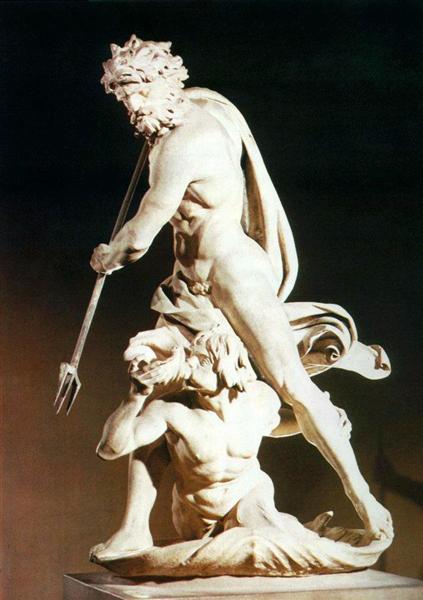
david-1624(4).jpg!Large

    “Neptune and Triton (1620 – 1622) 


          Gian Lorenzo Bernini


                ____________


              When Jupiter, surveying Earth from high,
              Beheld it in a lake of water lie,
              That where so many millions lately liv’d,
              But two, the best of either sex, surviv’d;
              He loos’d the northern wind; 


the new world begins


                                                       fierce Boreas flies
              To puff away the clouds, and purge the skies:
              Serenely, while he blows, the vapours driv’n,
              Discover Heav’n to Earth, and Earth to Heav’n. 


Boreas, ruler of the northern wind, as in 

aurora borealis, at the instigation of the

officiating Jupiter, disperses the clouds, 

drives away the vapours, allowing Heav’n 

to see Earth, and Earth  to see Heav’n, 

nothing between the earth and the 

clear blue sky


              The billows fall, while Neptune lays his mace
              On the rough sea, and smooths its furrow’d face. 


while billows fall, gusts of boreal wind, 

Neptune, god of the Sea, as well and 

simultaneously in the service of Jupiter

smooths the surface of the water by 

laying his mace, a club with spikes, 

upon it, to still the unruly waves


              Already Triton, at his call, appears
              Above the waves; 


Triton, son of Neptune, also a sea deity


                                           a Tyrian robe he wears; 


Tyrian, of Tyre, a city in what is now

Lebanon, but was then Phoenicia, it 

was famous at the time for its cloth 

of a particular colour, Tyrian purple


Tyre is one of the oldest continuously

inhabited cities in the world


              And in his hand a crooked trumpet bears. 


Triton is characteristically depicted 

with a conch shella crooked trumpet 


see above


              The soveraign bids him peaceful sounds inspire,
              And give the waves the signal to retire. 


[t]he soveraign, or sovereign, is none

other than Neptune, his father 


              His writhen shell he takes; whose narrow vent
              Grows by degrees into a large extent, 


writhen, twisted, contorted, as is typical 

of a conch shell, which grows from 

where one blows into it, by degrees,  

towards the much larger opening from 

which the sound emanates


              Then gives it breath; the blast with doubling sound,
              Runs the wide circuit of the world around: 


Triton blows into the conch, gives it 

breath, the blast [ ] doubling [the]

sound, resounding, reverberating, 

the world around, the world over


              The sun first heard it, in his early east,
              And met the rattling ecchos in the west.
              The waters, listning to the trumpet’s roar,
              Obey the summons, and forsake the shore.


the waters begin to recede


R ! chard


“Metamorphoses” (The Giants’ War, VIII) – Ovid

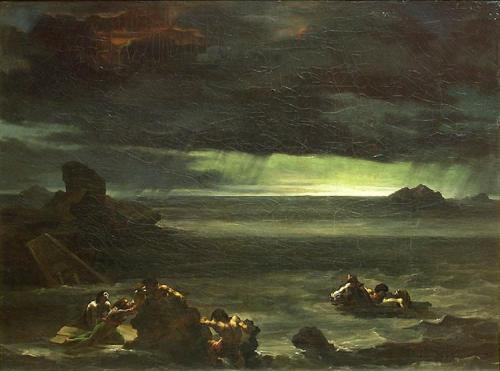
scene-of-the-deluge.jpg!Large

    Scene of the Deluge (1820) 


            Théodore Géricault


                    _______


following upon the threat of water,

rather than fire, to destroy the world

under the command of Jove, dutifully 

abetted by Neptune, his Olympian

brother, sea god himself, with his 

fleet of observant minions, the 

rivers, streams, waterways, the 

annihilating flood takes place


Ovid recounts


            The floods, by Nature enemies to land,
            And proudly swelling with their new command,
            Remove the living stones, that stopt their way, 


the living stones, you’ve got me there, 

these could only be stones as initial 

matter somehow contributing to the 

advent of an inherent life source, later 

activated, induced into vivifying action


we are dust, in other words, we return 

to dust, inert dust, however 

incomprehensibly


            And gushing from their source, augment the sea. 


the flowing rivers augment, enlarge, 

the growing sea, covering the land


          Then, with his mace, their monarch struck the ground; 


a mace is a club with metal spikes


          With inward trembling Earth receiv’d the wound; 


a comma after trembling here would 

make this line easier to read, “With

inward trembling, Earth receiv’d the 

wound”, but not everyone is as 

punctilious about grammar as I am


          And rising streams a ready passage found. 


streams easily found their way 

amidst the bracken, the shrubbery, 

the rushes, to overwhelm the 

otherwise quiescent pastures


          Th’ expanded waters gather on the plain: 


Manitoba, often, lately, in spring


          They float the fields, and over-top the grain;
          Then rushing onwards, with a sweepy sway,
          Bear flocks, and folds, and lab’ring hinds away. 


Bear here is a verb, not a noun, meaning 

that animals, flocks, and folds, and lab’ring

hinds, are carried away, borne away,

borne asunder 


          Nor safe their dwellings were, for, sap’d by floods, 


sap’d, sapped, deprived, weakened,

rendered unsuitable


          Their houses fell upon their houshold Gods. 


household Gods, icons, Lares or Penates

personally held by the Ancients, like we 

now keep pictures, tokens, of our own

particular, however often secular, 

rather than religious, idols


            The solid piles, too strongly built to fall,
            High o’er their heads, behold a watry wall: 


though tall, and apparently indestructible,

the solid piles are nevertheless submerged, 

the very recent South Asian tsunami, for

instance, or the Japanese one that 

provoked the nuclear incident that put an

end there to that earlier profoundly 

nationally integrated industry, if you’ll 

remember 


            Now seas and Earth were in confusion lost;
            A world of waters, and without a coast. 


water, water, everywhere, but the last 

thing you want to do is drink


next, how humans survive


stay tuned


R ! chard