Richibi’s Weblog

Just another WordPress.com weblog

Tag: Narcissus – son of Cephisus and Liriope

“The Story of Narcissus” (lll) – Ovid

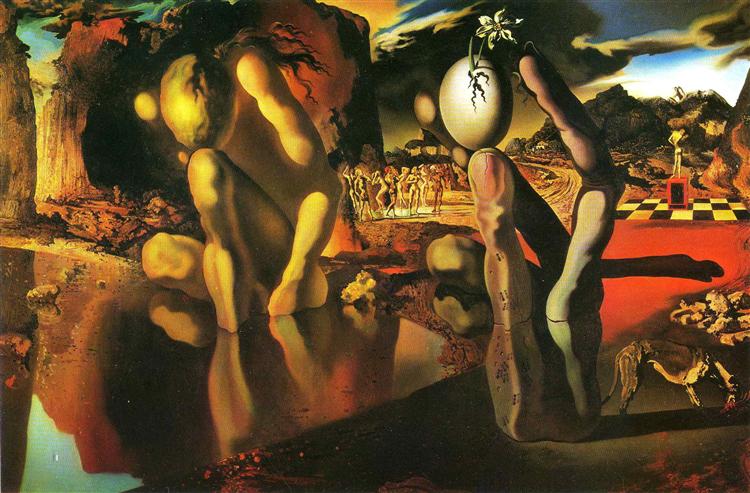
The Metamorphosis of Narcissus, 1937 - Salvador Dali


         The Metamorphosis of Narcissus” (1937)


                   Salvador Dali


                            _____


              This said, the weeping youth again return’d

              To the clear fountain, 


This said, you’ll remember that Narcissus

had pondered suicide, but was afraid that

such an act would also have an impact on

his reflection


                                          where again he burn’d;


burn’d, from the unusual fire that kindled
his breast


                His tears defac’d the surface of the well,

                With circle after circle, as they fell:


disfiguring reverberations in the water

from the tears


               And now the lovely face but half appears,
               O’er-run with wrinkles, and deform’d with tears.
               “Ah whither,” cries Narcissus, “dost thou fly?
               Let me still feed the flame by which I die;


the flame by which I die, the fire which

burns in his chest


              Let me still see, tho’ I’m no further blest.”


Narcissus will not willingly forego the

sight of his reflection though it will

manifestly not at all still his desire,

nor quell his fate


              Then rends his garment off, and beats his breast:
              His naked bosom redden’d with the blow,
              In such a blush as purple clusters show,
              Ere yet the sun’s autumnal heats refine
              Their sprightly juice, and mellow it to wine.


bruises the colour of wine blush in

purple clusters on his chest where

Narcissus has struck himself

repeatedly


              The glowing beauties of his breast he spies,
              And with a new redoubled passion dies.


The glowing beauties, the throbbing

discolorations left by the redoubled

blows


              As wax dissolves, as ice begins to run,
              And trickle into drops before the sun;
              So melts the youth, and languishes away,
              His beauty withers, and his limbs decay;
              And none of those attractive charms remain,
              To which the slighted Echo su’d in vain.


slighted, rebuffed


Echo, the nymph who’d pursued him,

in vain, if you’ll remember


su’d, sued, implored


              She saw him in his present misery,
              Whom, spight of all her wrongs, she griev’d to see.


spight, in spite


              She answer’d sadly to the lover’s moan,
              Sigh’d back his sighs, and groan’d to ev’ry groan:
              “Ah youth! belov’d in vain,” Narcissus cries;


to his reflection


              “Ah youth! belov’d in vain,” the nymph replies.


Echo can only echo


              “Farewel,” says he; the parting sound scarce fell
              From his faint lips, but she reply’d, “farewel.”


Narcissus, interestingly, is reproduced

not only visually in the water by his

own reflection, but audibly as well by

Echo‘s reverberating sounds


see above

              Then on th’ wholsome earth he gasping lyes,
              ‘Till death shuts up those self-admiring eyes.
              To the cold shades his flitting ghost retires,
              And in the Stygian waves it self admires.


Stygian, of the river Styx, which forms

the boundary between Earth and the

Underworld

              For him the Naiads and the Dryads mourn,


Naiads, water nymphs


Dryadstree nymphs


              Whom the sad Echo answers in her turn;


Echo also mourns


              And now the sister-nymphs prepare his urn:
              When, looking for his corps, they only found
              A rising stalk, with yellow blossoms crown’d.


corps, corpse, dead body


rising stalk, with yellow blossoms

crown’d, the narcissus, the flower


R ! chard

“The Story of Narcissus” – Ovid


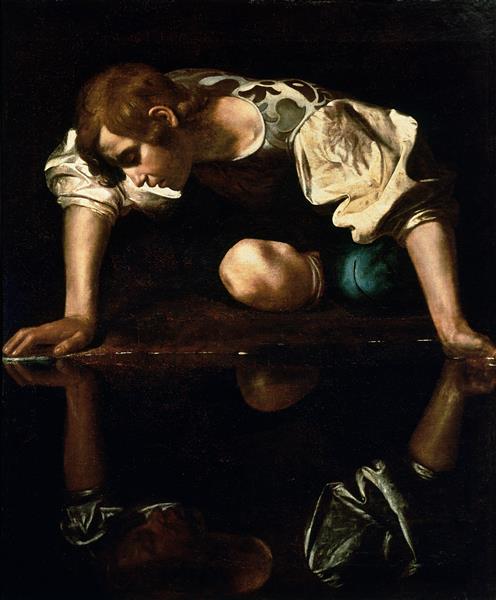
Narcissus, c.1599 - Caravaggio

          Narcissus” (c.1599)


                 Caravaggio


                       ______


               Thus did the nymphs in vain caress the boy,


the boy, Narcissus


in vain , Narcissus‘ pride, you’ll remember,

was such that love-sick maid[s] uselessly

[their] flame confess’d, Narcissus was

oblivious to their advances


He still was lovely, but he still was coy;
               When one fair virgin of the slighted train


slighted train, row of followers, love-sick

maid[s] who’d been spurned by Narcissus


               Thus pray’d the Gods, provok’d by his disdain,


provok’d by his disdain, angered by his

rejection


               “Oh may he love like me, and love like me in vain!”


beseeches the one fair virgin


               Rhamnusia pity’d the neglected fair,


Rhamnusia, goddess of Retribution,

also known as Nemesis


               And with just vengeance answer’d to her pray’r.


just vengeance, justified retribution


               There stands a fountain in a darksom wood,
               Nor stain’d with falling leaves nor rising mud;
               Untroubled by the breath of winds it rests,
               Unsully’d by the touch of men or beasts;
               High bow’rs of shady trees above it grow,
               And rising grass and chearful greens below.


bow’rs, enclosures among trees


greens, lawns, grasslands


               Pleas’d with the form and coolness of the place,
               And over-heated by the morning chace,
               Narcissus on the grassie verdure lyes:


verdure, greenness


               But whilst within the chrystal fount he tries
               To quench his heat, he feels new heats arise.


chrystal fount, glistening fountain,

or spring


               For as his own bright image he survey’d,
               He fell in love with the fantastick shade;


shade, apparition, illusion


               And o’er the fair resemblance hung unmov’d,


see above


               Nor knew, fond youth! it was himself he lov’d.
               The well-turn’d neck and shoulders he descries,


descries, espies, catches sight of


               The spacious forehead, and the sparkling eyes;
               The hands that Bacchus might not scorn to show,


Bacchus, god of Wine and Revelry, also

known as Dionysus


And hair that round Apollo’s head might flow;


Apollo, god of the Sun


               With all the purple youthfulness of face,
               That gently blushes in the wat’ry glass.


wat’ry glass, the chrystal fount


               By his own flames consum’d the lover lyes,
               And gives himself the wound by which he dies.


the wound, the sight of himself


dies, succumbs, is undone


               To the cold water oft he joins his lips,
               Oft catching at the beauteous shade he dips

               His arms,


shade, see above


                     as often from himself he slips.


slips, becomes abstracted, bewildered

 
               Nor knows he who it is his arms pursue
               With eager clasps, but loves he knows not who.


he cannot give substance to this illusion


What could, fond youth, this helpless passion move?

               What kindled in thee this unpity’d love?

 move, excite, indeed kindle[]


               Thy own warm blush within the water glows,


the poet, here, note, interjects, speaks

directly to Narcissus


               With thee the colour’d shadow comes and goes,


colour’d, because of the water, an exact

replication, even chromatically, but

shimmering, com[ing] and go[ing]


shadow, shade, see above, reflection


               Its empty being on thy self relies;


empty being, fabrication, imagined

construct


on thy self relies, you are yourself

the source of your illusion


               Step thou aside, and the frail charmer dies.


frail charmer, shimmering, insubstantial

illusion


stay tuned


R ! chard
“The Transformation of Echo” – Ovid

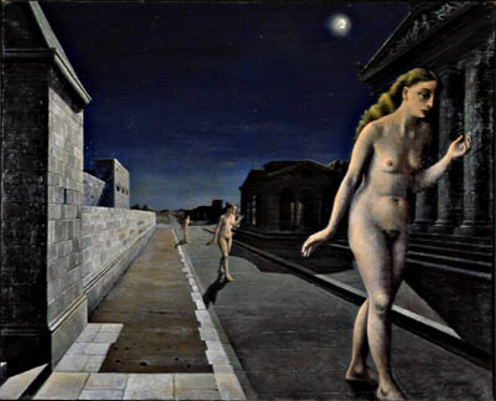
Echo, 1943 - Paul Delvaux


        “Echo” (1943)

           Paul Delvaux


                _______


Fam’d far and near for knowing things to come,

             From him th’ enquiring nations sought their doom;


him, Tiresias, the prophet, if you’ll

remember


their doom, their auguries, their

fates, their destinies


             The fair Liriope his answers try’d,


Liriopea water nymph, a naiad


             And first th’ unerring prophet justify’d.


justify’d, gave credence to, believed


             This nymph the God Cephisus had abus’d,


Cephisusa river god


             With all his winding waters circumfus’d,


circumfus’d, surrounded, enveloped


And on the Nereid got a lovely boy,


the Nereid, Liriopedaughter of Nereus,

god of the Sea, in Dryden’s, inaccurate

however, translation of Ovid, Liriope is,

rather, a fresh water nymph, a naiad,

not listed among the fifty, fifty, I say, 

daughters of Nereus, the Nereids,

sea nymphs


Whom the soft maids ev’n then beheld with joy.


soft maids, sister, the other 49,

presumably, Nereids


             The tender dame, sollicitous to know

             Whether her child should reach old age or no,

             Consults the sage Tiresias, who replies,

             “If e’er he knows himself he surely dies.”


The tender dame, Liriope


“If e’er he knows himself he surely dies.”,

typically cryptically for a prophecy, see,

for instance, your daily horoscope


             Long liv’d the dubious mother in suspence,

             ‘Till time unriddled all the prophet’s sense.


in the depth of time, all is revealed

             Narcissus now his sixteenth year began,


Narcissus, son, however illicit, of

Liriope and Cephisus


             Just turn’d of boy, and on the verge of man;

             Many a friend the blooming youth caress’d,

             Many a love-sick maid her flame confess’d:


I’ve noted that beautiful people are

pursued by men and women, be 

that beautiful person either a man 

or a woman, a situation they have 

to ever undergo, if not even endure


             Such was his pride, in vain the friend caress’d,

             The love-sick maid in vain her flame confess’d.


pride, independence, personal

distance

             Once, in the woods, as he pursu’d the chace,

             The babbling Echo had descry’d his face;


Echo, a mountain nymph


babbling, like water rippling


descry’d, espied, caught sight of


             She, who in others’ words her silence breaks,


who can only speak when others have

spoken


             Nor speaks her self but when another speaks.


Echo‘s curse since time immemorial


             Echo was then a maid, of speech bereft,


bereft, deprived


             Of wonted speech;


wonted, usual, habitual, ordinary


                             for tho’ her voice was left,

             Juno a curse did on her tongue impose,

             To sport with ev’ry sentence in the close.


To sport with, have fun with


in the close, at the end


             Full often when the Goddess might have caught

             Jove and her rivals in the very fault,


the Goddess, Juno / Hera, wife of

Jove / Jupiter / Zeus, God of gods


             This nymph with subtle stories would delay

             Her coming, ’till the lovers slip’d away.


it is interesting to note that not only

Echo, but any, in such a culture of

many gods, would’ve had to choose

among them, despite their, however

divine, individual inconsistencies, 

to the sure detriment of any mortal

caught in the middle, personal guilt

wouldn’t’ve been as foundational a

driving element, therefore, in such

a culture as it would be under

monotheistic religions, where the

moral path is categorically ordained,

specifically determined, as in, for

instance, the Ten Commandments,

but Fate, rather, or the will of the

gods, however frivolous, plays a

much larger role there, we are

putty in this alternate theological

universe, in the hands of

essentially disinterested deities


             The Goddess found out the deceit in time,


The Goddess, Juno / Hera, wife of
Jove / Jupiter / Zeus, God of gods


             And then she cry’d, “That tongue, for this thy crime,

             Which could so many subtle tales produce,

             Shall be hereafter but of little use.”


one would think that Jove / Jupiter /

Zeus, the instigator, might’ve had

something to say about that, though

the challenger be his wife, but he

doesn’t


Hence ’tis she prattles in a fainter tone,

             With mimick sounds, and accents not her own.


a mere shadow of her former self


see above


             This love-sick virgin, over-joy’d to find

             The boy alone, still follow’d him behind:


the pining of a woman for a man

without moral judgment in a

theological text is radical in our

monotheistic tradition, where

lust, voluptuousness, in either

direction, have been the work

of the Devil, not the natural

inclination, brought on by very

springtime, instinctive, rather

than premeditated or predatory,

that more pantheistic belief

systems present


When glowing warmly at her near approach,

             As sulphur blazes at the taper’s touch,

             She long’d her hidden passion to reveal,


long’d, desired, hoped, wished for


             And tell her pains, but had not words to tell:

             She can’t begin, but waits for the rebound,

             To catch his voice, and to return the sound.


Echo cannot voice, begin, her own

words, sentences, needs an already

vocalized statement, a prompt, in

order to utter whatever, is therefore,

before Narcissus, her intended, her

desired, ever mute


             The nymph, when nothing could Narcissus move,

             Still dash’d with blushes for her slighted love,


dash’d, undone, thrown asunder


             Liv’d in the shady covert of the woods,

             In solitary caves and dark abodes;

             Where pining wander’d the rejected fair,


or Where the rejected fair, Echo,

wander’d pining


             Till harrass’d out, and worn away with care,

             The sounding skeleton, of blood bereft,


sounding skeleton, reverberating

remains, resonating essence


see, again, above


             Besides her bones and voice had nothing left.


Echo, the entity itself, herself,

barren, indeed bereft


             Her bones are petrify’d, her voice is found

             In vaults, where still it doubles ev’ry sound.


listen, you’ll hear it, despite the

intervening centuries


R ! chard