Richibi’s Weblog

Just another WordPress.com weblog

Tag: “My Last Duchess”

“Monet Refuses the Operation” – Lisel Mueller‏

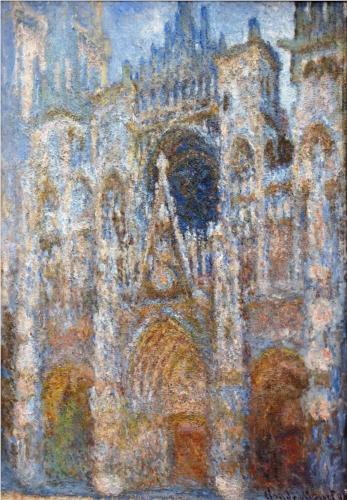
Claude Monet - "Rouen Cathedral, Magic in Blue"

Rouen Cathedral, Magic in Blue (1894)

Claude Monet

______

up until now I’ve presented dramatic
monologues
, but only to music, on my
blog
, referring to Robert Browning as
their originator, but not ever producing
any representative spoken work, never
mind any of, themselves, the poet’s
seminal masterpieces, My Last
Duchess
“, “Fra Lippo Lippi“, “How
They Brought the Good News from
Ghent to Aix
“,
for instance, which,
granted, can be daunting now in their
breadth and erudition, the Romantics
didn’t have television, they had to
entertain themselves

here’s a poem for our time, written
in 1996, only two decades ago, gasp,
Lisel Mueller imagines herself Claude
Monet
, an easier concept, after all,
who’s been to Ghent or Aix, why
would anyone want to run there,
whereas Monet‘s another story, who
doesn’t today know Monet

Monet was blind at the end of his life,
one learns from the website where I
got this
, a blog with plenty of breadth
and already considerable erudition, he
received corrective surgery to be able
to continue with his work

there was, however, a limit

Monet Refuses the Operation

Doctor, you say there are no haloes
around the streetlights in Paris
and what I see is an aberration
caused by old age, an affliction.
I tell you it has taken me all my life
to arrive at the vision of gas lamps as angels,
to soften and blur and finally banish
the edges you regret I don’t see,
to learn that the line I called the horizon
does not exist and sky and water,
so long apart, are the same state of being.
Fifty-four years before I could see
Rouen cathedral is built
of parallel shafts of sun,
and now you want to restore
my youthful errors: fixed
notions of top and bottom,
the illusion of three-dimensional space,
wisteria separate
from the bridge it covers.
What can I say to convince you
the Houses of Parliament dissolve
night after night to become
the fluid dream of the Thames?
I will not return to a universe
of objects that don’t know each other,
as if islands were not the lost children
of one great continent. The world
is flux, and light becomes what it touches,
becomes water, lilies on water,
above and below water,
becomes lilac and mauve and yellow
and white and cerulean lamps,
small fists passing sunlight
so quickly to one another
that it would take long, streaming hair
inside my brush to catch it.
To paint the speed of light!
Our weighted shapes, these verticals,
burn to mix with air
and change our bones, skin, clothes
to gases. Doctor,
if only you could see
how heaven pulls earth into its arms
and how infinitely the heart expands
to claim this world, blue vapor without end.

Lisel Mueller

Richard

psst: thanks Brain for this beautiful poem

“Ambush at Five O’clock” – Stephen Dunn‏


from the New Yorker, February 3, 2014

Ambush at Five O’clock

We were by the hedge that separates our properties
when I asked our neighbors about their souls.
I said it with a smile, the way one asks such a thing.
They were somewhat like us, I thought, more
than middle-aged, less dull than most.
Yet they seemed to have no interest
in disputation, our favorite game,
or any of the great national pastimes
like gossip and stories of misfortunes
about people they disliked.

In spite of these differences, kindred
was a word we often felt and used.
The man was shy, though came to life
when he spotted an uncommon bird,
and the woman lively, sometimes even funny
about barometer readings and sudden dips
in pressure, the general state of things.
We liked their affection for each other
and for dogs. We went to their house;
they came to ours.

After I asked about their souls
they laughed and stumbled towards an answer,
then gave up, turned the question back
to me. And because I felt mine always was
in jeopardy I said it went to the movies
and hasn’t been seen since. I said gobbledy
and I said gook. I found myself needing
to fool around, avoid, stay away from myself.

But my wife said her soul suffered from neglect,
that she herself was often neglectful
of important things, but so was I.
Then she started to cry. What’s the matter? I asked.
What brought this on? She didn’t answer.
I felt ambushed, publicly insensitive
about something, whatever it was.

It was a dusky five o’clock, that time
in between one thing and another.
Our neighbors retreated to their home,
but the women returned
and without a word put her arms
around my wife as if a woman weeping
indicated something already understood
among women, that needn’t be voiced.
They held each other, rocked back and forth,

and I thought Jesus Christ, am I guilty again
of one of those small errors
I’ve repeated until it became large?
what about me? I thought. What about
the sadness of being stupid?
Why doesn’t her husband return
with maybe a beer and a knowing nod?

Stephen Dunn

____________

poetry is a conversation, of course, a poet
has with all the other poets who’ve come
before him, her, here Dunn is evidently
channelling Robert Browning, “This is
my last Duchess”,
Browning writes,
“painted on the wall / Looking as though
she were alive.”,
from his My Last
Duchess
“,
a poem I’ve never forgotten,
wherein the speaker discusses the
portrait of his earlier wife, one he’d
summarily purportedly got rid of

Robert Browning had learned his craft,
the dramatic monologue, from, of course,
Shakespeare, down to even its dramatic
content

Elizabeth meanwhile had been inspired
rather by Shakespeare’s sonnets, by his
thee, thy, thine, and thou’s

in Dunn the Browningian drama is
significantly less dour, nobody out and
out dies, though the dilemma is never
not existential, however less morally
compromised, less psychologically
and tragically fraught

neither does Dunn rhyme

but that just sends us back to Homer
of course, less epic, more, maybe,
middle class, very, and distinctively,
XXlst Century

but that’s how you read between the
lines, the verses, in this case, and
thus across the centuries

poetry is a conversation

Richard