Richibi’s Weblog

Just another WordPress.com weblog

Tag: Mozart

Maria Mazo‏


if Mozart had written nothing other
than his piano concerto no 21 in C
major
, he would have still been
famous, its adagio is resplendent,
written even in our DNA, time stops,
one enters an epiphany

Maria Mazo could win the Rubinstein
Competition
for her interpretation of
this iconic piece

wow

watch, just click

Richard

Mozart piano sonata no 11, in A major, K 331

again my especially musically erudite friend,
Norm, has returned with a catchy morsel, a
popularized version this time of the third
movement, the Alla Turca“, of Mozart’s
piano sonata no 11, in A major, K 331
,
possessed by the glitzy spirit, in this
outing
, of Las Vegas

these whet my appetite always for the entire
meal, the source from which these playful
tidbits originate, like an ebullient tributary
returning to its more elementary, and
profound, as it were, spring, a lost child
needing to return to its place of origin
for direction and validation

Mozart, you’ll note, is not Beethoven, though
he might be a not inconsequential Mozart, I
think of his stuff as music for the nursery,
toy soldiers and rocking horses, dairy maids
and cuckoo clocks, not at all to inform but to
delight, the musical structure is foursquare,
lilting ever, and entirely comprehensible,
Mozart just wants to have fun, with here
and there a nod to melancholy, perfect, I
would think, for a powdered and pampered,
though pilloried eventually, indeed
guillotined then, court

the first movement, you’ll remark, is a set
of variations, a bit of a novelty still during
this period, 1778 to 1783 approximately,
the date of composition is not precisely
known, which allowed for, of course, a
variety of styles, voices, to be flaunted
in one only section of a work, instead
of the usual call and response of,
ordinarily, the traditional movement,
extending already, incidentally, the
possibilities of the sonata form, which
later composers would make much
use of

neither of the next movements are
slow, Mozart, as I said, just wanted
to essentially enjoy himself, or his
sponsors did, music did, that’s
what they payed him for

but the times they were a’ changing

as indeed they still are

Richard

psst: thanks Norm

Schubert – Piano Sonata D959‏

to my utter surprise when I checked I’d never
but only once in the many months I haven’t
been able to shut up since I started spouting
my bristling endorsements, like a very rushing
river gushing with the overflowing bounty of
an inveterate spring, mentioned Schubert, an
incandescent voice from surely heaven

it was about his String Quartet in C major, the
D956, not surprisingly, it is utterly enchanting,
D for Otto Erich Deutsch still, incidentally

here’s an alternate version of it, an utterly
inspired one

but if I’ve reintroduced Schubert it’s specifically
this time to compare him with Beethoven, they’re
easily confounded, I even did it once myself, to
my crushing embarrassment, in erudite and
unflinching company, oof, I cringe to even
remember it

the D959, moments only after the 956 of course,
has all the idioms of a Beethoven, and exercises
them as expertly, the beat, however, is always
on, unlike Beethoven, whose beat is always off,
contrary, rebellious, against the prevailing
order

though this variance might seem slight, one
senses already in the younger and later
Schubert a return to form, elegance, and civility,
the First Empire had indeed taken hold during
the transformation of Napoleon from hero of
the Revolution to a different incarnation of
Emperor, Chopin as well would be beholden
to later similarly reinstated French courts

so seemingly trivial an alteration speaks
volumes when one attentively listens, one
must do this with one’s heart

such a return to aristocratic principles is not
uncommon, incidentally, we seem, indeed, to
thirst for dynasties, if you’ll note the return of
late, of the Bushes, the Clintons, and most
recently the Canadian Trudeaux

Putin is another, though arguably somewhat
less democratic, version of that principle

Beethoven is off the beat then, Schubert on, you
won’t find much else that’s different upon first
listening, you’ll note only that their music is very
much the same, rigorous beat, tonal, essentially,
harmonics, and the return eventually of the
melodies, Classical imperatives, but with the
distinction of the new Romantic,
transformational however, sensibilities

Schubert might’ve even outpaced Beethoven
had he survived, I think, but he didn’t, he died
much too young, at the most tender age of
only 31, younger even than the more
celebrated Mozart, famous for succumbing
prematurely at the still early age of 36

may they rest, may they all rest, Schubert,
Mozart, and the somewhat longer-lived
Beethoven, still early deceased at 56, in
eternal peace, for they have brought us
but wonders

Richard

psst: here’s a movie to go with the earlier
Schubert
, The Company of Strangers“,
the very best film Canada has ever had
to offer, bar none, a gaggle of old women
are stranded in the Laurentians after their
tour bus breaks down, Schubert would’ve
loved it

and been honoured

Beethoven piano sonata no 28 in A major, opus 101

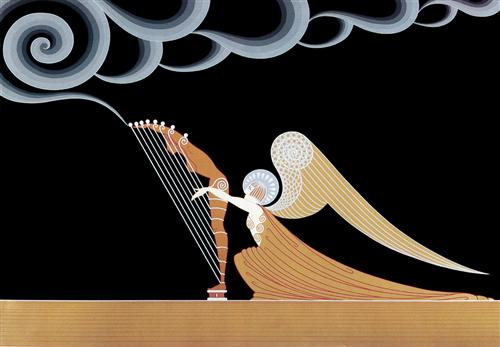
Erte - "The Angel"

The Angel

Erte

___

Beethoven’s piano sonata no 28, opus 101,
in A major
, is the first of what is considered
to be his late piano sonatas, as opposed to
early and middle, three entirely distinct
periods that are easily recognizable upon
closer listening, the early ones are bold,
even headstrong, with Beethoven’s ever
characteristic vigor and Promethean authority,
the length themselves of his early works are
a testament to his sense of his own great
personal validity, the first four, to my mind,
go on much longer than often enough they
should, a typically youthful presumption on
his part, and are musically at best trite, I find,
after their first expositions, the repeats come
as redundant, and tolerable merely, surprises,
even the famous 8th, the Pathétique“, opus 13,
is, I think, too brash and impudent, however in
this manner, nevertheless admittedly, entirely
effective, listen

the Pastorale“, of the middle period, opus 28,
no 15
, is where I deem the music to become
henceforward sublime, it has a settled
confidence that brims with not only technical
wizardry but with also positively enchanting
and entrancing musical ideas, bursting like
very flowers in springtime, with colour and
inspired, effervescent, imagination

the late period is where Beethoven becomes,
however, a sage, a prophet, and indeed a
hierarch in the new secular order of a
reconstituted Heaven, after all, someone
had to take the place of the now discredited
angels, Nietzsche called them Übermenschen,
Supermen

the 28th sonata starts out slowly, or rather,
more slowly than the earlier forthright ones,
already a sign of less physical, more
measured and considered reponses, my
impression here is of a grandfather visiting
his granchildren, jovial but not too disportive,
merely jaunty, always cheery but for a moment
of haunting melancholy, at the adagio, before
becoming congenial and avuncular again,
with then a big, boastful ending, snapping
staunchly his patriarchal suspenders,
getting the last, and traditional, word, with
a firm, which is to say, a foursquare-major-
chord, finish, the aural equivalent of turning
out the lights

musically, however, the progressions are
exploratory, incremental, more and more
layered with possible, and often apparently
rejected outcomes, in order to try out
something more fitting, maybe, more
accurate, a deconstruction, in other words,
of musical ideas, an investigation, in search
of a viable musically cohesive path

in the 28th sonata Beethoven, I think, is
doodling, however, coming up with the
methods of his great addresses, the
language here is not yet philosophically
precise, a smattering merely of pianistically
plausible ideas, musical sketches, the first
stirrings here, you’ll gather, of formal jazz

in the next sonata, the 29th, the still
unsurpassed “Hammerklavier”, he writes
the definitive book, speaking for music in
the forthcoming history of the world, and
determining its future path, we are still
moving along on his transcendent carpet,
no one ‘s come along still to give us a
more assured ride, kind of like Homer,
some would say Shakespeare, others
Albert Einstein, other, incidentally,
post-Christian, post Revolutionary
Supermen

who do you presently pray to, who are
your angels, who your Superwomen,
-men,
towards what do you aspire,
towards whom

Superwomen, -men, incidentally,
cultivate their own efflorescence,
manifest their own, I think, destinies,
or, if you like, their own Heaven

much as I believe angels also do

Mozart’s Fantasy in C minor on the
same program
shows him in a nearly
Beethovenian mode atavistically, much
more somber than he usually is, but he’s
nevertheless easily distinguished by
his much less intricate musical
accompaniment and his much more
rigorous melodic line, you’re more
likely to hum it

Mozart also composes from the nursery,
I find, the exhilaration of playful discovery,
you can see the toy soldiers, the golden
tresses on little milkmaids in dirndls with
red circles for cheeks

Mozart’s pieces are like nursery rhymes

Beethoven progresses to literature

before you judge me too harsh on Mozart,
by the way, consider that my favourite
piece of the two in this program is the
Mozart, it’s like comparing apples and
oranges, though, it depends on your
mood that day which you’ll favour

cheers

Richard

psst: just in case you missed it, this version
of the Pathétique is the best I’ve ever
heard, indeed, of all the pieces here
the most extraordinary, don’t miss it
Chopin Preludes, opus 28‏

you will remember surely preludes from Bach’s
Well-Tempered Clavier, but as indeed an
introduction to, there, fugues  
 
it might be interesting to note that preludes
were originally ditties instrumentalists cooked up,
spontaneously and improvisationally, to warm up
and tune their muse, one would expect the form
then to be short, sweet and pithy
 
and, by definition, unfinished, which is why Bach
added the fugue  
 
Chopin in 1839 gets them to stand alone, they 
have become by then of course entirely stylized,
less improvisational than formal  
 
Chopin gives them their rightful eminence by simply
validating their claim to the role, they have no trouble
at all standing forthrightly in the footlights, and are
even still individually commanding, unblemished yet
by the infelicities of most lacerating time   
 
like Bach they are still an intellectual exercise, there’s
a prelude for every key, all 24 of them, major and minor, 
like the “Études”, they are technical challenges to the
pianist, an Everest to climb, the work of an eminently
able nevertheless practitioner who didn’t shirk at 
challenging himself heroically, though surely goaded
by the most magnanimous, if unrelenting, of gods
 
others of course took up the contest for the sake of
both the prestidigitational Olympics his compositions 
represented as well as for itself the rapturous music, 
works for the deftest of fingers as well as for the
newly stranded, existentially unfettered and
hungering, 19th-Century soul   
 
you’ll note the humanity that didn’t appear in Mozart,
the intensely emotional appeal of both a more ardent
fury, a tip of the hat here to Beethoven, and a more
melting, sentimental tone  
 
 
incidentally I find Chopin infinitely more aristocratic
than Mozart ever, despite being the epitome of the
more democratic Romanticism, whereas it had been 
the more unruly Mozart who’d written for the
“Classical” courts 
 
Haydn is temperamentally the only other so courtly
composer, appropriately and most efficiently fitting
in his case his own Classical mold, even up until now,
no others have had that distinct personal pedigree 
 
 
allow me to submit my prose therefore to your most
good and gentle graces, as well as the illustrious
music contained therein
 
 
yours
 
Richard 
 
psst: here‘s a version played in a castle, noteworthy
         for its aristocratic allusions not to mention its
         accomplished artistry   


Debussy’s “Études”

 Man with a Guitar - Georges Braque
 
                    Man with a Guitar (1914)
 
                               Georges Braque 
 
                                       ______
 
 
while we’re on the subject of études, listening to 
hundred years later, 1830s to 1915, would prove
instructive, I deemed 
 
picture me deeming, August 3, 2012, my brow
just slightly pensively constricting 
 
 
if the basis of music as defined by the Classical
period depended on beat, tonality, and the repetition
of the tune, usually of both musical statements, these
apparently essential components of course would be
the first places to bear the scrutiny of probing musical
minds, seeking to find, seeking to set more expansive,
more profound dimensions to the areas of their quest,
that’s what artists do 
 
and this of course is exactly what happened starting
with Beethoven, by the time of Chopin music had
relaxed its stricter Classical rhythmic precision,
allowing great expansive gestures in the more
malleable tempi, tempos, producing the effect of
more compassion and soulful examination than
the earlier less indulgent, more disciplined code
 
the fact of having musical tapestries, sound patches,
take the place of melody, narrative, in the musical
presentation of Chopin also suggests a more
diversified, dare I say prismatic, telling, than the 
linear account of for instance Mozart‘s solitary
tuneful wanderer
 
it also evokes incidentally the vagaries of the
inconstant heart rather than its unflinching
condemnation, a repudiation of atavistic
Christian ecclesiastical intolerance 
 
 
by the time the old order was about to be extinguished,
in 1915, at the onset of the First World War, Debussy’s
Études, like Chopin 12 of them per set, had seen
social injustice – see Charles Dickens, see Émile Zola,
see Karl Marx – the improbable discoveries of science –
Darwin, Freud, Einstein – the car, the airplane,
photography were changing everything, the old
paradigms no longer applied, were irrelevant, even
harmful, in this new context, the First World War 
would prove all that 
 
in the language of music, tempo, melody, repetition
would be inevitably subverted
 
Debussy produces erratic tempi, foregoes melody for
harmonic exploration, combining incidentally the
musical patches of Chopin with the intellectually
driven investigations of Beethoven for a more
cerebral understanding of music, a music for the
head, with expert displays of pianistic skill, indeed
prestidigitation, for, along with the intellectual
rigour, spectacle  
 
is this then still music 
 
is Post-Impressionist painting still art  
 
what would 1915 have said
 
 
above is Georges Braque‘s nearly contemporary, 1914,  
 
man with a guitar, who’d a thunk it
 
 
Richard


Chopin: “Études”, opus 10

if I haven’t brought up Chopin much in this series
it’s that I think of him more as a decorator than
as an innovator, he was developing a sensibility
that had been defined by the earlier Beethoven,
adding texture and style, form instead of function,
the wheel had been invented, now it remained to
be artfully applied
 
some break new ground, others decorate it, make
it enchanting, Chopin makes things enchanting 
 
he is also the first composer we think of when we
think of Romanticism, which says quite a lot about
the quality, the universality, of his gift 
 
 
here are his opus 10, “Études”, or “Studies”, 12 of
them, they are not sonatas, for not having more
than one movement, they are “études” , “studies”,
called by that name for being what they are, then
given numbers to differentiate them, also their
key, the convenience of universally attributing
titles not having quite caught on yet though a
couple of these do have them, the 5th, the
“Black Keys”, for obvious reasons, and the last,
the “Revolutionary”, again for reasons you’ll find
obvious once you’ve heard it 
 
tonality however remains, no apparent discords,
that’ll come later  
 
 
note that in comparison to Mozart the notes are
a shimmer, the same alphabet is used, the one
set up by Bach, but where Mozart made these
into narratives to follow, and even sing along to,
with Chopin the same flurry of notes becomes
a wash of sound you could never vocally keep
up with, a texture rather, an enveloping caress,
prefiguring incidentally the Impressionists, the
lush soundscapes of for instance Debussy 
 
 
though you’ll find the same prerequisite opening
musical statement as in Mozart, followed by the  
contrasting one, often these will be in altogether
constrasting rhythms as well, tempi, compared
to the single strict beat throughout of the 
foundational Classical model    
 
the tempo itself is also much more lax, some
passages surrendering formal rhythmic strictures
to greater emotional content, more self-expression,
less attention to rules, in accord with the newly
installed ideal of individual human rights 
 
hence Romanticism, the fruit of the Revolution 
 
 
note also that the musical argument is no longer
in the Mozartean playground but of a more mature
understanding, Chopin has known love 
 
 
Richard


XVlll. I never gave a lock of hair away – Elizabeth Barrett Browning

from Sonnets from the Portuguese

XVlll. I never gave a lock of hair away

I never gave a lock of hair away
To a man, Dearest, except this to thee,
Which now upon my fingers thoughtfully
I ring out to the full brown length and say
“Take it.” My day of youth went yesterday;
My hair no longer bounds to my foot’s glee,
Nor plant I it from rose- or myrtle-tree,
As girls do, any more: it only may
Now shade on two pale cheeks the mark of tears,
Taught drooping from the head that hangs aside
Through sorrow’s trick. I thought the funeral-shears
Would take this first, but Love is justified, –
Take it thou, – finding pure, from all those years,
The kiss my mother left here when she died.

Elizabeth Barrett Browning

_______________________________

with her one word, “this”, peremptory and indicative,
Elizabeth anchors us to a common present, making
us witness to the scene, a scene of the most tender
intimacies

these effortlessly transcend by their apparent
urgency and truth the usual meter of a sonnet,
leaving in the dust however always only perfect
rhymes, like wooden sentinels left twirling in too
strong a wind

enough of them however to constitute a poem

or what’s a poem

the same kind of thing happens in the history
of music, where notes skip deftly over a bar
without even the semblance of an
acknowledging curtsy, caught up in the more
compelling reality of their vivid and impetuous
imagination, like children who haven’t learned
quite all the rules yet

in Mozart, his piano sonata in D major, K576,
here for instance, the incorrigible child is
ever even present, even ever evident

both poets reflect a search for greater
authenticity, challenging established ideas
of beauty in its unending deliberation with
truth, see Keats on this irreducible dichotomy

Richard

XVll. My poet, thou canst touch on all the notes – Elizabeth Barrett Browning

from “Sonnets from the Portuguese

XVll. My poet, thou canst touch on all the notes

My poet, thou canst touch on all the notes
God set between His After and Before,
And strike up and strike off the general roar
Of the rushing worlds a melody that floats
In a serene air purely. Antidotes
Of medicated music, answering for
Mankind’s forlornest uses, thou canst pour
From thence into their ears. God’s will devotes
Thine to such ends, and mine to wait on thine.
How, Dearest, wilt thou have me for most use?
A hope, to sing by gladly? or a fine
Sad memory, with thy songs to interfuse?
A shade, in which to sing – of palm or pine?
A grave, on which to rest from singing? Choose.

Elizabeth Barrett Browning

______________________

it is to be remembered that Robert Browning at the
time was considered a poet of growing authority
though Elizabeth herself had not been of no
consequence, and her star was not to lose its
brilliance in the literary firmament throughout her
lifetime and beyond, but Robert was a man and
benefited therefore from greater consideration
than would’ve then a woman, a not unfamiliar
situation even now

the institutional role of women was pretty well
the one that Elizabeth naturally took on, when
women had no other recourse but to be
dependent, if not graced with comfortable
independent means, which in fact Elizabeth
was

with such an unmistakable gift as hers, however,
I can’t imagine that beyond the genuine love she
manifests for her husband throughout her poems
she would have been unaware of her own
considerable worth, ever granting that love can
be even ever so blind, my own love for instance
riding each morning for me preternaturally and
however improbably the very chariot of a
blinding, mesmerizing, sun

“Choose” though, she at the very last commands,
striking again a telling imperative

note the elision of the rhyme through several
verses in the poem giving the lines a momentum
that lets the poem fly, making the matter
compelling, urgent

compare Mozart soaring above the bar lines
when the piano is comparably unleashed, to
let the music make a similar irrepressible magic

prose is finding its way into poetry here, poetry
conversely into prose

Richard

Mozart – Clarinet Quintet in A major, K581

there are several reasons for which Classical music
is called Classical, the word itself suggests a standard – 
austere, concise, clear, rigorously authoritative – nearly
like mathematics 
 
and such is the music of Mozart, and most others, even
into Romanticism
 
despite the flurry of iridescent notes filling vaults of
effervescent atmosphere, like the apparent serendipity
of so many flights of birds that describe music for us in
our own heavens, you’ll hear a tune, then another
constrasting one, then you’ll hear both of them all over
again, not much different from a song’s refrain and verse,
except that the verse is not new but like the refrain a
repetition 
 
both repetitions usually will have some embellishments,
and sometimes the repetitions are in a divergent order,
but the idea remains the same, you’ll always hear again
what you heard at the beginning no matter how far away
you’ve strayed
 
this foursquare structure is at the basis of music
 
nearly like mathematics
 
 
beat remains also essential, a peremptory component of
what it means to be music in the Classical Age, despite
the leeway now given by a revolutionary it would turn
out fortepiano  
 
Mozart doesn’t sway from the tempo he imposes on a
movement, does so even categorically, otherwise would
be louche, disruptive, in an age of order 
 
 
in the last movement of his Clarinet Quintet in A major,
however, K581, he has his way with that proscription by
making the movement a set of variations, which allow
him, of course, to on a theme display an array of melodic
options, irrelevant of coherence of pace, to test the
boundaries of what it means to be within the larger
musical structure one of its movements 
 
a path is thereby forged to a new understanding
 
 
he gives us also here another new invention, the
addition of a clarinet to the usually set quartet – two
violins, a viola and a cello – that was then the staple
of chamber music essentially 
 
nor can I think of an earlier Clarinet Quintet 
 
you’ll find this unassuming, usually more reclusive, 
wind instrument to be an utterly inspired addition
to even the most vaunted sounds of even this most
silken string quartet
 
 
Richard