Richibi’s Weblog

Just another WordPress.com weblog

Tag: Mozart

mass appeal, or “Missa Solemnis”, opus 123 – Beethoven
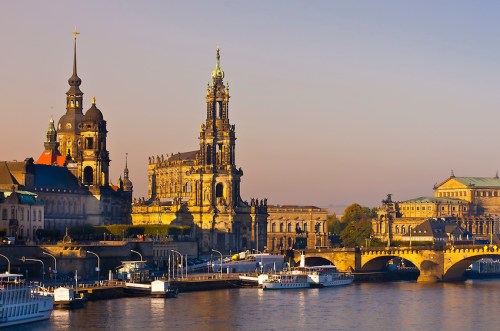
Hofkirche (Dresden Cathedral) and the Elbe River, Dresden, Saxony, Germany

    from the centre, the Hofkirche, the Dresden Cathedral, across from the 
    Augustusbrückeor Augustus Bridge, extends into the Zwinger, one  
    of three only palaces in Europe, along with Versailles and Vienna’s 
    Schönbrunndistinctly horizontally to the right, not to be confused 
  with a crook in the Cathedralan intolerable, were it so, ecclesiastical  
   gaffe, it ‘s now become one of the most significant art galleries in  
   Europe, the green rooves, to the right still, are the Semperoper‘s, the   
  black roof, nestling before it, an unforgettable Italian
  restaurant 

  before it all, majestically, the Elbe

        _______

from the very Semperoper in Dresden,
where I’ll ever remember seeing the 
worst “Barber of Seville” I’ve ever seen,
first balcony, left of centre, Figaro came 
out on a motorcycle, I ask you, it was 
downhill after that, my mom, beside 
me, was falling even asleep, we left at 
intermission, soldiered on to a 
restaurant overlooking the Elbe, Italian
if I remember, but utterly more enjoyable 
than the disappointing operatic option, 
there might even ‘ve been a moon at our 
tableside window, picturesquely 
shimmering on the river

but, hey, we both would‘ve stayed,
incontrovertibly, for this performance
Beethoven’s Missa Solemnis“, a late, 
and towering, entry, 1823, in his opus 
– second definition of that word, which 
is to sayhis entire output, all 135 
opuses, first definition there, discrete 
compositions – plus all his works 
without opus – first definition again – 
numbers, WoO

the plural of opusincidentally, can 
also be, both meanings, opera, just 
to confuse things, I use either
interchangeably, according to my 
narrative rhythm

 
missae solemnes, plural of missa 
solemnis, are a particularly Catholic
form of music, going back to the 
very Middle Ages, at which point 
religious art was all that really 
mattered, anything else was entirely
peripheral, of no consequence 

but Catholicism, and its Protestant
offshoots, which is to say, their 
common Christianity, remained 
culturally entrenched during the 
process of their slow disintegration

Nietzsche would, later, take care 
of that, but that’s another story

Beethoven, Mozart, Catholics, if, 
either, only by name, delivered 
missae solemneswhile Bach, 
Handel, both Protestant, 
delivered oratorios, with some 
intermingling

about which, later

Catholic, Protestant expression still
find, even strong, exponents at 
present, though the form is, 
essentially, outdated, our anthems 
are national, now, mostly, if even 
somewhat, that, halfheartedly, when 
notparadoxically, searchingly, 
hopefully, and maybe even
revolutionarily, again, ideological

imagine Imagine for instance, as 
suchjust click


R ! chard

“Caprices” for Solo Violin – Paganini

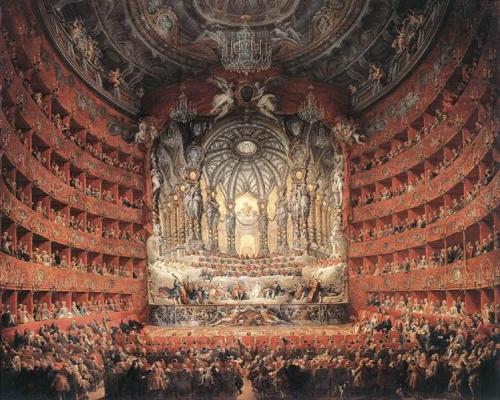
musical-f-te-1747.jpg!Large

    “Musical Fête (1747) 

           Giovanni Paolo Panini

                        ____________

though by now you must be assuming 
that Beethoven had been defining the
entire early Romantic Period all by 
himself, 1803, let’s say, to, say, 1810, 
when Schubert, 13 by then, started 
kicking in, however immaturely, with 
his D1 – D1, note, not D960, over a 
thousand compositions later, a work 
imbued, so early, not unexpectedly,  
with the irrepressible spirit of Mozart, 
and therefore, by thenincidentally, 
audibly outdated – but you would be, 
we would  be, overlooking the extraordinary  
influence of a maverick, a relic of the  
earlier Italian domination of the arts, 
from the Renaissance, at least, on – 
Paganini – the wizard of the 
violin, who’d sold his soul, like Faust,  
to the devil, it was susurrated, for his
extraordinary gift
 
Bach had not only changed the course 
of musical history, in the early 18th
Century, but shanghaied the very 
language of art as oracular expression,
and substituted music as the voice that 
spoke for the people, music will define 
henceforth, for a time, the period
 
there is the Italian Baroque, of course,
utterly masterful paintings, sublime
even, see abovebut it has been 
supplanted in our 21st-Century 
popular imagination by the Baroque 
of the German nations, their music, 
Bach’s, transcendental then, though 
ever so intricate, descriptions of his 
particular epoch 

this dominance will migrate to Paris, 
eventually, and back to art, painting, 
after over a hundred tumultuous, 
and impermeable, years, with the 
Impressionists, in the late 19th 
Century

meanwhile, Paganini will get in the 
way, 1780 – 1840, an exact, more or 
less, contemporary of Beethoven, 
1770 – 1827, and show off what 
Romantics can do, unleashed, 
before a newly enfranchised, and 
thrilled, as you will surely be, 
audience  

watch, be dazzled


R ! chard

psst: the Caprices are essentially
          cadenzas, the improvised solo
          sections in concertos, where 
          instrumentalists get to show 
          off their stuff, and riff, however
          exponentially, on their subject

          Paganini, makes an art form 
          of that, as do others, whom 
          I’ll bring up, trust me, later

          stay tuned


what’s up in Frankfurt – Piano Sonata in F minor, “Appassionata” – Beethoven

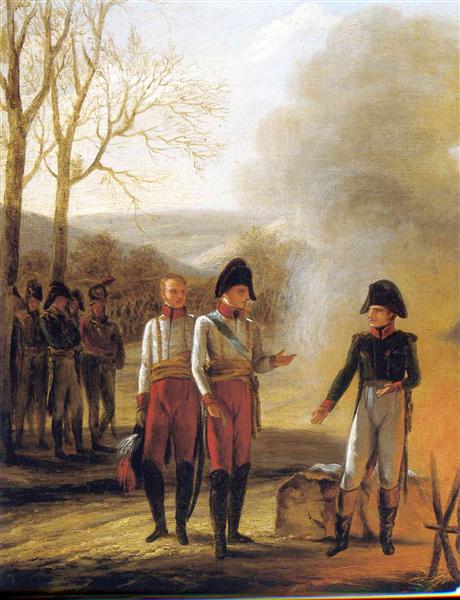
the-conversation-of-napoleon-and-francois-ii-1808.jpg!Large

  “The conversation of Napoleon and Francois II (1808) 

        Pierre-Paul Prud’hon

________

it’s 1804, Beethoven has entered his
Middle Period, left the more formal 
constraints of the Classical Period, 
Mozart and Haydn, behind, though
perhaps not essentially, the 
structure remains, hardwiredbut 
its spirit is entirely different, 
revolutionarily different, thanks to
Napoleon

and Beethoven is as opinionated 
as the revolutionaries, boisterous,
adamant, peremptory even, he is 
Zeus, and not undeservedly, at 
the top of Olympus’ musical 
mountain, where, incidentally, 
he still prevails, harmony’s very 
Homer

by his Opus 57, the Appassionata” 
– a name not of his own invention, 
but, however discriminately, ascribed 
later – he isn’t as metaphysical as 
Schubert is in that later poet’s D960
Beethoven is still writing descriptive 
texts, torrid novels, however 
masterfully illustrated, more than 
the philosophical stuff he’ll later 
undertake, even topping, when that
takes place, Schubert’s, ever, 
nevertheless, transcendental D960
if you can believe it

but Schubert remained a stripling, 
Beethoven, his elder, was given the 
grace to probe longer his humanity,
however might it have been equally 
cruelly benighted, and to stretch his 
speculative reach into previously 
unimagined dimensions, beyond 
the limited temporal scope of the 
surely shriven since Schubert 

all of whose wonders have defied 
the harsh indignities of time, and 
continue still to profoundly and
indelibly reverberate

listen, marvel


R ! chard

String Quintet in C major, D. 956 – Franz Schubert

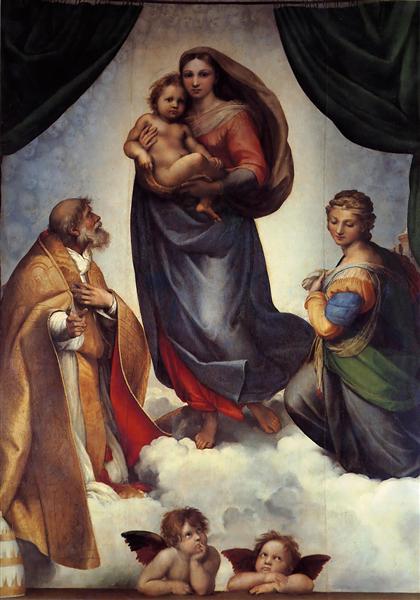
the-sistine-madonna-1513.jpg!Large

   “The Sistine Madonna (1513)
 
          Raphael


          __________ 


if you listen to only one piece of music  
this week, make it this one, Schubert’s 
a monument of Western culture, it’d be
like missing the Venus de Milo when 
you’re at the Louvre, or the Sistine 
Madonna of Dresden’s Zwinger 
the church of Saint Agnes Outside the 
Walls, transformative experiences

quartets, I couldn’t not next introduce
their very gold standard 
 
written in 1828, it was composed at 
the very height of the Romantic 
Period, just a little ahead of Chopin,
1810 – 1849, his other significant 
counterpart, apart from the ageing
Beethoven, 1770 – 1827, who still 
towered above all, despite his 
demise, and was universally 
admired 
 
but had Schubert lived longer than 
his 31 years, I suspect he might’ve 
been Beethoven’s equal, Schubert 
died even earlier than Mozart did, 
at 35, but of something that wasn’t
spoken of until much later, which 
is why we haven’t heard about the 
loss of this other musical giant
quite as grievously as we have 
about his somewhat more senior 
counterpart
 
but listen
 
it’s even hard to tell him apart from 
Beethoven, the passion, the urgency, 
the drama, even composing against 
the beat, a signature trait in 
Beethoven, like Alfred Hitchcock 
showing up in his own movies, or
Woody Allen, always introducing a 
work of art
 
a few things
 
though the frame is immaculately 
Classical, tonality, tempo, and 
recapitulation are not at all 
unobserved, the mood has changed 
from courteous, deferential, and 
respectful, to urgent, confessional, 
and private, the walls are there, but 
the furniture has changed, thanks 
of course here to Beethoven
 
and to the times
 
was writing her Sonnets from the 
Let me count the ways. – right about 
thenunfettered love poems to her 
beloved husband, Robertthe equally 
famous poet, who was remaining 
nevertheless, in his own work, more 
emotionally punctilious
 
I noted as well that the tempo in the 
second movement, one of the most 
beautiful adagios eversurely, 
lurches into an intemperate rebellion,
a second rhythm, up against the earlier 
mournful resignation of the poignant 
lament – note, in passing, that its 
stress of the dominant note is on the 
last beat not the first, like a weight 
that becomes, at every inching 
forward, intolerable, very path to a 
personal Calvary – before returning 
to that very fateful, though luminous, 
initial, stricken dirge

the next movement, the scherzo, does 
the reverse, fast, then slow, then fast 
again, to give the work in its entirety
eight rather than the four traditional 
tempi
 
the piece now has episodes, rather 
than merely a clockwork display,
drama has replaced the dance
entirely as the subtext for music
 
Schubert died two weeks after its
publication, for your info, I think 
his soul had been talking
 
 
R ! chard

psst: there’s a magical film I associate 
          with this music, The Company 
          of Strangers“, a Canadian 
          production, about several elderly
          ladies who get stuck in the 
          wilderness after their tour bus  
          breaks down in the middle of 
          nowhere
 
          you’ll never forget it


Cello Concerto no 2 in D major – Haydn

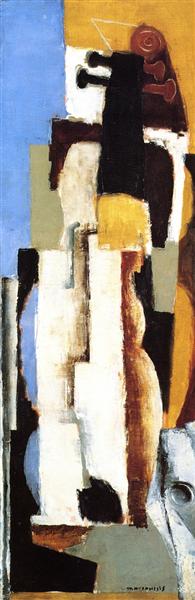
a-cello-1921.jpg!Large

         A Cello (1921)

        Louis Marcoussis

             ___________

between Bach’s transcendent Suites for
Cello and Beethoven’s reinvention of that 
instrument, two only cello works occupy
the last half of that century, both by
Haydn

his Second, however, Concerto, written 
several years later than his First, 1783, 
indeed nearly twenty years later, seems 
to me less accomplished, though ever, 
nevertheless, unimpeachably, and 
impressively, Haydn 

the first movement is long, long works 
only until you start thinking it’s long

the initial melody in the adagio, the 
second movement, struck me as artificial, 
saccharine, though Haydn weaves magic, 
not unexpectedly, still, and  
continuously, around it in its 
development, his elaboration of it

and the pace of the third movement, 
following the second, is disconcerting 
rather than surprising, rather than, 
were it effective, delightful

Mozart wrote a Cello Concerto too, 
apparently, but, if so, it is lost

otherwise we’re on to the next historical
epoch, Beethoven’s, after this inauspicious 
turn at this generation for the cello, lost 
for a while among the more assertive 
instruments of that prim, and proper,
Classical Era


R ! chard

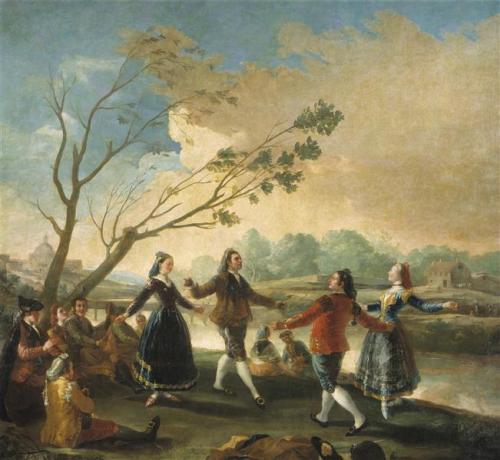
French Suite no 3 in B minor – Bach

dance-of-the-majos-at-the-banks-of-manzanares-1777.jpg!Large.jpg

   “Dance of the Majos at the Banks of Manzanares (1777)

           Francisco Goya

                _________

upon reading up somewhat on the different
Bach Suites, I’ve provisionally concluded
that the earlier English Suites, 1715 to 1720,
were a modification of the established form 
of the suite, which would not have included 
a prelude, which isn’t, indeed, a dance

the Cello Suites follow, ahem, suit

but by the French Suites, 1722 to 1725, Bach 
is eschewing – Gesundheit – the prelude, but 
inserting, however, an air in his Fourth – an  
air is not either a dance – and mixing up  
their order in the later Suites, a minuet, for 
instance, in the last one of them, his Sixth,  
coming up after the gigue, which sports even
also a polonaise, where in his Fifth, Bach adds  
a loure, I ask you, a slow French gigue, to his  
bristling concoction

the terms French and English, incidentally, 
were added only after Bach’s demise, for 
diverse and uncorroborated reasons, so 
that these titles probably don’t mean much 
to a contemporary audience, who can’t tell, 
anyway, our gavottes from our bourrées

the music of Bach is like that of no other 
composer, he owns essentially the Baroque
Period, having, in fact, wrenched the Era 
from the painters, who’d established it in 
art to such a degree that it defined its
earlier historical phase

with Bach, the torch is handed over to 
music, from then on until the 
Impressionists, the period is defined 
by composers, both Classical, then 
Romantic, with some poets holding 
some sway 

the technique that dominates the music 
of Bach is that of counterpoint, where 
a tune is repeated in the harmonization
a few beats from its first iteration, 
vocally, we call that singing in canon

his music is introspective, as though 
the player were privately meditating,
it has the playfulness of Mozart, but
Mozart is expressive, not interior,
therefore nowhere near as spiritual,
Beethoven will return with a 
profundity that matches Bach’s, but 
with much more Sturm und Drang, 
tempestuous moral struggle, much  
less resignation, ouch, watch

listening to Bach for me is like getting 
on a train, and just letting the rhythm
of the wheels sustain me, as I watch,
indeed introspectively, the surrounding 
countryside, stopping at the musical 
journey’s several halts, its intervals, 
until its final destination, which 
despite, or even because of, taking 
sometimes hours, is nevertheless  
endlessly satisfying, and never  
ever less than, however improbably, 
inspiring

here’s Bach’s Third French Suite
you’ll note it includes an idiosyncratic 
“trio”, not strictly a recognized dance
either – leave it to the saucy French, I   
say, to consider interpolating a trio


R ! chard

English Suite No 3 in G Minor – Bach

suite-fibonacci-2003.jpg

   “Suite Fibonacci (2003) 

           Charles Bezie

               ________

 
before I say much more about his Cello
Suites, let me point out that Bach has
some French Suites, some English 
Suites, on top of similarly structured 
Partitas and Toccatas, the French have 
their tout de suites, and hotels have, 
nowadays, their so named luxury 
apartments 

musical suites are sets of dance pieces, 
by the early 18th Century much stylized, 
with an introductory prélude, an allemande, 
followed by a courante, which is to say, folk 
dances, the first German, the next French, 
then a sarabande, Spanish, followed by a 
couple of galanteries, court dances, 
minuets, gavottes, bourrées, then a final 
English gigue

all of the markings are in French, which
leads me to believe that all of these 
dances must’ve originated at the court 
of Louis XlVth, the Sun King, 1638 to 
1715

but the suggestion is that Europe was 
becoming an integrated community
all of these dances were eclipsed by
the Classical Period, of Haydn and 
Mozart, apart from the minuet, which 
more or less defined, nevertheless, 
that new era

the minuet will die out by the time of
Beethoven, you’ll note, to be replaced
by the waltz, which had been 
considered much too racy until 
transformed by Chopin into a work 
of ethereal art

the Strausses, father and son, gave it,
only a little later, celebratory potency,
but that’s another story


here’s Bach’s English Suite, the 3rd
for context, the French ones are a 
little too salty, as it were, they do not 
quite conform to prescribed suite 
notionshowever might their 
propositions have been, ahem, 
sweet 

meanwhile, enjoy this one


R ! chard

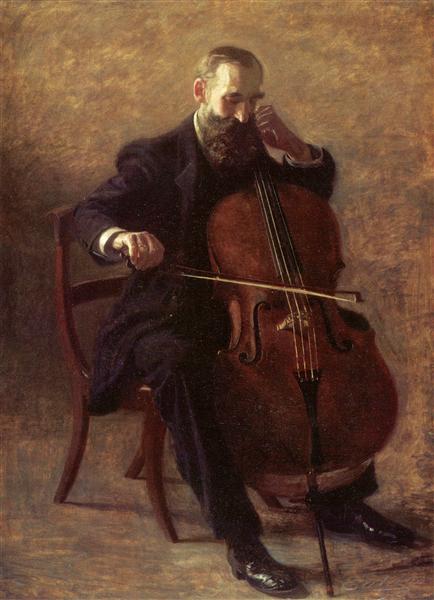
what’s up in Pyeongchang / Bach

the-cello-player-1896.jpg!Large.jpg

      “The Cello Player (1896) 

              Thomas Eakins

                   ________

though I’d considered presenting all six
of Bach’s Cello Suites – your one stop
shopping for these extraordinary 
compositions – even one only of these
masterpieces floored me each time I
individually listened  

why the Suites, cause I couldn’t follow 
up on Beethoven’s Opus 5, for cello
and piano accompaniment, without 
saying more about the cello, by then 
an instrument of some significance, 
and who could argue, it’s resonance 
thrills you in your bones, in your very 
being

Frederick ll, King of Prussiaplayed it, 
earning for him tailored compositions, 
however controversial, from both 
Mozart and Haydn, but even earlier, 
Bach had composed definitive pieces 
for it, much as he’d done for the 
harpsichord, precursor to the piano, 
students of either still go to Bach for 
their basics, their intricate, exquisite, 
technical proficiency

the cello can play one note only at a
time, which means that, like a voice, 
you’re working without harmony, 
you need to make your own, 
otherwise your performance is 
boring, no one else, as far as I know,
has ever written anything else for 
unaccompanied cello, not even 
Beethoven

I find most performers lend Bach a 
more Romantic air, torrid emotion,
excesses of volume, pauses to the 
pace, ritardandos, rallentandos, 
which aren’t appropriate to the 
more genteel Baroque period,
something I usually find 
unwelcome

but in this performance, I’m sure 
not even Bach would object

I’m offering up first the Sixth Cello
Suite, D major, played by Jian Wang
someone I’d never heard of, in a 
dazzling performance in Pyeongchang
place I’d neither ever heard of, until 
only very recently

it appears both of these new kids on 
the block ought to be on the map


R ! chard

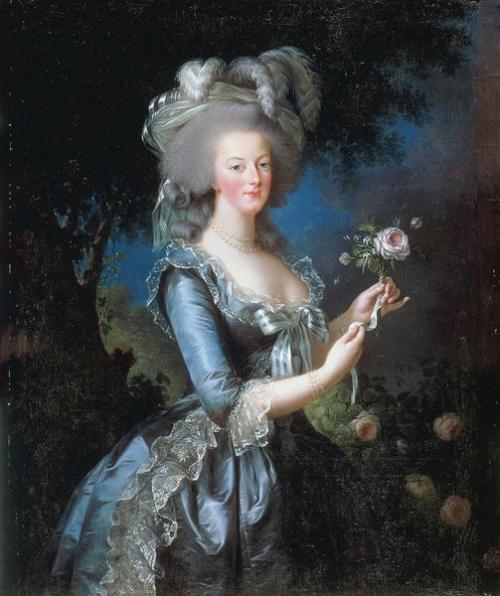
String Quartet in B flat, Opus 55, no 3 – Haydn

queen-marie-antoinette-of-france-1783.jpg!Large

                      “Queen Marie Antoinette of France (1783) 

                                Louise Élisabeth Vigée Le Brun

                                              ___________________

first of all, let me grievously repent an
egregious confusion I probably left
in my last diatribe, I said that the second
movement of the Opus 54, no 2 sounded 
to me like a minuet, I had, through 
embarrassing inattention, confused its,
however unmemorable, adagio with that
of this Opus 55, no 3, which I’d listened 
to in too quick succession, driven as I 
am by my thirst for epiphanies

the Opus 54, no 2 will do, but I’m not 
going back for seconds, nor to the 
Opus 55, no 3, though here’s where  
I flaunt nevertheless Haydn, not to 
mention Bach, Mozart, Beethoven, 
all the way to eventually Bruckner, 
Brahms, the extraordinary Richard
Wagner, passing through Schubert,
Mendelssohn, the Strausses, father
and son, and the unrelated Strauss,
Richard, another incontrovertible 
giant, and I nearly left out the 
unforgettable Liszt, all of them 
forefathers of our present music

you might have noticed that these 
are all Germanic names, obedient 
to the Hapsburg empire, with 
Vienna as its supreme cultural 
capital, and it was that 
Austro-Hungarian dynasty that
indeed nearly single-handedly 
secured our Western musical 
traditions

a few Italians are remembered,
from the 18th Century, Scarlatti 
maybe, Boccherini, Albinoni
but not many more 

no one from France, but they were 
about to have a revolution, not a 
good time for creative types,
though, incidentally, Haydn was 
getting Tost, to whom he was 
dedicating his string quartets for 
services rendered, to sell his stuff 
in very Paris 

then again, Marie Antoinette, I thought, 
was Austrian, an even archduchess, 
and would’ve loved some down-home 
music at nearby Versailles

so there you are, there would’ve been 
market

the English had Handel, of course,
who was, albeit, German, getting 
work where he could when you 
consider his competition, he was 
too solemn and plodding by half,
to my mind, for the more 
effervescent, admittedly Italianate, 
continentals, Italy having led the 
way earlier with especially its 
filigreed and unfettered operas

but here’s Haydn’s Opus 55, no 3
nevertheless, the best Europe had
to offer, socking it to them

Haydn’s having a hard time, I think, 
moving from music for at court to
recital hall music, music for a much
less genteel clientele, however 
socially aspiring, we still hear 
minuets, and obeisances all over 
the place, despite a desire to 
nevertheless dazzle, impress

then again, I’m not the final word, as
my mea culpa above might express, 
you’ll find what eventually turns 
your own crank, floats your own 
boat, as you listen

which, finally, is my greatest wish


R ! chard

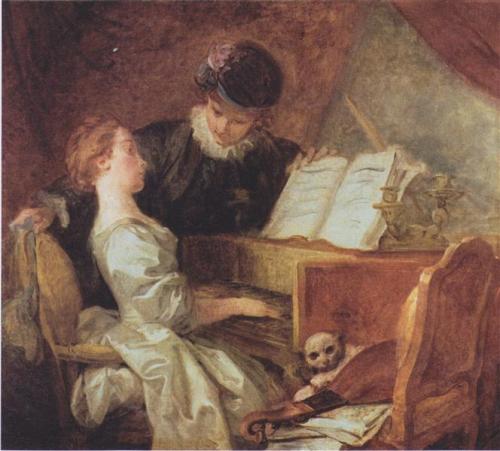
String Quartet, Opus 33 no 3 – Joseph Haydn

the-music-lesson.jpg!Large.jpg

        “The Music Lesson (c.1769) 

             Jean-Honoré Fragonard

                       __________

by 1781, Haydn was, along with Mozart,
the most celebrated composer in Europe,
and via publication of his musical scores,
his compositions would’ve been played 
even in smaller communities, where 
string players would’ve blossomed 
everywhere for there being no television

only two generations ago, my own family
sported, if not violinists, remarkable 
fiddlers – see, for comparable example, 
Deliverance“, I have old movies at home 
of my own kin doing such wonders

the Opus 33, no 3 is no longer, you’ll note, 
especially courtly, this is music to heed,
pay attention to, not meant to be 
background

nor is it

in the first few bars of the very first 
movement, Haydn’s got you riveted,
you know you’re going to get your 
money’s worth, and you do, in 
exponential spades 

you’ll note there are no dance 
references, cerebral tempo markings 
only allegro moderato, scherzo: 
allegretto, adagio ma non troppo, 
finale: rondo – presto – which means 
the music will be entirely edifying, 
not carnal, sensual, music is 
specifically becoming an intellectual 
exercise, a new, as it were, language, 
no longer doing tribal tribute around 
bonfire, it’s speaking rather than 
pulsating

pay attention to the vehemence,
the stark contrast between the 
opening statement in the second
movement and its response, a
nearly unnerving juxtaposition

pay attention to what Haydn does 
to the entire first section of the 
adagio ma non troppo, the third 
movement, with the recapitulation 
of the themes by introducing very 
magic in the superimposed 
peregrinations of the first violin,
to entirely enchant and exalt the 
original musical proposition

and that final exit in the last
movement, after so fiery a
rondo presto, urgent and 
even confrontational

but ever so brilliantly, in the last  
few moments, rendered courtly, 
respectful, deferential, indeed 
the very Classical spirit of 
Haydn


R ! chard