Richibi’s Weblog

Just another WordPress.com weblog

Tag: Mozart

November / Month of the Sonata – 13
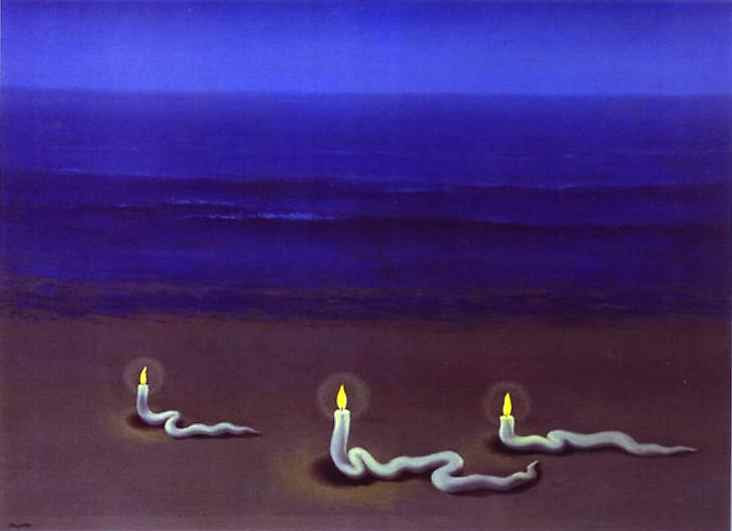
Meditation, 1936 - Rene Magritte

       Meditation  (1936) 


            René Magritte


                  _______


a story


while I volunteered at the palliative care

unit of our downtown hospital, a family 

asked if I could monitor their mother

while they took time off for lunch


of course, I agreed


their mother lay unsettled on her hospital

bed, jittery, shaking, distressed, incoherent,

out of touch, in her own nether, dissociated 

world, while the family, about ten of them, 

had been chatting, seemingly oblivious to, 

or unconcerned with, their mother’s flailing


they left


I sat by her side, placed a palm tenderly on 

her quivering arm, to impart what calm I

could, to bring her warmth, care, attention, 

and began to sing a mantra I’d learned at 

an ashram I had been attending, weekly, 

for months, after the death of my beloved, 

in order to find solace, consolation, Om 

Namah Shivaya, I chanted, gently, quietly,

over and over again


little by little, she settled, was becoming 

calm


then, in a whisper, she began to join in, 

Row, row, row your boat, she sang, 

over and over again, along with my 

own mantra, a duet of communication, 

despite even the incongruity of the 

tunes, we were meeting at an even 

deeper, primordial level


something stirred behind me, I turned,

the family was standing in the doorway, 

all held their breath, watching, as though 

they were witnessing grace


I think they were


a mantra is a distillation of the three

pillars of Western music, tempo, 

tonality, and repetition, what we sing 

to children to lull them to sleep, that’s 

what a mantra is


Row, row, row your boat indeed


the history of music in the West is 

the disintegration of those norms,

for better or for worse


here’s a solo, note, violin sonata of

Bach, no accompaniment, no piano,

his Sonata No. 2 in A minor, BWV 1003


Bach is of the late Baroque Period, the 

tail end of the Renaissance, when art 

was directed by the Christian Church,

Bach was in fact cantor, music director, 

of several churches in Leipzig


it took Mozart to kickstart the Classical

Era in the West, the purview, now, of 

the aristocracy, a process that started 

with Louis XIV, the Sun King, the art 

that he commissioned for Versailles

leaving the Church behind in a 

secularizing world


with Bach, tempo, tonality and repetition,

set the uncorrupted standard for the

ensuing ages, Bach is the next best 

thing, to my mind, to meditation


R ! chard

November / Month of the Sonata – 7

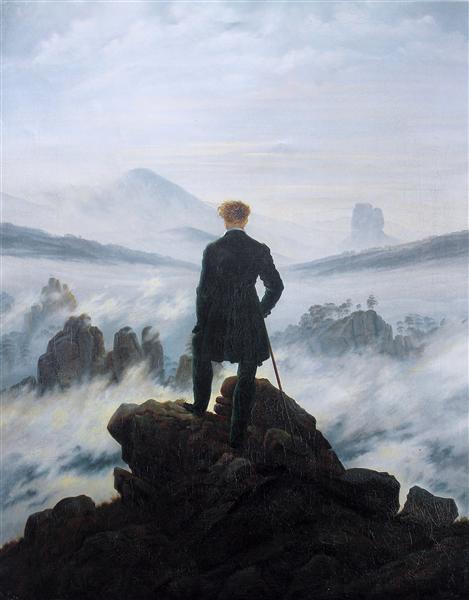
The Wanderer Above the Sea of Fog, 1818 - Caspar David Friedrich

     “The Wanderer Above the Sea of Fog(1818)


             Caspar David Friedrich


                   _____________


meanwhile, back at sonatas for one 

instrument, it’s about time I brought 

up Chopin, the one composer that 

everyone associates before anyone

else with Romanticism, 1800, say, 

till about 1880, he incorporates it, 

not without reason, Chopin 

personifies the Romantic Era, like 

Mozart represents the Classical


others who count would be Elizabeth

Barrett Browning, her “Sonnets from

the Portuguese” – How do I love thee? 

Let me count the ways – Victor Hugo’s

Les Misérables”, and Charles Dickens

preaching, in all his works, humanity


Caspar David Friedrich‘s, also, iconic 

Wanderer Above the Sea of Fog“, 

see above


Chopin sounds a lot like Beethoven,

indeed, the first notes of his Second

Piano Sonata, in B-flat minor, Op. 35

are a reference to Beethoven’s 

Sonata no 8, his Pathétique“, listen,

you’ll hear the same peremptory,

commanding, chord, demanding 

attention, the rest is consummate,

however, Chopin 


in the last movement, you’ll specifically

hear what Chopin brought to the table,

texture, soundscape, rather than a 

narrative line, music as background,

atmosphere, context


enjoy


R ! chard

November / Month of the Sonata – 3

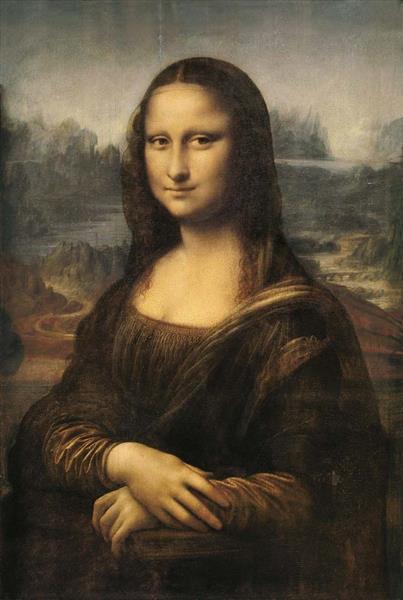
Mona Lisa, c.1503 - c.1519 - Leonardo da Vinci

  “Mona Lisa ( c.1503 – c.1519) 


      Leonardo da Vinci


             __________


the next sonata, Beethoven’s Piano Sonata 

No 8 in C minor,  Op 13, the ‘Pathétique’“, 

is one that everyone’s heard, if only ever in 

fragments, right up there with “Jingle Bells” 

in our musical repertory, in our cultural DNA,

or, for that matter, Beethoven’s, also, other 

iconic piece, the Moonlight Sonata“, the 

Mona Lisa, nearly, see above, of music 


the initial chords are peremptory, have 

resonated, echoed, reverberated, 

throughout the ages


this is not, however, the way one should 

be addressing the aristocracy, Beethoven

was speaking for the growing Middle

Classes, who, hungering for the status 

and refinement of the elite, the French

Revolution having just happened, were 

crowding the burgeoning concert and 

recital halls cashing in on that interest


the artist was now the main attraction,

where earlier the performer had been

merely decorative, the sponsored

employee of an, however benevolent, 

aristocrat, see Mozart, see Haydn


listen to Beethoven strutting, for the 

ages, his revolutionary stuff, thumbing

his nose at convention, demanding

attention


enjoy


R ! chard 


November / Month of the Sonata – 2

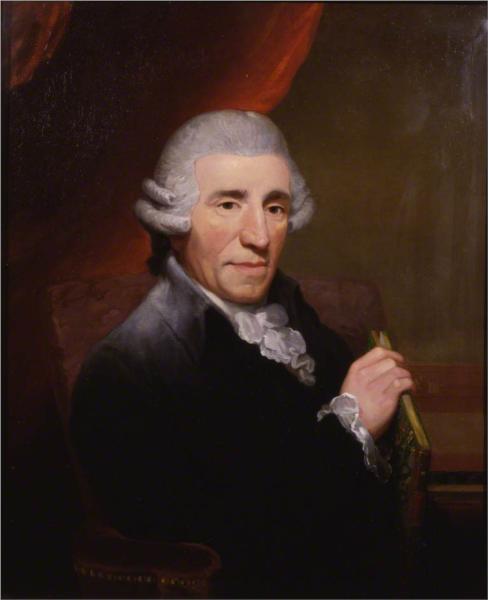
Joseph Haydn, 1791 - Thomas Hardy

     “Joseph Haydn (1791) 


           Thomas Hardy


               ________


Haydn, profoundly underrated, was the

other pillar of Classical music during that 

period, Beethoven, with half a foot only 

in that era, uses its elements to yank us, 

yelling and screaming, into the next, the 

Romantic Era, 1800 to 1870 more or less, 

more about which later


if Haydn sounds a lot like Mozart, it’s that

this piece was also written in 1789, both 

were catering to the aristocracy, courts, 

salons, music was therefore frivolous, 

meant to be entertaining, not inspirational,

trills, a lot of decoration, technical agility,

prestidigitation over profundity


Beethoven will change all that, stay tuned 


meanwhile, listen to, enjoy, Haydn’s Piano  

Sonata in A-flat major, no 31, Hob XVI-46,  

today’s prescribed apple


R ! chard

how to listen to music if you don’t know your Beethoven from your Bach, X

Joseph Haydn, 1791 - Thomas Hardy

        Joseph Haydn” (1791)


                 Thomas Hardy


                         _______


though I’ve focused especially, during

this introduction to Classical music,

on Mozart, a second great pillar of

that era is Haydn1732 – 1809


here is one of his 62 piano sonatas,

which expresses more than anything

you’ve heard here yet the definition

of what music was at the time, or

should be, tonality, as I’ve earlier

said, tempo and repetition were

tantamount


listen for or the rigidity of the tempo,

the consistent melliflousness of

the melody, and therefore tonality,

and the repetition of all the

component tunes


I remember going to a drum recital

once, here in Vancouver, a guy was

expressing his artistry in a formal

venue, I was sitting in a forward

row, saw him set up his music on

his music stand, and I thought,

he’s going to have to turn the

pages, which he did, a drummer


that’s all I remember of the

presentation, but that was enough,

an entire revelation


in this Haydn sonata, the pianist

turns the pages of his score, back

and forth, an interesting visual

expression of the imperative of

repetition in that era’s music,

having to return to what had

been written on the previous

page


also note that trills abound


note too in the second movement,

the adagio cantabile, the sudden

introduction of arpeggios,

transcendent, as though angels

had just appeared


which prefigures the metaphysical

aspirations of the Romantic Period

which ensued, see, for instance, 

Chopin


note also that we’re on fortepiano

here, a period instrument, a cross

between the harpsichord and the

modern instrument


thoroughly enjoy


R ! chard

how to listen to music if you don’t know your Beethoven from your Bach, IX

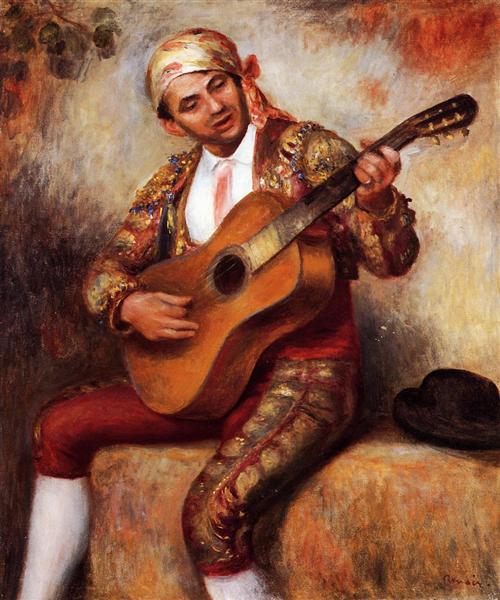
The Spanish Guitarist, 1897 - Pierre-Auguste Renoir

          The Spanish Guitarist” (1897)


                  Pierre-Auguste Renoir


                            ____________


just as I was about to relegate the trill

to Mozart and the Classical Period, I

inadvertently came upon something

wonderful by Joaquín Rodrigo, a

Spanish composer, 1901 – 1999, a

concerto for guitar


the trill had been decorative, meant to

appeal to aristocrats frequenting

salons


then the French Revolution happened,

and the growth of the Middle Class,

and consequently popular avenues

of entertainment for the liberated,

concert halls, for instance, looked

for a more emotionally powerful

experience, arpeggios took care of

that


the trill died


but in 1939, nearly two centuries

later, Rodrigo wrote his Concierto

de Aranjueza descendent pays

homage to an elder, trills abound


it should be stated that a guitar can

play only one note at a time, it might

be that trills lend themselves better

to such an instrument than an

arpeggio would


then again, I’ve found that Spanish

music, the tango, the tarantella, for 

instance, see above, has held more

rigidly to the imperatives of Western 

music I’ve spoken of here before,

tempo, tonality, repetition, it is not 

Debussy, Ravel, it is not even

Chopin, it is peripheral, maybe, to

the cultural establishment, but

potent, steeped in blood and

tradition


here’s Rodrigo giving you Mozart


enjoy


R ! chard

how to listen to music if you don’t know your Beethoven from your Bach, Vl

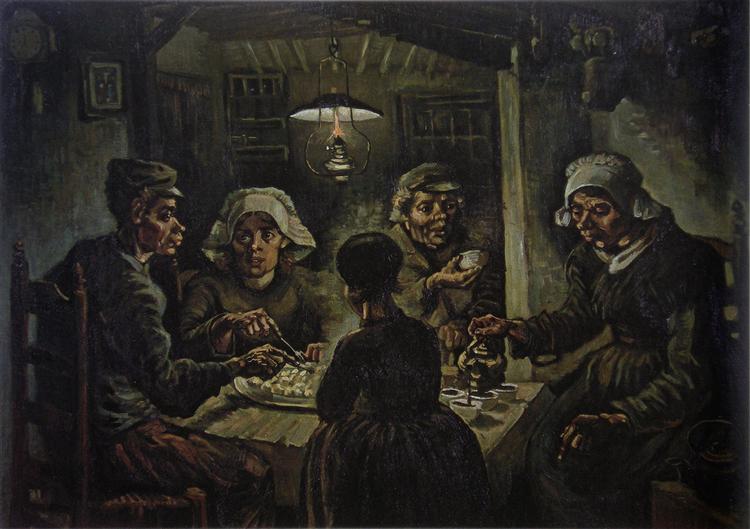
The Potato Eaters, 1885 - Vincent van Gogh

            The Potato Eaters” (1885)


                   Vincent van Gogh


                        ___________


where do you start with Chopin, he is

in our Western cultural bloodstream,

as identifiable in music as, say, van

Gogh is in painting, you don’t need 

to be interested in any kind of art to

have not been given even only a

whiff of these iconic artists


nearly anything I might present here

of Chopin you’ve probably already

heard somewhere before, if only in

bits


of van Gogh, well, he goes back in

the public imagination to at least

Vincent1971, the song, no one

doesn’t know about him, when I

heard it playing in Amsterdam at

the museum, with the first piece I

saw, The Potato Eatersdominating

the first wall, insisting on van Gogh’s

vision, his prophecy, his profound

compassion, I cried, I understood

what art is, see above


Chopin exerts a different kind of,

however equally potent, magic


Mozart might sound like Haydn,

Beethoven might sound like

Schubert, all of the Impressionists

sound like all of the Impressionists,

be they Ravel, Debussy, Satie, or

Saint-Saëns, to the untrained ear


but no one sounds like Chopin,

he’s, culturally, a North Star


here’s one of his nocturnes, the

moonlit one, in E flat major  


here’s a polonaisehere’s an étude,  

in English, a study, a finger exercise,

an iconic, here, prestidigitation


here’s an impromptu, his very,

indeed, Fantaisie-Impromptu, just

to get your categories going


consider its construction, having

some information already about

fantasias, a work of the imagination,

open to any experimentation within

the confines of one movement, with

an impromptu, something purported

to have been created on the spot,

also in one movement


the answer requires you to sharpen

your aesthetic pencil, always a

delight – an impromptu, a

spontaneous invention, a fantaisie,

a work of the imagination, how do

they differ, which part is a fantaisie,

which an impromptu, how do they

nevertheless coalesce


this exercise is the first step in

listening


enjoy


R ! chard

Piano Concertos 2, 3, 4 – Beethoven

the-liberty-leading-the-people-1830.jpg!Large

     “Liberty Leading the People (1830) 

             Eugène Delacroix

                    _________

                               for everyone, with great gratitude, 
                                  who reads me, I mean only to 
                                     bring poetry, which is to say,
                                        light

though I’d considered leaving the 
Romantic Piano Concertos behind
to explore other areas of the period
in this survey, it seemed unfair,  
indeed remiss of me, not to include 
the three among my top ten that I 
haven’t yet highlighted, Beethoven’s 
2nd, 3rdand 4th Piano Concertos
Opuses 1937and 58 respectively,
after all, these are where the spirit 
of the age, the Zeitgeist, was 
constructed, like a building, with 
walls, windows, a hearth, all of 
which would become church, 
then a Church, and by the time of 
Brahms, a very Romantic Cathedral 

the foundation had already been laid 
by Mozart with his 27, but music had 
not yet become anything other than 
an entertainment by then, or 
alternatively, an accessory to 
ceremonial pomp and circumstance, 
see Handel and England for this, or 
liturgical stuffsee, among many 
others here, Bach

but with the turn towards 
independence of thought as the 
Enlightenment progressed, cultural 
power devolved from the prelates, 
and their reverent representations, 
to the nobles, who wanted their own 
art, music, which is to say, something 
secular, therefore the Classical 
Period, 1750 – 1800, in round figures

then in the middle of all that, 1789, 
the French Revolution happened, 
and the field was ripe for prophets, 
anyone with a message of hope, 
and a metaphysical direction, midst 
all the existential disarray – the Age
of Reason had set the way, 
theoretically, for the possibility of a 
world without God, something, or 
Something, was needed to replace 
the The Trinity, the Father, the Son, 
and the Holy Ghost, Who had been 
seeing Their supremacy contested 
since already the Reformation 

Beethoven turned out to be just
our man, don’t take my, but history‘s 
authentification of it, see the very
Romantic Period for corroboration

in a word, Beethoven established 
Faith, a Vision, not to mention the 
appropriate tools to instal this new 
perspective, a sound, however
inherited, musical structure – his 
Piano Concertos TwoThreeand 
Four, for instance, are paramount 
amongst a host of others of his  
transcendental revelations

briefly, the initial voice, I am here, in 
the first movement, is declamatory, 
even imperious, but ever 
compositionally solid, and proven, 
tempo, tonality, recapitulation, the 
materials haven’t changed from the 
earlier Classical epoch, just the 
design, the interior, the 
metaphysical conception

his construction is masterfully
direct, the line of music is 
throughout ever clear and concise, 
despite flights ofoften, ethereal, 
even magical, speculation, you 
don’t feel the music in your body 
as you would in a dance, as in the 
earlier eraof minuets, but follow 
it, rather, with your intellect, you,
nearly irresistibly, read it

but the adagio, the slow movement, 
the middle one Classically, is always, 
for me, the clincher, the movement 
that delivers the incontrovertible 
humanity that gave power to the 
Romantic poet, who touched you 
where you live 

Beethoven says life is difficult, and
eventually, at the end of his Early, 
Middle and Late Periods, life may 
even have no meaning
 
but should there be someone, he 
says, who is listening, Someone – 
though implicit is that one may be 
speaking to merely the wind – this 
is what I can do, this is who I am
 
and while I am here, however 
briefly, am not insignificant, I 
can be worthy, even glorious, 
even beautiful, I am no less 
consequential, thus, nor  
precious, than a flower

for better, of course, or for worse


R ! chard
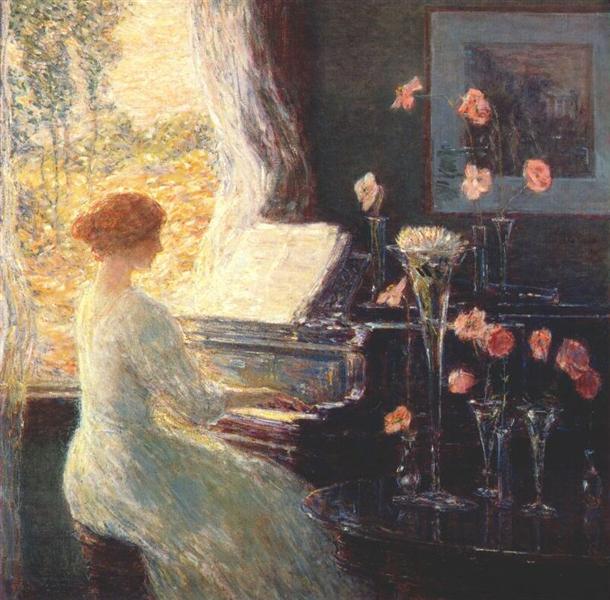
Piano Sonata in C# minor, opus 80 – Tchaikovsky

the-sonata-1.jpg!Large

The Sonata 

              Childe Hassam

                     ___________

                            for Sarah and Rachel, the daughters
                              of the son of a dear cousin, after a 
                                belated lunch recently, two young 
                                  girls14, 16, in bloom, as Proust 
                                    would say, who speak not only 
                                      music, but French and English,
                                        fluently, I checked – perhaps   
                                          even German, their Oma  
                                            lives with them – they also  
                                              play the flute, the piano,    
                                                and sing, what could be
                                                  I ask you, more beautiful,  
                                                   two young girls ibloom, 
                                                     indeed in very blossom   
                                        
                               or am I being too French
 
the form of the sonata had been established 
decisively during the Classical Period, out 
of the rudiments of Bach’s own such pieces
Mozart and Haydn had given the concept its 
final shape, its structure, three or four 
contrasting movements, by definition all 
entertainments

Beethoven kicked the entertainment part 
right out of the ball park, made his show 
into a veritable transcendental meditation, 
rather than to merely applaud, audiences 
gasped, were meant to be awed, as I still 
ever am by his musical speculations

but by definition as well, a sonata is a 
piece for a single instrument, therefore
inherently introspective, whether the 
player has an audience or not, soloists, 
note, play easily on their own

even an accompanied sonata, as violin
sonatas often are, for instance, or this 
one for two pianos, would lose the 
intimacy of a solo piece, for having 
someone playing, however compatibly, 
over one’s shoulder  

in other words, a piano sonata is, by
definition, a monologue, a soliloquy,
where notes tell the story that words 
would intimately, even confessionally,
in poetry, convey

the emotions that are elicited from 
a piece are as real as they would 
be from any literary alternative, 
except that they’re quickened, like 
aromas, through the senses, rather 
than through divisiveby definition 
confrontational, logic

rosemary reminds me always, for 
instance, of one of my departed 
aunts, like the taste of a madeleine 
dipped in tea opened the door for 
Proust to an entire earlier epoch, 
the seed, the subject, of his 
disquisition on Time, À la 
recherche du temps perdu“, An 
Exploration into Elapsed Time“, 
my own translation, none of the 
published proffered titles   
having rendered the subtlety  
of the shimmering original
  
rosemary, in other words, speaks,
if even only to me

listen to Tchaikovsky’s First Piano
Sonata, in C# minor, opus 80, one
of only two of his, what do you 
hear, think, feel


R ! chard
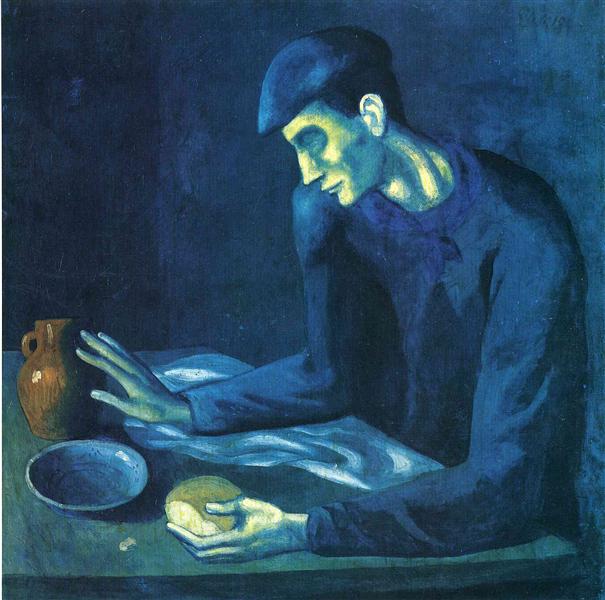
“Lament From Epirus” – Christopher King

breakfast-of-a-blind-man-1903.jpg!Large.jpg

   “Blind Man’s Portion (1903) 

          Pablo Picasso

                ________

though you’ll have to actively listen 
to Christopher King rather than 
merely hear him hereas you might 
have been doing with many of my 
suggested musical pieces, should 
you be at all interested in the history 
of music, he is fascinatingdates his 
investigations back millennia to very 
Epirus, Ancient, nearly primordial, 
Greece, to mirologia there, ancient 
funerary chants

some have survived, and have been 
recorded for posterity, onein 1926, 
by Greek exile fled to New York City,
Alexis Zoumbas, a year laterhowever 
improbably, by an Americanblind 
man, his own story inspirational, akin 
to that of Epictetus, one of the two 
iconic Stoic philosophers, the other,
incidentally, an emperorthough the 
blind man here, Willie Johnson, was 
never himself slave, but only, by a 
historical whisker, the emancipations 
of the American Civil War


Christopher King‘s comparison
of an Epirotic miralogi with an 
American one brings up, for me,
the difference between Mozart 
and Beethoven, notice how the
Willie Johnson version is more
rhythmic, the cadence is much 
more pronounced than in the 
Greek one, Johnson would’ve
got that from the musical 
traditions Europeans had 
brought over from their native 
continent, probably also from
Africa, Africans

Beethoven would’ve been 
surroundedmeanwhile, by Roma, 
perhaps called gypsies then, their 
music ever resonant in his culture, 
not to mention later Liszt‘s, and 
the Johann Strausses’ even, for 
that matter, Paganini also seems 
to have been imbued with it, it 
having come up from Epirus 
through, notably, Hungary – not 
to mention, later still, that music’s 
influenceand I’ll stop there, on
late 19th-Century Brahms


Christopher King, incidentally,
sounds a lot like someone you 
already know, I think, from his 
eschewing Gesundheit – cell 
phones, for instance, to his 
enduring preoccupation with 
death, not to mention his 
endearing modesty, indeed 
his humility, his easy 
self-deprecationdespite his,
dare I say, incontestable, and 
delightful, erudition

makes one wonder why that 
other hasn’t become also 
famous yet

what do you think


R ! chard