Richibi’s Weblog
Just another WordPress.com weblog
Tag: Mount Olympus
June 1, 2020
“The Transformation of Daphne into a Lawrel” (III) – Ovid
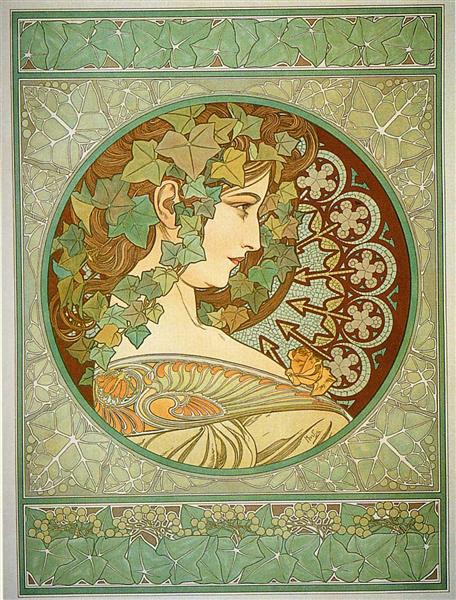
“Laurel” (1901)
Alphonse Mucha
_______
however ardently might’ve Phoebus
been pleading his case before
Daphne, his, however recalcitrant,
intended, flashing his divine pedigree,
vowing to put all that aside to serve
only her
She heard not half; so furiously she flies;
And on her ear th’ imperfect accent dies,
th’ imperfect accent might be the
unnatural tone of a divinity Daphne
might be hearing, the unusual timbre
of a deity’s voice, I can’t imagine Ovid
would be suggesting that Daphne and
Phoebus spoke different Greek dialects
perhaps th’ imperfect accent is the
unsettling manner of his entreaties,
his indecorous urgency
poets can be confounding
Fear gave her wings; and as she fled, the wind
Increasing, spread her flowing hair behind;
And left her legs and thighs expos’d to view:
Which made the God more eager to pursue.
the pagan gods were notoriously
mischievous, spirited, impulsive,
quite human, never sublime and
irreproachable as is the Abrahamic
Supreme Deity
the pagan gods lived in the fields
and streams, the hills and vales,
the seas and mountains, that
surrounded Greek and Roman
communities, Olympus was their
steepest height, never the
supernatural elevations, beyond
even our visible heaven, that our
present pervasive monotheism
proclaims
The God was young, and was too hotly bent
To lose his time in empty compliment:
But led by love, and fir’d with such a sight,
Impetuously pursu’d his near delight.
often, the gods of antiquity were
perverse, not at all blameless,
not innocent, not irreproachable,
like the one and only god that,
today, in its several interpretations,
even murderously conflicting, rules,
oversees, mostly, our present, at
least Western, faith communities
As when th’ impatient greyhound slipt from far,
Bounds o’er the glebe to course the fearful hare,
glebe, fields
She in her speed does all her safety lay;
And he with double speed pursues the prey;
O’er-runs her at the sitting turn, and licks
His chaps in vain, and blows upon the flix:
flix, fur, the greyhound’s pelt
perhaps greyhounds do this, blow
upon their flix, you’ll have to ask
Ovid, or maybe Dryden, his
translator
She scapes, and for the neighb’ring covert strives,
a covert, a bush in which to hide
And gaining shelter, doubts if yet she lives:
doubts if yet she lives, she can’t
believe she made it
If little things with great we may compare,
Such was the God, and such the flying fair,
the flying fair, Daphne, the God,
Phoebus
She urg’d by fear, her feet did swiftly move,
But he more swiftly, who was urg’d by love.
love, as Ovid, or is it, once again,
Dryden, who defines it, urg’d,
compelled by hormones, not at all
our romantic conception of it
He gathers ground upon her in the chace:
Now breathes upon her hair, with nearer pace;
And just is fast’ning on the wish’d embrace.
Red Riding Hood and the Big
Bad Wolf
The nymph grew pale, and in a mortal fright,
Spent with the labour of so long a flight;
Spent, defeated
And now despairing, cast a mournful look
Upon the streams of her paternal brook;
her father, Peneus, was a river god,
if you’ll remember, paternal brook,
the rill, the rivulet, of her father
Oh help, she cry’d, in this extreamest need!
If water Gods are deities indeed:
if there is a god, be with me, she
cry’d, you, yourself, I’m sure, have
been there, though Daphne‘s faith
was grounded in help, in this case,
from her father, god of, appropriately
in this instance, streams
Gape Earth, and this unhappy wretch intomb;
I’d rather die, Daphne pleads, I’d
rather the earth swallowed me up,
I’d rather be intomb[ed]
Or change my form, whence all my sorrows come.
transform me, rid me of what makes
me appealing, Daphne pleads
Scarce had she finish’d, when her feet she found
Benumb’d with cold, and fasten’d to the ground:
A filmy rind about her body grows;
a condition I’ve found not unlike the
ravages I call, ironically, bark, crusty
imperfections that afflict my own
ageing body
Her hair to leaves, her arms extend to boughs:
The nymph is all into a lawrel gone;
Daphne is turning into a tree,
a lawrel
The smoothness of her skin remains alone.
of Daphne, only her smoothness
remains
Yet Phoebus loves her still, and casting round
Her bole, his arms, some little warmth he found.
bole, the stem of a tree
The tree still panted in th’ unfinish’d part:
where Daphne had not yet become
a tree, she still panted, pulsed
Not wholly vegetive, and heav’d her heart.
heav’d her heart, passionately
reacted
He fixt his lips upon the trembling rind;
rind, bark
It swerv’d aside, and his embrace declin’d.
kisses not at all sweeter than wine,
said the lawrel
To whom the God, Because thou canst not be
My mistress, I espouse thee for my tree:
Phoebus begins to speak directly
here, Because thou canst not be, /
My mistress, he says, I espouse
thee for my tree:
espouse, marry
Be thou the prize of honour, and renown;
you will be, he continues, the
prize that will represent heroes
The deathless poet, and the poem, crown.
honour, first of all, worthy, deathless,
poets, Phoebus commands, let the
laurel wreath crown deserving
wordsmiths
Ovid had reason to champion poets,
he’d been exiled from Rome by the
Emperor, Augustus, his catering to
the Roman ruler becomes
intermittently evident throughout
this masterpiece
Thou shalt the Roman festivals adorn,
And, after poets, be by victors worn.
victors, Olympic champions, notably
Thou shalt returning Caesar’s triumph grace;
Ovid curries imperial favour here with
Augustus, by simply immortalizing in
poetry the name of Caesar, the new
Emperor’s great-uncle, and adoptive
father, making his own personal
nemesis shine, for what it might be
worth, by association
When pomps shall in a long procession pass.
the parades will be long ones
Wreath’d on the posts before his palace wait;
the laurel leaves will garland the
posts, stations, before, in front of,
the imperial palace
And be the sacred guardian of the gate.
Secure from thunder, and unharm’d by Jove,
even Jove / Jupiter, god of gods,
will stand by, honour, the symbol
of the laurel
Unfading as th’ immortal Pow’rs above:
Unfading, into very eternity
it’s interesting to note that the
laurel has not lost its significance
despite the intervening centuries,
epochs, we find reference to it even
in the honorific title of laureate, as
in Nobel laureate, or even in the
accolade of baccalaureate, the
bachelor’s degree, the prestigious
academic accomplishment
Unfading indeed
And as the locks of Phoebus are unshorn,
Phoebus always sports perfect
hair
So shall perpetual green thy boughs adorn.
it would seem that, according to
this, laurel leaves, perpetual
green, don’t ever lose their
colour, but I can’t attest to this,
being a poet rather than an
arborist, a gardener, though
bay leaves, laurel, even dry,
don’t turn brown, I’ve since
noticed
The grateful tree was pleas’d with what he said;
And shook the shady honours of her head.
and they all lived happily ever
after
or didn’t
myths are the enduring fairy tales
that adults continue to believe in,
according to their culture, about
men and women rather than
boys and girls, they help us, like
fairy tales, make up our moral
order
R ! chard
May 1, 2020
“Metamorphoses” (The Giants’ War, VII) – Ovid
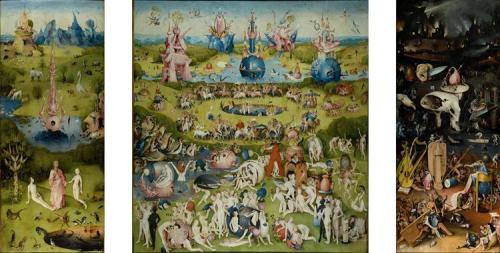
“The Garden of Earthly Delights“ (1510 – 1515)
Hieronymus Bosch
__________
Nor from his patrimonial Heaven alone
Is Jove content to pour his vengeance down;
let me say something about Heaven
here, a concept that is quite different
from the earlier Ancient Greek and
Roman understanding of the term,
was it, for that matter, even a term
then, of the Ancients, that would’ve
meant nothing other to them than
the blue sky above, not at all an
area reached by extraterrestrial
transcendence
the abode of the gods and goddesses
at the time of Ovid was Mount Olympus,
and had been for centuries, much closer
to the earth than the more ethereal home
we imagine of the gods today, every one
of them, however professedly uniquely
supreme, otherworldly
all gods, note, no goddesses, what’s up
with that, I’ve long wondered
the Underworld was for the Ancients
the dwelling place of the departed,
somewhere deep beneath the earth,
or at the very ends of all the seas,
never totally beyond the very
cosmos, as our prevailing faiths
now uniformly preach
the image of Heaven, Hell, and
Purgatory for that matter, that last
a completely Catholic invention – to
account for the salvation, however
partial, of innocent souls deprived
of Heaven for not having been
christened, though not able yet, at
so early an age, to have sinned –
was pretty well codified by Dante
in the 14th Century in his
masterpiece, The Divine Comedy,
a daunting, but profoundly
illuminating read, which has
shaped our impression of these
several possible afterlives ever
since
see above
this particular translation, however
magisterial, but crafted after over a
thousand years of Catholic cultural
domination, cannot avoid the impact
of the Catholic understanding of
Heaven
neither, now, can we, for that matter,
intimately imbued as we are with
the binding faiths of our relatively
more recent forebears
be therefore perspicacious
Aid from his brother of the seas he craves,
To help him with auxiliary waves.
later, we’ll learn that Jove’s brother
of the seas is Neptune, god of all
aqueous things
The watry tyrant calls his brooks and floods,
Who rowl from mossie caves (their moist abodes);
rowl, or roil, upset
mossie, mossy
And with perpetual urns his palace fill:
To whom in brief, he thus imparts his will.
Neptune is stockpiling water, with
the help of his conforming waterways
Small exhortation needs;
no time, in other words, no need,
to do much coaxing, much
exhortation
your pow’rs employ:
use, put into action, or employ,
your pow’rs
And this bad world, so Jove requires, destroy.
Jove, god of gods, is here commanding,
authorizing, orchestrating
Let loose the reins to all your watry store:
Bear down the damms, and open ev’ry door.
The floods
will inexorably follow
stay tuned
R ! chard
 Richibi's Weblog