a veritable Schubertiade, III
“Impression, Sunrise“ (1872)
Claude Monet
________

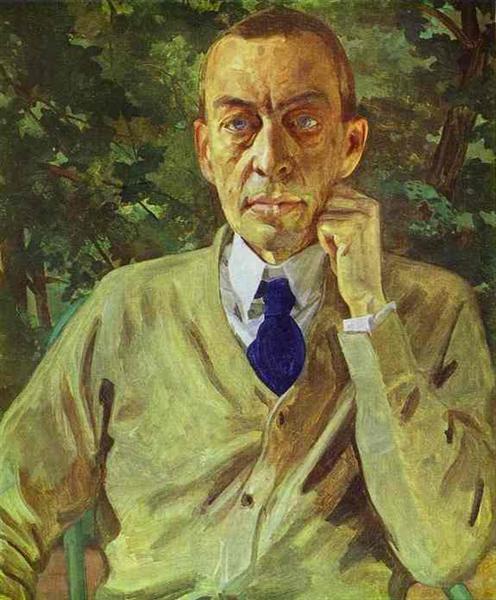
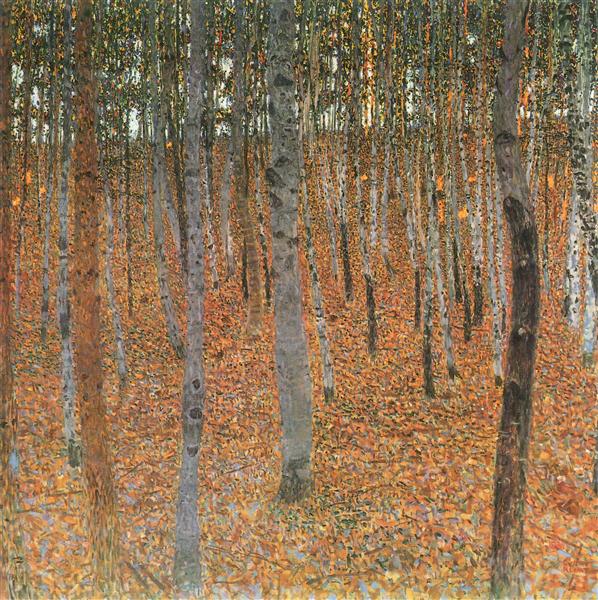
“Beech Grove I“ (1902)
________
if a sonata, or any composition for one
instrument, is a meditation, a rumination,
an introspection, a concerto is its entire
opposite, it’s a declamation, a very
harangue, the performer is not only
before an audience, but before an
orchestra, before the conductor of that
orchestra, that soloist had better be,
therefore, something
Tchaikovsky’s 2nd Piano Concerto
hasn’t cut the cultural mustard, you’ve
probably never heard of it, never mind
heard it, not even in the miasma of our
collective unconscious
why
who knows, it’s magnificent
I suspect that Moscow’s distance,
St Petersburg’s, might’ve had something
to do with it, Russia would still have been
a backwater to Europe, regardless of what
Catherine the Great might’ve done for its
intellectual edification, indeed a veritable
Elizabeth the First, Queen of England,
she, in her sponsorship of the arts
something like that happened, but in
reverse, to Gustav Klimt, Egon Schiele
in art, Schoenberg, Berg, Webern, the
Second Viennese School in music, in
literature, Robert Musil, his “The Man
Without Qualities“ a very rival to
Proust‘s epic trip down memory lane,
“Remembrance …“, when the centre
of gravity for the arts moved from
Vienna to Paris in the late 19th
Century with the advent of
Impressionism
France had entered its Fourth
Republic by then, was to finally
entrench its democracy, and we got
Monet, Debussy, and indeed Proust
instead, not to mention all of that
city’s celebrated others
leaving creative Vienna, meanwhile,
the undisputed engine of the Zeitgeist,
the spirit of the times, for over three
quarters of an earlier century, thereby,
in the dust
New York would take over in the
1950s, similarly, for a time, Andy
Warhol and The Factory, eclipsing
any other town
in other words, location, location,
location, in tandem with historical
events
R ! chard
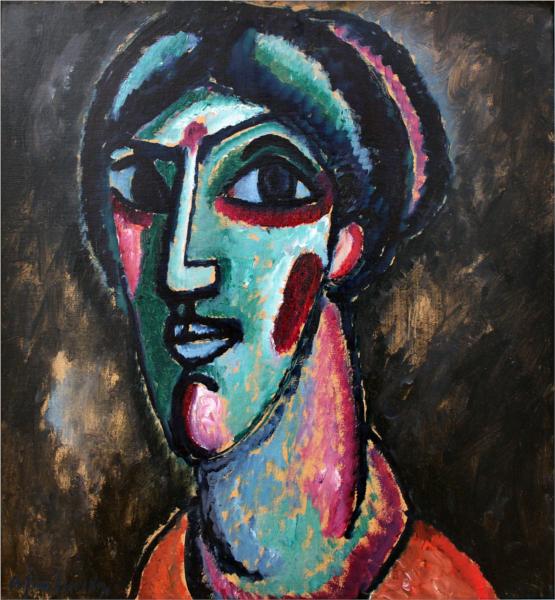
“Head in Black and Green“ (1913)
___________
the line of music, the essential melody,
is not resolved in Beethoven until several
bars from the beginning in his Fifth Cello
Sonata, one note follows another without
any specific reference to what preceded it
but the tempo, and the voice, which is to
say, its tonality
there is ever, however, though perhaps
sometimes eccentric, a harmony, a
convincing argument, we are speaking
the same language
as in reading, one follows the musical
line for those several bars, hanging
onto each note for meaning, spotting
even commas, semi-colons, periods,
however unconsciously, until one
reaches the end of the paragraph,
made evident by the recapitulation
therefore music
which doesn’t only, however,
recapitulate, here, but elaborates,
adding depth, dimension, local
colour, to the already intricate
story
Beethoven is challenging the very
idea of music in this composition,
much as later the Impressionists
did, for instance, when they
upended the entrenched idea of
merely representational art – a
process I saw reverberating in my
very own 1950’s, ’60’s, when even
Monet, people objected, could’ve
been managed by their children
Picasso, of course, was, at the time,
nothing less than a joke, not to
mention any of the Surrealists, or –
gasp – the Expressionists, see
above
I prefer the very early cello sonatas
of Beethoven, for their verve, their
energy, the second movement, the
“Adagio con molto sentimento
d’affetto” in this late one, overdoes
it, I think, a little, it’s like sitting with
someone you can’t leave, whose
sorrow is immense, and which you
can barely handle, but must, out of,
if nothing else, chivalry, or common,
and insuperable, one hopes, human
compassion, consider, and duly,
thus, proffer, ideally, grace
who hasn’t been there
R ! chard
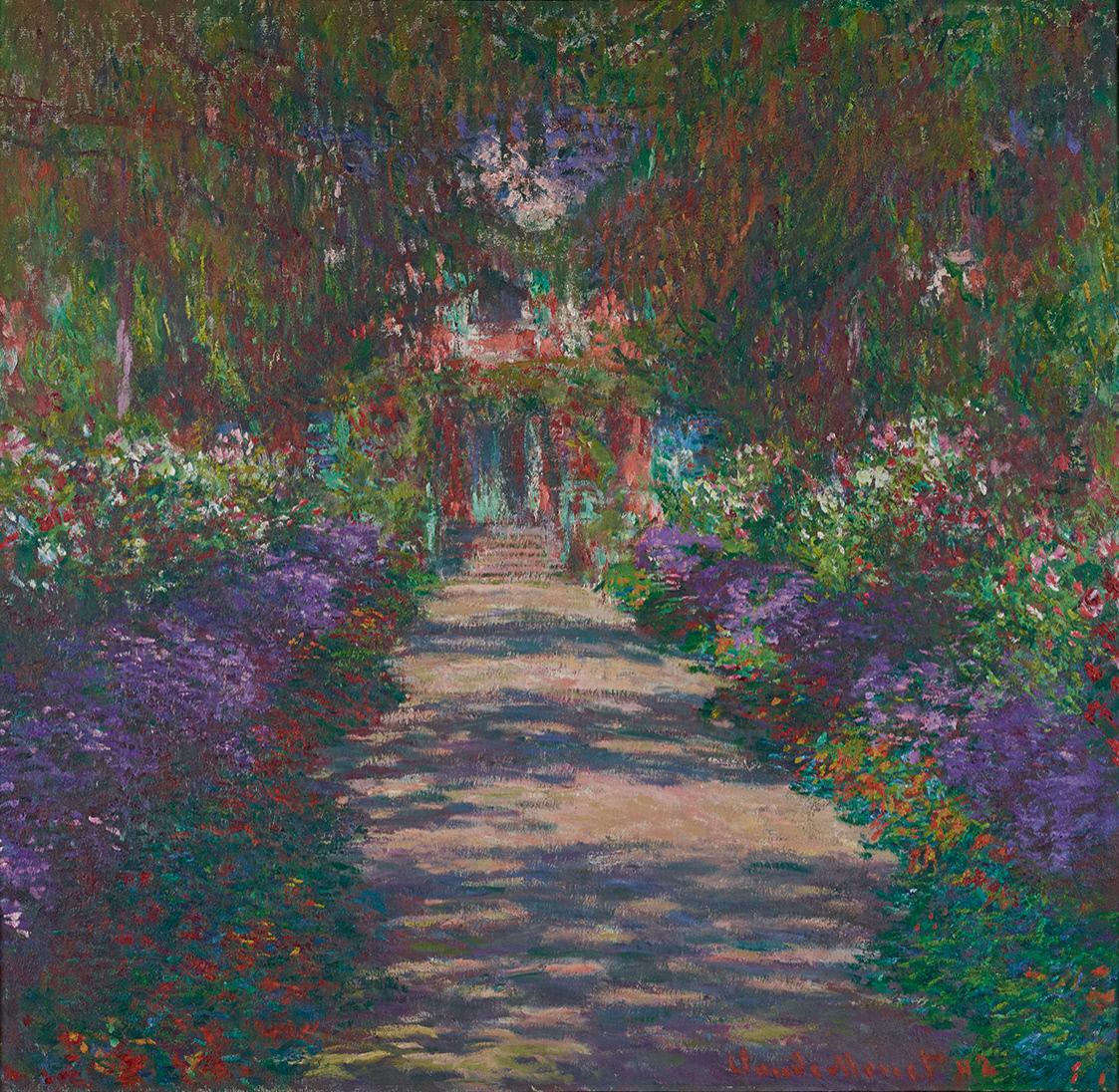
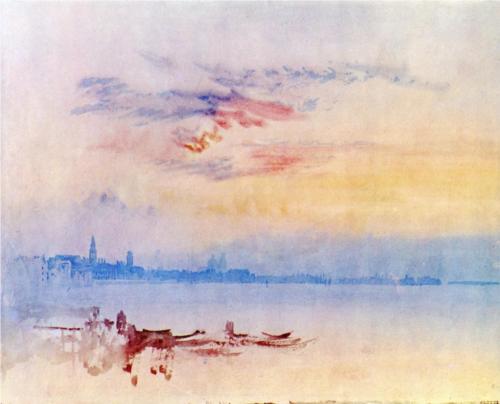
“Venice Looking East from the Guidecca, Sunrise“ (1819)
_______
“Death in Venice“ is perhaps the most
beautiful film I’ve ever seen, just click
Visconti suffuses his masterpiece with
all the colours and textures of Monet,
Renoir, Seurat, Toulouse-Lautrec, and
a host of other Impressionists, and
settles them all upon, nearly inevitably,
the splendours of a Canaletto Venice
Dirk Bogarde has never been better,
his von Aschenbach is definitive,
Silvana Mangano is every single inch
an aristocrat, the epitome of poise,
elegance and propriety, Tadzio is
throughout the very incarnation of a
Botticelli
all is given stately motion by the art
of film and made thereby into another
equal and haunting form of poetry
enjoy, marvel
Richard
psst: Visconti even makes Mahler sound
profound
as does Leonard Bernstein, incidentally,
in the accompanying clip, who is
manifestly transported throughout his
evidently otherworldly experience,
just as you might even be, just click
ekphrasis
poring among the possibilities the nearby university had to offer – they’re listed in a catalogue they seasonally send around – one on poetry, of course, how to make one out of a painting, stood out, how to make of something visual, a Monet, a Van Gogh, a Renoir, a poem
ekphrasis, there’s a word for that, I thought
and ate it up
the picture I got to ekphrase, my word for that, was one of a set the teacher sent around of Kobayashis, snapshots, I’d never heard of him, her, either, Milt Kobayashi, all of them intriguing
I quickly snapped one up, letting my instinct instead of my judgment pick it out – I find it’s usually more accurate – in order to keep the ball rolling, not slow things up
a waif in especially blue, the colour also of chairs behind her – like skies in winter, I thought, when the pressure’s up and the light is pale, colours aren’t crisp but muted – making that sort of association, hoping that wouldn’t be unintelligent
rudimentary roses, wine red, spotted here and there her blue skirt, more like patches than ornamental flowers, a black top the colour of her jet black hair was cut low in a U at her neck, she leaned against a wall, itself nondescript, at the right of the picture, her left, far to that side, and in her own black shadow there splashed upon the wall, a fathomless apparently abyss, seemed to find refuge, a respite, like a womb, pushing herself and it nearly right out of the picture
her arms were crossed, but one reached for her shoulder, lightly resting there, covering inadvertently, or not, her chest, and by my inference her soul, her modesty, her bosom, whereupon, like Michelangelo’s God touched Adam, with love, light and understanding, inadvertently again or not, she touched mine
and her black, plaintive eyes were looking right back
there’s next to nothing on the spartan walls, the table is somewhat set, but light reflected off some glasses there, and dishes, is gleaming, like in Dutch still lifes, artfully, and delightfully
“The Last Table” it’s called, though I’m not too sure what that’s about, a waitress calling it a day, a playful reference somehow to da Vinci’s “The Last Supper” maybe
that’s what I’d have to make into a poem, ekphrase
_____________________________________________
 Richibi's Weblog