Just another WordPress.com weblog
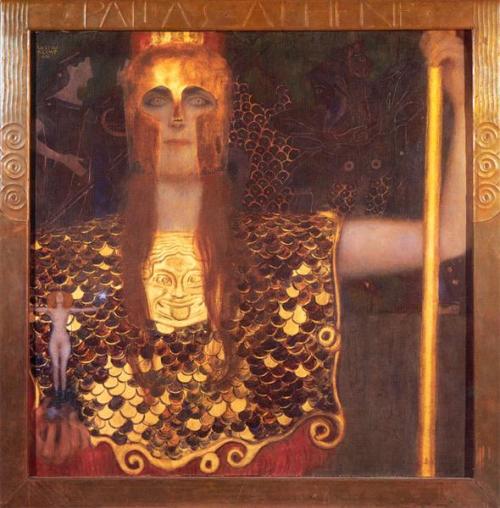
Tag: “Minerva or Pallas Athena” – Gustav Klimt
_______ has spotted Herse , Greek princess, from on high, the most beautiful among a procession of shining virgins fir’d, swoops down toearth, to th’ apartment of the royal maid, in order to seduce her The roof was all with polish’d iv’ry lin’d, That richly mix’d, in clouds of tortoise shin’d. colour, or the substance itself, are referenced here, or maybe even both Three rooms, contiguous, in a range were plac’d, contiguous, one beside the other The midmost by the beauteous Herse grac’d; Her virgin sisters lodg’d on either side. Cecrops , they’d seen the childEricthonius , half man, half snake,son of Minerva , who had been given to them, into their care, categorically not to open, but did, to their great, to their utter, indeed mythic, chagrin Aglauros first th’ approaching God descry’d, descry’d, witnessed, beheld And, as he cross’d her chamber, ask’d his name, And what his business was, and whence he came. “I come,” reply’d the God, “from Heav’n, to woo Your sister, and to make an aunt of you; however unabashedly be he forthright I am the son and messenger of Jove; My name is Mercury, my bus’ness love; Do you, kind damsel, take a lover’s part, And gain admittance to your sister’s heart.” take a lover’s part , Mercury entreats, Aglauros , in thisamorous adventure, strategize a path, gain admittance for me, to your sister’s heart, to her serene acquiescence She star’d him in the face with looks amaz’d, As when she on Minerva’s secret gaz’d, Minerva’s secret, her babe,Ericthonius , half man, half snake,whom Aglauros had earlier, however treacherously, beheld And asks a mighty treasure for her hire; sure, says Aglauros , I’ll help, but what will you give me in return for my service, my hire And, ’till he brings it, makes the God retire. Aglauros will not assist till shereceives the mighty treasure she requests for her hire Minerva griev’d to see the nymph succeed; get anything at all because of her earlier indiscretion, disobediently goddess’ son And now remembring the late impious deed, When, disobedient to her strict command, She touch’d the chest with an unhallow’d hand; In big-swoln sighs her inward rage express’d, That heav’d the rising Aegis on her breast; fashioned by the Cyclopes , brothers, one-eyed giants, in the workplace of Hephaestus , god of Craftsmen, Fire,Metallurgy, it bore the Gorgoneion , the head of Medusa , which would turn one to stone when looked upon Then sought out Envy in her dark abode, Defil’d with ropy gore and clots of blood: Shut from the winds, and from the wholesome skies, In a deep vale the gloomy dungeon lies, Dismal and cold, where not a beam of light Invades the winter, or disturbs the night. Envy, its personification, is a goddess here, though the representative of Envy is usually considered to be next stop, Envy’s dark abode stay tuned R ! chard
______ But you, perhaps, may think I was remov’d, As never by the heav’nly maid belov’d: says the daw to the still snowy plume[d], [w]hite as the whitest dove’s unsully’d breast raven the heav’nly maid, Minerva But I was lov’d; ask Pallas if I lye; Pallas, another name for Minerva Tho’ Pallas hate me now, she won’t deny: hate , note, is in the subjunctive here, the mood of conjecture, where the s is removed from the ending of the third person singular, that she, he, or one, for instance, read, no s on read, Ovid , would be a part of any Latin curriculum For I, whom in a feather’d shape you view, Was once a maid (by Heav’n the story’s true) A blooming maid, and a king’s daughter too. A crowd of lovers own’d my beauty’s charms; own’d, admitted to, acknowledged My beauty was the cause of all my harms ; to a vain friend once who complained to me of the rigours of being beautiful, I said, your beauty, girl, to upend the, otherwise tiresome, conversation, is your curse, get over it, which he did, it did, in at least that instance Neptune, as on his shores I wont to rove, Neptune , god of the Sea wont, to be used to, predisposed to Observ’d me in my walks, and fell in love. He made his courtship, he confess’d his pain, And offer’d force, when all his arts were vain; all of the gods, it appears, are engines, ever, of irrepressible lust, perhaps allegorically alluding to the unquenchable generative powers of very Nature Swift he pursu’d: I ran along the strand, ‘Till, spent and weary’d on the sinking sand, I shriek’d aloud, with cries I fill’d the air To Gods and men; nor God nor man was there: who hasn’t been there, forlorn, abandoned, desolate, forsaken A virgin Goddess heard a virgin’s pray’r. the virgin Goddess , remains, however For, as my arms I lifted to the skies, I saw black feathers from my fingers rise; I strove to fling my garment on the ground; My garment turn’d to plumes, and girt me round: My hands to beat my naked bosom try; Nor naked bosom now nor hands had I: the king’s daughter, still unnamed, note, attesting to the interchangeability of virgin’s in Greek and Roman mythology, is in the process of becoming a daw, a black bird Lightly I tript, nor weary as before Sunk in the sand, but skim’d along the shore; it appears there are advantages to becoming a bird ‘Till, rising on my wings, I was preferr’d To be the chaste Minerva’s virgin bird: go, girl Preferr’d in vain! I am now in disgrace: Nyctimene the owl enjoys my place. friendship, it appears, can turn on a dime, or an inadvertent, but decisive, irritation R ! chard
 Richibi's Weblog