Richibi’s Weblog

Just another WordPress.com weblog

Tag: Minerva / goddess  of Wisdom

“The Story of Coronis, and Birth of Aesculapius” (IV) – Ovid

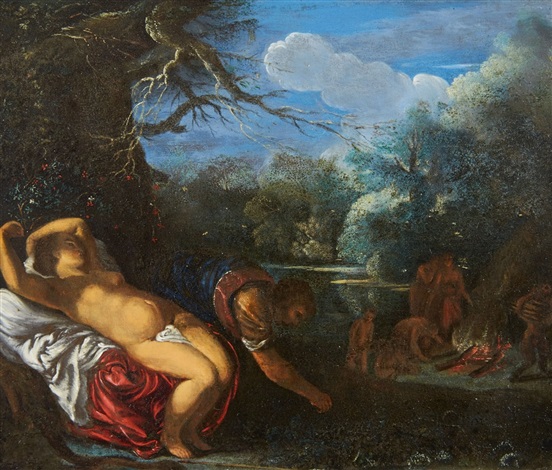
adam-elsheimer-apollo-and-coronis-2

   “Apollo and Coronis (1606 – 1608)


                Adam Elsheimer


                   __________


               On her incestuous life I need not dwell 
               (In Lesbos still the horrid tale they tell), 
               And of her dire amours you must have heard, 
               For which she now does penance in a bird, 
               That conscious of her shame, avoids the light, 
               And loves the gloomy cov’ring of the night; 
               The birds, where-e’er she flutters, scare away 
               The hooting wretch, and drive her from the day.” 


Nyctimene, daughter of Epopeus

king of Lesbos, a Greek Island in

the Aegean Sea, had been defiled 

by her father, Minerva, out of pity,

transformed her into an owl, the

above verses tell the story of

that owl, Nyctimene


               The raven, urg’d by such impertinence, 
               Grew passionate, it seems, and took offence, 
               And curst the harmless daw; the daw withdrew: 
               The raven to her injur’d patron flew, 
               And found him out, and told the fatal truth 
               Of false Coronis and the favour’d youth. 


the raven, Apollo’s own bird, having 

discovered Coronis to be unfaithful 

to their master, its and hers, remained

intentdespite the daw’s warnings,

earlier here reported, on informing

the god of the Sun 


               The God was wroth, the colour left his look, 


wroth, angry


               The wreath his head, the harp his hand forsook: 


[t]he wreath, … the harp, Apollo’s

usual attributes, symbols of his

harmony, concord


               His silver bow and feather’d shafts he took, 
               And lodg’d an arrow in the tender breast, 
               That had so often to his own been prest. 


though Apollo is not usually 

associated with bows and arrows,

his twin sister Diana, goddess of

the Hunt, always is, it would not 

be unusual to conflate the two 

deities for poetic, or indeed

mythological, purposes


               Down fell the wounded nymph, and sadly groan’d, 
               And pull’d his arrow reeking from the wound; 
               And weltring in her blood, thus faintly cry’d, 
               “Ah cruel God! tho’ I have justly dy’d, 
               What has, alas! my unborn infant done, 
               That he should fall, and two expire in one?” 
               This said, in agonies she fetch’d her breath. 


it is supposed here that the unborn

infant is indeed Apollo’s


               The God dissolves in pity at her death;

               He hates the bird that made her falshood known, 
               And hates himself for what himself had done; 
               The feather’d shaft, that sent her to the Fates, 
               And his own hand, that sent the shaft, he hates.


Apollo is suffused with regret, anger,

self-recrimination


               Fain would he heal the wound, and ease her pain, 


Fain, with pleasure, gladly


               And tries the compass of his art in vain. 


the compass of his art, the range 

of his ability, in this case vain, 

faulty, ineffective


               Soon as he saw the lovely nymph expire, 
               The pile made ready, and the kindling fire. 


pile, pyre


the sentence lacks a verb here, it 

should read The pile was made 

ready, just saying


               With sighs and groans her obsequies he kept, 


obsequies, funeral rites


               And, if a God could weep, the God had wept. 


I’ll have to watch out for gods

weeping, I suspect some have, 

some can


               Her corps he kiss’d, and heav’nly incense brought, 
               And solemniz’d the death himself had wrought. 


corps, body, corpse


wrought, brought about, made

happen


               But lest his offspring should her fate partake, 
               Spight of th’ immortal mixture in his make, 


Spight, in spite 


               He ript her womb, and set the child at large, 
               And gave him to the centaur Chiron’s charge: 


Chiron, first among the centaurs,  

half man, half horse, was highly 

revered as a teacher, having 

been raised by the twins, Apollo 

and Diana / Artemis, supremely

accomplished deities


               Then in his fury black’d the raven o’er, 
               And bid him prate in his white plumes no more. 


black’d, Apollo turned the snowy 

plume[d], [w]hite as the whitest 

dove’s unsully’d breast raven 

black


prate, babble, talk incoherently


R ! chard


“The Story of Coronis, and Birth of Aesculapius” (II) – Ovid

the-daughters-of-cecrops-finding-the-child-erichthonius

     “The Daughters of Cecrops Finding the Child Erichthonius (1640) 


               Jacob Jordaens


                   _________


                                 Once upon a time, 


something interesting happens here,

where earlier in this particular myth

we had a fable, a story in which 

animals play major roles, Aesop is 

famous for his, for instance, as is

Jean de la Fontainewith the

opening catchphrase above, a line

as old at least as Dryden, we’re

suddenly in the land of fairy tales,

structurally, technically


              The two-shap’d Ericthonius had his birth 
              (Without a mother) from the teeming Earth; 


Ericthonius, son of Minervagoddess 

of Wisdom, and of several other traits 

and abilities, and Hephaestus, god of 

Craftsmen, Metallurgy, Fire, among

other, again, areas of malleability 

and possibility


Without a mother, not in the usual,

mammalian, manner


two-shap’d, half human, half serpent,

don’t ask


              Minerva nurs’d him, and the infant laid 
              Within a chest, of twining osiers made. 


Minerva hid her fearsome child in  

a box, a chest, closed the lid, and 

entrusted the secret contents to a 

trio of sisters


              The daughters of king Cecrops undertook 
              To guard the chest, commanded not to look 
              On what was hid within.


king Cecrops, mythical founder and

first king of Athens


                                                               I stood to see 
              The charge obey’d, perch’d on a neighb’ring tree. 


I, the daw, the storyteller


              The sisters Pandrosos and Herse keep 
              The strict command; Aglauros needs would peep, 


Pandrosos, not to be cofused with 

Pandora, Herseand Aglauros, the

three daughters of Cecrops


              And saw the monstrous infant, in a fright, 
              And call’d her sisters to the hideous sight: 
              A boy’s soft shape did to the waste prevail, 
              But the boy ended in a dragon’s tail. 


there’s the ring here, nevertheless,

of Pandora’s tale, though this story

is not at all as dire for humanity as 

Pandora‘s fateful introduction of 

very evil into the world


              I told the stern Minerva all that pass’d; 
              But for my pains, discarded and disgrac’d, 
              The frowning Goddess drove me from her sight, 
              And for her fav’rite chose the bird of night. 
 

the bird of night, the owl, with which

Minerva is often associated, often

portrayed


              Be then no tell-tale; for I think my wrong 
              Enough to teach a bird to hold her tongue. 


and aptly, we learn the lesson a

fable is meant, by definition, to 

expose


R ! chard