Richibi’s Weblog

Just another WordPress.com weblog

Tag: “Metamorphoses” – Ovid

“Metamorphoses” – Ovid, 102
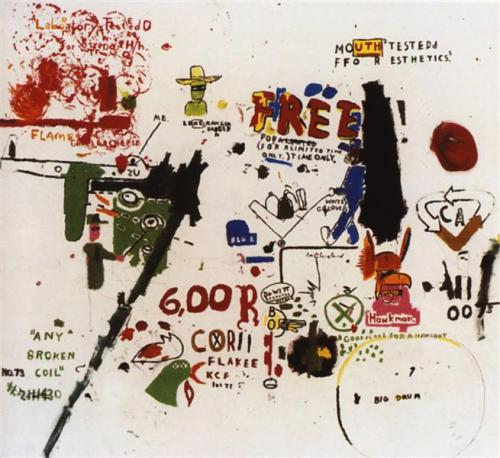
to-be-titled.jpg!Large

   To Be Titled (1987) –


          Jean-Michel Basquiat


                     __________


next, according to Ovid, inspired, presumably,  

by the Gods, is what happens before the world 

is created


        Before the seas, and this terrestrial ball, 


which is to say, the earth


        And Heav’n’s high canopy, that covers all,

        One was the face of Nature; if a face:


the “face of Nature” was “One”, an 

indistinguishable, perhaps not even, “face”


        Rather a rude and indigested mass:

        A lifeless lump, unfashion’d, and unfram’d,

        Of jarring seeds; and justly Chaos nam’d.


this undifferentiated agglomeration, this “lifeless 

lump” was called Chaos


note the “seeds”, however, potential, though 

“jarring”, or conflicting, the genesis for what 

is to follow   


           No sun was lighted up, the world to view;

           No moon did yet her blunted horns renew:


the horns of the moon are visible when the 

crescent moon lies flat on the horizon, in 

the shape of a smile, presenting “horns”, 

the twin elevated extensions


           Nor yet was Earth suspended in the sky,

           Nor pois’d, did on her own foundations lye:


or lie


           Nor seas about the shores their arms had thrown;

           But earth, and air, and water, were in one.


see again Chaos here


           Thus air was void of light, and earth unstable,

           And water’s dark abyss unnavigable.

           No certain form on any was imprest;

           All were confus’d, and each disturb’d the rest.

           For hot and cold were in one body fixt;

           And soft with hard, and light with heavy mixt.


next, the first metamorphosis


stay tuned


R ! chard


“Metamorphoses” – Ovid, 101

primavera-1478(1).jpg!Blog

   “Primavera (1478) 


       Sandro Botticelli


             _________


a friend expressed some interest in Ovid’s

Metamorphoses recently after I’d sung for 

a few moments its praises, had told her I 

was revisiting it after some time with the 

intention of duly, this time, completing it, 

given that, hey, we’ve got lots of time, at 

present, all of us, on our hands, by very 

mandate  


it sounds wonderful, she briefed me after 

I’d sent her the appropriate link, but there 

are some parts I don’t understand


I’ll help, I said, only too eager to share 

the delights of this inprobable treasure,

a gift nearly two thousand years old, 

with the magic still of very revelation


Metamorphoses is a creation story, the 

equivalent of the Bible for those who 

revered the Roman deities, the same 

deities that the Greeks revered, but 

transplanted, renamed, to Roman 

stock, like the Puritans did their  

Christian seed at Plymouth Rock  


Ovid, 43 BC to 17/18 AD, was a Roman

poet, paying fealty to Augustus, Emperor

of Rome, 63 BC to 14 AD, therefore his 

Roman goddesses, gods, and his, 

contemporary, Latin


which was translated into English early 

in the Renaissance, but found its best

expression, to my mind still, in the 

eminent hands of Sir Samuel Garth,

John DrydenAlexander PopeJoseph

AddisonWilliam Congreve, among 

others in, already, 1717


listen 


The Creation of the World


       Of bodies chang’d to various forms, I sing:
 

Ovid is saying my topic is transformation, very

metamorphoses, plural of metamorphosis


       Ye Gods, from whom these miracles did spring,
       Inspire my numbers with coelestial heat;
       ‘Till I my long laborious work compleat:
       And add perpetual tenour to my rhimes,
       Deduc’d from Nature’s birth, to Caesar’s times. 


poets have traditionally called upon their related

muses to inspire them to accomplish their task,

Ovid invokes his Gods, compare Shakespeare’s 

O for a Muse of fire, that would ascend / The

brightest heaven of invention, his prologue to 

Henry V   


“Ye Gods”, Ovid says, from whom these 

miracles did spring”, those everyday wonders 

that surround us, inspire me, he asks, that I 

might “compleat”, which is to say complete, 

his poem, this long laborious work”


his “numbers” are his years, “coelestial”, or

celestial, “heat”, is inspiration


“tenour to my rimes” means rhythm, weight, 

to his poetry


“Nature’s birth”, or the beginning of time, to

“Caesar’s time”, Ovid‘s own period under

Augustus


Ovid asks the Gods to fuel him with the

fire to tell the story of the world from its 

very beginning to his own epoch,

Caesar’s 


how’s that for a project


enough for now


but stay tuned for, to follow, the Creation,

capital C, I tell you 


R ! chard


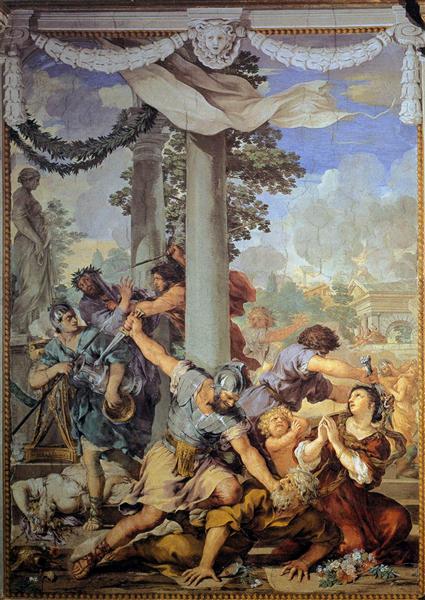
“The Iron Age” – Ovid


the-age-of-iron-1641-1.jpg!Large.jpg

                                “The Age Of Iron (1637-1641)

                                          Pietro da Cortona

                                               __________

The Iron Age

Hard steel succeeded then: 
And stubborn as the metal, were the men. 
Truth, modesty, and shame, the world forsook: 
Fraud, avarice, and force, their places took. 
Then sails were spread, to every wind that blew. 
Raw were the sailors, and the depths were new: 
Trees, rudely hollow’d, did the waves sustain; 
E’re ships in triumph plough’d the watry plain.

Then land-marks limited to each his right: 
For all before was common as the light. 
Nor was the ground alone requir’d to bear 
Her annual income to the crooked share, 
But greedy mortals, rummaging her store, 
Digg’d from her entrails first the precious ore; 
Which next to Hell, the prudent Gods had laid; 
And that alluring ill, to sight display’d. 
Thus cursed steel, and more accursed gold, 
Gave mischief birth, and made that mischief bold: 
And double death did wretched Man invade, 
By steel assaulted, and by gold betray’d, 
Now (brandish’d weapons glittering in their hands) 
Mankind is broken loose from moral bands; 
No rights of hospitality remain: 
The guest, by him who harbour’d him, is slain, 
The son-in-law pursues the father’s life; 
The wife her husband murders, he the wife. 
The step-dame poyson for the son prepares; 
The son inquires into his father’s years. 
Faith flies, and piety in exile mourns; 
And justice, here opprest, to Heav’n returns.

                                        Metamorphoses – Ovid

just saying

Richard


to Socrates – on monotheism‏

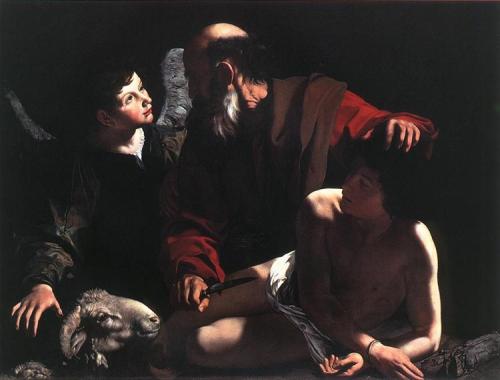
sacrifice-of-isaac(1).jpg!Large

      “The Sacrifice of Isaac (1598)

                        Caravaggio

                               ________

by very definition, the inevitable
result of monotheism, Socrates,  
is war, if there is one authority it  
will eventually be opposed by a 
contrary, however picayune, 
however trivial, opinion, see the 
Protestant Reformationsee Islam, 
for instance, now
 
after which there is disintegration
 
before Christianity, there were gods, 
a pantheon of them symbolically
alive among the rivers, the trees, 
the mountains, read Ovid for an
exhilarating description, wars were 
waged for territory, not conscience  
 
Judaism, the religion of the Jews,
evolved for their own existence a
deity, Yahweh, who was their one 
god, disdainful of foreign others,
an uncharacteristic attitude among 
other religions then, becoming one 
of the very first monotheistic, and
consequently existentially 
compromised faiths, if not the 
first
 
the intent was to rally ideological 
support among its adherents so 
that they could protect the lands 
of Israel and Judahtheir ancestral 
homesas they would have it, a 
sanctification of the territorial 
principle
 
their Bible, the Torah, a vengeful 
work, and the basis for the 
Christian Old Testament, 
demanded of its followers 
unblinking and cruel allegiance,
the sacrifice of Isaacfor instance,
a father required to sacrifice his 
own son, however might it ‘ve
been at the last minute averted by 
the intercession of an angel sent 
by that very Lord
 
Christ came along to turn the other
cheek
 
which didn’t last long 
 
indeed Montesquieu, an early 
philosopher of the French
Enlightenment, tells of the 
King’s librarian of Chinese 
texts, who had been converted 
to Catholicism in China, but 
who was nonplussed upon his 
arrival in Christian France to find 
that the French did not do onto 
others as they would have them 
do unto themselves, nor did they, 
more catastrophically, turn the  
other cheek
 
for that matter see what Christian 
Europe did to the Americans
 
Christ’s own followers, once they’d 
achieved political prominence, after, 
admittedly, 300 years of persecution 
by the prevailing Roman authorities, 
set their own deity, God, on high, 
indeed beyond the rivers, the 
mountains, the trees into the very 
ineffable, the inscrutable abstract, 
and squelched any opposition for  
the next thousand and some years,
the philosophical underpinnings of 
which was the work of your 
contemporary, Plato, Socrates, his 
ideal of the Ideal
 
Augustine signed those recalibrated 
papers with his City of God“, it took 
the Renaissance to make a dent in its 
armour, and another several centuries 
to declare the Christian God dead, 
Time magazine in the ’60s, on the 
heels of Nietzsche‘s nihilistic  
pronouncement some 70 years earlier, 
that God had exited history
 
what we are left with, Socrates, is every 
wo/man for hirself, therefore the Age of 
Human Rights, for better or for worse
otherwise many of us would’ve been 
guillotined, burnt at the stake, stoned 
to death, by now
 
what do you think
 
I’ll bet I can tell, you think that every 
wo/man owes allegiance to what s/he 
believes in, even to inexorable death, 
however impractical, unfortunate, or 
fateful, if your exemplary life has  
anything to say about it 
 
 
cheers
 
Richard

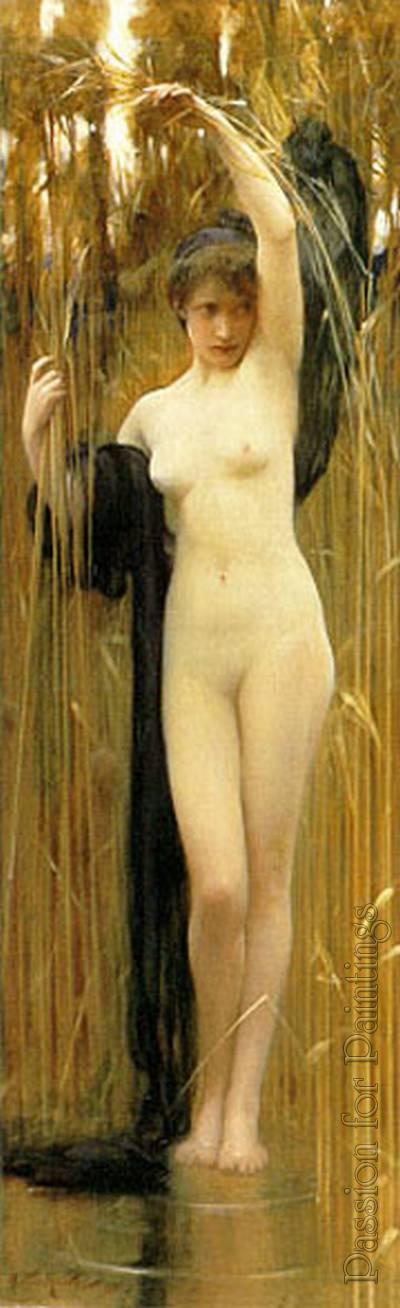
“Syrinx” – Claude Debussy‏

big

         Syrinx (1892)
 
          Arthur Hacker
 
            __________
 
 
though Debussy would’ve called his
Syrinx “Flûte de Pan”, “Pan Flute”,
alas, the name had already been 
taken, he therefore came up with the 
much more inspired Syrinx
 
Syrinx, with the help of other nymphs, 
who’d come at her cry for help as she 
fled the god Pan, a pursuer, had been 
turned into a bush of reeds, its canes 
producing a song so sweet as to 
confound and disarm him, impelling
him to create of them that sublime 
instrument  
 
Hermes had been telling Argus, Argus 
Panoptes, the giant with the hundred 
eyes, the story about the pipes he  
was playing, an implement received 
from Jove, apparently, god of all the 
gods, who wanted him to kill Argus, 
for confining Io, who’d been turned 
into a heifer by Juno, Jove’s wife, 
who’d caught him chasing her, Io’s 
plaintive lows had been getting to 
Juno as Io fretted unfettered through 
the fields too close to Olympus 
 
when Hermes’ music finally closed the
giant’s last two eyes, he beheaded him,
but Juno, in merciful recognition of his
service, however ultimately ineffectual, 
set them into the variegated tail of the 
peacock
 
are you kidding me, I always think when
I read Ovid’s “Metamorphoses”, and am
ever nevertheless entirely enchanted
 
a flute solo had not been composed in
over 150 years when Debussy composed
his Syrinx“, 1913, after C.P.E. Bach’s not  
at all unimpressive Sonata in A Minor 
of 1747, it duly set off a new life for the 
long overlooked flute, a reed which 
Mozart famously didn’t like
 
note the tonal, rhythmic, and repetition 
shifts from the rigid Classical model, 
where these are much more strict, 
Impressionism was not only breaking 
down pictures, the pictorial arts, but its
sound world as well, it was an utterly
new era, new sensibility, new zeitgeist, 
and you can feel it, though you might
not be quite able to immediately 
verbalize it, the arts were again, as
they ever ‘ve been, the canary in the 
gold mine
 
 
Richard
 
psst:
 
   The Transformation of Syrinx into Reeds 
 
Then Hermes thus: A nymph of late there was 
Whose heav’nly form her fellows did surpass. 
The pride and joy of fair Arcadia’s plains, 
Belov’d by deities, ador’d by swains: 
Syrinx her name, by Sylvans oft pursu’d, 
As oft she did the lustful Gods delude: 
The rural, and the woodland Pow’rs disdain’d; 
With Cynthia hunted, and her rites maintain’d: 
Like Phoebe clad, even Phoebe’s self she seems, 
So tall, so streight, such well-proportion’d limbs: 
The nicest eye did no distinction know, 
But that the goddess bore a golden bow: 
Distinguish’d thus, the sight she cheated too. 
Descending from Lycaeus, Pan admires 
The matchless nymph, and burns with new desires. 
A crown of pine upon his head he wore; 
And thus began her pity to implore. 
 
Now while the lustful God, with speedy pace, 
Just thought to strain her in a strict embrace, 
He fill’d his arms with reeds, new rising on the place. 
And while he sighs, his ill success to find, 
The tender canes were shaken by the wind; 
And breath’d a mournful air, unheard before; 
That much surprizing Pan, yet pleas’d him more. 
Admiring this new musick, Thou, he said, 
Who canst not be the partner of my bed, 
At least shall be the confort of my mind: 
And often, often to my lips be joyn’d. 
He form’d the reeds, proportion’d as they are, 
Unequal in their length, and wax’d with care, 
They still retain the name of his ungrateful fair.
 
                                                  Ovid