Richibi’s Weblog

Just another WordPress.com weblog

Tag: Mendelssohn

String Quartet in B flat, Opus 55, no 3 – Haydn
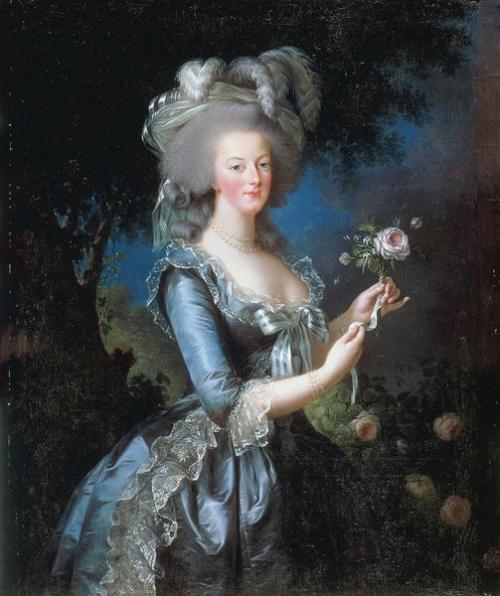
queen-marie-antoinette-of-france-1783.jpg!Large

                      “Queen Marie Antoinette of France (1783) 

                                Louise Élisabeth Vigée Le Brun

                                              ___________________

first of all, let me grievously repent an
egregious confusion I probably left
in my last diatribe, I said that the second
movement of the Opus 54, no 2 sounded 
to me like a minuet, I had, through 
embarrassing inattention, confused its,
however unmemorable, adagio with that
of this Opus 55, no 3, which I’d listened 
to in too quick succession, driven as I 
am by my thirst for epiphanies

the Opus 54, no 2 will do, but I’m not 
going back for seconds, nor to the 
Opus 55, no 3, though here’s where  
I flaunt nevertheless Haydn, not to 
mention Bach, Mozart, Beethoven, 
all the way to eventually Bruckner, 
Brahms, the extraordinary Richard
Wagner, passing through Schubert,
Mendelssohn, the Strausses, father
and son, and the unrelated Strauss,
Richard, another incontrovertible 
giant, and I nearly left out the 
unforgettable Liszt, all of them 
forefathers of our present music

you might have noticed that these 
are all Germanic names, obedient 
to the Hapsburg empire, with 
Vienna as its supreme cultural 
capital, and it was that 
Austro-Hungarian dynasty that
indeed nearly single-handedly 
secured our Western musical 
traditions

a few Italians are remembered,
from the 18th Century, Scarlatti 
maybe, Boccherini, Albinoni
but not many more 

no one from France, but they were 
about to have a revolution, not a 
good time for creative types,
though, incidentally, Haydn was 
getting Tost, to whom he was 
dedicating his string quartets for 
services rendered, to sell his stuff 
in very Paris 

then again, Marie Antoinette, I thought, 
was Austrian, an even archduchess, 
and would’ve loved some down-home 
music at nearby Versailles

so there you are, there would’ve been 
market

the English had Handel, of course,
who was, albeit, German, getting 
work where he could when you 
consider his competition, he was 
too solemn and plodding by half,
to my mind, for the more 
effervescent, admittedly Italianate, 
continentals, Italy having led the 
way earlier with especially its 
filigreed and unfettered operas

but here’s Haydn’s Opus 55, no 3
nevertheless, the best Europe had
to offer, socking it to them

Haydn’s having a hard time, I think, 
moving from music for at court to
recital hall music, music for a much
less genteel clientele, however 
socially aspiring, we still hear 
minuets, and obeisances all over 
the place, despite a desire to 
nevertheless dazzle, impress

then again, I’m not the final word, as
my mea culpa above might express, 
you’ll find what eventually turns 
your own crank, floats your own 
boat, as you listen

which, finally, is my greatest wish


R ! chard
Dmitri Shostakovich – “Symphony No 4” in C minor, opus 43

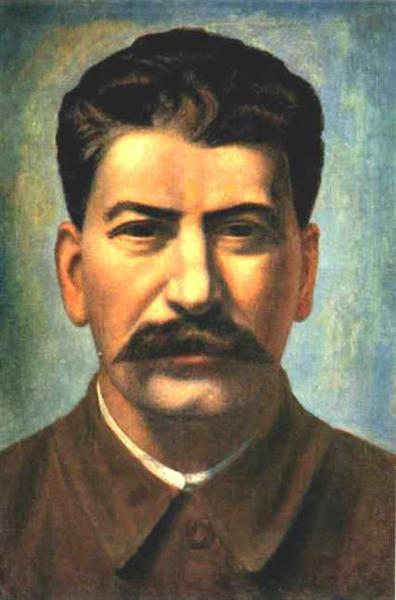
portrait-of-joseph-stalin-iosif-vissarionovich-dzhugashvili-1936.jpg!Large

   “Portrait of Joseph Stalin (Iosif Vissarionovich Dzhugashvili) (1936)

                   Pavel Filonov

                           _________

if you’ve been waiting for a Shostakovich 
to write home about among his early 
symphonies, here’s the one, his 
Symphony no 4 in C minor, opus 43 will
knock your socks off from its very 
opening gambit, have a seat, settle in, 
and get ready for an explosive hour

the Fourth was written in 1936, some 
years after the death of Lenin, and the 
instalment of Stalin as the supreme, 
and ruthless, authority, after several 
years throughout the Twenties of
maneuvering himself, cold-bloodedly,
into that position 

from Stalin, Death is the solution to 
all problems. No man – no problem.

fearing retribution after Stalin had 
criticized his recent opera, Lady 
Macbeth of Mtsensk“, Shostakovich 
cancelled the first performance of 
this new work, due to take place in 
December, ’36, others had already 
suffered internal exile or execution 
who had displeased the tyrant, a 
prelude to the infamous Great Terror

the Symphony was eventually played
in 1961, 25 years later, conducted by
no less than Kirill Kondrashin, who’d
partnered Van Cliburn a few years 
earlier in Cliburn’s conquest of Russia
but along with this time however the 
long-lived Leningrad Philharmonic 
Orchestra 

to a friend, I said, this is the biggest
thing since verily Beethoven, no one 
has so blown me away symphonically 
since then

he looked forward, he replied, to 
hearing it 

the Fourth Symphony has three distinct 
movements, to fit thus appropriately the 
definition of symphony, though the first 
and third have more than one section, 
something Shostakovich would have 
learned from already Beethoven, it gives 
the opportunity of experiencing a variety 
of emotions within one uninterrupted 
context, add several movements and 
you have a poignant, peripatetic musical 
journey, more intricate, psychologically 
complex, than many other even eminent
composers, Schubert, Chopin, 
Mendelssohn, even Brahms, for instance 

it’s helpful to think of film scores, and 
their multiple narrative incidents,
brimming with impassioned moments,   
however disparate, Shostakovich had 
already written several of them

let me point out that Shostakovich’s 
rhythms are entirely Classical, even 
folkloric in their essential aspects, 
everywhere sounds like a march, 
proud and bombastic, if not a 
veritable dance, peasants carousing,
courtiers waltzing, and repetition is
sufficiently present to not not 
recognize the essential music 
according to our most elementary
preconceptions

but the dissonances clash, as though 
somewhere the tune, despite its rigid 
rhythms, falls apart in execution, as 
though the participants had, I think,  
broken limbs, despite the indomitable 
Russian spirit

this is what Shostakovich is all about, 
you’ll hear him as we move along 
objecting, however surreptitiously,
cautiously, to the Soviet system, like 
Pasternak, like Solzhenitsyn, without 
ever, like them, leaving his country 
despite its manifest oppression, and 
despite the lure of Western accolades,
Nobel prizes, for instance, it was their 
home

and there is so much more to tell, but
first of all, listen

R ! chard 


Dmitri Shostakovich – Symphony no. 1, opus 10, continued

Dmitrij_Dmitrijevič_Šostakovič_(Дми́трий_Дми́триевич_Шостако́вич)

        Shostakovich in 1925

                   __________

                                        for Barbara, who died recently,
                                                 she would’ve loved this 

Shostakovich was just nineteen when
his Symphony No.1, opus 10 was 
first performed – it had been his 
graduation piece the previous year
from the Petrograd Conservatory –  
by, then, which is to say 1926, the 
Leningrad Philharmonicrenamed the 
Saint Petersburg after the fall of the 
U.S.S.R., the name it had held before 
the Bolshevik Revolution, the oldest 
philharmonic orchestra, therefore, 
incidentally, in our Russia, going  
back to 1882 

the work was a complete success, not 
surprisingly, if you’ll consider its scope, 
its power, and its novel musical 
interpolations, I mean a piano as an 
integral orchestral instrument rather 
than as a distinct, however interrelated, 
component, a pas de 40 instead of 
pas de deuxsomething I can’t remember 
anywhere else having seen for piano 

not to mention the drum roll between 
the last two movements, drums making 
splash in an orchestral setting, who’d 
‘a’ thunk it, though Richard Strauss had
done just that in his extraordinary 
Burleske” several decades earlier,  
another youthful work, Strauss only 21

but meanwhile back in Russia, before 
too seriously digress, Shostakovich  
was immediately compared to another 
earlier young prodigy there, Alexander 
Glazunovwho’d himself put out his 
own First Symphony, the Slavonic“,
at age 16, introducing, incidentally, his 
own instrumental novelty then, an oboe 
obbligato, which by very definition is 
lovely
  
Glazunov also mentored, by the way, 
Shostakovich at the Petrograd, proved
to be instrumental indeed in his 
progress

it’s interesting to put these last two 
together, to compare, the Glazunov, 1881,
follows the traditional Romantic 
imperatives, tempo, tonality and 
repetition, but with more bombast, to my
mind, than its European counterparts,
its fields are the Russian steppes with 
troikas, horse-drawn carriages, flying 
across vast unhampered vistas of the 
Russian snow-covered, therefore 
pristine, tundra, to whet the unbridled 
Russian spirit, the Europeans, Brahms,
MendelssohnMahler, conversely, 
are confined to the hunt, however ever
glorious, but with shrubs, copses,   
thickets, if not veritable forests, to blur
the sonic arena, inspire dreams, 
consequently, less far-reaching than  
those of Johnny Appleseed even, of 
the North American Prairies poets,    
their own far-flung, boundless  
imaginations, inspiration, you can 
hear it all, blatantly, in the resonance
of the horns

you’ll note the movements follow 
essentially the same rhythmic order 
in either symphony, the first two fast 
enough, then a third that’s somewhat 
slower, a variation from the strictly 
Classical order of fast, slow, fast, then
a last, eclectic, movement 

but Shostakovich is more atonal, 
melodically divergent, an eccentricity 
he’ll later polish to a degree of 
politically subversive brilliance

for not submitting, however, to the rule 
of repetition, which is manifest, though,  
in GlazunovShostakovichI find, leaves
us trying to find our bearings as his music 
rolls along, kind of like in biographical 
movies, when you start looking at your 
watch to determine how many life 
incidents remain in this particular, 
however significant, existential drama

as spectacle – and it must be noted that 
symphonic displays were at the time 
indeed spectacles – there was no 
phonographic, photographic 
equipment to transmit such 
experiences, the symphony itself was 
the show, it had, right there, itself, to 
wow the audience

in all of these cases, all of them did 

Shostakovich, however, of all of them 
remained eventually potently 
pertinent, powerfully paramount, 
watch

R ! chard

J.S. Bach – Sonatas for Violin and Keyboard

though Bach wrote several works for solo violin – 
the astonishing feat of keeping you entertained
for again, like his work for the cello, with one
note only at a time for a couple of nevertheless
rapturous hours – this performance of the sonatas 
for violin and keyboard, which at the time would’ve
been the harpsichord, is live, complete, and too
sublime not to take precedence over his equally
mesmerizing solo stuff, unavailable anyway yet
cohesively on the Internet, before taking leave
of this mighty master, as we eventually must, 
for more contemporary pastures 
 
Bach was the end of an era, of civility, of order,
of, after Newton, the apparently clockwork
universe, where all would be ultimately
mathematically comprehensiblethough God, 
somewhere beyond the paradoxically
indecipherable still infinite, would remain
obstinately for a while the watchmaker
 
you can hear this in Bach’s music, each intricate
piece coming to an always thoroughly satisfying
end, like absolution, like sonic grace 
 
 
this would change, the dissolution of the idea
of God, the basis of the rights of kings, would
logically have to founder on the primacy of
individual rights, democracy, and the
positioning of the heart at the centre of
philosophical speculation, which is to say, 
after a Classical intervention, the Romantic
Age  
 
yes, of course, it was saying, to staunch and
irrevocable reason, indeed the mind, but the
heart has also its ratiocinations of which
reason knows naughtas Blaise Pascal,
1623-1662, iconic mathematician, physicist,
philosopher, had so incisively stated, who
even so early had understood the ineluctable
place of passion in the affairs of men   
 
 
you’ll note the more languid pace of the violin
that the keyboard at this point cannot accomplish,
but that the pianist here mimics with only spare
use of the hold petal, which would give notes
otherwise a too reverberant, too self-indulgent 
tone 
 
 
the music of Bach by the time of Mozart was
considered unfashionably dated, and was lost
for nearly a hundred years, to be revived
decisively by conductors and performers only
in the mid-nineteenth century, Mendelssohn
among the most noteworthy of these proponents 
 
today I can think of no other more consistently
profoundly satisfying composer, pace even the 
very Homer of music, the monolithic Beethoven  
 
but of course that’s just my opinion   
 
 
Richard
 
psst: Polling Abbey is a monastery in Upper
         Bavaria, a short distance from Munich