at the movies – “Phaedra”
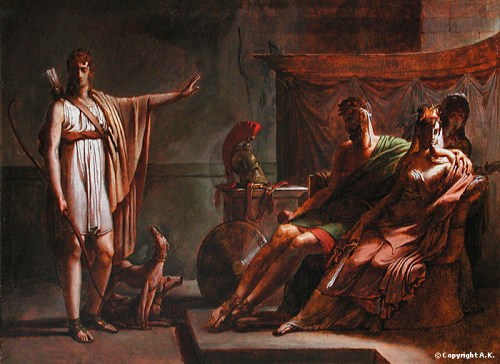
“Phaedra and Hippolytus“ (1802)
_____________
Phaedra, according to Greek myth, fell
in love with her stepson, and, of course,
ruined, for everyone, everything
she’s been represented in music by
composers from, at least, Rameau,
1733, to, here, now, Benjamin Britten,
1976, by way of even Tangerine
Dream, 1973, however peripherally,
and the hits just keep on coming
in literature, the story goes back to
Euripides, 480 – 406 BCE, through
Jean Racine, 1639 – 1699, poet at
the court of Louis XlV, the version
that I studied in French Literature,
along with, in English, Shakespeare,
who was doing courtiers, rather,
and royalty there, then, incidentally,
instead of the Continent’s iconic
Mediterranean figures – it remains
my favourite play in my mother
tongue, next to, for me, its only
other equal, “Cyrano de Bergerac“
but I’d never seen a production of
“Phaedra“ until this searing,
modern, rendition, set in, relatively
contemporary, Greece, London,
and Paris, with the irrepressible,
the irresistible, Melina Mercouri,
torrid temptress, the very goddess
Hera, here, and Anthony Perkins,
perfect as her suitor, a youth still,
pulsing with a young man’s
unbridled intentions
sparks fly, from moment to
incendiary moment – I had often
to pause to catch my breath –
portents of an inescapable, and
eventually epic, indeed mythic,
apocalypse
watch, if you dare
R ! chard
 Richibi's Weblog