Richibi’s Weblog

Just another WordPress.com weblog

Tag: Maria van Bourgondië

my Bruges, December 24, 2013‏ (the Groeningemuseum)

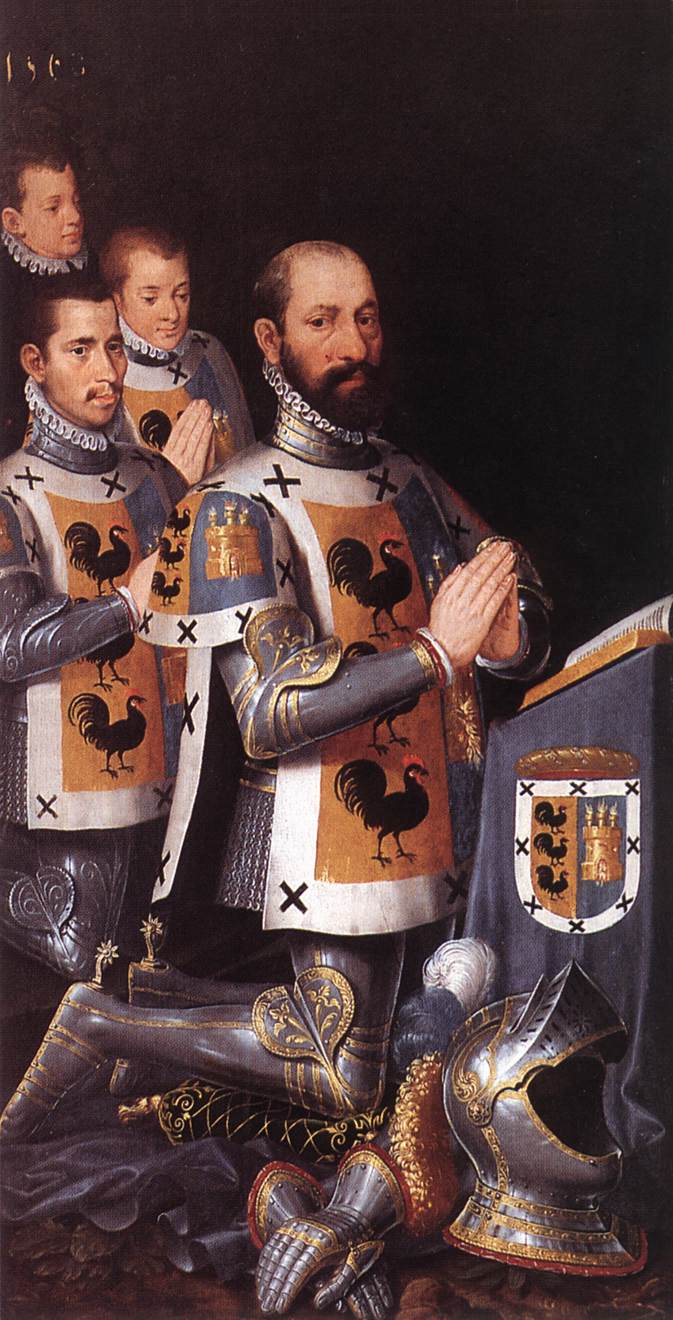
Pieter Pourbus - Portrait of Jan Lopez Gallo and His Three Sons (1568)

“Portrait of Jan Lopez Gallo and His Three Sons” (1568)

Pieter Pourbus

________

if Proust had his little patch of yellow wall
from Vermeer’s “View of Delft” to enchant
him, I’ve succumbed rather to blues that
I’ve found now in three paintings, van Eyck’s
Madonna and Child with Canon Joris van
der Paele
“, both of them, years ago at
London’s National Gallery the ultramarine
of the extraordinary Wilton Diptych, just
click, then again just click for a wonderful
presentation of it
, then the steel blue of the
one above, the “Portrait of Jan Lopez Gallo
and His Three Sons
” by Pieter Pourbus,
also like the van Eyck at the
Groeningemuseum in Bruges, a bargain
there therefore in unforgettable blues

the Groeningemuseum is Bruges’ most
impressive museum, despite both the
Picasso and the Dali nearby, though
nothing is very far in Bruges, except,
of course, the outskirts

we had wandered across the wrong
bridge our final day, confusing our
canals, and diligently marched forward
along a street perpendicular to our
purpose, heading out into what appeared
to be only countryside, though not
especially unduly cause we’d been
looking for Bruges’ famous windmills

but there were no windmills at all in
the distance, only open fields, and the
unending length of the wrong canal, it
transpired, had it been ever so
nevertheless idyllic

about a mile out a young man on a bike
passed us by with his dog and replied
when we asked that the windmills had
been all the time behind us, directly
to the left of our original bridge,
right there behind a tree which had
obstructed our view of the first of
them

that’s what you get maybe, I guessed,
for chasing, even famous, windmills

meanwhile back at the
Groeningemuseum, set along a path
along other medieval buildings, stone
instead of brick as later, then over a
bridge and beyond a small garden,
the door opens to especially early
Flemish art of very transcendental
qualifications, see again, for instance,
above, more profound than either the
brash Picasso, his fine though not
essential museum there, and the
flamboyant Dali, great fun however
ubiquitous ever, his museums seem
to pop up in countless cities

later, up the street, we ate at the
Maria van Bourgondië again, cause
nowhere could we find for Mom some
pasta, and where I could still savour
their Stroganoff sauce from the
previous night, and where, last but
not least, we could rest after a long
day our tired, tried indeed, feet

the Stroganoff was again sublime

so was their fireplace

Richard

my Ghent, December 6, 2013‏

 The Ghent Altarpiece - Jan van Eyck

                            “The Ghent Altarpiece (1432)

                                                    Jan van Eyck  

                                           ________

 
our room at the Ter Brugge was called
the van Eyck, after, of course, the most
impressive, perhaps, of the Flemish
painters, if you’ll put aside the
magnificence of the impish Bruegel,
the ubiquitous Rubens, and the
masterful van Dyck, for instance,
among countless other inspired 
artists of their rightly celebrated,
and wondrous, golden age  
 
what’s “Ter”, Mom asked, we see it
everywhere, “Ter” here, “Ter” there,
“Ter”, as I said, everywhere, and every
day of course at the Ter Brugge  
 
it means “at”, Staf said, as in “at the
bridge” for “Ter Brugge“, ever ready
to shower us with courtesy and 
attention
 
how obvious, I thought, and faulted
myself for not having already figured
that out
 
much like Kerkstwat, in Amsterdam, or,
more accurately, Kerkstraat, instead of
the more pungent pet name I had given
it, turned out to be Church Street, a
breeze when I’d set my mind to it
 
 
books then even followed, fresh fruit by
the handful, beer, voted the best in the
world, from a monastery in Belgium, he
said, and verily presented us with proof
of that high accolade, our favourite
Classical music over breakfast, not to
mention transportation back and forth
to the bus stop, for us too impracticable 
a distance 
 
we met him or Annemie at 8:11 every
evening there after our Brugesfest, they
were never, nor we either ever, late   
 
 
Staf had urged us to go to Ghent, a more
Romanesque city than the Gothic Bruges,
and putting two and two together I
remembered the GhentAltarpiece, The 
 
duh, chided myself
 
 
once there we had been given a proposed
route to follow to witness the sights, but
winds, cobblestones, and too short a time
for the visit halted us in our tracks at the
 
no, I don’t want to go up to the top, Mom
said, she’d climbed both the Frauenkirche
in Dresden and the Dom in Cologne,
Königstein even in Königstein, a few years
earlier, indeed so had I, but would not
undertake so steep again, and arduous,
an ascent
 
nor would I
 
 
we went next door instead to the Cathedral
we spent an hour marvelling, it is profoundly
inspired, a vision in complexity, colour, and
execution, all multiplied exponentially by
devotion, in all connotations of that word  
 
we were too, however, profoundly inspired,
and foreshortened, therefore, our tour of
Ghent, Ghent went   
 
 
later in Bruges we ate at what became there
our favourite restaurant, Maria of Something-
or-Other* – right beside Maria-of-Somewhere-
Else**, my next favourite restaurant, if you’ll
excuse my faltering memory, – on cordiality,
fine wine and hearty victuals before making
our way back home for 8:11, having indelibly
taken in Ghent  
 
no one was late


Richard 
  
 
** Maria van Bourgondië, read the menu, take
     the virtual tour, just click