Richibi’s Weblog

Just another WordPress.com weblog

Tag: Machiavelli

” Shakespeare and Politics”- Professor Paul Cantor
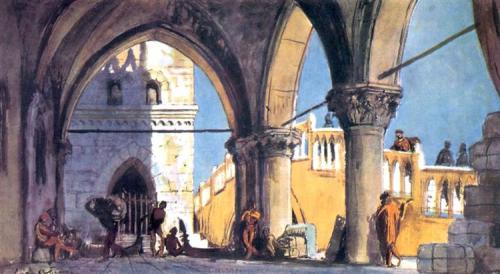
on-the-waterfront-set-design-for-shakespeare-s-drama-the-merchant-of-venice(1).jpg!Large.jpg

 On The Waterfront. Set Design For Shakespeare’s Drama

   “The Merchant Of Venice” (1920)


      Alexandre Benois


                 ________


though this recommendation might seem 

erudite, esoteric, indeed eccentric, if not

even improbable, I vaunt this invaluable 

series to the stars, Professor Paul Cantor

of the University of Virginia, speaking from 

Harvard, however, here, shines such 

glorious light on the already extraordinary 

Shakespeare so as to make him the equal 

of very  Beethoven, poets of nearly 

supernatural ability 


Professor Paul Cantor views Shakespeare 

through Shakespeare’s understanding of  

politics, comparing his political settings – 

commercial Venice, imperial Rome, 

medieval and Renaissance England, 

Denmark under a Christian king – to not 

only shed light on those individual 

political systems alive at a time when 

democracy was being born, but as well 

on Shakespeare’s own unexpectedly 

probing philosophical insights in the 

matter of governance, right up there 

with John Locke and Machiavelli


who’d ‘o thunk it 


the professor is engaging throughout, his  

information entirely absorbing, you’ll come 

out a new wo/man


the lectures are not short at an hour, twenty
minutes, I break to powder my nose, get a
a glass of wine, even answer the phone to,
of course, preferred only parties, but have 
been returning addictively daily 

 it’s a heady indeed addiction


Richard   
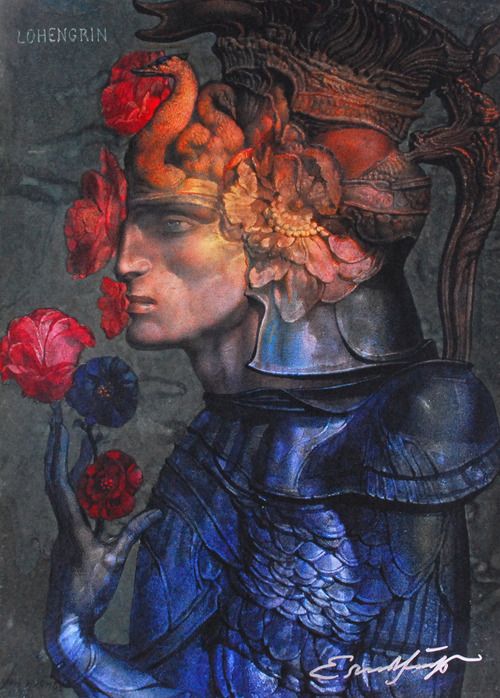
“Lohengrin”, Act 1‏

"Lohengrin" - Ernst Fuchs

Lohengrin (1977)

Ernst Fuchs

_______

this morning, requiring especially strong
medicine to get me through my day, I put
on Lohengrin, Wagner’s masterpiece,
directed by the thorny and unpredictable
Werner Herzog, from Bayreuth, the high
temple of that music, its very Acropolis,
1990, to lighten my load, to give me
mythic, maybe even Sisyphean,
perseverance, it didn’t disappoint

Elsa of Brabant is accused by Friedrich
of Telramund of having killed her brother,
who stood before both of them in line to
the throne, Ortrud, Friedrich’s wife, stands
silent throughout the first act looking
positively Machiavellian, Lady,
incontrovertibly, Macbeth

Elsa, summoned to plead her corner, tells
of a shining knight who appears to her in
her dreams, calls upon him to defend her
honour, he shows up at the very last
moment, on no less than a swan

he’ll only fight for her, he says, after she’s
offered him her anticipated kingdom, her
throne, her very honour and chastity, to
do with what he will, should he win for
her her cause, if she’ll pledge to never
ever ask about his origins, despite his
extraordinary entrance

she accedes, of course, though no other
knight, critically, has shown up to redeem
her

the shining knight conquers, of course,
but Ortrud, during the celebrations,
lurking ominously nearby, doesn’t give
the impression that anyone’s going to
live happily ever after, so long as
she can help it

it was the end of Act 1, I got up, made
a sandwich, I’d watch the following act
tomorrow, and so on, until the distant
end of that four-hour saga, to which
the epithet “Wagnerian”, for “epic”,
also, manifestly, belongs

wistfully I wondered about my own
knights in shining armour, who might
be my own guardian angels, entering
on fabled, maybe, even, swans,
concluded one of them had just been
Wagner, who’d turned, from heavy to
at the very least wistful, my day
around

wishing you Wagners

Richard