Richibi’s Weblog

Just another WordPress.com weblog

Tag: Lucas Cranach the Elder

“Adam and Eve” – Lucas Cranach the Elder
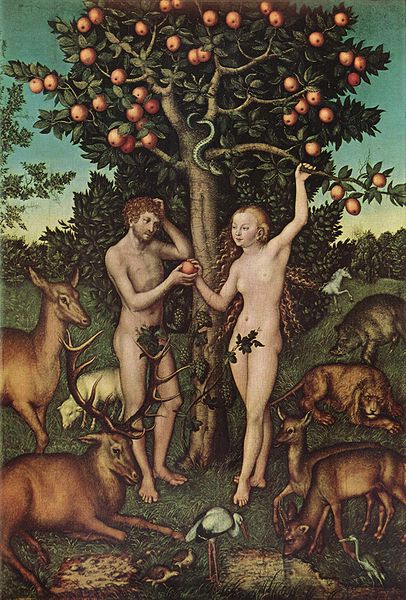
Cranach Adam Eve

Adam and Eve (1596)

Lucas Cranach the Elder

____________

from The New Yorker, January 27, 2014

Adam and Eve” by Lucas Cranach the Elder, 1526

She seems a mere girl really,
small-breasted and slim,
her body luminescent
next to Adam, who scratches
his head in mild perplexity,
So many baubles hang
from the tree
it didn’t hurt to pick one.
The snake is a quicksilver curve
on a branch she is almost
young enough to swing from.

The garden bores her anyway:
no weedy chaos among
the flowers and vegetables;
the animals so tame
you can hardly tell the lamb
from the lion, the doe from the stag
whose antlers outline Adam’s modesty.
She is like that teen-age girl
who wandered from the mall last week
not to be seen again, the world before her
glittering and perilous.

Linda Pastan

______________

yesterday on a mission to buy socks,
finally – I had only a pair left and one
of those with a hole in it – I wondered
about clothes, why hadn’t we evolved
fur or feathers or, heaven forbid,
scales, like all other creatures,
without exception

cherry trees were in blossom, birds
sang along my path, despite an
inoffensive drizzle as I went along

perhaps, I thought, by standing erect
our private parts were too much in
evidence for even indiscriminate
Nature to bear, though apes in all
their varieties walk on two legs and
seem to cavort happily, indeed
lasciviously, though ever
unsheathed, I objected, everywhere

the only difference I could muster
between us and them was that we’d
eaten from the Tree of Knowledge,
the fruit, apparently, of our
apocalyptic decadence, while they’d
never had ever an Eve, nor, for that
matter, an, equally complicit, note,
Adam, no matter what the, mostly
male, elders might say

therefore apes gambol in their
Garden of Eden still, as you can
see in the Cranach above, serenely
uncontrite, while we buy socks in
the jungle next door, and berate,
burdened, our bedevilled lubricities,
what’s under those strategically
positioned, and obliterating, leaves

Tree of Knowledge indeed

Richard

psst: from the Courtauld Gallery in
London, more on Cranach’s
painting
, just click

the ensuing Ages – Ovid‏

    The Silver Age - Lucas Cranach the Elder

                            The Siver Age  (c.1516)

                              Lucas Cranach the Elder

                                                     ________


it is interesting to note how profoundly Ovid‘s mythological
setting marked Christian notions of the Creation, which at
least in the West have held sway now for some nearly two
thousand years
 
it is a tale then twice told, the last time however with not
half even the first one’s contagious exuberance, I think  
 
I believe more in Ovid then, also in Cranach and da Cortona,
worthy indeed proponents of that earlier oracular deity 
 
 
Richard
 
                       ____________________


But when good Saturn, banish’d from above,
Was driv’n to Hell, the world was under Jove.
Succeeding times a silver age behold,
Excelling brass, but more excell’d by gold.
Then summer, autumn, winter did appear:
And spring was but a season of the year.
The sun his annual course obliquely made,
Good days contracted, and enlarg’d the bad.
Then air with sultry heats began to glow;
The wings of winds were clogg’d with ice and snow;
And shivering mortals, into houses driv’n,
Sought shelter from th’ inclemency of Heav’n.
Those houses, then, were caves, or homely sheds;
With twining oziers fenc’d; and moss their beds.
Then ploughs, for seed, the fruitful furrows broke,
And oxen labour’d first beneath the yoke.
 
 
To this came next in course, the brazen age:
A warlike offspring, prompt to bloody rage,
Not impious yet…


   The Age of Iron - Pietro da Cortona
 
                             The Age of Iron”  (1637)
 
                                      Pietro da Cortona
 
                                            __________


Hard steel succeeded then:
And stubborn as the metal, were the men.
Truth, modesty, and shame, the world forsook:
Fraud, avarice, and force, their places took.
Then sails were spread, to every wind that blew.
Raw were the sailors, and the depths were new:
Trees, rudely hollow’d, did the waves sustain;
E’re ships in triumph plough’d the watry plain.

Then land-marks limited to each his right:
For all before was common as the light.
Nor was the ground alone requir’d to bear
Her annual income to the crooked share,
But greedy mortals, rummaging her store,
Digg’d from her entrails first the precious oar;
Which next to Hell, the prudent Gods had laid;
And that alluring ill, to sight display’d.
Thus cursed steel, and more accursed gold,
Gave mischief birth, and made that mischief bold:
And double death did wretched Man invade,
By steel assaulted, and by gold betray’d,
Now (brandish’d weapons glittering in their hands)
Mankind is broken loose from moral bands;
No rights of hospitality remain:
The guest, by him who harbour’d him, is slain,
The son-in-law pursues the father’s life;
The wife her husband murders, he the wife.
The step-dame poyson for the son prepares;
The son inquires into his father’s years.
Faith flies, and piety in exile mourns;
And justice, here opprest, to Heav’n returns.

 
                                               Ovid 
                                                                    
                                   (fromMetamorphoses“, Book I, in a translation by
                                   Sir Samuel Garth, John Dryden, Alexander Pope,
                                   Joseph Addison, William Congreve and other
                                   eminent hands)


C*r*s*mas greetings from Dresden, December 24, 2006

Bellotto Bernardo - Dresden Elbufer

    View of Dresden from the Right Bank of the Elbe with  Augustus Bridge

                                                        (1748)                      

                                                 Bernardo Bellotto

                                                      1720 – 1780

                          _________________________________

                                                                                                                                                                                                                                           these earlier “back tracks“, of which the following is one example, are pieces I consider still to be worth your while

please enjoy

                        _______________________

                                                                                                                                                                                                                                       December 24, 2006

through the good graces of a dear friend, a lady I met last year, my teacher in German at the Goethe-Institut, I´ve been afforded the wonderful opportunity of spending the next several weeks, while she is away with her family in their hideaway in rural Belgium, here in shimmering Dresden, the jewel, I´m sure, of central Europe, I´d already rendered her the use of my own apartment in Vancouver when in September she came to visit and I could use my mom´s place while she was away touring for most of the month the Iberian peninsula, Spain, Portugal, as well as, across the strait, Morrocco

Dresden celebrated its eight hundredth anniversary this year and, though its buildings don´t date back that far, much of it has worn its architectural robes several centuries, the Zwinger, Dresden´s answer to Versailles, was built from 1609 to 1611, I was yesterday informed as I marvelled at the Bernardo Bellottos, Canaletto the Younger, the Elder´s nephew, who was court painter there, I believe I understood through a charming attendant´s perhaps too rapid German, and whose views of the city then were as detailed and precise as his uncle’s famous masterpieces of Venice, their styles are indeed so similar that until recently I´d believed, to my great embarrassment when I found out they were not, that they were one and the same, that the uncle had spent time in both Dresden and Warsaw, which he had not, the nephew rather had, I inadvertently discovered in a book I read on Dresden that cleared everything up, the one had superseded the other, channelled him there, more darkly perhaps due to those cities’ darker tones, but not at all less brilliantly 

not only the Canalettos of course but many other masters adorn the Zwinger, the city´s most sumptuous art museum, the Madonna of the Sistine Chapel of Raphael (which you’ll find below) with its couple of attendant cherubs for instance holds a place of the highest honour, and during the past couple of days I took in a wonderful exhibition of Cranachs there, both the Elder and the Younger, was mightily impressed by the latter´s “Adam” and “Eve”, which tall, naked, and still innocent beneath their modest leafy branches, graced either side of a doorway that led onward through a row of precisely positioned doors partitioning a long narrow corridor into a series of smaller rooms that seemed infinite, like a mirror reflecting itself in a mirror, in a rich burgundy throughout

but on the opposite side in the next room behind the “Eve”, a demure and elegant St Catherine stood large as life leaning upon her eponymous wheel while before her she held upright a heraldic sword whose blade rested on the pebbled ground, a work of the Elder Cranach

her medieval robes were golden, as was her headdress and hair, a prim plaited bodice attested to both her youth and modesty, her eyes shy and discreet gazed softly on the beholder and upon, as in all timeless art, I´m sure, infinity

I would´ve taken her with me but am caught up in the fleeting here and now

Dresden itself is of course much reconstructed after the scandal of its destruction, quite equal I would think to the ravages of Hiroshima and Nagasaki, its center lies across the Elbe, the river that runs through the town, from the Neustadt, the New City, so called already several centuries ago

in the Altstadt, the Old City, there along the river´s opposite bank beyond the several bridges, are the exquisite Baroque structures, churches and palaces and stately buildings, that make up her glory

in the evening as the city lights are reflected in the meandering river the shimmering city achieves the quality of high art, a tribute through the ages to the very best in culture and civilization

it hasn´t snowed here yet, already on December the 24th, Christmas won´t, it appears, be white, it´ll nevertheless be for me quite special as is evident I´m sure in my attitude of awestruck reverence

may it be as well for you, may it be happy, healthy and thoroughly blessed

                                                                                                                                                                                                                                                     with all my heart

Richard


                            _______________________________________