
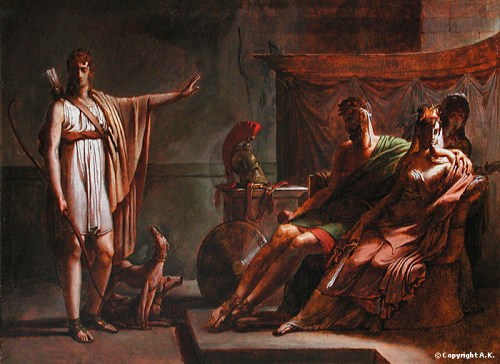
“Aristotle” (1653)
Luca Giordano
___________
so what’s a poem
in an attempt to get a clearer picture
of what a poem should be, rather
than trust only my own, however
informed perhaps, opinion – though
it must be added that we all bring
something to that word’s definition,
mine no less worthy than yours,
yours no less worthy than mine – I
thought I’d go back to authoritative
sources to see what they might
have said
and it doesn’t get any earlier and
authoritative than Aristotle, writing
in 350 B.C.E., at the height of
Ancient Greek preeminence,
dissecting the term in his
penetrating and perspicacious,
ahem, “Poetics”
“I propose to treat of Poetry in itself and of its various kinds,
noting the essential quality of each, to inquire into the
structure of the plot as requisite to a good poem; into the
number and nature of the parts of which a poem is
composed; and similarly into whatever else falls within
the same inquiry.“, he says in Part 1 of his
magisterial treatise
and proceeds to declare the parameters
of “Poetry” for the ages
“Poetry in general seems to have sprung from two causes“,
he proceeds, imitation and rhythm
by imitation I think it best to think of
representation, which is another way,
anyway, of saying imitation, but
much more evocative in this instance,
more attuned to our sense of his word
a poem is a representation then, a
reproduction of something other than
itself
while its rhythm is what George
Gershwin‘s got, and by extension, as
you can see from this video, Gene Kelly
and yes, that means that “Epic poetry and Tragedy, Comedy also
and Dithyrambic poetry, and the music of the flute and of the lyre in
most of their forms, are all in their general conception modes of
imitation.”
so, according to Aristotle, is dance
all, therefore, poems
an interesting elaboration about “Tragedy”
states that it should have the three unities
that I grew up with during my French
Canadian upbringing, the unity of time, of
space, and of action the famous French
Classical dramatists, Racine and Corneille,
applied under the aegis of Louis XlV
not to mention “Tragedy’s“ use of iambic
pentameter, Shakespeare’s ubiquitous
beat, a beat that persevered into the very
Nineteenth Century, in France with
Rostand‘s “Cyrano de Bergerac“, for
instance, and into the Twentieth Century
with Eliot‘s “Murder in the Cathedral“,
about the assassination of Archbishop
Thomas Becket at Canterbury in 1170
under Henry the Second‘s own aegis,
all written as poetry
the most famous play to follow the
three unities in the modern era is
“Who’s Afraid of Virginia Woolf?“,
the play which I think defines the
Twentieth Century, which takes
place overnight somewhere in a
New England college town, mid-
century, at George and Martha’s
though followed closely by O’Neill‘s
“Long Day’s Journey int Night“,
which transpires from morning, one
day in August, 1912, till midnight, at
the home of, unity of space, note,
the dysfunctional Tyrones
so it appears not much has changed
about poetry, Aristotle got a lot of
mileage out of his early definition,
nearly 2500 years
makes you wonder why so much
attention was paid instead to
Plato, his contemporary, the
mystic, who would’ve banned
poetry, he thought it was
subversive
Richard
psst: for a modern day application
of the three unities, watch
“In Treatment“, a television
series, which takes place
in a psychotherapist’s office,
each episode a session,
 Richibi's Weblog